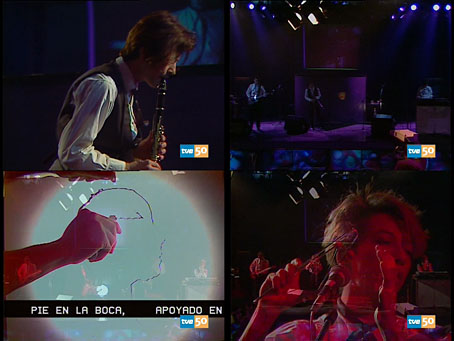
Tuxedomoon on La Edad de Oro, 1983

tuxedomoon1.jpg

La Edad de Oro (The Golden Age) was a Spanish television show which only ran from 1983 to 1985 but during that time it managed to cause a considerable stir, first by showcasing in lengthy programs many musical groups that would have been unknown to the Spanish public (or the public of their native countries, for that matter), and secondly by scandalising that public with irreligious performances from some of those bands. La Edad de Oro was part of a general attempt to bring Spain up to speed with the rest of European culture following the end of the Franco regime, as a result of which a number of leftfield groups were given far more attention than they would have received in the UK. Psychic TV were one of the groups offered a carte blanche two-hour slot, and I remember Genesis P Orridge mentioning this with some surprise in interviews.
tuxedomoon2.jpg

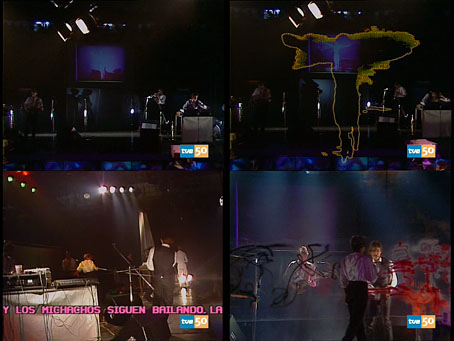
Tuxedomoon’s own edition of La Edad de Oro was broadcast on May 24, 1983. I’ve been fortunate to acquire a pristine copy of a later screening from one of the tape trading sites, and it’s a remarkable thing, cutting between couch interviews with the band members and a complete studio performance of their songs. The latter can been seen on YouTube, of course, so there’s no need to go hunting down rare files. This is the first Tuxedomoon concert I’ve seen, I don’t recall them ever being on British TV although some of their videos must have been screened somewhere. What’s fascinating is seeing how theatrical their performance is. In addition to screening some of Bruce Geduldig’s films on a backdrop, there are shadow vignettes and bits of stage play such as the ropes that bind each of the band members together during The Cage. Later on, Blaine Reininger and Winston Tong graffitise a sheet of film stretched over the stage. (Tuxedomoon’s “Joeboy” designation originated in some San Francisco street art.) I’m wondering if the rope business was borrowed from David Bowie: in the Cracked Actor film he does a similar thing during the Young Americans tour.

Wikipedia has a list of La Edad de Oro‘s artistas invitados not all of which are essential—China Crisis…please—but I’d love to see some of the other editions, the Cabaret Voltaire one especially. Time to go hunting.

Previously on { feuilleton }
Tuxedomoon designs by Patrick Roques
Pink Narcissus: James Bidgood and Tuxedomoon
Weekend links 212

non-format.jpg

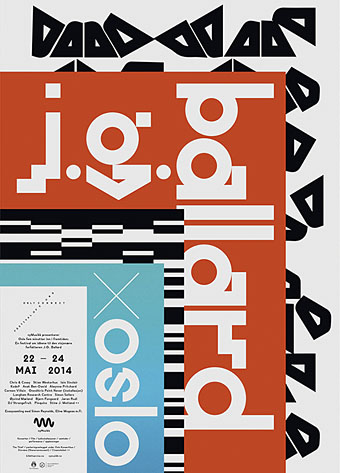
Poster for the recent Ballard-themed Only Connect Festival of Sound in Oslo. Design by Non-Format.

Bulldozer by Laird Barron was my favourite piece in Lovecraft’s Monsters, the recent Tachyon anthology edited by Ellen Datlow that I designed and illustrated. So it’s good to hear that Nic Pizzolato, writer of the justly-acclaimed HBO series True Detective, is among Barron’s readers. True Detective, of course, created a stir for referencing Robert Chambers’ weird fiction in a police procedural. The series is out now on DVD and Blu-ray, and I can’t recommend it too highly.

• Citation-obsessed Wikipedians don’t believe Hauntology is a genuine musical genre, a sentiment which will probably surprise some of its practitioners. Whatever the merits of the argument, I rather like the idea of a musical form that resists strict definition.

• “This year, in order to do things differently, I will make a conscious effort to separate the man from his writing.” Giovanna Calvino, daughter of Italo Calvino, remembers her father.

With ideology masquerading as pragmatism, profit is now the sole yardstick against which all our institutions must be measured, a policy that comes not from experience but from assumptions – false assumptions – about human nature, with greed and self-interest taken to be its only reliable attributes. In pursuit of profit, the state and all that goes with it is sold from under us who are its rightful owners and with a frenzy and dedication that call up memories of an earlier iconoclasm.

Alan Bennett delivers a sermon.

Zarina Rimbaud-Kadirbaks, aka Dutch Girl In London, reviews the Chris Marker exhibition that’s currently running at the Whitechapel Gallery, London.

• Exteriorizing the Inner Realms: Christopher Laursen talks to Phantasmaphile and Abraxas magazine‘s Pam Grossman about occult art, past and present.

• The Beast is back: Erik Davis talks to Gary Lachman about his new book, Aleister Crowley: Magick, Rock and Roll, and the Wickedest Man in the World.

• The body as factory: anatomy of a New Scientist cover image. Rick Poynor on the recurrent use of a familiar visual metaphor.

• Mix of the week without a doubt is FACT Mix 445 by Stephen O’Malley, a three-hour behemoth.

• Jennifer in paradise: Photoshop developer John Knoll on the story of the first Photoshopped image.

• The trailer for Grandfather of Gay Porn, a documentary about Peter de Rome by Ethan Reid.

Giorgio’s Theme is a new piece of electronic music by Giorgio Moroder.

Agender, a series of androgynous photo-portraits by Chloe Aftel.

• RIP Little Jimmy Scott

Evil Spirits

Chase (1978) by Giorgio Moroder | Call Me (1980) by Blondie | The Apartment (1980) by Giorgio Moroder

Weekend links 211

shau.jpg

Secret Bloom (2014) by Natalie Shau.

Bloomsday approachs. “Reading Ulysses changed everything I thought about language, and everything I understood about what a book could do,” says Eimear McBride whose debut novel, A Girl Is a Half-formed Thing, recently won the first Bailey’s women’s prize for fiction. McBride was interviewed by Susanna Rustin last month, shortly before the award was announced, and her novel has now become one of those minor causes célèbres for being rejected so often it was eventually published by a new imprint set up by a bookseller. “If the publishing industry doesn’t take a risk then who will?” asks Henry Layte, the bookseller in question.

Speaking of risk, David Hebblethwaite coincidentally wrote a post earlier this week asking where the formal challenge has gone in science-fiction writing. (He mentions McBride in passing.) Nina Allen followed up with a post of her own. I suspect the books are still being written but they’re no longer being accepted by editors and publishers who want even more adventure stories, “sympathetic” characters, and easy reads. Novels that only aspire to be written equivalents of action films or computer games are doomed to be less exciting than their more kinetic competitors. The struggle between the values of art and the values of entertainment is an old one but it shouldn’t be an either/or proposition. “Difficulty is subjective,” says Eimear McBride, “the demands a writer makes on a reader can be perceived as a compliment.”

Related: the following from Geoffrey Hill on “difficulty”:

We are difficult. Human beings are difficult. We’re difficult to ourselves, we’re difficult to each other. And we are mysteries to ourselves, we are mysteries to each other. One encounters in any ordinary day far more real difficulty than one confronts in the most “intellectual” piece of work.

• The Quietus pulled out all the stops this week, interviewing Annette Peacock, Iain Sinclair (again), Alan Moore (again), and asking Peter Strickland, the director of Berberian Sound Studio, for a list of his favourite albums. Given the above, it’s worth noting that all those people have produced challenging work of their own in different media.

• “The Satyrs Motorcycle Club was founded in 1954 with seven members, but little did anyone know it would become the oldest running LGBT organization (and oldest gay motorcycle club) in the world.”

Trunk TV posted another great selection of television title sequences. The previous selection has been taken down for the usual tiresome copyright reasons so watch this one while you can.

• “Detroit techno and black metal have so much in common,” say Wolves In The Throne Room whose new album, Celestite, is predominantly a product of synthesizer technology.

• “Houghton Library’s copy of Arsène Houssaye’s Des destinées de l’ame (FC8.H8177.879dc) is without a doubt bound in human skin.”

• The secret of Nabokov’s sexual style: David Lodge reviews Nabokov’s Eros and the Poetics of Desire by Maurice Couturier.

• How long can you hold your breath? 2 models, 7 divers in an underwater shipwreck by photographer Von Wong.

• At Dangerous Minds: Paul Gallagher on The fantastic world of Sharmanka Kinetic Theatre.

• Wizards of the Coast: Benjamin Breen on John Dee and the occult in California.

• More photography: Peter Guenzel captures strange lights in forests.

• Mix of the week: Bleep podcast 121 presented by Margot Didsbury.

I’m The One (1972) by Annette Peacock | Eros Arriving (1982) by Bill Nelson | The Dire And Ever Circling Wolves (2005) by Earth

Steampunk catalogued

steampunk1.jpg

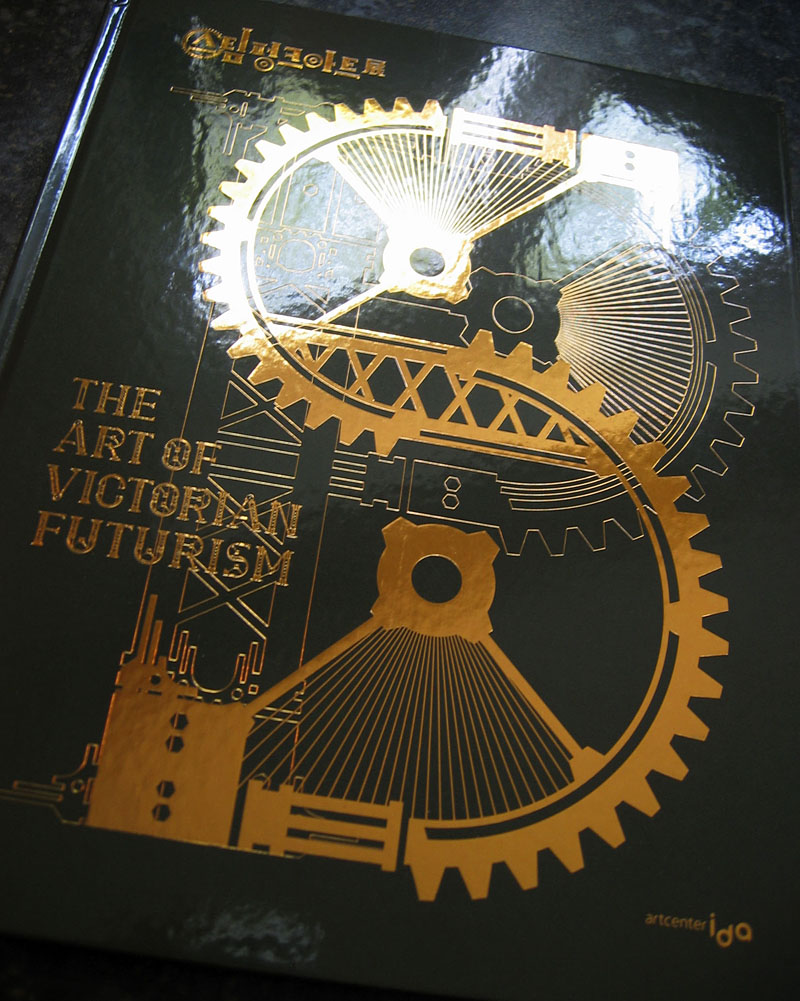
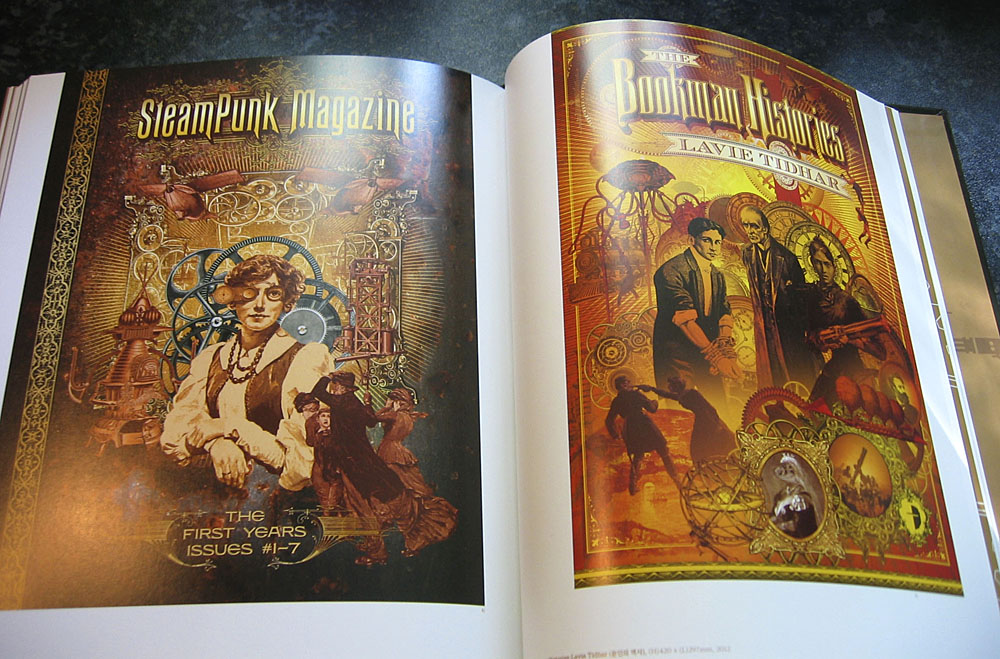
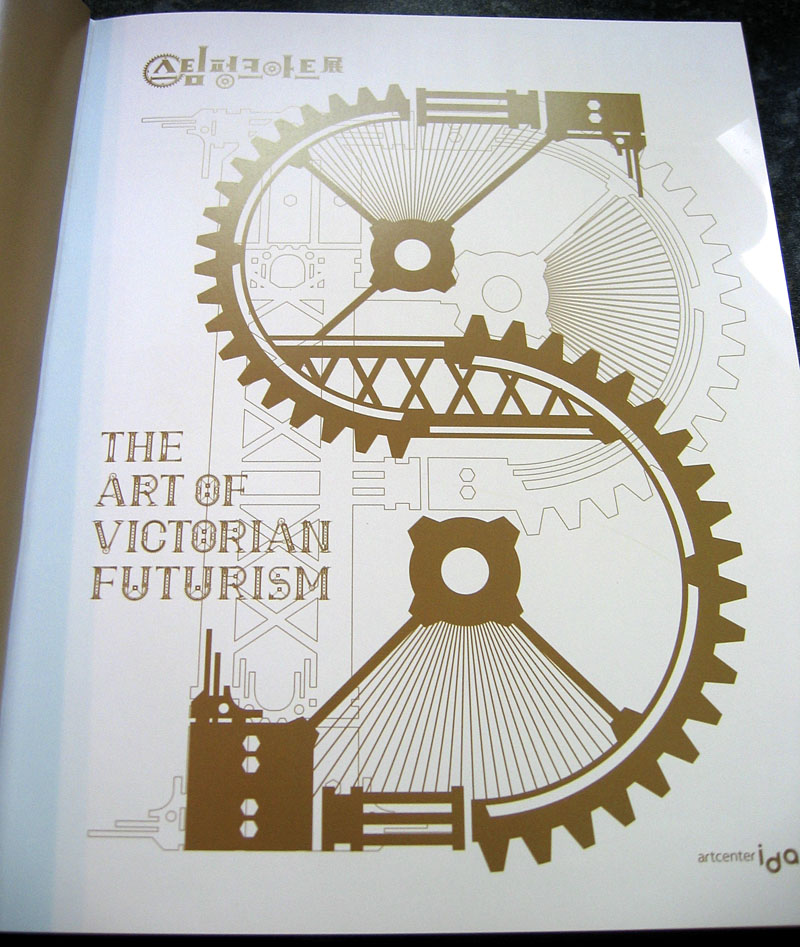
Another month, another exhibition catalogue. Steampunk: The Art of Victorian Futurism is still running at Artcenter IDA in Seoul with a selection of my book covers on display among a great variety of mechanical sculptures, costumes and other creations. The catalogue is a suitably lavish affair, so much so that it puts to shame many of the bandwagon-jumping coffee-table books that have been appearing recently. Excellent printing with lots of gold-ink embellishment, and all the exhibits are given substantial space. I especially like the mechanical type designs, and can now credit them to designers Se Byeol Moon and Han Woong Yoon. Korean TV news has run a couple of reports about the exhibition, the best of which may be seen here. The exhibition itself continues until May 18th.

steampunk2.jpg

steampunk3.jpg

steampunk4.jpg

Previously on { feuilleton }
Steampunk: The Art of Victorian Futurism
Steampunk Calendar
Words and pictures
Nathanial Krill at the Time Node
Fiendish Schemes
Ghosts in Gaslight, Monsters in Steam
Steampunk Revolution
The Bookman Histories
Aether Cola
Crafting steampunk illustrations
SteamPunk Magazine
Morlocks, airships and curious cabinets
The Steampunk Bible
Steampunk Reloaded
Steampunk overloaded!
More Steampunk and the Crawling Chaos
Steampunk Redux
Steampunk framed
Steampunk Horror Shortcuts

Weekend links 207

barker.jpg

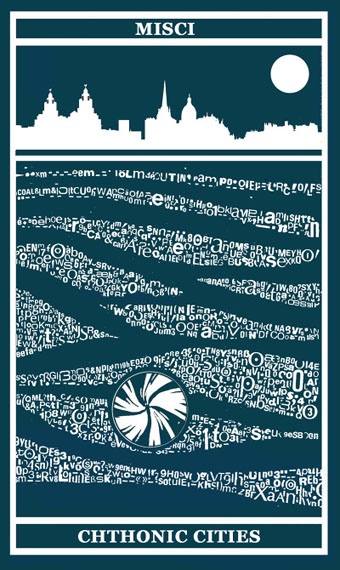
Chthonic Cities by David Chatton Barker. One of a series of Folklore Tapes screenprints available from Bleep.

• The original version of Kenneth Anger’s Lucifer Rising, the one with the Jimmy Page soundtrack that was completed in 1973, has always been described as lost/stolen/buried or otherwise gone forever. So you’d think the news that a print had been discovered recently by Brian Butler would have received greater attention. There’s a screening in Los Angeles this Thursday. When do the rest of us get to see it?

Chris Marker: A Grin Without a Cat, an exhibition and series of Marker-related events at the Whitechapel Gallery, London. Related: The Encounter of M. Chat & Chris Marker as Told By Louise Traon.

• The trailer for The Gospel According to St Derek, a forthcoming documentary about Derek Jarman. Related: Carl Swanson on why Tilda Swinton is not quite of this world.

Maybe there’s just something conservative at the bedrock of American fiction. […] Or maybe it’s just another symptom of the creeping conservatism that’s infected so many aspects of the culture.

Eric Obenauf talks to author Jeff Jackson whose comments about cultural conservatism could equally be applied to the UK.

• Primitive graphics, inventive graphics, budget Surrealism, and some great theme tunes; it’s Trunk TV, Episode 1: Title Sequences.

• Mixes of the week: Secret Thirteen Mix 110 by Black To Comm, and Intro To Drone For Debcon 1, almost 7 hours of music!

Joseph Burnett reviews Ett, an album of electronic music by Klara Lewis.

The Delian Mode (2009), a film about Delia Derbyshire by Kara Blake.

• Extracts from Tokyo Reverse by Simon Bouisson and Ludovic Zuili.

Dan Piepenbring on The Haunting Illustrations of Alfred Kubin.

• At Strange Flowers: Photos of arcades by Germaine Krull.

• Fish, Fiends, and Fantasy: The Gothic Art of Ian Miller.

• At 50 Watts: Richard Teschner and His Puppets.

• Sonic Foam: Ian Penman on Kate Bush and Coil.

Bits and Pieces

Lucifer (1968) by The Salt | Experiment IV (1986) by Kate Bush | Methoxy-N, N-Dimethyl (5-MeO-DMT) (1998) by Coil