Weekend links 600

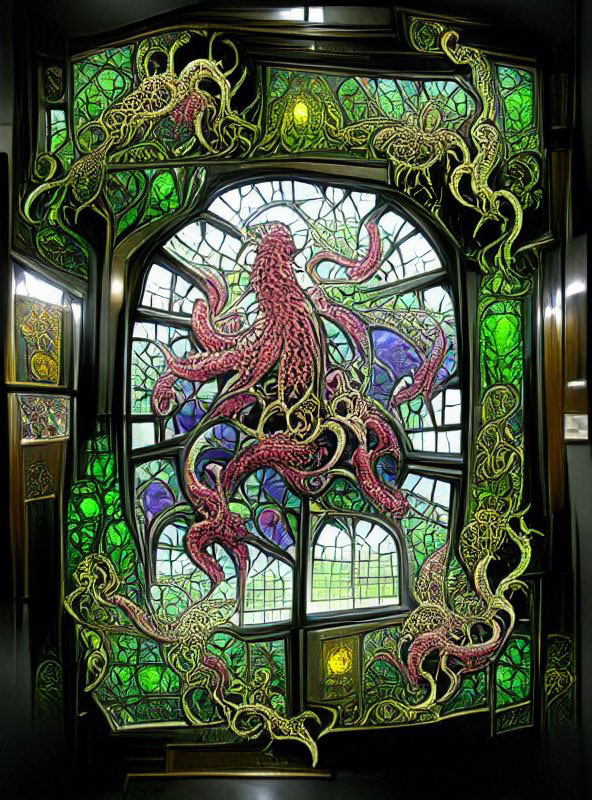
window.jpg

My kind of window. From a collection of machine-learning images by Unlimited Dream Co. Via Bruce Sterling.

• “I will never call myself a queer. That word is one of the things that I detest that has happened, and it’s almost being forced now. For me, you cannot separate that word from the hatred and violence that once accompanied it. When I read it being used in The New York Times, I think, ‘It’s their word and they can fucking have it all they want.’ I will never use ‘queer.’ It’s an ugly word.” John Rechy, still active at the age of 90, talking to Jeff Weiss about hustling, social opprobrium, and his pioneering books.

• “At a time when we are being constantly told that humanity is destroying the planet, it is somehow comforting to see nature not merely outlasting, but triumphing over humanity’s constructions—as nature does in many of Piranesi’s Views of Rome.” Alasdair Palmer on Piranesi’s peerless renderings of Roman ruins.

• “The magical aspect of Get Back is its total refusal to adhere to the standard tropes of music documentaries. There are no talking heads commenting on the Beatles’ greatness, no continual barrage of quick edits and highlights.” Geeta Dayal on Peter Jackson’s resurrection of the Fab Four.

But men are not traditionally meant to be objects of art. “Men look at women,” John Berger wrote. “Women watch themselves being looked at.” When men look at men, however, they break rules. “I didn’t set out to be radical,” says Miller. “But I was at a fair and I had a huge nude on a stand by Michael Leonard. I’d only been open ten minutes and a woman started having a go and saying it’s filth. What I found fascinating is she’d walked past a whole span of female nudes. I think society is just immune to female nudity. People don’t see it. If you take this to the straight world of an art fair, it provokes reactions other dealers don’t get. There isn’t anyone else like me.”

Tony Wilkes talks to Henry Miller, owner of an art gallery devoted to the male form

• “I imagine men with starched collars, horrified by an animal with no hard edges to grab onto, no solidity to venerate. Something low, lateral, creeping.” Fiona Glen on “Devil Fish”, Cthulhu and cephalomania.

• I like glowing things so Brian Eno’s glowing record turntable has an immediate appeal. A shame it’s a very limited production which is almost certainly sold out by now.

• The next release on the Ghost Box label will be A Letter from TreeTops by Pneumatic Tubes.

• At Dangerous Minds: A Sight for Sore Eyes Vol. 1, a visual history of The Residents.

• At Wormwoodiana: Mark Valentine on the supernatural thrillers of Archie Roy.

• Mix of the week: A reflection on 2021 at A Strangely Isolated Place.

Swan River Press looks back over a year of book production.

• New music: Spherical Harmonics by Joseph Hyde.

Octopus’s Garden (1969) by The Beatles | The Kraken (2006) by Hans Zimmer | Kraken (2017) by Dave Clarkson

Weekend links 588

br.jpg

Gerry Barney’s logo for British Rail. A page from the British Rail Corporate Identity Manual (1965).

• RIP Russ Kick, writer, editor, and founder of many websites/blogs such as Rare Erotica, Books Are People Too and (notoriously) the several iterations of The Memory Hole, a space dedicated to keeping visible information that successive US governments would have preferred to remain unseen. I’d known Russ remotely for many years, initially as a reviewer of the Savoy comics in Outposts. Savoy Books later helped find him a publisher for Psychotropedia: A Guide to Publications on the Periphery, a wide-ranging overview of alternative/underground print culture in the late 1990s. In 2004 his information activism gave him a fleeting taste of world-wide attention when he forced the Bush administration to make public the photos of flag-draped coffins returning from Iraq. The scandal put his name on the front pages of newspapers that should have been finding those photos for themselves instead of cheerleading the war. A run of books for Disinformation presented his archival researches for the general reader, then in 2012 he edited The Graphic Canon, a massive three-volume collection of comics and illustrations based on classic works of literature. I was among the many contributors to the latter with an adaptation of The Picture of Dorian Gray, and would have worked on the follow-up collection of crime stories if I hadn’t been busy with other things. I had hoped that we might work together again in the future.

• “‘The new mainstream has attempted to erase the innovations of the avant-garde from jazz history,’ the film declares.” Geeta Dayal reviews Fire Music, a documentary about the jazz innovations of the 1960s.

• I don’t have the hardware to play this but Sable is a new computer game from Raw Fury whose design owes much to the desert landscapes seen in comics by Moebius.

• New/old music: Stealing Sheep and The Radiophonic Workshop reimagine the score for René Laloux’s animated science-fiction film La Planète Sauvage.

• At Spine: Savannah Cordova on how to perfect your book cover’s typography. Having recently designed an all-type cover design this is timely.

• Mixes of the week: Isolatedmix 113 by Sunju Hargun, XLR8R Podcast 714 by Soela, and Holograficzne Widmo ze Bart De Paepe by David Colohan.

• “If it ain’t broke, don’t fix it.” Gerry Barney, designer of the British Rail logo, doesn’t like the green reworking of his design.

• Scottish lord goes blood simple: a teaser for The Tragedy of Macbeth by Joel Cohen and some bloke called William Shakespeare.

• “It’s unmanageable.” Ellen Peirson-Hagger on how the vinyl industry reached breaking point.

Macbeth (1973) by John Cale | Rail (1994) by Main | Logotone (2013) by Steve Moore

Weekend links 587

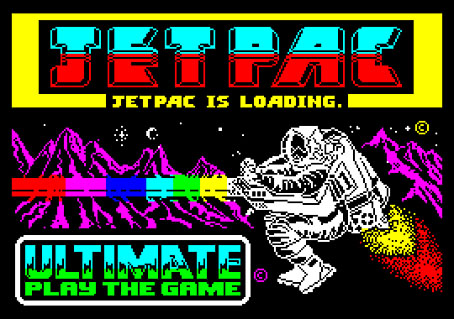
jetpac.jpg

Jetpac (1983) by Ultimate Play The Game. Lunar Jetman was the superior sequel but Jetpac had the better loading screen.

• RIP Clive Sinclair. Products made by Sinclair Research Ltd. were among the first electronic gadgets I owned: the Sinclair Scientific calculator which compelled you to learn Reverse Polish notation before you could use it; the ZX Spectrum computer, of course; and the pocket TV that came bundled with the computer, a machine with such feeble reception that it only ever worked outdoors. I’ve still got my Spectrum computer, and it still worked the last time I plugged it in although it’s hardly worth keeping when emulators proliferate. Spectacol for Android is a good example of the latter. Related: World of Spectrum; the early stages of the Spectrum design process by Sinclair designer Rick Dickinson; XL-1 by Pete Shelley, electro-pop with Spectrum-generated lyrics and graphics.

• Mixes of the week: A Lee “Scratch” Perry tribute mix by Dennis Bovell, and Blood Tide Station 1: Breakaway plus Blood Tide Station 2: Force of Life by The Ephemeral Man.

• “It’s not an easy time to be daring,” says Dennis Cooper, talking to Barry Pierce about his new novel, I Wished.

• London under London: Adam Zamecnik interviews Tom Chivers about searching for London’s lost rivers.

• New music: Ode To The Blue by Grouper, and A Shadow No Light Could Make by Nathan Moody.

• At Public Domain Review: 700 years of Dante’s Divine Comedy in art.

• At Wormwoodiana: The Mushroom Man—A Note on EC Large.

DJ Food trips out with a collection of psychedelic drug posters.

Nodnol (1969) by The Spectrum | Spectrum (1969) by The Tony Williams Lifetime | Spectrum (1973) by Billy Cobham

Weekend links 586

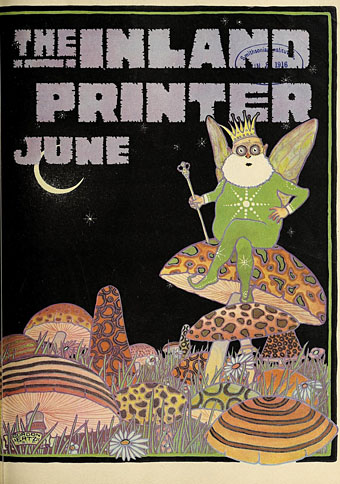
ertz.jpg

Cover by Gordon Ertz for The Inland Printer, June 1916.

• “I worry that enthusiasm is being mistaken for a moral virtue, and negative criticism for a character flaw.” Dorian Lynskey on the dying art of the hatchet job. Also a reminder (not that we require it) that the word “fan” in this context has always been an abbreviation of “fanatic”.

• Culture.pl explores the work of Stanisław Lem, the science-fiction writer “whose works, abilities and quirky sense of humor convinced Philip K. Dick that he was too brilliant to exist and must have actually been a committee of people”.

• The electronic music of Paul Schütze receives a reappraisal on Phantom Limb in November with a compilation album, The Second Law.

Aliya Whiteley on Amanita Muscaria, the hallucinogenic mushroom seen in hundreds of fairy-tale illustrations.

• Stuart Firestein talks to Roger Payne about changing the world’s attitude to whales by recording their songs.

• Jennifer Lucy Allan talks to Sam Underwood about his unique Acoustic Modular Synth.

Jóna G. Kolbrúnardóttir sings Odi Et Amo from Englabörn by Jóhann Jóhannsson.

• A forthcoming release on Dark Entries: Back Up: Mexican Tecno Pop 1980–1989.

• Luc Sante looks at Jim Jarmusch’s collages.

John Grant‘s favourite albums.

• RIP Michael Chapman.

• The Divination Of The Bowhead Whale (1978) by David Toop & Max Eastley | Keflavik: The Whale Dance (1980) by Richard Pinhas | Ballet For A Blue Whale (1983) by Adrian Belew

Weekend links 585

bertha_lum.jpg

Fox Woman (c. 1916) by Bertha Lum.

• “Apparently he had been walking though customs/arrivals with a large cube of weed stuck on the end of his silver Dr Martens and a foot long silver flashlight full of seed, but when they realised who he was, and that today was his 60th birthday, he was released with just a warning.” Radio Lancashire DJ Steve Barker remembers the late Lee “Scratch” Perry, and links to one of his shows with Perry (and Roger Eagle) here.

• “…it’s the chase itself that shapes the film’s distinctive aesthetic—the under-lit interiors and the sunless and frigid exteriors of the many locations across the city, sites that take the cops well beyond their usual beat, to places both above and below ground.” Chris McGinley explains how William Friedkin’s The French Connection reinvented (and exploded) the police procedural.

• “Toibin, who is himself gay, has always extended historical sympathy to sexual outsiders. As he’s written elsewhere, ‘There are no 19th-century ballads about being gay.'” Dwight Garner reviews Colm Toibin’s The Magician, a novel about Thomas Mann.

Here is the key point: to experience such marvels you have to risk an unsophisticated, even credulous love for corn, and part of that love involves a willingness to submit to what [Phil] Ford calls a “magical hermeneutics” capable of transforming marginal chunks of pop culture. As he writes in the wonderful 2008 essay that inspired the episode, exotica is “less a genre of music than a class of cultural objects that share a characteristic projection of the self across boundaries of space and time.” This makes it essentially psychedelic—“film music for daydreams”—and Ford draws out that historical connection in his essay, which argues that while the hippie movement that Nature Boys like Ahbez prophesied looks like a radical rejection of the space-age bachelor pad of ’50s consumerism, tendrils of transcendent yearning link the exotica imaginary to the earnest if stoned mysterioso to come.

Erik Davis on Eden Ahbez and Californian exotica

Edgar Froese interviewed on WSHU radio in 1974 where he talks about Tangerine Dream, live performance and the future of electronic music.

• At Dangerous Minds: A momentary lapse of reason…when Dario Argento interviewed Pink Floyd in 1987.

• It’s that man again: John Doran interviews Kevin Martin, aka The Bug.

David McKenna on The Strange World of France, La Nòvia & friends.

• At Dennis Cooper’s: Tape deck.

Exotica (1958) by Martin Denny | Exotica Lullaby (1976) by Harry “The Crown” Hosono | Exotica (1979) by Throbbing Gristle