Les Chants de Maldoror by Shuji Terayama

terayama.jpg

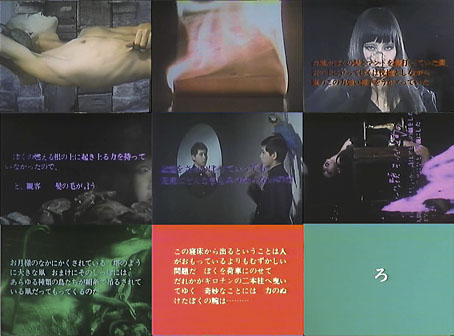
27 minutes of experimental video from 1977 in which director Shuji Terayama retrieves some predictably unorthodox images from the bottomless pit of Lautréamont’s text. The preoccupations here seem to belong as much to the director’s mind as to that of Isidore Ducasse, what with the emphasis on various forms of bondage and unusual erotics. (Not that Maldoror lacks sexual material but what there is adopts a different guise.) With a score that sounds like outtakes from a Clock DVA studio session it’s very much a product of its time, but not without interest. Terayama was (among other things) the director of Emperor Tomato Ketchup (1971), a film whose title was later swiped by Stereolab. Les Chants de Maldoror may be viewed at Ubuweb.

terayama2.jpg

Previously on { feuilleton }
Polypodes
Ulysses versus Maldoror
Maldoror
Books of blood
Magritte’s Maldoror
Frans De Geetere’s illustrated Maldoror
Maldoror illustrated

Polypodes

jianfu.jpg

Sepia (no date) by Gao Jianfu.

Quelquefois, dans une nuit d’orage, pendant que des légions de poulpes ailés, ressemblant de loin à des corbeaux, planent au-dessus des nuages, en se dirigeant d’une rame raide vers les cités des humains, avec la mission de les avertir de changer de conduite, le caillou, à l’œil sombre, voit deux êtres passer à la lueur de l’éclair, l’un derrière l’autre; et, essuyant une furtive larme de compassion, qui coule de sa paupière glacée, il s’écrie: «Certes, il le mérite; et ce n’est que justice.» Après avoir dit cela, il se replace dans son attitude farouche, et continue de regarder, avec un tremblement nerveux, la chasse à l’homme, et les grandes lèvres du vagin d’ombre, d’où découlent, sans cesse, comme un fleuve, d’immenses spermatozoïdes ténébreux qui prennent leur essor dans l’éther lugubre, en cachant, avec le vaste déploiement de leurs ailes de chauve-souris, la nature entière, et les légions solitaires de poulpes, devenues mornes à l’aspect de ces fulgurations sourdes et inexprimables.

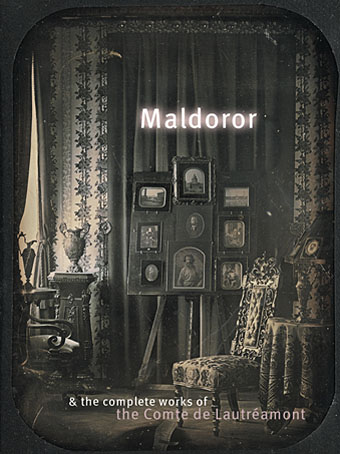
Les Chants de Maldoror (1869) by the Comte de Lautréamont

maldoror.jpg

Sometimes on a stormy night while legions of winged squids (at a distance resembling crows) float above the clouds and scud stiffly towards the cities of the humans, their mission to warn men to change their ways—the gloomy-eyed pebble perceives amid flashes of lightning two beings pass by, one behind the other, and, wiping away a furtive tear of compassion that trickles from its frozen eye, cries: “Certainly he deserves it; it’s only justice.” Having spoken thus it reverts to its timid pose and trembling nervously, continues to watch the manhunt and the vast lips of the vagina of darkness whence flow incessantly, like a river, immense shadowy spermatozoa that take flight into the dismal aether, the vast spread of their bat’s wings obscuring the whole of nature and the lonely legions of squids—grown downcast viewing these ineffable and muffled fulgurations.

Translation by Alexis Lykiard, 1970

pennington-cthulhu.jpg

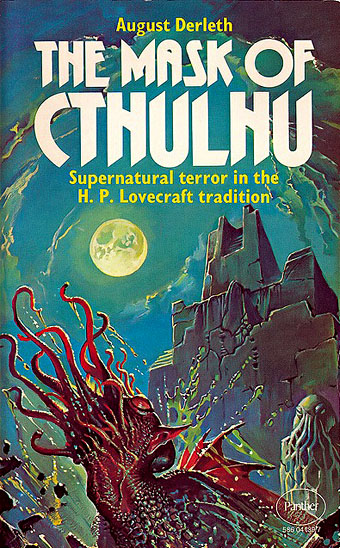
The Mask of Cthulhu, 1976 paperback reprint. Cover art by Bruce Pennington.

Above these apparent hieroglyphics was a figure of evidently pictorial intent, though its impressionistic execution forbade a very clear idea of its nature. It seemed to be a sort of monster, or symbol representing a monster, of a form which only a diseased fancy could conceive. If I say that my somewhat extravagant imagination yielded simultaneous pictures of an octopus, a dragon, and a human caricature, I shall not be unfaithful to the spirit of the thing. A pulpy, tentacled head surmounted a grotesque and scaly body with rudimentary wings; but it was the general outline of the whole which made it most shockingly frightful. Behind the figure was a vague suggestion of a Cyclopean architectural background.

The Call of Cthulhu (1928) by HP Lovecraft

Previously on { feuilleton }
Ulysses versus Maldoror
Maldoror
Vampyroteuthis Infernalis by Vilém Flusser
Books of blood
Magritte’s Maldoror
Frans De Geetere’s illustrated Maldoror
Maldoror illustrated

Big fish

undying.jpg

Illustration by Lawrence for The Undying Monster (1946) by Jessie Kerruish.

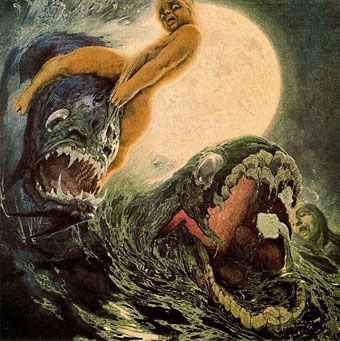
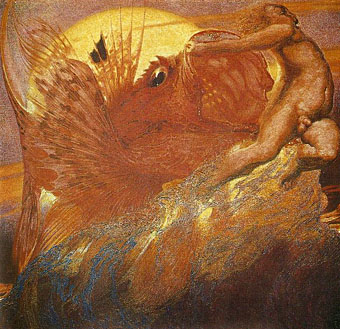
Another of those collisions between fine art and pulp fiction that I like to note now and then. The drawing above by Lawrence Sterne Stevens (from this page) I immediately recognised as borrowing its fish from the painting below by Néstor Martín-Fernández de la Torre (1887–1938), or Néstor as he’s usually known. Stevens was also usually credited by the single name Lawrence, and this is one of his many first-rate contributions to Famous Fantastic Mysteries. I’ve already noted a similar borrowing by his contemporary, Virgil Finlay, so this example isn’t too surprising. It’s unlikely that many of the readers eagerly devouring Jessie Kerruish’s tale would have been familiar with Néstor’s paintings. On the same Lawrence page there’s his illustration for Arthur Machen’s The Novel of the Black Seal which ran in the same issue.

nestor1.jpg

Poema del Mar: Noche (1913–1924).

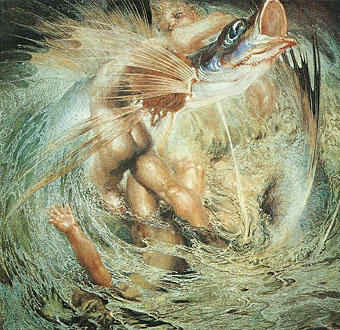
Néstor is distinguished by a predilection for aquarian scenes and writhing figures, all of which are presented in a very distinctive and recognisable style. He also happens to be one of the few major artists to come from the Canary Islands which no doubt explains his interest in the sea. The Poema del Mar series, and other works such as this satyr head, often find him numbered among the Spanish Symbolists although he’s rather late for that movement, and this assumes that every artist has to be placed in one box or another whether they belong there or not. These giant fish could just as well make him another precursor of the Surrealists, and they do occasionally receive a mention for their similarity to (and possible influence upon) Dalí’s enormous Tuna Fishing (Homage to Meissonier) (1966–67). There’s more of Néstor’s work over at Bajo el Signo de Libra (Spanish language).

nestor2.jpg

Poema del Mar: Tarde (1913–1924).

nestor3.jpg

Poema del Mar: Reposo (1913–1924).

Continue reading “Big fish”

Weekend links 185

rondelli.jpg

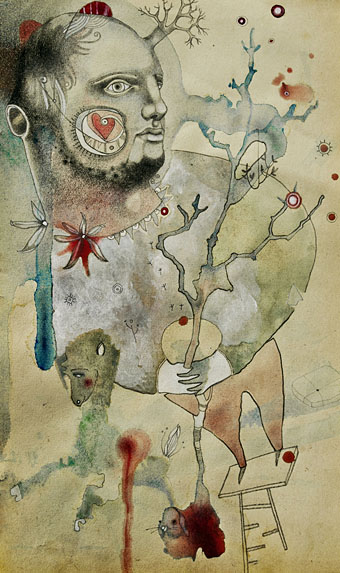
L’uomo che piantava gli alberi (2013) by Sofia Rondelli. Via Form Is Void.

• I’m looking forward to hearing the new album by Chrome Hoof, a band whose ambition and attitude makes many of their contemporaries seem lukewarm at best. Mick Middles gets to grips with Chrome Black Gold here. John Doran interviewed the group in 2010, a piece which includes a Chrome Hoof mix of tracks by other artists.

Jay Roberts: “I was a young Marine scout sniper, definitely his type. And for a single, unforgettable afternoon, Orange County’s most notorious serial killer coaxed me into a place from which many didn’t escape.”

Jonathan Meades: “Why I went postal … and turned my snaps into postcards.” “Meades isn’t your average architectural fanboy,” says Rachel Cooke who went to talk to him at his home in Marseille.

“Faced with a Nabokov novel,” Zadie Smith writes, “it’s impossible to rid yourself of the feeling that you’ve been set a problem, as a chess master sets a problem in a newspaper.” Certainly, while Humbert asks the reader “not to mock me and my mental daze”, the suspicion is that the power dynamic in his tale is a little different.

Tim Groenland on the difficulties of writing, publishing and reading Lolita.

Cosmic Machine is a double-disc collection of French electronic music from the 1970s & 1980s. Justice enthuse about the music here where you can also preview the tracks.

The Midnight Channel, Evan J. Peterson’s horror-poetry homage to the VHS era, is available now from Babel/Salvage. There’s a trailer here.

• “Our age reveres the specialist but humans are natural polymaths, at our best when we turn our minds to many things,” says Robert Twigger.

• Another musical Chrome: Richard Metzger on newly resurrected recordings by one of my long-time cult bands.

• Hermes Trismegistus and Hermeticism: An interview with Gary Lachman.

• A stunning set of photos of London in the sweltering summer of 1976.

Pye Corner Audio live at The Outer Church, Madrid, November 2013.

Judee Sill, the shockingly talented occult folk singer time forgot.

• Designer Jonathan Barnbrook answers twenty questions.

• Don’t trust the painting: Morgan Meis on René Magritte.

Laurie Anderson’s farewell to Lou Reed.

Philippe Druillet at Pinterest.

• The Chrome Plated Megaphone Of Destiny (1968) by The Mothers of Invention | March Of The Chrome Police (1979) by Chrome | Chrome (1981) by Debbie Harry

Belgian Autochromists

autochrome2.jpg

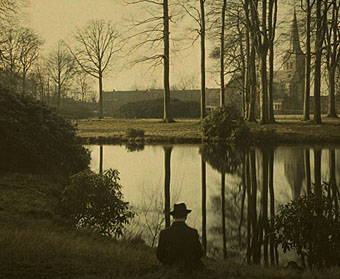
Misty wood (c. 1910) by Charles Corbet.

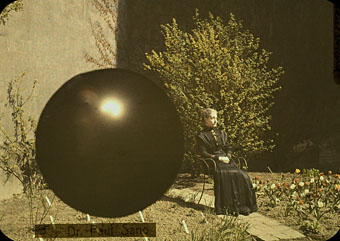
A perfect autumnal scene from Charles Corbet, one of many woodland views at the Belgian Autochromists site. As usual with autochromes it’s hard to believe that almost all these images are over a century old, the colours are so subtle. Some of the lighting is also remarkable, especially the self-portraits by Ernest van Zuylen which are lit with a single candle. Paul Sano’s lady sitting in the garden gives a foretaste of Magritte-like Surrealism, its inset eclipse appearing at first glance to be a large black sphere hovering unnoticed or ignored beside the seated woman.

Via Wood s Lot.

autochrome1.jpg

Melancholia (c. 1910) by Charles Corbet.

autochrome3.jpg

Sunset on the heath (c. 1910) by Paul Sano.

autochrome4.jpg

Lady and inset of solar eclipse (c. 1910) by Paul Sano.

Previously on { feuilleton }
Colour photography, 1908
Fred Holland Day revisited
Constantinople, 1900
Albert Kahn’s Autochromes
Gertrude Käsebier’s crystal gazer
The Dawn of the Autochrome