Collagescapes

tortoise1.jpg

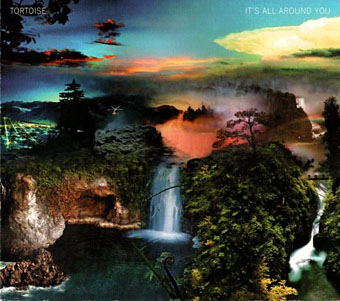
Oliver Wasow‘s artwork for It’s All Around You (2004), an album by US group Tortoise, contains some fine examples of disjunctive (Surrealist, if you must) collage landscapes. This is a sub-genre of collage that I’ve always enjoyed, especially when it’s carefully done, and I was wondering recently whether Wasow had done anything similar for other groups. Discogs has a few more examples, one of which looks like something from the masters of the photo-collage cover, Hipgnosis.
slapphappy.jpg

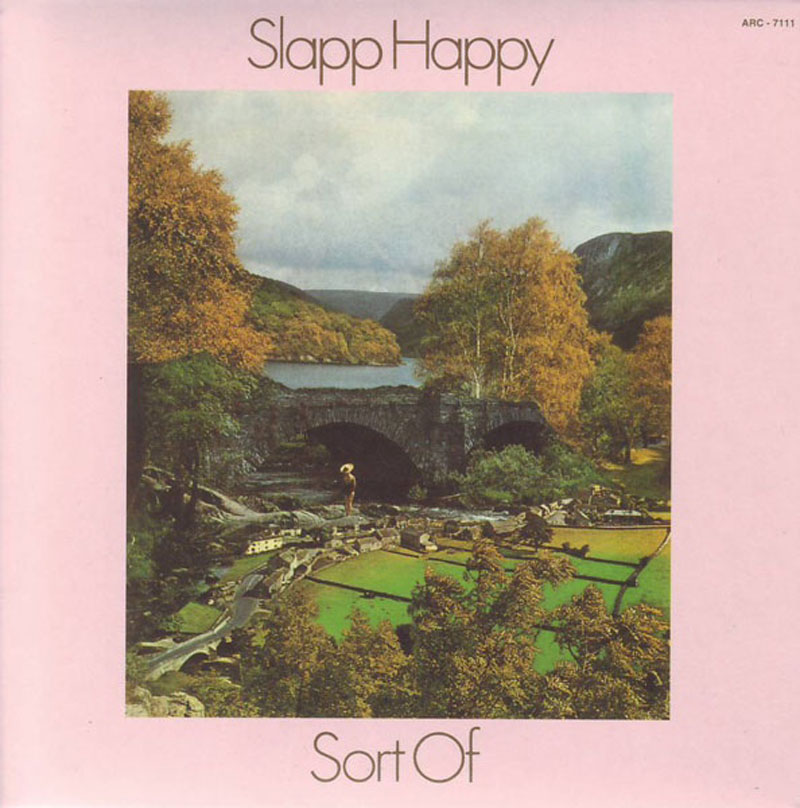
But searching was curtailed when I remembered a much earlier example of the disjunctive collagescape on the cover of Sort Of (1972) by Slapp Happy. I’d forgotten all about this superb piece by avant-garde filmmaker David Larcher which really needs to be seen on a 12-inch sleeve; this is one of those collages where the combination of careful composition, equalised light and shade, and concealed edges makes the picture seem at first glance like an ordinary photograph. Whether Larcher has produced more work of this quality, I can’t say. Another of his collages can be found at The Quietus where Cyclobe enthuse about his films. For more elaborate collagescapes you have to look elsewhere, to one of the prime exponents of the technique, Tsunehisa Kimura.

Elsewhere on { feuilleton }
• The album covers archive
Weekend links 288

gourmelin.jpg

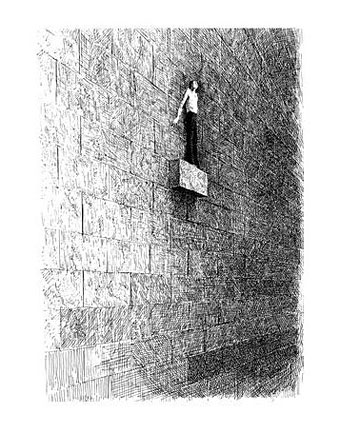
Untitled drawing by Jean Gourmelin.

• Yet another book featuring my design work (interiors this time) has been published in the past week. Leena Krohn: Collected Fiction is an 850-page selection of novels, novel extracts and short works from a prolific Finnish author of the fantastic. Many of the selections are being published in English for the first time:

From cities of giant insects to a mysterious woman claiming to be the female Don Quixote, Leena Krohn’s fiction has fascinated and intrigued readers for over forty years. Within these covers you will discover a pelican that can talk and a city of gold. You will find yourself exploring a future of intelligence both artificial and biotech, along with a mysterious plant that induces strange visions. Krohn writes eloquently, passionately, about the nature of reality, the nature of Nature, and what it means to be human. One of Finland’s most iconic writers, translated into many languages, and winner of the prestigious Finlandia Prize, Krohn has had an incredibly distinguished career. Collected Fiction provides readers with a rich, thick omnibus of the best of her work—including novels, novellas, and short stories. Appreciations of Krohn’s work are also included.

• “Not only is the nature of Rollin’s choice of images close to [Clovis] Trouille’s, the director structures his movies in a similar fashion, crowding his movies with dreamy horror iconography. Rollin has specifically cited the influence of Trouille’s paintings on his work alongside that of other Surrealist painters working in a figurative style.” Tenebrous Kate explores the influences (and influence) of Jean Rollin’s erotic horror films.

• “[Morton] Subotnick might just have been the first person to get a club full of people—including the entire Kennedy family—dancing to purely electronic music when he played his Silver Apples Of The Moon at the opening night of New York’s legendary Electric Circus.” Robert Barry interviews the pioneering composer.

• “What I actually wanted to do was make music that contained all that was new in the 20th century,” says Irmin Schmidt in an interview with Bruce Tantum. Good to read that Rob Young is writing a biography of Can.

• “…gay mainstream culture was never really about expressing individuality, for me. It always seemed very conformist,” says Bruce LaBruce in conversation with Mike Miksche.

• At Dangerous Minds: Paul Gallagher on the making of Ken Russell’s The Devils, and Martin Schneider on the return of Paul Kirchner’s wordless comic strip, The Bus.

• Two years ago a group of Russian urban explorers climbed the Pyramid of Cheops at night. They’ve just returned from South America, and have a report here.

• In the wake of their new album, Kannon, Jason Roche asks “Are drone-metal icons Sunn O))) the loudest band on the planet?”

• Junji Ito returns to horror with two new titles. Related: Fuck Yeah Junji Ito.

• Mix of the week: FACT mix 527 by Jóhann Jóhannsson.

• Anna von Hausswolff‘s favourite albums.

• Touch (Beginning) (1969) by Morton Subotnik | Rapido De Noir (1981) by Irmin Schmidt & Bruno Spoerri | The Gates of Ballard (2003) by Sunn O)))

Weekend links 287

hugo.jpg

Cover by Valentine Hugo for Contes Bizarres (1933) by Achim d’Arnim. See Hugo’s interior illustrations here.

• “In spite of the blood-drinking pursuits of Rollin’s protagonists, there’s very little in the way of body horror to be found. His undead are sensual, romantic creatures that are frequently delicate of mind and body. These movies attempt to evoke nuanced emotional responses with their mixture of romance, loss, eroticism, and tragedy.” Tenebrous Kate on Sex, Death, and the Psychedelic Madness of Jean Rollin.

• “Late at night, [Melville] ‘turned flukes’ down Oxford Street as if he were being followed by a great whale, and thought he saw ‘blubber rooms’ in the butcheries of the Fleet Market.” Philip Hoare on Herman Melville’s time in London.

• Haunted by Books, a new collection of writings by Mark Valentine, “explores the more curious byways of literature.” Full details at the home of the esoteric, Tartarus Press.

I am completely an elitist, in the cultural but emphatically not the social sense. I prefer the good to the bad, the articulate to the mumbling, the aesthetically developed to the merely primitive, and full to partial consciousness. I love the spectacle of skill, whether it’s an expert gardener at work, or a good carpenter chopping dovetails, or someone tying a Bimini hitch that won’t slip.

Art critic Robert Hughes quoted in a review by Siri Hustvedt of The Spectacle of Skill: Selected Writings of Robert Hughes

• “Art, art – I couldn’t give a crap about art.” Oscar Wilde’s nephew, Arthur Cravan, puts in another appearance at Strange Flowers.

• “The Tarot is utterly fascinating,” says Evan J. Peterson discussing his Tarot-inspired writing with Tarot Poetry.

• Manuel Göttsching: “A lot of crazy music happened at the end of the ’60s, very strange, and very curious…”

• Mixes of the week: Secret Thirteen Mix 169 by Chra, and 28th November 2015 by The Séance.

• Czech Artists’ Radical Book Designs of the Early 20th Century

• Ten things you might not know about Yayoi Kusama.

• More megaliths: Francis Pryor on ritual landscapes.

• Peaches gets wild in the desert: Rub (uncensored).

• Irmin Schmidt‘s favourite records (this week)

• Mount Etna erupts

• Rituals (1981) by Bush Tetras | Ballet For A Blue Whale (1983) by Adrian Belew | Etna (2006) by Boris & Sunn O)))

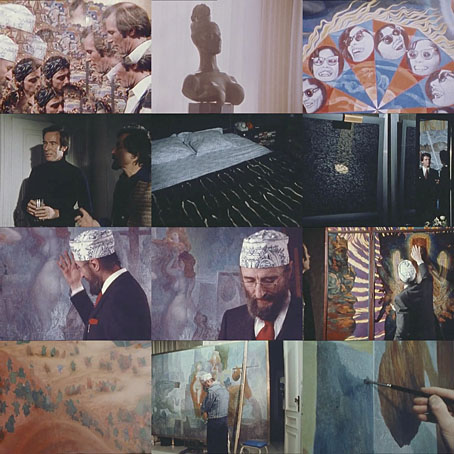
Trois peintres visionnaires, a film by Fabienne Strouvé

threepainters.jpg

Another gem of an arts documentary, Trois peintres visionnaires is a companion film to Mati Klarwein, peintre Américain: both films feature Klarwein and Ernst Fuchs, while this one also includes another artist, Austrian Arik Brauer (credited as Eric in the titles). As with yesterday’s film there’s a small extract from Popol Vuh’s Hosianna Mantra on the soundtrack plus one of the Cluster and Eno recordings. The three painters are shown performing an impromptu Tibetan (?) chant inside Mati Klarwein’s Aleph Sanctuary then talking together inside Fuchs’ resplendent museum where the Aleph Sanctuary was housed for several years. As before, the conversation is in French but you also get to see Fuchs at work, and there’s a roaming closeup of one of his jewelled paintings.

Elsewhere on { feuilleton }
• The fantastic art archive

Previously on { feuilleton }
• Mati Klarwein, peintre Américain, a film by Fabienne Strouvé
• Ernst Fuchs, 1977
• The art of Mati Klarwein, 1932–2002

Ernst Fuchs, 1977

fuchs12.jpg

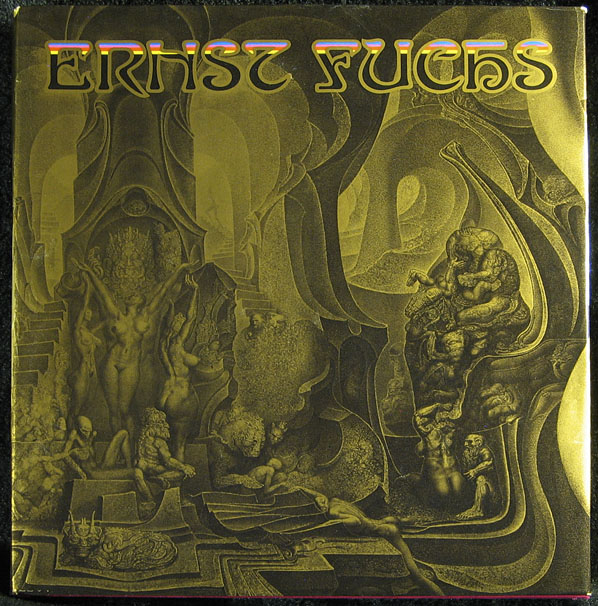
I try to avoid buying even more big art books when I already have shelves groaning under the weight of the things but this one was unavoidable. I’d been after Draeger’s Ernst Fuchs (1977) for some time but whenever I went searching for a copy all the available ones were prohibitively expensive. The news of Fuchs’ death earlier this month prompted a new search which revealed a copy that was astonishingly cheap: £17.50 (!) for a large, heavy and very lavish art book that’s been out of print for years. Even with the postage this was still a remarkable bargain.

fuchs01.jpg

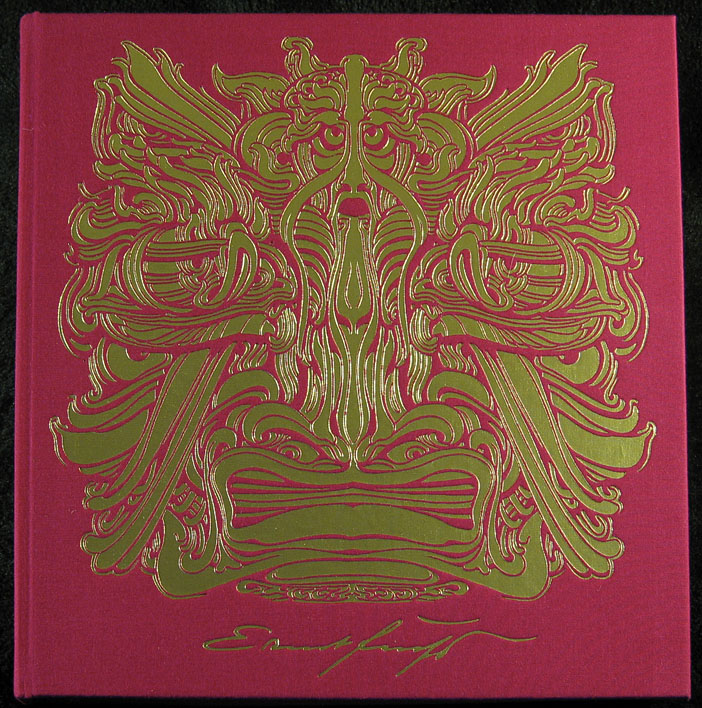
After taking delivery of it today I’m even more surprised since the book is better than expected, with heavy paper throughout and numerous colour plates. The text is in German, of course, but that’s not a problem when there are so many beautiful reproductions of favourite pictures. An exceptional production with a dust jacket of deep metallic gold beneath which you find a Fuchs design blocked onto the boards, front and back.

fuchs02.jpg

Something I realised looking through the pages is that this is yet another of the art books that provided pictures for the early issues of Omni magazine. Mati Klarwein’s God Jokes was published in 1976; Giger’s Necronomicon had its first English edition in 1977, the same year as the Fuchs book; Bob Venosa‘s Manas Manna appeared in 1978; Omni showcased work by all these artists and others like them, and was the first place where I and many other readers would have seen their paintings. One of the pictures in this Fuchs collection appeared on the cover of Omni #6 in March, 1979. The 1970s was, among other things, a great period for this type of fantastic art.

Continue reading “Ernst Fuchs, 1977”