Remedios Varo’s recipe for erotic dreams

varo.jpg

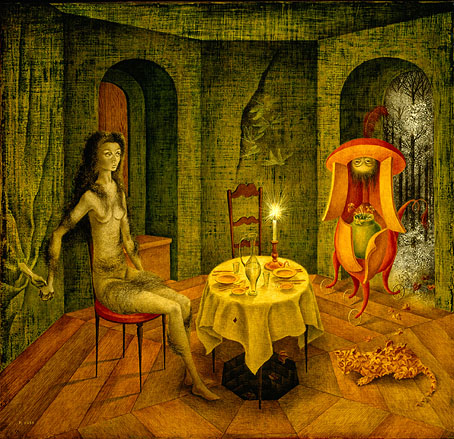
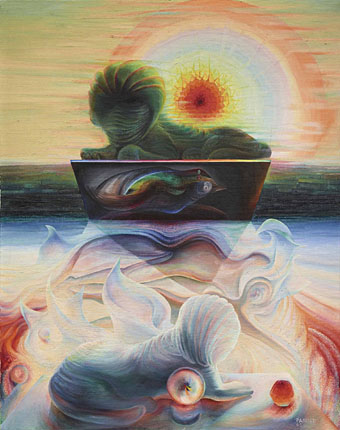
Visita Inesperada (1958) by Remedios Varo.

Ingredients:
One kilo black radishes; three white hens; one head of garlic; four kilos honey; one mirror; two calf’s livers; one brick; two clothespins; one whalebone corset; two false moustaches; two hats of your choice.

Pluck the hens, carefully setting aside the feathers. Boil in two quarts of unsalted distilled water or rainwater, along with the peeled, crushed garlic. Simmer on a low fire. While simmering, position the bed northwest to southeast and let it rest by an open window. After half an hour, close the window and place the red brick under the left leg at the head of the bed, which must face northwest, and let it rest.

While the bed rests, grate the black radishes directly over the consommé, taking special care to allow your hands to absorb the steam. Mix well and simmer. With a spatula, spread the four kilos of honey on the bedsheets, sprinkle the chicken feathers on the honey-smeared sheets. Now, make the bed carefully…

And so on. If you want to read the rest then you’ll have to find a copy of Surrealist Women: An International Anthology (1998), edited by Penelope Rosemont. (Extract translated by Walter Gruen.)

Weekend links 521

parent.jpg

Au Lion d’or (1965) by Mimi Parent.

• After the recent announcement of Jon Hassell’s health issues it’s good to see he has a new album on the way at the end of July. Seeing Through Sound (Pentimento Volume Two) follows the form of the first volume, Seeing Through Pictures (2018), in reworking elements of earlier recordings into new forms. Not remixes, more reimaginings, and a process that Hassell has been applying to his own work for many years, most notably on his collaboration with Peter Freeman, The Vertical Collection (1997). The latter is an album which is impossible to find today and really ought to be reissued, together with more scarcities from the Hassell catalogue.

• Death of a typeface: John Boardley on Robert Granjon’s Civilité, a type design intended to be the national typeface of France but which fell out of favour. It wasn’t completely forgotten however; I was re-reading Huysmans’ À Rebours a couple of weeks ago, and Civilité is mentioned there as being a type that Des Esseintes chooses for some of his privately-printed books.

• At Plutonium Shores: Kurosawa versus Leone in A Fistful of Yojimbo. Christopher Frayling makes a similar analysis in his landmark study, Spaghetti Westerns (1981), but I didn’t realise that Leone had based so many of his shots on Kurosawa’s film.

• More lockdown art: Seen from Here: Writing in the Lockdown is a collection of new writing edited by Tim Etchells and Vlatka Horvat. A PDF book whose sales will go to support the Trussell Trust, a UK food bank charity.

• The week’s culture guides: Ben Cardew on where to start with the back catalogue of Miles Davis, and Hayley Scanlon on where to begin with the films of Yasujiro Ozu.

• “We can no longer ignore the potential of psychedelic drugs to treat depression,” says Robin Carhart-Harris.

• At Dangerous Minds: Laraaji returns with a new album, Sun Piano, and a preview of the same, This Too Shall Pass.

• Mixes of the week: The Ivy-Strangled Path Vol. XXI by David Colohan, and XLR8R Podcast 647 by The Orb.

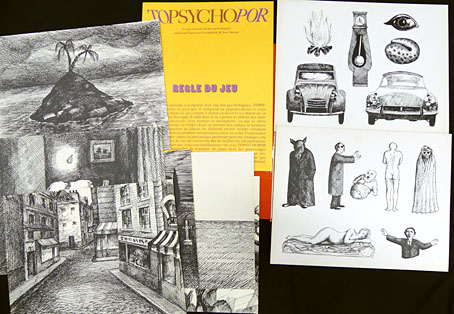
Penelope Rosemont on the humorous Surrealism of Mimi Parent.

• At Dennis Cooper’s: Jeff Jackson presents Free Jazz Day.

The Golden Lion (1967) by Lomax Alliance | Dread Lion (1976) by The Upsetters | Gehenna Lion (1982) by Chrome

The Heat of a Thousand Suns by Pierre Kast

kast1.jpg

In an earlier post I mentioned how invaluable I’d found Philip Strick’s Science Fiction Movies, a large-format study published in 1976. Like Denis Gifford’s Pictorial History of Horror Movies (1973), the book was intended as a cheap introduction to a popular genre but Strick wasn’t content to limit himself to familiar titles, offering instead a remarkably eclectic list of films, many of which are barely science fictional at all: Last Year at Marienbad, The Saragossa Manuscript, The Hour of the Wolf, Teorema, The Discreet Charm of the Bourgeoisie, and so on. For my teenage self, and no doubt many other readers, this was my first encounter with these and other titles, and it was Strick’s descriptions that kept me on the lookout for them for many years (over 20 in the case of Saragossa). Strick’s equanimity treated cinema as a global medium, not one where Hollywood dominates the marketplace and all the conversation. Other films under discussion were definitely SF but unviewable to those of us who without access to an arts cinema, and little hope of ever seeing them on TV, European obscurities such as La Jetée, Fantastic Planet, Je t’aime, je t’aime and The End of August at the Hotel Ozone. Despite the book’s age, and the relative ease with which anyone can now see films such as these, a few scarcities remain, one of which I watched for the first time last week.

kast2.jpg

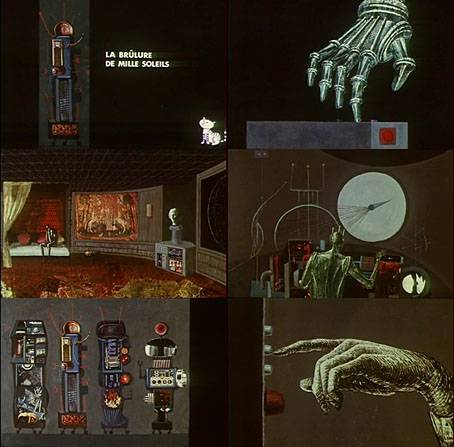
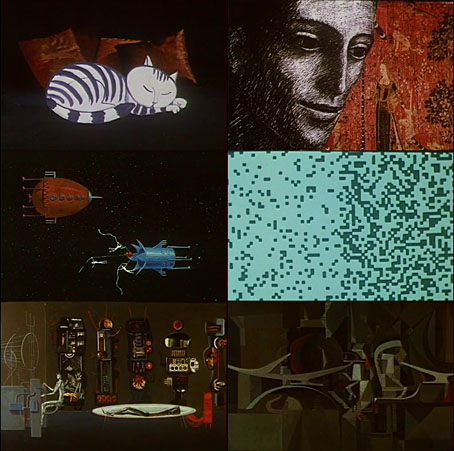
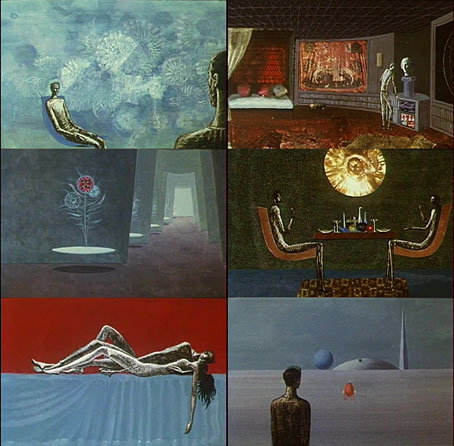
The Heat of a Thousand Suns/La Brûlure de Mille Soleils (1965) is a 25-minute animated film written and directed by Pierre Kast that Strick not only describes but further tantalises the reader with a pair of stills, which may account for its title having lodged in my memory all this time. Strick discusses the film between two other animations that are now very familiar: The Green Planet, an early work by Piotr Kamler, and Les Jeux des Anges by Walerian Borowczyk. (If all this sounds like wilful obscurantism on Strick’s part, on the previous page he discusses a pair of classic Hollywood features, This Island Earth and Forbidden Planet.) Kamler’s film is a humorous one, while Borowczyk’s is strange and disturbing; Kast’s film is pitched somewhere between the two:

A young man in the far future becomes bored with the solar system he knows too well and goes for an unrepeatable trip to the stars, in the company of his robots and his cat. On a remote planet he encounters a tranquil civilization where something has only to be wished for, and it happens; he meets a girl, they fall in love, and their romance is frustrated by his complete inability to recognize the different standards of her society where sexual groups of eight comprise a family. Put together from paintings by a Spanish surrealist artist, Eduardo Luiz, whose suffused landscapes and delicate tapering figures provide the perfect balance to the gentle melancholy of the hero’s monologue, the film has the same touch of scorn at its centre as was evident in Kast’s other science-fiction works, Amour de Poche (1957) and Les Soleils de l’Ile de Pâques (1971), although its twinkling conclusion is more in keeping with his romantic comedy Vacances Portugaises (1961). It’s one of the most effective screen versions so far of science fiction’s crusade not so much for a better world as for better people on it.

Strick also mentions a detail about the production that I’d forgotten, namely the editing being the work of La Jetée director, Chris Marker. The latter’s credit makes the inclusion of a space-faring cat both funny and fitting although the animal is unconcerned by interstellar travel, and spends most of its time asleep. Another notable name is electronic composer Bernard Parmegiani who provided the score for this and other films by Kast; he also scored several shorts by Piotr Kamler and Borowczyk’s Jeux des Anges.

kast3.jpg

Now that I’ve finally seen Kast’s film I wouldn’t say it was worth the wait but it was definitely worth watching. The animation is very minimal, with most of the shots being still images that the camera wanders over. The SF scenario is very conventional, as are the trappings: a pointed rocket, bleeping robots, aliens that look and behave like Earth people even if they do have eight sexes. The film distinguishes itself much more with its design, the Giacometti-like figures, and the interior of the spacecraft which pre-empts Barbarella with its lavish chambers filled with period decor and artwork. Despite Strick’s praise, Kast’s conventionality seems a missed opportunity when animation can do so much more than ape live-action cinema. Piotr Kamler’s films, in particular Labyrinth (1969) and Chronopolis (1983), offer science-fiction scenarios that are remote from our own lives and preoccupations; so too with Borowczyk’s Jeux des Anges, a film whose industrial nightmare is closer to David Lynch than Barbarella. Kast does have a late surprise, however, although this may only mean anything to those familiar with Chris Marker’s photography.

The Heat of a Thousand Suns is on YouTube but with no subtitles for its French narration. The copy I watched was from this page which includes a subtitle file. I suspect this may be a DVD rip, and therefore immoral, but the same probably applies to the YouTube version as well. The choice is yours.

Previously on { feuilleton }
A Pictorial History of Horror Movies by Denis Gifford
Saragossa Manuscript posters
Marienbad hauntings
Chronopolis by Piotr Kamler
Les Jeux des Anges by Walerian Borowczyk

The nightingale echo

ernst3.jpg

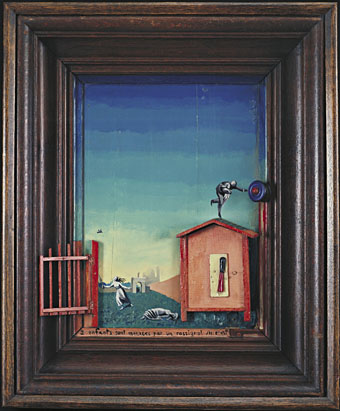
Two Children Are Threatened by a Nightingale (1924) by Max Ernst.

Another discovery from Charles Henri Ford’s View: Parade of the Avant-Garde. Sidney Janis devotes several pages to one of the earliest Surrealist paintings by Max Ernst, Two Children Are Threatened by a Nightingale. After describing the picture in detail he makes this comparison:

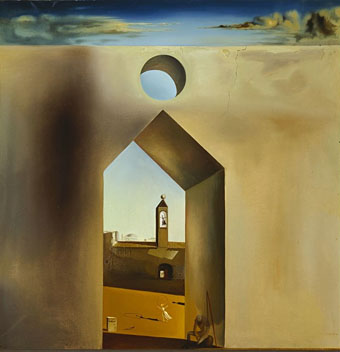
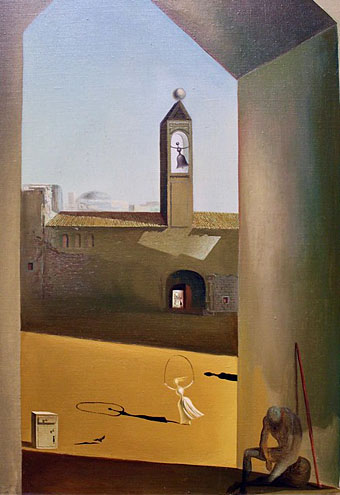
In 1935, Dalí painted a Nostalgic Echo, obviously of this very picture by Max Ernst. Eleven years divided the two paintings; still the lapse of time has not interrupted a continuity of idea which takes place between them. For now we have the next sequence of events. Ernst’s adolescent with the knife appears again in the Dalí, her gesture identical but free of her earlier emotional tension. We find her contentedly skipping rope, her contour and movement echoed in the belfry as a ringing bell. And here it is the nightingale that is menaced. It alights, and as it does, a shadow moves toward it in the form of a snare. This shadow-snare is thrown by the girl and the rope. Finally, the nimble-footed man no longer leaps the rooftops—he is brought to earth to brood in the shadow of his own senility. Relegated to a humble corner of the foreground portal, he is a sorry sight, while in the belfry-tower which repeats the image of the portal, the feminine form triumphantly dominates the aperture, swinging against the sky. The play of ideas in the two pictures is like a Surrealist game in which one participant carries on where the other leaves off.

dali1.jpg

Nostalgic Echo (1935) by Salvador Dalí.

Dalí’s paintings frequently quoted other artists but seldom, if ever, the work of his contemporaries so I’m sceptical that Nostalgic Echo is a response or a sequel to the Ernst. But paranoiac-critical-Sherlock Holmes would agree that the comparison is a suggestive one.

dali2.jpg

Nostalgic Echo (detail).

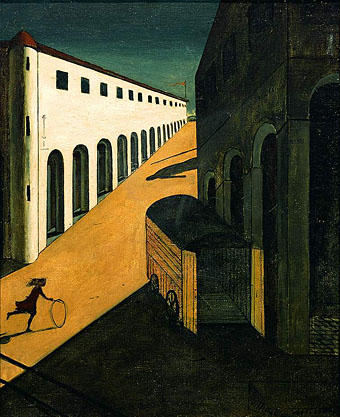
A more obvious echo for Dalí is Giorgio de Chirico’s The Mystery and Melancholy of a Street (below), where we find a similar girl at play among plastered walls, arched portals and elongated shadows. Three paintings, and three stages in a narrative whose events rearrange themselves depending on the order in which they are viewed.

dechirico.jpg

The Mystery and Melancholy of a Street (1914) by Giorgio de Chirico.

Previously on { feuilleton }
Max Ernst’s favourites
Viewing View
Max Ernst album covers
Maximiliana oder die widerrechtliche Ausübung der Astronomie
Max and Dorothea
Dreams That Money Can Buy
La femme 100 têtes by Eric Duvivier

Max Ernst’s favourites

ernst1.jpg

The cover for the Max Ernst number of View magazine (April, 1942) that appears in Charles Henri Ford’s View: Parade of the Avant-Garde was one I didn’t recall seeing before. This was a surprise when I’d spent some time searching for back issues of the magazine. The conjunction of Ernst with Buer, one of the perennially popular demons drawn by Louis Le Breton for De Plancy’s Dictionnaire Infernal, doubles the issue’s cult value in my eyes. I don’t know whether the demon was Ernst’s choice but I’d guess so when many of the De Plancy illustrations resemble the hybrid creatures rampaging through Ernst’s collages. Missing from the Ford book is the spread below which uses more De Plancy demons to decorate lists of the artist’s favourite poets and painters. I’d have preferred a selection of favourite novelists but Ford was a poet himself (he also co-wrote an early gay novel with Parker Tyler, The Young and Evil), and the list is still worth seeing.

ernst2.jpg

Poets: Charles Baudelaire, Friedrich Hölderlin, Alfred Jarry, Edgar Allan Poe, George Crabbe, Guillaume Apollinaire, Walt Whitman, Comte de Lautréamont, Robert Browning, Arthur Rimbaud, William Blake, Achim von Arnim, Victor Hugo, Johann Wolfgang von Goethe, William Shakespeare, Samuel Taylor Coleridge, Lewis Carroll, Novalis, Heinrich Heine, Solomon (presumably the author of the Song of Solomon).

Painters: Pieter Bruegel the Elder, Giovanni Bellini, Hieronymus Bosch, Matthias Grünewald, Albrecht Altdorfer, Georges Seurat, Piero della Francesca, Paolo Uccello, Lucas Cranach the Elder, Hans Baldung, Vittore Carpaccio, Leonardo Da Vinci, Cosimo Tura, Carlo Crivelli, Giorgio de Chirico, Henri Rousseau, Francesco del Cossa, Piero di Cosimo, NM Deutsch (Niklaus Manuel), Vincent van Gogh.

I’ve filled out the names since some of the typography isn’t easy to read. Some of the choices are also uncommon, while one of them—NM Deutsch—is not only a difficult name to search for but the attribution has changed in recent years. The list of poets contains few surprises but it’s good to see that Poe made an impression on Ernst; the choice of painters is less predictable. Bruegel, Bosch and Rousseau are to be expected, and the same goes for the German artists—Grünewald, Baldung—whose work is frequently grotesque or erotic. But I wouldn’t have expected so many names from the Italian Renaissance, and Seurat is a genuine surprise. As for Ernst’s only living contemporary, Giorgio de Chirico, this isn’t a surprise at all but it reinforces de Chirico’s importance. If you removed Picasso from art history de Chirico might be the most influential painter of the 20th century; his Metaphysical works had a huge impact on the Dada generation, writers as well as artists, and also on René Magritte who was never a Dadaist but who lost interest in Futurism when he saw a reproduction of The Song of Love (1914). Picasso’s influence remains rooted in the art world while de Chirico’s disquieting dreams extend their shadows into film and literature, so it’s all the more surprising that this phase of his work was so short lived. But that’s a discussion for another time.

Previously on { feuilleton }
Viewing View
De Plancy’s Dictionnaire Infernal
Max Ernst album covers
Maximiliana oder die widerrechtliche Ausübung der Astronomie
Max and Dorothea
Dreams That Money Can Buy
La femme 100 têtes by Eric Duvivier