Weekend links 140

cards.jpg

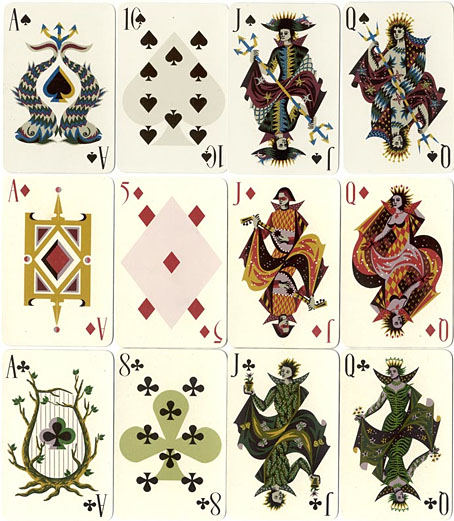
Thanks to Callum for pointing the way to a beautiful set of playing cards designed by Picart le Doux.

Of cigars and pedants by Houman Barekat, in which Vladimir Nabokov has a problem with Henry James. Tangentially related: Post-Punk’s Nabokov: Howard Devoto and Magazine, live from Berlin, 1980. (Given A Song From Under The Floorboards, and lines like “I could have been Raskolnikov / But mother nature ripped me off”, I’d say it’s more accurate to describe Devoto as Post-Punk’s Dostoyevsky.)

• “I was introduced to Kneale’s work like most kids: by a fifty-foot hologram of a psychic locust and a British colonel deliquesced by five million years of bad Martian energy.” In Keep Me in the Loop, You Dead Mechanism Dave Tompkins looks back at Nigel Kneale’s TV play The Stone Tape. I reported my own impressions at the end of October.

• At The Quietus this week, Carol Huston on Lord Horror: A History Of Savoy Publishing. Michael Butterworth is interviewed, and the piece includes some quotes from earlier interviews by yours truly.

As the Massachusetts minister Increase Mather explained in 1687, Christmas was observed on Dec. 25 not because “Christ was born in that Month, but because the Heathens Saturnalia was at that time kept in Rome, and they were willing to have those Pagan Holidays metamorphosed into Christian” ones. So naturally, official suppression of Christmas was foundational to the godly colonies in New England.

Rachel N. Schnepper on the Puritan War on Christmas.

• Maxine Peake and the Eccentronic Research Council have a seasonal song for you. Take the title, Black ChristMass, as a warning. The group recently played live on The Culture Show.

• Clive Hicks-Jenkins’ Artlog is currently hosting Alphabet Soup, an online exhibition by different artists each depicting the letters of the alphabet. Start here and click forward.

Ornate Typography from the 19th Century featuring samples from the King George Tumblr. Related: Sheaff ephemera.

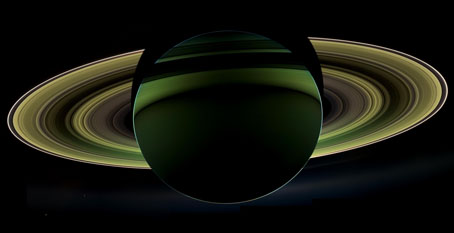
saturn.jpg

Saturn at Saturnalia. A Cassini image of the planet’s nightside.

Kenneth Anger interviewed by P. Adams Sitney. A 53-minute tape recording from 1972.

• At The Outer Church: James Ginzburg of Emptyset posts a winter music mix.

When Candy Darling met Salvador Dalí.

The psychedelic secrets of Santa Claus.

• At Pinterest: Camp as…

Saturn (1956) by Sun Ra | Permafrost (live, 1980) by Magazine | Uptown Apocalypse (1981) by B.E.F.

Astronomy in China: The Pekin Observatory, 1888

observatory6.jpg

Observatoire de Peking (c. 1790).

Work this week has necessitated going through more 19th-century journals. For a while now I’ve had some downloaded copies of Scientific News, a kind of London equivalent of Scientific American, but I hadn’t noticed this particular article until I had to look through it again. The uncredited piece describes the ancient astronomical instruments at the observatory in the heart of Beijing, China (or “Pekin” as they have it here). Armillary spheres always catch my attention, and the Beijing ones are splendid examples supported by ornamental dragons. The text is informative but also mildly condescending as most discussion of China or Japan at this time tended to be. The piece includes some nice engraved illustrations of the instruments (scroll down), all of which can still be seen today surrounded by a city which the Chinese of 1888 would no longer recognise.

*   *   *

ASTRONOMY IN CHINA: THE PEKIN OBSERVATORY

VICE-ADMIRAL MOUCHEZ has just received from Pekin, for the Astronomical Museum which he has founded in connection with the Observatory of Paris, a series of photographs representing the Pekin Observatory and the instruments there erected. By the courtesy of our contemporary La Nature we are enabled to place these curious views before our readers, and thus give them an exact idea of the present state of astronomy in the nation which has cultivated it with the greatest zeal, for the longest time, and among whom it has received the most remarkable developments.

Astronomical functions have not ceased to be held in honour in China, and the Observatory of the Celestial Empire is at present under the direction of an uncle of the Emperor, who ranks as the fifth prince of the blood, and bears the title of Chancellor.

The number of persons attached to this establishment is more considerable than that at Paris. It amounts, including students, to 196. The chief functionaries after the Chancellor are a Chinese director and a Tartar director, having the right to wear a button of a precious stone, and to bear on the chest the image of a sea-raven. Then follow two sub-directors, one Chinese and one Tartar, and two assistants entrusted with calculations. These latter, prior to the expulsion of the Jesuits, were always foreigners. Two other functionaries require to be noted. The first is the keeper of the buildings, and the second the custodian of the water-clocks, as chronometers have not been as yet introduced into the observatory, any more than have telescopes.

Continue reading “Astronomy in China: The Pekin Observatory, 1888”

Weekend links 131

thingposter.jpg

Japanese poster (1982).

At The Quietus Steve Earles looks back at John Carpenter’s visceral and uncompromising The Thing which exploded messily onto cinema screens thirty years ago. It’s always worth being reminded that this film (and Blade Runner in the same year) was considered a flop at the time following bad reviews and a poor showing at the summer box office. One reason was The Thing‘s being overshadowed by the year’s other film of human/alien encounters, something called E.T. the Extra-Terrestrial. To The Thing‘s status as the anti-E.T. you can add its reversal of the can-do heroics of Howard Hawks’ The Thing from Another World (1951), an attitude out-of-step with Reaganite America. Carpenter’s film is not only truer to the original story but from the perspective of 2012 looks like one of the last films of the long 1970s, with Hawks’ anti-Communist subtext replaced by bickering, mistrust, paranoia and an unresolved and completely pessimistic ending that most directors would have a problem getting past a studio today.

I was fortunate to see The Thing in October of 1982 knowing little about it beyond its being a John Carpenter film (whose work I’d greatly enjoyed up to that point) and a remake of the Hawks film (which I also enjoyed a great deal). One benefit of the film’s poor box office was a lack of the kind of preview overkill which made E.T. impossible to avoid, and which a couple of years earlier did much to dilute the surprise of Ridley Scott’s Alien. I went into The Thing mildly interested and came out overwhelmed and aghast. For years afterwards I was insisting that this was the closest you’d get on-screen to Lovecraft’s At the Mountains of Madness. The correspondence is more than merely Antarctica + monsters when you consider this:

Lovecraft’s story was rejected by his regular publisher Weird Tales but was accepted by Astounding Stories in 1936 >> The editor of Astounding, John W. Campbell, published his own Antarctica + monsters story (under the pen-name Don A. Stuart), “Who Goes There?”, in the same magazine two years later >> Charles Lederer wrote a loose screen adaptation of Campbell’s story which Howard Hawks and Christian Nyby filmed as The Thing from Another World.

This isn’t to say that Campbell copied Lovecraft—both stories are very different—but I’d be surprised if Lovecraft’s using Antarctica as the setting for a piece of horror-themed science fiction didn’t give Campbell the idea.

More things elsewhere: Anne Billson, author of the BFI Modern Classics study of The Thing, on the framing of Carpenter’s shots, and her piece from 2009 about the film | Mike Ploog’s storyboards | Ennio Morricone’s soundtrack music, of which only a small percentage was used in the film.

• The week in music: 22 minutes of unreleased soundtrack by Coil for Sara Dale’s Sensual Massage | Analog Ultra-Violence: Wendy Carlos and the soundtrack for A Clockwork Orange | A Halloween mixtape by The Outer Church | Herbie Hancock & The Headhunters, live in Bremen, 1974: a 66-minute set, great sound, video and performances | Giorgio Moroder’s new SoundCloud page which features rare mixes and alternate versions | A video for Collapse by Emptyset.

One of the main themes of the book, and what I found in The Arabian Nights, was this emphasis on the power of commodities. Many of the enchanted things in the book are lamps, carpets, sofas, gems, brass rings. It is a rather different landscape than the fairy tale landscape of the West. Though we have interiors and palaces, we don’t have bustling cities, and there isn’t the emphasis on the artisan making things. The ambiance from which they were written was an entirely different one. The Arabian Nights comes out of a huge world of markets and trade. Cairo, Basra, Damascus: trades and skills.

Nina Moog talks to Marina Warner

John Palatinus, “one of the last living male physique photographers of the 1950s”, is interviewed. Related: the website of Ronald Wright, British illustrator for the physique magazines.

• “A classic is a work which persists as a background noise even when a present that is totally incompatible with it holds sway.” Italo Calvino’s 14 Definitions of What Makes a Classic.

Huge Franz Kafka archive to be made public. Related: Judith Butler asks “Who owns Kafka?”

• Geoff Manaugh’s Allen Ginsberg Photos & Ephemera, 1994–Dec 1996.

Magic mushrooms and cancer: My magical mystery cure?

Clark Ashton Smith Portfolio (1976) by Curt Pardee.

Jan Toorop’s 1924 calendar.

artQueer: a Tumblr.

• All The Things You Are (1957) by Duke Ellington | Things That Go Boom In The Night (1981) by Bush Tetras | Things Happen (1991) by Coil | Dead People’s Things (2004) by Deathprod.


Vampyroteuthis Infernalis by Vilém Flusser

vampyroteuthis.jpg

Cover design by Michel Vrana.

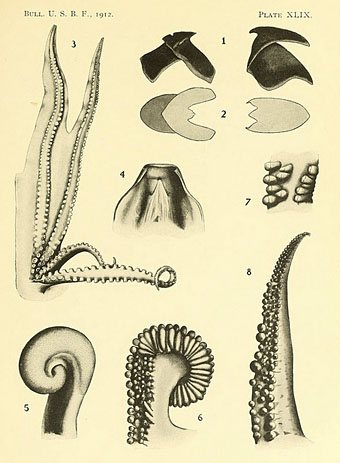
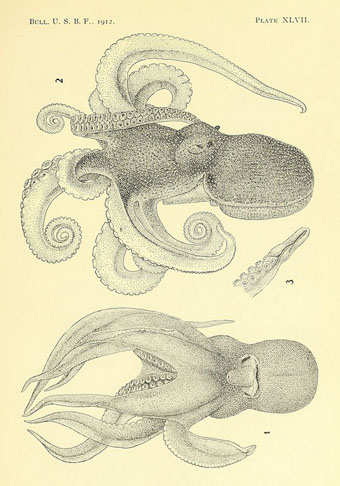
This, then, is the book that arrived a fortnight ago when I just happened to be in the midst of a week of tentacle posts. Vampyroteuthis Infernalis: A Treatise, with a Report by the Institut Scientifique de Recherche Paranaturaliste was originally published in Germany in 1987. This new edition is the first translation into English (by Valentine A. Pakis) published by the University of Minnesota Press in their Posthumanities series. It’s 100 pages long with a supplement of squid illustrations by Louis Bec. It is, to say the least, an odd book:

Part scientific treatise, part spoof, part philosophical discourse, part fable, Vampyroteuthis Infernalis gives its author ample room to ruminate on human—and nonhuman—life. Considering the human condition along with the vampire squid/octopus condition seems appropriate because “we are both products of an absurd coincidence…we are poorly programmed beings full of defects,” Flusser writes. Among other things, “we are both banished from much of life’s domain: it into the abyss, we onto the surfaces of the continents. We have both lost our original home, the beach, and we both live in constrained conditions.”

I’m not familiar with Flusser’s other work since I read few academic texts but it seems safe to assume that Vampyroteuthis Infernalis is an exception among the author’s volumes of media and communication theory. The tone is light but not overly comic unless you regard as inherently amusing Flusser’s analysis of an obscure cephalopod—the Vampyroteuthis Infernalis (the name translates as “vampire squid from hell”)—as a useful tool for studying the human condition. The study so far as it goes is along the lines of some of the essays by Jorge Luis Borges rather than any lengthy disquisition, looking at the squid’s existence from a number of angles in order to draw comparisons with human life. You wouldn’t think it easy to talk about “squid culture” or “squid politics” but Flusser manages:

…we are able to imagine cultural structures (“Utopias”) in which even our biological constraints are done away with. The vampyroteuthis cannot fathom Utopias, for the structure of its society is not a cultural product (it is not a “factum”) but rather a biological given (a “datum”). When it engages in politics, it does so against its own “nature”—it commits a violent act against itself. In the end, however, is not all human political activity contra nature?

And so on. In Borges terms (for me he’s the obvious touchstone) the book is reminiscent of the Chronicles of Bustos Domecq (1967), a series of deadpan essays about absurd cultural developments credited to one “H. Bustos Domecq” but written by Borges and Adolfo Bioy Casares. Flusser lived in Brazil for a number of years so Borges may have been an inspiration. Like Borges, Flusser is learned enough to write convincingly about his subject before he starts evading the reader’s grasp. The opening of Vampyroteuthis Infernalis is a creditable and informative run through the Octopoda taxonomy; later we have references and terminology from Heidegger, and Wilhelm Reich makes a surprising appearance. Many of the parallels are ingenious, such as when Flusser compares our electronic media—the glowing screens of televisions and computer monitors—to the glowing chromatophors on the skin of the squid which the animal uses to communicate in the lightless depths of the sea. Flusser ends on another Borgesian note, describing his “fable” as offering “an image of the self reflected between two facing mirrors”. Perhaps that’s the best way to regard this book: a continual play of reflections all of which would vanish if one of the mirrors were removed.

Those who wish to lose themselves in the reflections can order the book in hardback or paperback direct from the University of Minnesota Press. Elsewhere there’s a fair amount of Vampyroteuthis Infernalis footage on YouTube which reveals the animal in question to be as wonderfully strange as its name would imply.

Previously on { feuilleton }
Le Poulpe Colossal
Fascinating tentacula

Weekend links 127

whirlpool.jpg

M15, The Whirlpool Galaxy photographed by Martin Pugh. The overall and deep space winner of Astronomy Photographer of the Year, 2012.

The Final Academy, the series of William Burroughs-themed events that took place in London and Manchester in 1982, will be celebrated at the Horse Hospital, London, on 27th October. Academy 23, a publication edited by Matthew Levi Stevens, will include my report on the Manchester Haçienda performances.

• “Architects are the last people who should shape our cities,” says the thrillingly pugnacious Jonathan Meades in a piece from his new writing collection Museums Without Walls. Andy Beckett reviews the book here.

• Ex-Minimal Compact singer/bassist Malka Spigel talks about her new album, Every Day Is Like The First Day, which can be streamed in full here.

What’s new about the current acknowledgments page is that it’s unsolicited—it appears like an online pop-up ad, benefiting no one but the author and his comrades. This is surely why these afterwords are often so garrulously narcissistic and strewn with clichés. The most radical experimentalist adheres to the most mindless acknowledgments-page formula; the most stinging social critic suddenly becomes Sally Field winning an Oscar.

Sam Sacks at the New Yorker on the blight of novelists’ acknowledgments pages. DG Myers at Commentary Magazine piles on.

• Another streaming album: Composed by Jherek Bischoff. Try Insomnia, Death & The Sea featuring Dawn McCarthy.

• Film of Lindsay Kemp being interviewed in 1977 about his production of Salomé.

Electronic Performers (2004): a video by Machine Molle for the song by Air.

djuna.jpg

One of a series of Beardsley-like drawings by Djuna Barnes posted at Strange Flowers. The resurgent Ms. Barnes is mentioned three times in this Terry Castle review of All We Know: Three Lives by Lisa Cohen.

Fictitious Dishes, meals from novels photographed by Dinah Fried.

• Life, the Dinosaurs & Everything: Cosmicomics by Italo Calvino.

The Baby Died: Morbid Curiosities found in Old Newspapers.

• Portishead’s Adrian Utley gives a tour of his synth collection.

• Minimal Compact: Babylonian Tower (1982) | Not Knowing (1984) | When I Go (1985) | Nil Nil (1987).