The Fantastic World of MC Escher

escher1.jpg

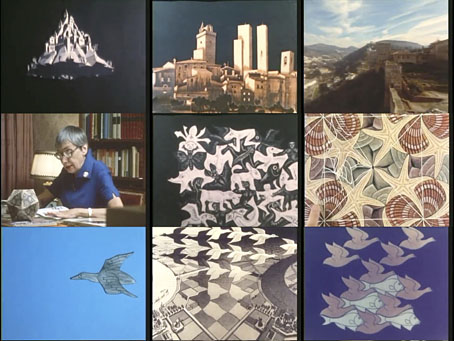
An Italian documentary about the Dutch artist made in 1980 and directed by Michele Emmer. I don’t recall ever seeing a British TV documentary about Escher (although I’d be surprised if there were none) but this resembles the type of thing the BBC used to do so well. Shots of the Italian towns where Escher lived for many years show the influence of the vernacular architecture on Escher’s prints. Elsewhere, animated sequences bring to life his tessellations, while various mathematicians examine some of the structural principles at work in these very familiar images. Of greatest interest for me is mathematician and physicist Roger Penrose discussing his first encounter with Escher’s work, and the development with his father of the Penrose Triangle, an impossible object similar to those that appear in some of Escher’s prints. (I used a Penrose Triangle in my cover art for Zones by Hawkwind.) The Fantastic World of MC Escher runs for 50 minutes, and may be watched here.

escher2.jpg

Previously on { feuilleton }
MC Escher album covers
Escher and Schrofer

Weekend links 243

burgoyne.jpg

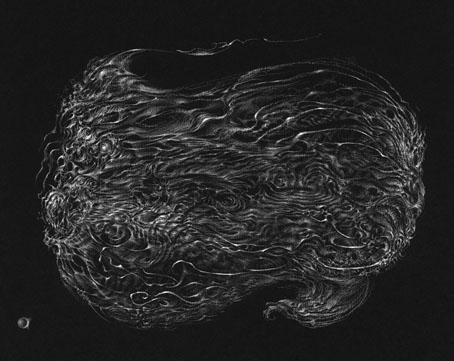
Genesia (2011) by Bette Burgoyne.

• “…so I started buying these old gay porn novels, just for the covers and kept on collecting them.” Maitland McDonagh on the underexamined world of gay pulp. McDonagh’s 120 Days Books is reprinting some of these scarce titles. More gay erotica: Plans are afoot to republish Des Grieux, the rare prequel to Teleny or The Reverse of the Medal (1893), a novel often attributed (without much evidence) to Oscar Wilde.

Merricat is the name under which the Turrell Brothers, John & Tom, produce their atmospheric “nacht music”. Albums with titles such as Oneiros, Widdershins and Zerkalo give an idea of the spheres of interest. They also make short films, clips from which may be seen here.

• “Fascists don’t like satire. They don’t like it at all. And they especially don’t enjoy visual satire. Because of its unique power to communicate.” Ralph Steadman talking to Robert Chalmers about recent events.

There is an unexamined commonplace now floating around the social media, which has it that satire derogates its proper function when it stops targeting the powerful, and targets the relatively powerless instead. Theodor Adorno has also been cited here and there with his remarks on satire in the Minima Moralia of 1951, but few have noticed that the account he offers there stands in direct contradiction to the current received wisdom. For Adorno, satire is in its essence wistful and traditionalist. It looks back to something that has been lost, and dismisses the straight-facedness of everyone who attempts, against all evidence, to maintain the illusion that there is anything respect-worthy about the present state of things. It targets not just elected officials, but the yokels who elected them; not just the honcho who runs the saloon, but the sucker who hands over his last possessions at the poker table. There is a need for this: the yokels and the suckers need it most of all. There is redemption in it, and I confess to harboring whatever amount of traditionalism it takes to appreciate this redemptive quality.

Paris, 2015: a lengthy meditation by Justin EH Smith on the responses of left and right to the Charlie Hebdo killings

• “When the surface of the world is so overloaded with competing narratives…there is an understandable impulse to go underground.” Iain Sinclair on the excavation of London.

• More German music: Sinai Desert (1981) and Kailash, Pilgerfahrt Zum Thron Der Götter (no date), two films with music by Popol Vuh.

Kim Fowley: Sins & Secrets of the Silver Sixties. UglyThings Magazine makes available its definitive Fowley interview from 2001.

• More electronica and mix of the week: the FACT guide to the Yellow Magic Orchestra and associates.

• Vegetable-snake Undersea Beings: Allen Ginsberg writes to the Paris Review about LSD in 1966.

• The Edge Question for 2015: What do you think about machines that think?

Life of Cats: Selections from the Hiraki Ukiyo-e Collection.

Lake Baikal frozen over

Serial Killer Barbie

NGC 891 (1974) by Edgar Froese | Overture (1974) by Tangerine Dream | PA 701 (1976) by Edgar Froese

Weekend links 241

clerc.jpg

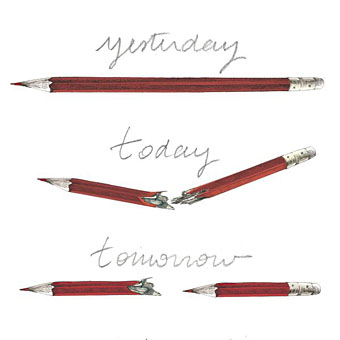
A drawing by Lucille Clerc.

• The usual imbalance of heat versus light this week but Kenan Malik and Teju Cole had some worthwhile things to say. Related: Atlantic illustrators respond to the events of Wednesday. And some history: covers of Charlie Hebdo‘s parent magazine, Hara-Kiri, whose legacy of bad taste and confrontation was overlooked in the rush to express disapproval.

• At The Quietus: Virginie Sélavy, Mark Pilkington and Stephen Thrower of the Miskatonic Institute talk to Mat Colegate about horror old and new. There’s more horror cinema in Mat Colegate’s interview with animator Carla MacKinnon.

• Mixes of the week: Sleepwalkers of the Montgomery Canal by The Geography Trip, and Secret Thirteen Mix 142 by Helena Hauff.

• Jazz legend Julian Priester reflects on his fusion classic Love, Love, Sun Ra, Herbie Hancock, and a lot more.

• “No gays, no blacks, no fat people”: Ryan Gilbey on how film advertising continues to betray filmmakers.

Paul Gorman on the drumheads that Barney Bubbles painted for Hawkwind’s Simon King in 1972.

Massive: Gay Erotic Manga and the Men Who Make It, edited by Anne Ishii & Graham Kolbeins.

NASA’s exoplanet travel bureau wants you to pack your bags.

• The New Humanist on imagining a world without work.

• At Strange Flowers: 15 books for 2015.

Ghosts in the TV

Prologue/Love, Love (1974) by Julian Priester | The Jewel in the Lotus (1974) by Bennie Maupin | Rima (1975) by The Headhunters

Maximiliana oder die widerrechtliche Ausübung der Astronomie

ernst1.jpg

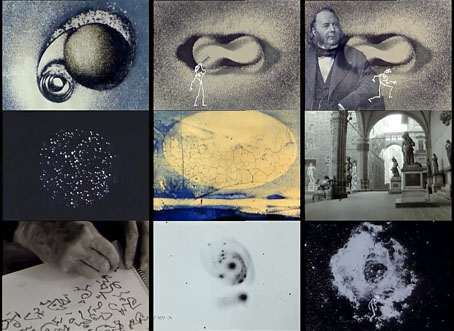
The title of this 10-minute film translates as Maximiliana or the Illegal Practice of Astronomy which is also the name of an art book created by Max Ernst in 1964. The film was a collaboration between Ernst and filmmaker Peter Schamoni, the subject being German astronomer and lithographer Ernst Wilhelm Leberecht Tempel (1821–1889). Tempel’s astronomy was “illegal” because he was regarded as an amateur by other astronomers which meant he was denied permission to name his discoveries. Maximiliana was the name Tempel and physicist Carl August von Steinheil decided on for an asteroid that Tempel discovered in 1861. This was deemed unacceptable so the asteriod was given the name Cybele instead (now 65 Cybele).

ernst2.jpg

Some of this is related in Schamoni’s film but you’ll need an understanding of German to appreciate the detail. The film is worth a look for other reasons, notably some shots of Ernst filling sheets of paper with the curious hieroglyphs that cover the surfaces of some of his later paintings. These hieroglyphs also feature in the Tempel book, and one of them appears in the film as an animated figure. Peter Schamoni made a number of art films including an excellent feature-length documentary about Max Ernst in 1991. That’s also on YouTube but untranslated so you’ll need some good German (and French) to appreciate it.

Previously on { feuilleton }
Max and Dorothea
Dreams That Money Can Buy
La femme 100 têtes by Eric Duvivier

Weekend links 231

advisory.jpg

Design by Julian House.

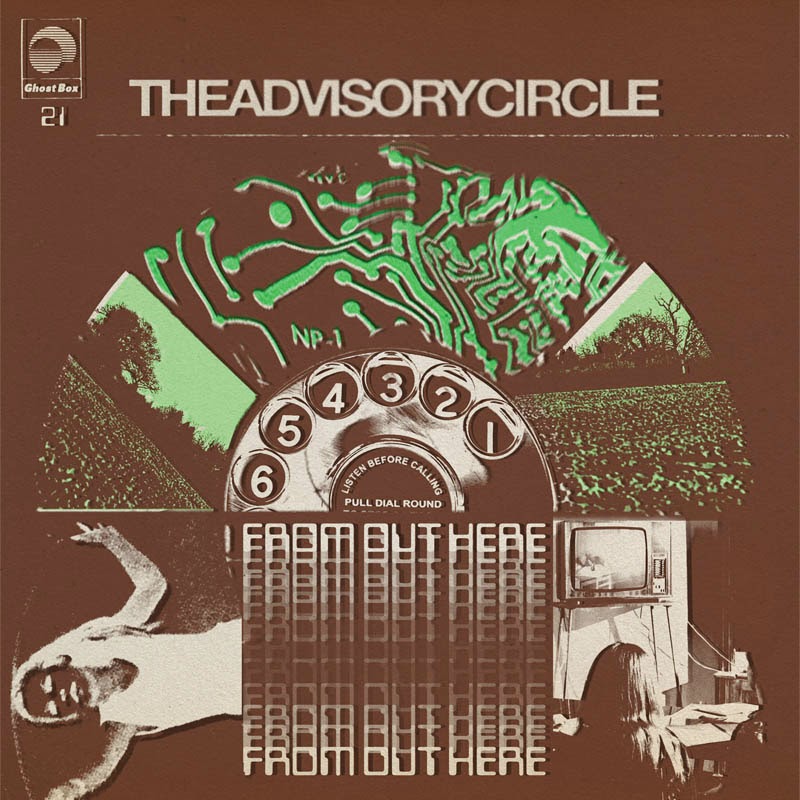
Always good to hear of a new release on the Ghost Box label, and a new album by The Advisory Circle (due on 5th December) is especially welcome. From Out Here is described thus: “Exploring darker territory than 2012’s more pastoral As The Crow Flies, The Advisory Circle hint at a Wyndham-esque science fiction story, where bucolic English scenery is being manipulated and maybe even artificially generated by bizarre multi-dimensional computer technology.” The Belbury Parish Magazine has extracts.

• Jon Hassell’s Fourth World Music Vol. I: Possible Musics receives a long-overdue reissue next month. Possible Musics was a collaboration with Brian Eno, and Eno has some of his own albums reissued again in expanded editions. Most notable is the first official release of My Squelchy Life, an album that was withdrawn in 1991 to be replaced by Nerve Net.

• Some Halloween theatre on Friday (the 31st) at the Museum of Bath at Work with a dramatisation of Ringing the Changes by Robert Aickman. There’s a repeat performance the following week (8th November) with added spectral atmospherics from the Electric Pentangle. Free admission.

The value of these books wasn’t anything wholesome they contained, or any moral instruction they offered. Rather, it was the process of finding them, the thrill of reading them, the way the books themselves, like the men they depicted, detached you from the familiar moral landscape. They gave a name to the palpable, physical loneliness of sexual solitude, but they also greatly increased your intellectual and emotional solitude. Until very recently, the canon of literature for a gay kid was discovered entirely alone, by threads of connection that linked authors from intertwined demimondes. It was smuggling, but also scavenging. There was no internet, no “customers who bought this item also bought,” no helpful librarians steeped in the discourse of tolerance and diversity, and certainly no one in the adult world who could be trusted to give advice and advance the project of limning this still mostly forbidden body of work.

Smuggler: A Memoir of Gay Male Literature by Philip Kennicott

• Getting in before the Mixcloud Halloween rush, mix of the week is Samhain Seance 3: Better Dead Than Never by The Ephemeral Man. My Halloween mix for this year is almost finished; watch the skies.

• For those who can’t wait until December for From Out Here, there’s a new Howlround album, Torridon Gate, out this week from A Year In The Country.

• Last week, Yello’s Boris Blank was choosing favourite electronic albums, this week he runs through a list of thirteen favourite albums.

Altered Balance: A Tribute to Coil by Jeremy Reed & Karolina Urbaniak. Richard Fontenoy reviewed the book for The Quietus.

Cut-Ups: William S. Burroughs 1914–2014, an exhibition of Burroughs’ typescripts at Boo-Hooray, NYC, from 7th November.

Brando, a film by Gisèle Vienne for the song by Scott Walker & Sunn O))).

NASA has a Soundcloud page

The art of leaves

Cobra Moon (1979) by Jon Hassell | Moon On Ice (1987) by Yello feat. Billy MacKenzie | Moon’s Milk Or Under An Unquiet Skull Pt. I (1998) by Coil