Weekend links 122

jackson.jpg

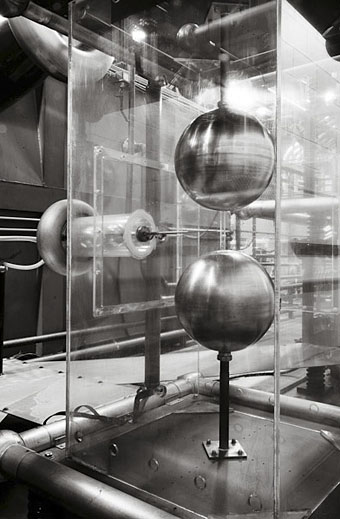
Transmitter Crowbar Discharge Unit, Bates Linear Accelerator. Photo by Daniel Jackson from his Dark Machines series.

The language we use for writing about art is oddly pornographic: We know it when we see it. No one would deny its distinctiveness. Yet efforts to define it inevitably produce squeamishness, as if describing the object too precisely might reveal one’s particular, perhaps peculiar, investments in it. Let us now break that unspoken rule and describe the linguistic features of IAE in some detail.

IAE has a distinctive lexicon: aporia, radically, space, proposition, biopolitical, tension, transversal, autonomy. An artist’s work inevitably interrogates, questions, encodes, transforms, subverts, imbricates, displaces—though often it doesn’t do these things so much as it serves to, functions to, or seems to (or might seem to) do these things. IAE rebukes English for its lack of nouns: Visual becomes visuality, global becomes globality, potential becomes potentiality, experience becomes…experiencability. […] Whatever the content, the aim is to sound to the art world like someone worth listening to, by adopting an approximation of its elite language.

International Art English by Alix Rule & David Levine

For years I’ve been calling it Artspeak: the frequently disingenuous, misleading or merely confused jargon that passes for descriptive writing in the art world. Alix Rule and David Levine apply the more neutral label of International Art English. In a lengthy essay at Triplecanopy they reveal the origins of IAE’s terminology and show why the stuff has spread like semantic kudzu.

• “What a bizarre focal point Anish Kapoor’s spiral callipers are: a Laocoönian observation platform strangled in red steel at a cost of many millions, while electricity pylons, with their austere elegance, once hymned by the poets of the 1930s, have been removed, at enormous cost, from the same site to be buried in the radioactive tilth of landfill dumps and industrial detritus.” Iain Sinclair reports on the Olympics.

Alfred Kubin in…Nottingham! The Other Side, an exhibition of “haunting drawings of death, trauma and fantastical creatures inhabiting imaginary worlds”, running to the end of September.

Francis Ford Coppola and Stewart Copeland discuss the making of Rumble Fish (1982). Over at The Rumpus there’s Coppola talking about his career and his latest film, TWIXT.

Eraserhead: The Making of a Cult Classic. In the 1980s Kenneth George Godwin interviewed everyone responsible for making David Lynch’s film. Fascinating reading.

Skin Job, the debut poetry collection by Evan J. Peterson, is twenty-one poems about monsters, horror, and science fiction. Evan made a trailer.

• Wood, brass and “the latest advances in nanotechnology”: Teka, an OLED lamp by Aldo Cibic and Tommaso Corà.

Tonite Let’s All Make Love in London (1967): Peter Whitehead’s film of the capital at its swinging height.

“Beam Us Up, Mr. Scott!”: Why Misquotations Catch On by Maria Konnikova.

Hari Kunzru‘s ten favourite books about underground London.

The Periodic Table of Heavy Metals.

Alan Garner: A life in books.

Fuck yeah, manuscripts!

• (HR) Giger Counter.

• This week was all about Vangelis in the 1970s: Creation du Monde (1973) | Spiral (1977) | Himalaya / Summit (1979).

Weekend links 121

lambshead.jpg

Title spread for The Thackery T. Lambshead Cabinet of Curiosities (2011) edited by Ann & Jeff VanderMeer.

I was surprised this week to find myself nominated as Best Artist in the World Fantasy Awards. The results will be announced at the World Fantasy Convention in November. Among the books nominated for Best Anthology is the Thackery T. Lambshead Cabinet of Curiosities for which I provided title page designs and some illustrations. Editors Ann & Jeff are well-represented (and ought to win for their landmark The Weird anthology), and I’m pleased to see Mark Valentine receive a nod for his excellent Wormwood magazine. Mark and Roger Dobson published my first Lovecraft adaptation, The Haunter of the Dark, in a large-format edition under their Caermaen imprint in 1988.

I remember having a conversation with my father about it. I told him what I’d really have liked to find, in my exhaustive search of the canon, was a gay superhero. You know: fucking dudes, saving the world. Never mind the fact that superheroes, with their notoriously contour-hugging apparel, are usually assumed gay by default. I wanted something that had existed, something from history. My father considered my criteria.

“I think what you want is Gore Vidal.”

Henry Giardina on Gore Vidal’s Bully Republic at the Paris Review.

• Appreciations and memorials for the late Gore Vidal continue to surface: “He was punk rock with a traditional, smooth exterior. But there was nothing traditional about him, not really. He defied singular category,” says Aaron Tilford at Lambda Literary. “Jokes course through Vidal’s entropy-heavy commentaries like a warm, reviving current. They, more than the barbs to which they form a counterpoint, are what make his essays a continuing pleasure to read,” says “J.C.” at the TLS.

• “Winterson’s opposition to strict realism is less an artistic critique than a cultural one. She uses the term ‘realism’ to describe an entrenched way of viewing the world, which it is the writer’s duty to challenge.” Hannah Tennant-Moore on Jeanette Winterson at n+1.

The Ghosts of Bush by Robin The Fog: “A final hauntological perambulation around the hidden corners of Bush House, Aldwych, London, June 2012”.

• “For everything that is not shown, the filmmaker counts on the power of imagination of his viewers.” Lebbeus Woods on Chris Marker and La Jetée.

Joseph Burnett on “Rainbow Ambiguity: Defying conservatism in mainstream LGBT culture”.

• Leigh Brackett book and magazine covers at Golden Age Comic Book Stories.

BLDGBLOG visited the Whitechapel Bell Foundry in London.

Stilled Life: A collection of photography by Thom Ayres.

• Underground subversion: Stickers on the Central Line.

Andrei Codrescu on five favourite Fantastical Tales.

Vangelis performs an analogue synth freakout for Spanish TV in 1982 | Oro Opus Alter, a track from the forthcoming album by Ufomammut | New World, a track from the forthcoming album by The Irrepressibles. Can’t wait.

A Trip to Mars

mars3.jpg

A floating Martian city from Letters from the Planets (1890) by WS Lach-Szyrma. Illustration by Paul Handy.

In honour of the remarkable landing on Mars of the Curiosity Rover, a handful of random illustrations from the vast stock of imagery generated by the Red Planet over the past century-and-a-half. When it comes to Mars I’m afraid you can keep your terraforming and geodesic domes, I prefer the more fanciful scenarios involving air-boats, cloaks and actual canals. Paul Handy’s illustration above shows what I believe is a Venusian vehicle sailing past a Martian city, Lach-Szyrma’s book concerning a journey through the solar system. I only have small copies of these pictures in a book, so far they don’t seem to have turned up online.

mars2.jpg

A Trip to Mars (1909) by Fenton Ash. Illustrations by WHC Groome.

Fenton Ash was the nom de plume of British author Francis Henry Atkins. A Trip to Mars concerns another exploratory journey taken this time by a pair of Edwardian schoolboys.

mars1.jpg

Continue reading “A Trip to Mars”

Chris Marker, 1921–2012

chrismarker.jpg

“A recurrent rumour says that Chris Marker and the cat Guillaume-en-Egypt sank with the Titanic.” Photo credited to Wim Wenders.

In our moments of megalomaniacal reverie, we tend to see our memory as a kind of history book: we have won and lost battles, discovered empires and abandoned them. At the very least we are the characters of an epic novel (“Quel roman que ma vie!” said Napoleon). A more modest and perhaps more fruitful approach might be to consider the fragments of memory in terms of geography. In every life we would find continents, islands, deserts, swamps, overpopulated territories and terrae incognitae. We could draw the map of such a memory and extract images from it with greater ease (and truthfulness) than from tales and legends. That the subject of this memory should be a photographer and a filmmaker does not mean that his memory is essentially more interesting than that of the next man (or the next woman), but only that he has left traces with which one can work, contours to draw up his maps.

Chris Marker, introductory notes to Immemory (2002)

Memory is the key word: it’s at the heart of Chris Marker’s most well-known films, his science fiction short La Jetée (1962), and the feature-length film-essay Sans Soleil. Both those films reference Hitchcock’s Vertigo, a film concerned with layered memories, both real and invented. Memory also comprises the subject of Marker’s most ambitious work from his later years, the CD-ROM Immemory, a unique creation which few will have experienced since it appeared after the great wave of ROM-mania in the 1990s, and was also Mac-only at a time (2002) when Macs were even more of a minority concern than they are today. My own copy is now unusable since it only runs on the outmoded OS 9 system (later copies were upgraded to OS X), leaving me with nothing but memories of Immemory and a box which sports a still from Vertigo among its cover images. The loss is regrettable but somehow fitting, and there’s a lesson here about impermanence for all you boys and girls planning bright new iPad apps. La Jetée is the film that receives the most attention, made on a budget that even when adjusted forward wouldn’t have covered the catering costs on Inception, it was one of JG Ballard’s favourites, and the source (of course) for Terry Gilliam’s Twelve Monkeys. But it’s to Sans Soleil that I always return, a place where the complex interleaving of documentary footage and fictional—or is it?—narration proves endlessly rewarding.

marker.jpg

The Beckoning Cats from Sans Soleil (1983).

Chrismarker.org: an essential resource
Chris Marker’s YouTube channel
Chris Marker interviewed by Samuel Douhaire and Annick Rivoire in 2003
The New Yorker: In Memoriam: Chris Marker by Richard Brody
Guardian obituary by Ronald Bergan
Telegraph obituary
Things That Quicken The Heart: Chris Marker’s Sans Soleil by David Moats
The Humanists: Chris Marker’s Sans Soleil by Colin Marshall
Brian Dillon on La Jetée

Previously on { feuilleton }
Junkopia
Penguin Labyrinths and the Thief’s Journal
Monsieur Chat
Sans Soleil

m_chat.jpg

The End of Books, 1894

robidabooks01.jpg

More illustrations from Albert Robida, and a riposte to anyone thinking that the idea of the end of books is a recent thing. This article by bibliophile Octave Uzanne appeared in Volume 16 of Scribner’s Magazine (July–December 1894). The piece opens with a description of various scientists and artists at a Royal Society evening making predictions about life in the future. Among other proposals there’s that old saw of science fiction, the meal of condensed nutrients which would supposedly put an end to world hunger. Uzanne’s account of the future of the book involves authors speaking their works into recording devices. Despite Robida’s somewhat comic extrapolations Uzanne seemed to have been semi-serious; even if he wasn’t he made a good job of predicting audio books, and (after a fashion) television: those wanting illustrations would have images projected by one of Edison’s Kinetoscopes.

There will be registering cylinders as light as celluloid penholders, capable of containing five or six hundred words and working up on very tenuous axles, and occupying not more than five square inches; all the vibrations of the voice will be reproduced in them; we shall attain to perfection in this apparatus as surely as we have obtained precision in the smallest and most ornamental watches.

As to the electricity, that will often be found in the individual himself. Each will work his pocket apparatus by a fluent current ingeniously set in action; the whole system may be kept in a simple opera-glass case, and suspended by a strap from the shoulder.

As for the book, or let us rather say, for by that time books “will have lived,” as for the novel, or the storyograph, the author will become his own publisher. To avoid imitations and counterfeits he will be obliged, first of all, to go to the Patent-Office, there to deposit his voice, and register its lowest and highest notes, giving all the counter-hearings necessary for the recognition of any imitation of his deposit. The Government will realize great profits by these patents.

The full article may be read here.

robidabooks02.jpg

robidabooks03.jpg

Continue reading “The End of Books, 1894”