Stone Tapes and Quatermasses

penguin.jpg

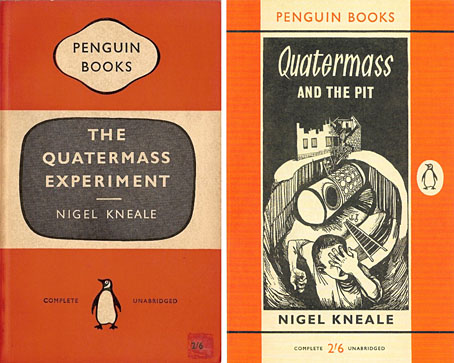
Quatermass paperbacks from Jovike’s Flickr pages.

This may be another occasional series in the making since there’s already been a post about Roadside Picnic/Stalker music, and one about music inspired by the cosmic horror of William Hope Hodgson. I was going to write something earlier this year about music derived from the works of Nigel Kneale after rewatching all of Kneale’s major works. The reappraisal was prompted by the publication in January of The Twilight Language of Nigel Kneale, an excellent anthology of essays/speculations (and a China Miéville interview) about Kneale’s film and TV dramas. The delay in writing was a result of having to wait several months after ordering a CD of the Tod Dockstader album (see below) which for some reason the distributors couldn’t manage to get in the post.

In the Twilight Language book there’s a piece by Ken Hollings about electronic music, some of which has material connections with Kneale’s work, notably the Radiophonic Workshop’s creation of sound effects for Quatermass and the Pit. Early copies of the book came with a bonus cassette tape of Kneale-inspired music; more about that below. The men and women of the Radiophonic Workshop are the godparents of the following Kneale soundworks, most of which are British, and inevitably tend towards the grinding, droning and doom-laden end of the electronic spectrum. Given the enduring influence of Kneale’s work, especially the Quatermass serials and their film equivalents, it’s surprising there isn’t more Knealesque music to be found. (I’m avoiding the obvious film soundtracks, and any bands such as Quatermass who may be named after Kneale’s work but whose music doesn’t reflect it.) If anyone can add to this list then please leave a comment.
quatermass.jpg

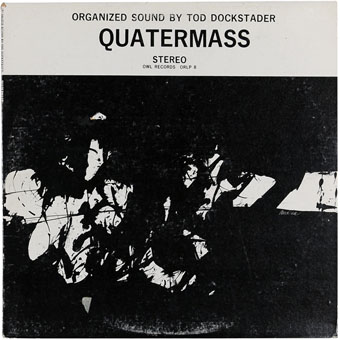
Quatermass (1964) by Tod Dockstader

The American master of tape manipulation here processes hours of recordings of cymbals, pipes, tone generators, a vacuum hose and rubber balloons to create what he calls “a very dense, massive, even threatening work”. Dockstader hadn’t seen any of the Quatermass films or serials when he chose the name but he said that it sounded right. It certainly does, as does the unnerving, shrieking morass of sound he manages to craft using the most primitive equipment. The Starkland CD containing the Quatermass suite includes two further edits of the source material entitled Two Moons of Quatermass.
seance.jpg

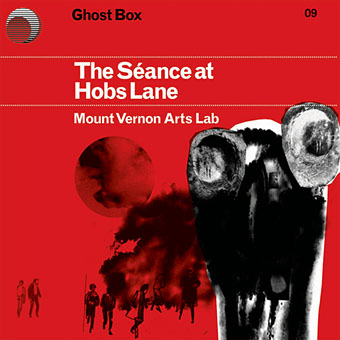
The Séance At Hobs Lane (2001) by Mount Vernon Arts Lab

Mount Vernon Arts Lab is Drew Mulholland and various collaborators. The Séance At Hobs Lane is an abstract concept album based on Mulholland’s lifelong obsession with Quatermass and the Pit (an idée fixe he writes about in the Twilight Language book), plus “Victorian skullduggery, outlaws, secret societies and subterranean experiences”. Among the collaborators are Coil, Norman Blake of Teenage Fanclub, Barry 7 of Add N to (X), and Adrian Utley of Portishead. The album was reissued in 2007 on the Ghost Box label.
ouroborindra.jpg

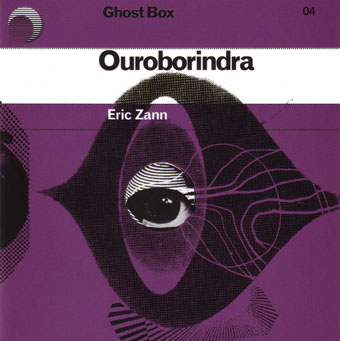
Ouroborindra (2005) by Eric Zann

And speaking of Ghost Box… This album has been mentioned here on several occasions, a one-off release that’s the most consciously horror-oriented of all the works in the Ghost Box catalogue. The artist “name” and track titles reference Lovecraft and Machen but it’s included here for the dialogue quote in the insert from Kneale’s ghost drama The Stone Tape. In addition to the Mount Vernon reissue other Ghost Box references to Kneale can be found in the samples from Quatermass and the Pit (TV version) on The Bohm Site from We Are All Pan’s People by The Focus Group, and the title of the track which follows: Hob’s Rumble. Continue reading “Stone Tapes and Quatermasses”
Digital Grotesque

3d1.jpg

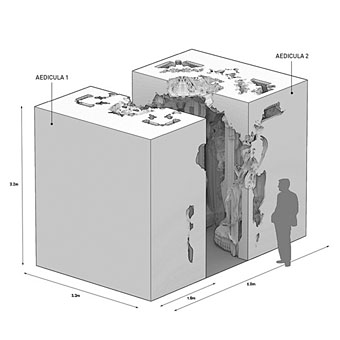
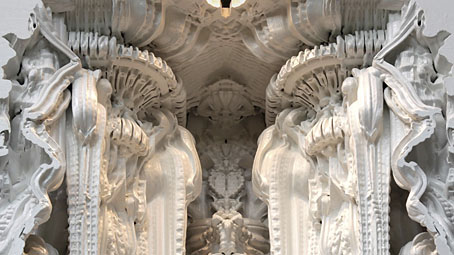
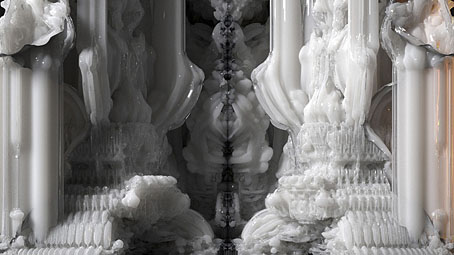
These organic forms are details of an architectural environment produced in sandstone using a 3D printer. The project is a collaboration between Michael Hansmeyer and Benjamin Dillenburger who use a series of algorithms to create the shapes the printer produces:

In the Digital Grotesque project, we use these algorithms to create a form that appears at once synthetic and organic. The design process thus strikes a delicate balance between the expected and the unexpected, between control and relinquishment. The algorithms are deterministic as they do not incorporate randomness, but the results are not necessarily entirely foreseeable. Instead, they have the power to surprise.

The resulting architecture does not lend itself to a visual reductionism. Rather, the processes can devise truly surprising topographies and topologies that go far beyond what one could have traditionally conceived.

3d2.jpg

The diagram below shows the scale of the completed structure. Regular readers won’t be surprised to hear that the first thing that came to my mind when looking at these photos was “Lovecraft!” This unpredictable rendering process immediately solves the problem of how to depict or construct a non-human architecture without resort to anything Earth-bound. Those ridged and fluted columns could be R’lyeh or they could equally be the vast and ancient buildings that Dyer and Danforth discover in At the Mountains of Madness. I’ve been waiting for a while for 3D printing to start moving beyond the mere replication of existing objects; this is a very promising development. There’s more detail about the process and construction at the Digital Grotesque site.

3d3.jpg

Previously on { feuilleton }
At the Mountains of Madness

The Bunker of the Last Gunshots

bunker1.jpg

Jean-Pierre Jeunet is known these days as a director in his own right but he started out working in collaboration with Marc Caro, a writing and directing partnership that lasted up to The City of Lost Children in 1995. Given how much I enjoyed that film, and their earlier Delicatessen (1991), I suspect it’s Caro’s sensibility I respond to. I loathed Jeunet’s Alien Resurrection so much I refuse to watch it again (for me the Alien series ends with Ripley’s swan dive at the end of the third film), and I’ve shunned Amelie and everything he’s done since.

bunker2.jpg

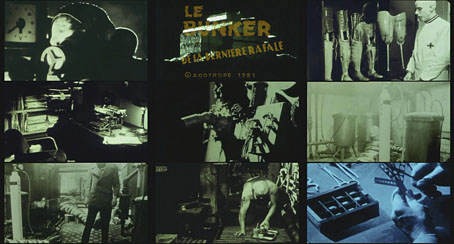
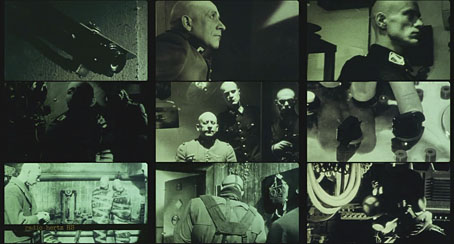
The Bunker of the Last Gunshots (1981) is an early Caro/Jeunet work set in the same retro environment as Delicatessen and The City of Lost Children, with equally eccentric or unpleasant characters and the same antiquated technology. There’s no dialogue, and the narrative is conveyed obliquely at best. Even more than their feature films this is a vehicle for conveying a mood, the concern here being less with story and more with monochrome visuals, chiaroscuro lighting and bits of grotesquery among the all-male inhabitants of a bunker from some unspecified war. For a low-budget piece it’s very assured, and if you’d seen this in 1981 you’d be expecting the pair to go on to bigger and better things. The Bunker of the Last Gunshots runs for 25 minutes; there’s a rough copy on YouTube or a better one at Vimeo.

Weekend links 175

maeda.jpg

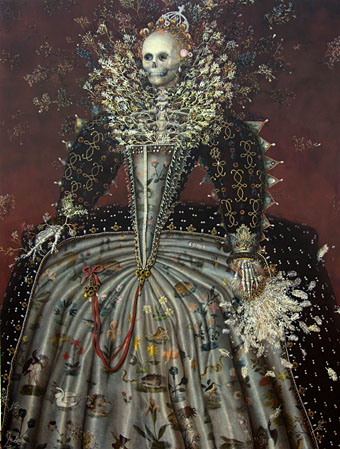
Heartbeat of the Death – Queen Elizabeth the First (2013) by Haruko Maeda.

• “The casual mixing of people from across the world at The Garden broke down many barriers. Its rich, beautiful, smart, and successful people were confident enough to exercise the kind of sexual freedom that would land you in jail elsewhere in the country.” Kate Webb on Alla Nazimova’s Hollywood estate, The Garden of Alla.

• “…from 1956 to 1970 Borges taught English literature at the University of Buenos Aires, and now, over half a century later, one of his courses is finally available in English in a slim, delightful volume.” Will Glovinsky on Professor Borges. Related: Jacob Mikanowski says “To Tlön: Let’s Invade Reality”.

• Mixes of the week: Secret Thirteen Mix 084 by Koen Holtkamp—Alice Coltrane, Alan Watts, John Cage, Popol Vuh, Faust and others—and Sequenze E Frequenze, “the rarefied outer limits of ‘stare at the sun, outsider peaked’ Italian music”.

Consider the fate of the concept of ‘futuristic’ music. The ‘futuristic’ in music has long since ceased to refer to any future that we expect to be different; it has become an established style, much like a particular typographical font. Invited to think of the futuristic, we will still come up with something like the music of Kraftwerk, even though this is now as antique as Glenn Miller’s big band jazz was when the German group began experimenting with synthesizers in the early 1970s.

Where is the 21st-century equivalent of Kraftwerk? If Kraftwerk’s music came out of a casual intolerance of the already-established, then the present moment is marked by its extraordinary accommodation towards the past. More than that, the very distinction between past and present is breaking down. In 1981, the 1960s seemed much further away than they do today. Since then, cultural time has folded back on itself, and the impression of linear development has given way to a strange simultaneity.

Mark Fisher on the present cultural moment, and the weirdness of Sapphire and Steel.

• At Front Free Endpaper: A Gay Library Thing and French Line Gay Pulp Cover Designs. Callum is also giving away books by Frederick Rolfe/Baron Corvo to anyone who asks. The proviso is you write a short review for his blog.

• Film director Ben Wheatley on Don’t Look Now: “I felt a great panic come over me”. Elsewhere it was announced this week that Wheatley is planning a film of JG Ballard’s High Rise.

• Brits may remember the wonderful Laurie Pike from the Manhattan Cable TV show in the early 1990s. These days she’s writing an online guide to the city of Paris.

Ben Frost has made three previously unreleased recordings available at Bandcamp.

The Media History Digital Library: 800,000 pages of film and radio periodicals.

• The results of three derives in London by Christina Scholz here, here and here.

• The late Seamus Heaney reads his own translation of Beowulf here and here.

High Rise (1979) by Hawkwind | Pop Sicle (1994) by High Rise | High Rise (2005) by Ladytron

Words and pictures

ghosts.jpg

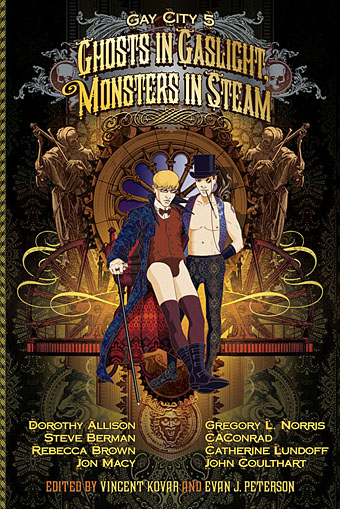
This one has been a long while gestating. Evan J. Peterson asked me late last year to contribute a cover to a new edition of Seattle’s Gay City anthology which he was editing with Vincent Kovar. In May this year the anthology successfully covered some of its production costs with a Kickstarter fund, and the anthology will have its official launch next month (although the book is on sale now). Ghosts in Gaslight, Monsters in Steam combines a loose take on steampunk themes with spectral or horror material, and adds a queer twist. The contents are as follows:

Cover art by John Coulthart
Illustrations by M S Corley and Levi Hastings
Graphic story: Paper Lantern by Jon Macy

Poetry:
from Preternatural Conversations and Oblivious Imperialism is the Worst Kind by CAConrad
Dear Dr. Frankenstein by Jericho Brown
Anaphora as Coping Mechanism and American Dreams by Ocean Vuong
Orpheus on the 74 and The Resurrection Spell by Oscar McNary
Zombie Autopsy by Janie Miller
Moon Goddess by Imani Sims

Hybrid/Flash Fiction/Prose Poetry:
Psychopomp by Lydia Swartz
Thangs by Imani Sims
The Door, Casualties of War, and The Worst is that You Can’t Even Ask Him to Use Protection by Jeremy Halinen

Short Stories:
Demon Lover by Dorothy Allison
Monster Movie by Rebecca Brown
B.E.M.s by Gregory L. Norris
Feeding Desire by Steve Berman
Medium Méchanique by Catherine Lundoff
Study in Blue, Green, and Gold by John Coulthart
A Captive Audience by Ryan Keawekane
Splinter by Ryan Crawford
The Difference Men by Kat Smalley
Alexander’s Wrath by J L Smither
Quota by Amy Shepherd
Heart of the Labyrinth by Tony Rella

This isn’t the first occasion when I’ve produced the cover for an anthology and also contributed some fiction inside—The Thackery T. Lambshead Pocket Guide to Eccentric and Discredited Diseases included a short fiction piece—but the Gay City anthology marks the first appearance in print of anything from my ongoing Axiom project. This is a long-term endeavour which I began in March 2001 but haven’t referred to much in public, mainly because the bulk of the project to date has been written fiction. There are few words more dismaying to hear than the dread phrase “I’m writing a novel”, especially today when the activity of fiction writing seems to have undergone an exponential increase. I tend to believe that unless you’re an established author there’s little to be gained by discussing your own literary labours in public until you have some results to offer. Well, now I have.

I know some people have been curious about the Axiom project so—keeping things brief—I can say it’s two novels, one finished, the second one nearly finished. Axiom was written from 2001 to 2007, and concerns a year in the life of an invented city. It’s fantasy of a sort but closer to the world of Reverbstorm than anything you’ll find on the swords-and-dragons shelves. The idea began in the late 1990s when I was working on Reverbstorm with David Britton and realised I could easily shift the city in that book a few degrees sideways to provide a setting for my own obsessions. I’d been writing a lot of fiction in the 1980s—short stories and two unfinished novels—and wanted to return to this seriously having tired of collaborations and illustrating the work of other people. Axiom marked out some territory I wanted to explore; the new novel, Vitriol, uses the territory to stage a “psychedelic apocalypse”. The project as a whole is loose enough to evolve into other media, and eventually there should be some Axiom-related art. I’ve been working on Vitriol since August 2006 (there was some overlap while finishing the first book); my contribution to the Gay City anthology, Study in Blue, Green, and Gold, is an extract from the work-in-progress which happened to function quite well as a self-contained piece. Despite the anthology theme it’s not quite a steampunk affair but there are some steam locomotives present so it has the required flavour.

Whilst working on the new book I’ve had an agent (Leslie Gardner at Artellus) trying to sell Axiom. This would have been in print by now if the London publisher who agreed to take it 18 months ago hadn’t gone bust after they’d sent us a contract. I’ve been considering putting out a limited hardback edition of the novel, although I’m busy enough as it is, and don’t relish having to self-distribute even a small number of books. For now it’s an option that remains open.

Gay City’s own site points to Amazon for sales of Ghosts in Gaslight, Monsters in Steam so on this occasion I’ll do that too. If you’re in the Seattle area there’s a launch party on September 27th. Details here.

Update: I’ve belatedly noticed that Evan is interviewed about the anthology here.