Weekend links 208

sungwon.jpg

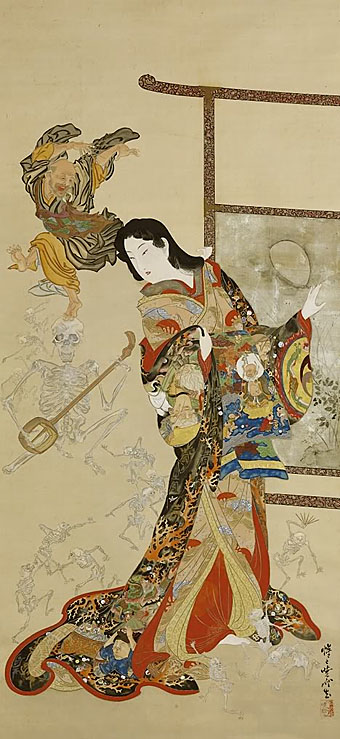
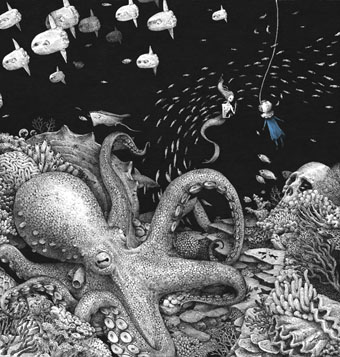
The Blue Girl (2013) by Sungwon.

• “Meanwhile, in her parents’ room [Max] Ernst painted aardvarks eating ants and big human hands around the windows. ‘Sexual connotations, I think,’ she says shyly.” Agnès Poirier talks to Cécile Eluard about her childhood among the Surrealists.

• “Thrilling and prophetic”: why film-maker Chris Marker‘s radical images influenced so many artists. Sukhdev Sandhu, William Gibson, Mark Romanek and Joanna Hogg on the elusive director.

• At Dangerous Minds: Throbbing Gristle live in Manchester in 1980, and Brian Butler talks about the rediscovered early print of Kenneth Anger’s Lucifer Rising. There’s a trailer!

• From 1981: The Art of Fiction No. 69 at The Paris Review, an interview with Gabriel García Márquez. Related: Thomas Pynchon reviewed Love in the Time of Cholera in 1988.

• “Seven years ago, a stolen first edition of Borges’s early poems was returned to Argentina’s National Library. But was it the right copy?” Graciela Mochkofsky investigates.

• “What was Walter Benjamin doing with his shirt off in Ibiza?” Peter E. Gordon reviews Walter Benjamin: A Critical Life by Howard Eiland & Michael W. Jennings.

• A video by Marcel Weber for Måtinden, a track from Eric Holm’s Andøya album. Another album on the Subtext label that I helped design.

• More Ian Miller: Boing Boing has pages from his new book, The Art of Ian Miller, and there’s an interview at Sci-Fi-O-Rama.

Outrun Europa, a free compilation of 80s-style electronic music. There’s a lot more along those lines here.

• Praise Be! Favourite religious and spiritual records chose by writers at The Quietus.

Ralph Steadman illustrated Alice’s Adventures in Wonderland in 1973.

British Pathé is uploading 85,000 of its newsreel films to YouTube.

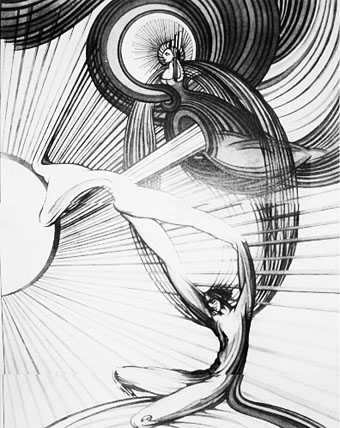
• Drawings by Lebbeus Woods at The Drawing Center, New York.

• At Pinterest: Ian Miller and Kenneth Anger.

Lucifer Sam (1967) by Pink Floyd | The Surrealist Waltz (1967) by Pearls Before Swine | Which Dreamed It (1968) by Boeing Duveen And The Beautiful Soup

Trip texts

trip1.jpg

I would have changed the subject today if it wasn’t for spotting a copy of David Solomon’s LSD: The Consciousness-Expanding Drug (1964) in Roger Corman’s notorious and rather creditable stab at psychedelia, The Trip (1967). Corman’s film is an oddity in his run of AIP exploitation films in being far less condemnatory than you’d expect (although Peter Fonda’s character isn’t always enjoying his experience), and must also be the only film in the whole AIP canon with signifying texts.

trip2.jpg

By the time Solomon’s book makes an appearance, Fonda’s character, Paul, has started freaking out but earlier on, during his conversations with John (Bruce Dern), we have Allen Ginsberg’s Howl and Other Poems (1956) shouting out of the frame. “I saw the best minds of my generation destroyed by madness…” Okay Rog, we get it.

trip3.jpg

There’s more, however. Behind Howl there’s another book whose identity eludes me, while behind that you can make out the red typography and white dorje symbol from the 1960 OUP edition of The Tibetan Book of the Dead. The only reason I recognised this is because I own that edition so the cover is very familiar. This would be a popular text in an acid-tripper’s apartment; John tells Paul to “Relax and float down stream”, a line that recapitulates the advice given in Leary, Metzner and Alpert’s The Psychedelic Experience: A Manual Based on The Tibetan Book of the Dead (1964). Most surprising for me about this inclusion is that The Tibetan Book of the Dead features a lot more prominently in that other major film about psychedelic experience, Enter the Void (2009). Am I the only person to have made this material connection? Probably. Does anyone care? Probably not, but I do like recording these associations.

trip4.jpg

tbotd.jpg

Cover design by Lawrence Ratzkin.

Previously on { feuilleton }
Acid albums
Acid covers
Lyrical Substance Deliberated
The Art of Tripping, a documentary by Storm Thorgerson
Enter the Void
In the Land of Retinal Delights
The art of LSD
Hep cats

Tresham’s Trinities

lodge.jpg

Memorials of Old Northamptonshire (1903), a book edited by Alice Dryden, includes an entire chapter by M. Jourdain about Thomas Tresham’s Triangular Lodge. Descriptions of the building usually skate over the Catholic symbolism encoded in its structure but Jourdain goes into some detail describing the many inscriptions and numerological details. The engraved illustration is rather good as well, although it makes the lodge appear a more squat than it should be. The chapter also contains a description of further symbolism at Tresham’s Lyveden manor. Read it here.

Previously on { feuilleton }
The Triangular Lodge again
The Triangular Lodge

The Triangular Lodge again

temples.jpg

Artwork & photography by Abbie Stephens, Zoë Maxwell. Design by Thomas Caslin.

Passing through a record shop the day after looking at photos of the Winchester Mystery House I couldn’t help but notice this sleeve for the debut album by British band Temples. Yesterday I described Sarah Winchester’s house as a folly, which it is, but it was also her home. The ideal folly is an ostensibly purposeless structure, although many of the ones scattered around the UK do serve some kind of decorative function, often as fake ruins intended to be seen from a distance.

Thomas Tresham’s mysterious Triangular Lodge near Rushton, Northants, has always been a favourite, a small triangular building constructed in the 16th century, and encoded all over with references to the number 3. Tresham was a Catholic at a time when the faith was persecuted in England so the lodge is an expression of his devotion to the Holy Trinity. Given the unusual appearance of the building you’d think it might have appeared on an album cover before now. Temples are from Kettering in Northants so they can claim some local attachment to the place. The cover picture has something of a Hipgnosis look to it, which is no bad thing, and there’s also some Hipgnosis-style collaging at work; those trees in the background have been copied then flipped over. One benefit of the current vinyl resurgence is that sleeve designs like this aren’t spoiled by being only seen at CD size. Some of Temples’ songs can be heard on their SoundCloud page, while Pinterest has more views of the Triangular Lodge.

Elsewhere on { feuilleton }
The album covers archive

Previously on { feuilleton }
The Triangular Lodge

Love gods

ganymede.jpg

The Raising of Ganymede (1886) by Gustave Moreau.

The story of the love between Zeus, king of the gods, and Ganymede, the handsome son of the Trojan king, goes back at least three thousand years and its roots disappear into the prehistoric neolithic. (more)

hylas.jpg

Hylas (1846) by HW Bissen.

Not for us only, Nicias, (vain the dream,)
Sprung from what god soe’er, was Eros born:
Not to us only grace doth graceful seem,
Frail things who wot not of the coming morn.
No—for Amphitryon’s iron-hearted son [Heracles],
Who braved the lion, was the slave of one:—

A fair curled creature, Hylas was his name.
He taught him, as a father might his child,
All songs whereby himself had risen to fame;
Nor ever from his side would be beguiled
When noon was high, nor when white steeds convey
Back to heaven’s gates the chariot of the day,

Nor when the hen’s shrill brood becomes aware
Of bed-time, as the mother’s flapping wings
Shadow the dust-browned beam. ‘Twas all his care
To shape unto his own imaginings
And to the harness train his favourite youth,
Till he became a man in very truth.

Theocritus, Idyll XIII: Hylas.

pan_daphnis.jpg

Pan teaching Daphnis to play the panpipes; Roman copy of a Greek original from the 3rd-2nd centuries BCE by Heliodoros.

hyacinth.jpg

The Death of Hyacinthos (1801) by Jean Broc.

‘You too, Hyacinthus, of Amyclae, Phoebus would have placed in heaven, if sad fate had given him time to do so. Still, as it is, you are immortal, and whenever spring drives winter away, and Aries follows watery Pisces, you also rise, and flower in the green turf. My father, Phoebus, loved you above all others: and Delphi, at the centre of the world, lost its presiding deity, while the god frequented Eurotas, and Sparta without its walls, doing no honour to the zither or the bow. Forgetting his usual pursuits, he did not object to carrying the nets, handling the dogs, or travelling as a companion, over the rough mountain ridges, and by constant partnership feeding the flames.

‘Now, the sun was midway between the vanished and the future night, equally far from either extreme: they stripped off their clothes, and gleaming with the rich olive oil, they had rubbed themselves with, they began a contest with the broad discus. Phoebus went first, balancing it, and hurling it high into the air, scattering the clouds with its weight. Its mass took a long time to fall back to the hard ground, showing strength and skill combined. Immediately the Taenarian boy, without thinking, ran forward to pick up the disc, prompted by his eagerness to throw, but the solid earth threw it back, hitting you in the face, with the rebound, Hyacinthus.

‘The god is as white as the boy, and cradles the fallen body. Now he tries to revive you, now to staunch your dreadful wound, and now applies herbs to hold back your departing spirit. His arts are useless: the wound is incurable. Just as if, when someone, in a garden, breaks violets, stiff poppies, or the lilies, with their bristling yellow stamens, and, suddenly, they droop, bowing their weakened heads, unable to support themselves, and their tops gaze at the soil: so his dying head drops, and, with failing strength, the neck is overburdened, and sinks onto the shoulder.

Ovid’s Metamorphoses, Bk X:143-219 Orpheus sings: Ganymede; Hyacinthus

Previously on { feuilleton }
Three stages of Icarus
The end of Orpheus