Opening the Seven Gates of Transcendental Consciousness

burchette1.jpg

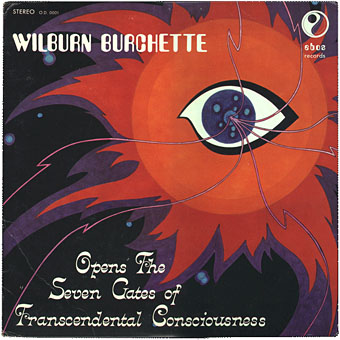
Wilburn Burchette Opens The Seven Gates Of Transcendental Consciousness (1972). Art by Caren Caraway.

For the next two weeks I’ll be playing out the end of the year with a 2-CD compilation from Light In The Attic, I Am The Center (Private Issue New Age Music In America, 1950–1990), 20 tracks of ambient/meditation music, most of which has never been widely distributed before. The “New Age” label is a thing I’ve loathed for years so buying this has meant trashing a decades-long embargo; it helps to examine your prejudices now and then.

burchette2.jpg

New Age in the 1970s referred, among other things, to the oft-promised, seldom-evident “Age of Aquarius”, a term vague enough to be used on albums by Steve Hillage, Manuel Göttsching and others without referring to anything specific. In the 1980s it was taken up by publishers as a marketing label, a catch-all for anything “spiritual” or mildly occult. (I can’t imagine the Goetic Demons ever being called New Age, even if you sprayed them pink.) Out went all the witchy strangeness of the occult boom of the 1970s—spiky typefaces, magical primers sold like Dennis Wheatley novels—in came a profusion of pastel shades, airbrushed pyramids and sparkly, crystal things. Having a fondness for the witchy strangeness I wasn’t impressed. I was even less impressed when New Age became a prevalent label for a style of instrumental music which was too obtrusive to be ambient (in the Brian Eno sense of the word), and also too bland and unassertive to be either jazz or electronica. The popularity of labels such as Windham Hill meant that the large record chains started using New Age as another catch-all label, this time for anything that wouldn’t fit the rock, jazz or folk categories. Along with Windham Hill releases you’d find Eno’s ambient recordings, Harold Budd, Jon Hassell, various German things like Cluster, and anything else that resisted easy labelling. The way the music business tries to hammer everything into a small number of boxes has always been annoying but this seemed like a major insult, hence my loathing of the term.

burchette3.jpg

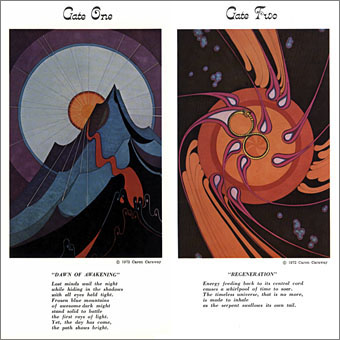
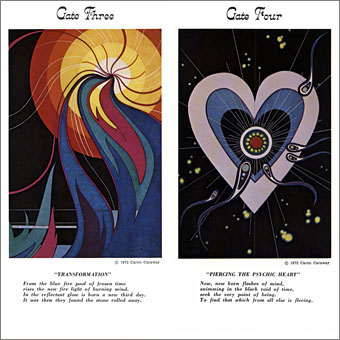
I Am The Center is a curious album in that it embraces both the recent New Age music label while also harking back to the spiritual yearnings of the 1970s. The general effect is of an impossible collision between the Harold Budd of Pavilion of Dreams, Steve Hillage’s Rainbow Dome Musick, and the lighter moments of Alice Coltrane. Many of the tracks are so good I’ve been searching through Discogs.com to discover more about the artists which is how I came across this album art from Wilburn Burchette. Witch’s Will is Burchette’s track on I Am The Center, from his Guitar Grimoire (1973) album. Looking through his discography, with its attention-grabbing titles and cover art, it’s surprising that his albums haven’t yet been reissued. This will no doubt change soon, especially when his music is like an American equivalent of Achim Reichel’s spacey guitar improvisations. The sleeve and booklet art for Wilburn Burchette Opens The Seven Gates Of Transcendental Consciousness is by Caren Caraway, and the album features notes by the indefatigable UFO/paranormal researcher Brad Steiger. They really don’t make them like this any more.

Joe Muggs enthused about I Am The Center last month for FACT. As I said about the Outer Church album earlier this year, compilations provide an invaluable service in concentrating the attention on overlooked or under-examined areas of music. I’m looking forward to seeing what emerges in the wake of this one.

Continue reading “Opening the Seven Gates of Transcendental Consciousness”

Weekend links 177

wickerman.jpg

A new Wicker Man poster by Dan Mumford appears on the cover of the forthcoming DVD/BR reissues. Prints are available.

• The long-awaited release of a restored print of Robin Hardy’s The Wicker Man approaches. Dangerous Minds has a trailer while The Guardian posted a clip of the restored footage. The latter isn’t anything new if you’ve seen the earlier uncut version, but the sound and picture quality are substantially better. I’ve already ordered my copy from Moviemail.

• “It’s a fairly bleak place, and it has this eerie atmosphere. East Anglia is always the frontline when there’s an invasion threatening, so there are lumps of concrete dissolving into sand, bits of barbed wire and tank tracks that act as a constant reminder. I really love it.” Thomas Dolby talking to Joseph Stannard about environment and memory.

Dome Karukoski is planning a biopic of artist Tom of Finland. Related: Big Joy, a documentary about the life and work of James Broughton, poet, filmmaker and Radical Faerie.

The desire to be liked is acceptable in real life but very problematic in fiction. Pleasantness is the enemy of good fiction. I try to write on the premise that no one is going to read my work. Because there’s this terrible impulse to grovel before the reader, to make them like you, to write with the reader in mind in that way. It’s a terrible, damaging impulse. I feel it in myself. It prevents you doing work that is ugly or upsetting or difficult. The temptation is to not be true to what you want to write and to be considerate or amusing instead.

Novelist Katie Kitamura talks to Jonathan Lee.

Leonora Carrington: The Celtic Surrealist opens on Wednesday at the Irish Museum of Modern Art, Dublin.

Julia Holter turns spy in the video for This Is A True Heart.

Alexis Petridis talks to graphic designer Peter Saville.

hashim.jpg

Al-Naafiysh (The Soul) by Hashim. From the Program Your 808 poster series by Rob Rickets.

Rob Goodman on The Comforts of the Apocalypse.

Post-Medieval Illustrations of Dante’s Sodomites.

• Annoy Jonathan Franzen by playing Cat Bounce!

Paolozzi at Pinterest

The Surrealist Waltz (1967) by Pearls Before Swine | The Jungle Line (1981) by Low Noise (Thomas Dolby) | Al-Naafiysh (The Soul) (1983) by Hashim

Bird Gods

birdgods01.jpg

Why, I asked myself, should certain birds have been allotted to certain gods and goddesses in the Greek and Roman mythology? Why should the eagle go with Zeus, the peacock with Hera, the dove with Venus, the swan with Apollo, the woodpecker with Ares, the owl with Pallas Athene? It could not be mere chance that so many gods and goddesses had each their attendant bird; the attribution was too regular; it was done too much on a system. What was the original meaning of it all?

Charles de Kay attempts to answer his question in Bird Gods (1898), a study of the mythological and religious import of birds through the ages. Illustrator George Wharton Edwards was an American artist who worked in the Impressionist style when painting but here deliveries a range of bird portraits embellished with bits of imitation Celtic knotwork. The interlacings of Celtic art underwent a resurgence of interest with the development of Art Nouveau. Edwards’ illustrations aren’t the best examples of this (Mucha’s Hamlet poster is much better) but they give an idea of the trend. Browse the rest of De Kay’s book here or download it here.

birdgods02.jpg

birdgods03.jpg

birdgods04.jpg

birdgods05.jpg

Continue reading “Bird Gods”

The Modern Antiquarian

modern1.jpg

The stones of Callanish are explored again, this time by an energetic and erudite Julian Cope. The Modern Antiquarian was a 55-minute TV documentary produced by the BBC in 2000 as a spin-off from Cope’s book-length study of the ancient past of the British Isles, The Modern Antiquarian: A Pre-Millennial Odyssey Through Megalithic Britain (1998). Cope has always been a great enthusiast, blessed with a talent for communicating that enthusiasm in his own inimitable manner. Needless to say this film, which follows him while he visits some of his favourite neolithic sites, is nothing like the standard television approach to archaeology. Cope isn’t an academic (thank Odin) yet his book is 448-pages of deep investigation which involved visiting every one of the sites he was writing about; he’s also not that other television standby, the shallow audience proxy, he’s too well-informed for that. It would have been good if this one-off film had developed into a series but for its original screening it was shunted into a late-night slot where few people would have seen it. Cope then, as now, is probably too intense for a general audience.

The Modern Antiquarian: part 1 | part 2 | part 3 | part 4 | part 5 | part 6

modern2.jpg

Previously on { feuilleton }
Callanish panoramas
Japrocksampler

Callanish panoramas

callanish1.jpg

Photo by Serge (SEB) Bogdanov.

A post for the Summer Solstice. I’ve linked to panoramas of the Callanish standing stones before but these are more recent photos at 360Cities where the full-screen views are more immersive, especially if you have a large monitor. The stones are situated on the Isle of Lewis in north-west Scotland, and still tend to be overshadowed by the reputation of their more visible relations in the south of England. Stonehenge and Avebury may be more famous but they’re ruined cathedrals next to the Callanish stones which have survived four thousand years of harsh Atlantic weather very much intact by virtue of being so remote. In that respect they retain some of their original aura: anyone planning a visit has to really want to see these things, you can’t simply drive past them on the way to somewhere else.

callanish2.jpg

Photo by Alan McLean.

callanish3.jpg

Photo by Alan McLean.

Elsewhere on { feuilleton }
The panoramas archive