Meetings with Remarkable Men

meetings1.jpg

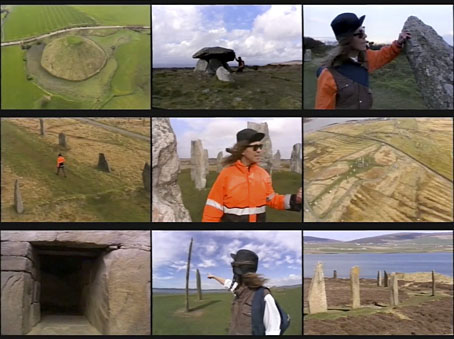
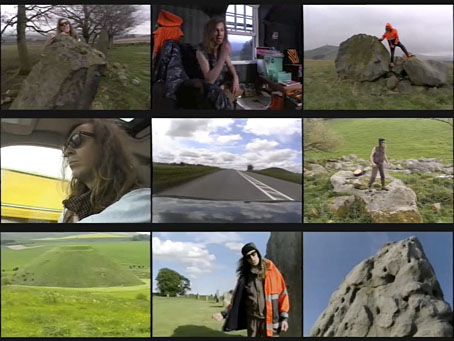
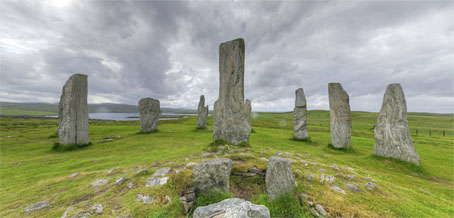
Another Peter Brook film, and a very strange one it is, not for its content but more for the way you wonder how the director managed to get anyone to pay for it, and what kind of audience it was supposed to be aimed at. Meetings with Remarkable Men is a book by GI Gurdjieff which is supposedly an account of the mystic’s early life and youthful questing for truth, although there’s always been debate about how much of it was intended as straight autobiography and how much as symbolic instruction. I’ve known about Brook’s film since it was first released in 1979 but its resolutely uncommercial nature means it never had a wide cinema release, and I’ve never seen it listed for TV screening either.

meetings2.jpg

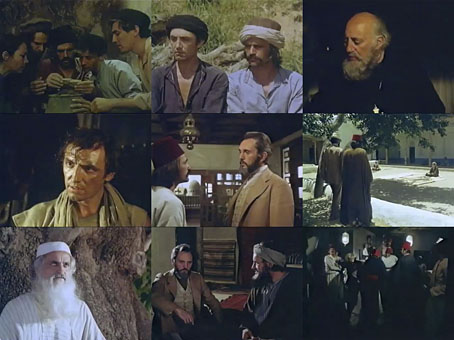
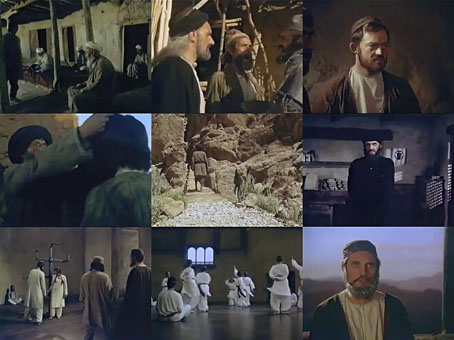
I’ve not read Gurdjieff’s book but know enough about the man’s life and general philosophies to at least appreciate Brook’s film. Many other viewers would have considerable problems when Brook and screenwriter Jeanne Salzmann make no attempt to elaborate on the details of Gurdjieff’s quest. From youthful worries about life and death, to a search for a secret brotherhood who may have preserved ancient philosophies, the film illustrates scenes in the sketchiest manner: old volumes are bought then discarded; a map is sought then forgotten; gurus are pursued only to be found unsatisfying. For a film about enlightenment it’s surprising to be left so unenlightened. Much of the film was shot on location in Afghanistan shortly before the Soviet invasion, and at times the film seems like a chase from one dusty location to another with little reason or purpose.

The most bizarre feature of all is the cast: Gurdjieff is portrayed by a Serbian actor, Dragan Maksimovic, but many of the other roles provide cameos for an array of British talent, not least Terence Stamp in between appearances as General Zod in the Superman films. Elsewhere there’s Warren Mitchell (!) playing Gurdjieff’s dad, Colin Blakely, Marius Goring, Ian Hogg (who was also in The Marat/Sade), and most surprising of all since I was watching him recently in Quatermass and the Pit, Andrew Keir as the head of the mysterious Sarmoung Monastery. The cast alone helps maintain some interest although at times it’s like one of those all-star features such as Around the World in Eighty Days where you’re wondering who’s going to turn up next. For those whose curiosity is piqued, the entire film is on YouTube.

Previously on { feuilleton }
The Marat/Sade

Ezio Anichini postcards

anichini2.jpg

More from Ezio Anichini (1886–1948), the Italian artist responsible for yesterday’s Salomé, these are part of a series of postcards on the theme of sacred music dated from between 1915 to 1920. The precision of these drawings is remarkable. See the (complete?) set here.

anichini3.jpg

Elsewhere on { feuilleton }
The illustrators archive

Previously on { feuilleton }
Ezio Anichini’s Salomé

Eustace details

durer01.jpg

St Eustace (c. 1501) by Albrecht Dürer.

As is often the case with his engraving on religious themes, Dürer is less concerned with the Biblical story—in this case St Eustace’s vision of Christ appearing between the horns of a stag—than with the opportunity to render with great fidelity a wealth of natural detail. Everything here is observed with the utmost precision, down to the binding of the spurs on Eustace’s boots. A superb composition which leads the eye past the mystical deer, through the trees and up the hill.

durer09.jpg

Continue reading “Eustace details”

Terror and Magnificence

spitalfields.jpg

Christ Church, Spitalfields, London, in 2001. A photo I took with a disposable film camera.

And so let us beginne; and, as the Fabrick takes its Shape in front of you, alwaies keep the Structure intirely in Mind as you inscribe it. First, you must measure out or cast the Area in as exact a Manner as can be, and then you must draw the Plot and make the Scale. I have imparted to you the Principles of Terrour and Magnificence, for these you must represent in the due placing of Parts and Ornaments as well as in the Proportion of the several Orders: you see, Walter, how I take my Pen?

Hawksmoor (1985) by Peter Ackroyd

*

Bentley had laid down tracks for a shot that would feature the saxophonist and composer John Harle tooting away at his Terror and Magnificence in the setting of Hawksmoor’s church, which was now established, post-Ackroyd, as a cathedral of baroque speculation. Harle, in the notes published with the CD, writes that “darkness beneath the architecture and the very fabric of the stones pushed the idea towards a text.” The language here harks back to Ackroyd, towards privileged notions of place. The church was, in its proportions, a score to be unravelled; an overweening Pythagorean geometry to be tapped and sounded.

Iain Sinclair in Rodinsky’s Room (1999) by Rachel Lichtenstein & Iain Sinclair

Iain Sinclair first drew the world’s attention (or the minuscule portion of the world that was reading his books) to the strange character of Hawksmoor’s London churches in 1975 with Lud Heat, a book-length poem. Peter Ackroyd a decade later turned Sinclair’s esoteric excavation into a bestselling architectural murder mystery with his novel Hawksmoor, since when Sinclair’s psychogeography (if that term still has any valid currency) has found its way into From Hell by Alan Moore & Eddie Campbell, where Christ Church dominates the proceedings, and a musical work, Terror and Magnificence, by composer John Harle which takes its title from Ackroyd’s novel.

tandm.jpg

The short BBC film to which Sinclair refers can be seen on Harle’s YouTube channel. In addition to running through the Hawksmoor mythology we receive some glimpses of David Rodinsky’s abandoned room in the Princelet Street synagogue, a location (and a life) explored in detail in Sinclair’s book with artist Rachel Lichtenstein.

Bob Bentley’s film of Harle, Sinclair and Keith Critchlow was broadcast in 1995. In the same year Harle was commissioned by the BBC Proms to write an opera. The resulting work, Angel Magick, with libretto by David Pountney, advertises itself as “the first Dr Dee Opera”, a subject equally of interest to both Sinclair and Alan Moore, who in Sinclair’s Liquid City (1999) take a walk to John Dee’s home at Mortlake. (“We were a thrift-shop Dee and Kelley cupping our ears for whispers from tired stone.”) In that piece Sinclair mentions having been in on the early discussions for the opera but doesn’t go into any detail. I haven’t heard Angel Magick but you can hear a complete performance of Terror and Magnificence by the John Harle Band, the Balanescu Quartet, and the London Voices, here.

Previously on { feuilleton }
Mister Jarman, Mister Moore and Doctor Dee
Compass Road by Iain Sinclair

Babel details

babel01.jpg

The Tower of Babel (c. 1563) by Pieter Bruegel the Elder. Kunsthistorisches Museum, Vienna.

Seeing as how I have a fetish for Towers of Babel I ought to have examined this one sooner, the copy at the Google Art Project being one which allows you to explore the surface of the picture in greater detail than the artist himself would have seen unless he was using a magnifying glass. I still find the Art Project interface awkward so the grabs here were taken from a massive jpeg at Wikipedia: 30,000 pixels across, or 243 MB, scaling up to around 1.84 GB in Photoshop which means it’ll make older machines grind in complaint.

babel02.jpg

The detail is astonishing even by Bruegel’s standards. I’d never realised before how much care is given to the individual actions of every single worker on the tower, however small. Bruegel’s close observation of the working habits of the people around him is here reflected in the myriad figures, all of whom are doing something purposeful. At this resolution you’re able to see that the workers have taken their wives and children up the tower with them—there’s the familiar line of washing hung out to dry—while various beasts of burden haul building materials up the spiral roadway. You could spend a long time exploring the details of the tower before even looking at the background where tiny boats are sailing the sea and the rivers, and more fortunate animals have been left to graze in fields.

Wikipedia has several more of these enormous images. It’s a shame there aren’t many more of Bruegel’s works available at this size, his other crowded paintings deserve equal scrutiny.

babel03.jpg

One of the builders on his lunch break.

babel04.jpg

A jug on a window sill.

Continue reading “Babel details”