The Hell Courtesan

yoshitoshi.jpg

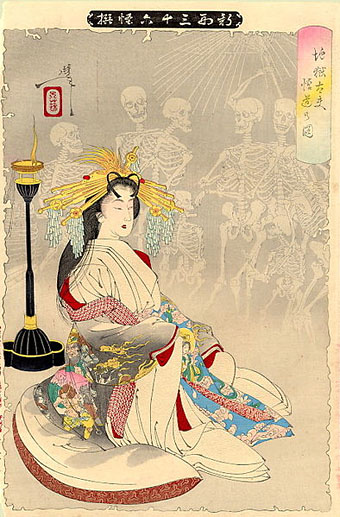
The Enlightenment of Jigoku-dayu (1890) from the series New Forms of Thirty-six Ghosts by Tsukioka Yoshitoshi.

Jigoku-dayu of Takasu was a courtesan adopted by the Zen Priest Ikkyu (1394–1481), who converted her to a religious life and gave her a literary education. She is seated in meditation with a ghostly vision of a procession of the skeletons of a courtesan and her entourage, thus showing her the impermanence of life.

Jigoku-dayu is portrayed here as a high-ranking courtesan. Her white robe is embossed with fine key patterns and her outer robe is decorated with the Goddess of Mercy on the front and at the back with scenes of hell. Her name consists of Jigoku (hell), a term for the lowest form of unlicensed prostitute and dayu (respect) for a courtesan of the highest rank. (via)

See also Junko Mizuno‘s contemporary drawings of Jigoku-dayu.

kyosai1.jpg

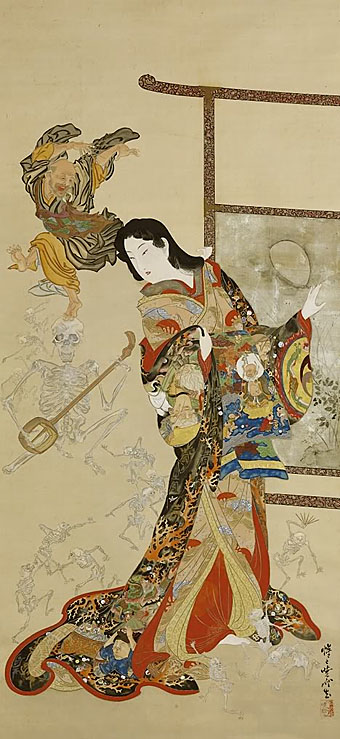
Jigoku-dayu (date?) by Kawanabe Kyosai.

kyosai4.jpg

Jigoku-dayu (another version) by Kawanabe Kyosai.

Continue reading “The Hell Courtesan”

Hinton’s hypercubes

hinton.jpg

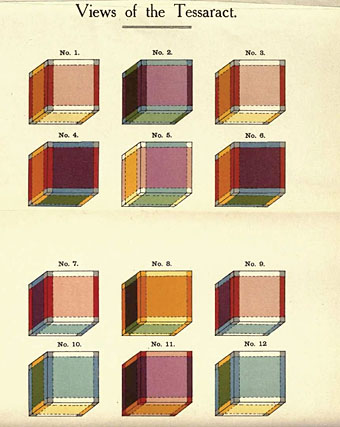
Illustration from The Fourth Dimension (1906) by Charles Howard Hinton.

A slight return to the worlds of Borges. I happened to be re-reading some of the stories in The Book of Sand (1975), one of the later collections which includes the story Borges dedicated to HP Lovecraft, There are more things. Borges’ writings are nothing if not filled with references to other works of literature, philosophies, religions, and ideas in general; following up the less-familiar references would preoccupy a reader to the detriment of the writing so there’s a tendency when reading a Borges piece to take for granted many of those nuggets of esoteric information. I’ve read There are more things many times—it’s a favourite in part for having the additional thrill of Borges going Lovecraftian—but only realised with this reading that I can now fully appreciate the following:

Years later, he was to lend me Hinton’s treatises which attempt to demonstrate the reality of four-dimensional space by means of complicated exercises with multicoloured cubes. I shall never forget the prisms and pyramids that we erected on the floor of his study.

Prior to reading this I did know that Hinton was Charles Howard Hinton (1853–1907), the British mathematician and dimensional theorist. Hinton’s name tends to turn up in discussions of the work of his mystical contemporaries, notably the Theosophists who were more taken with his theories than those in the scientific fields. (A conviction for bigamy didn’t help his reputation.) But those multicoloured cubes were a mystery until the publication of (fittingly) the fourth number of Strange Attractor Journal. Among the usual selection of fascinating articles the book contains a piece by Mark Blacklock about Hinton’s ideas including those mysterious cubes. Drawings of the cubes first appeared in A New Era of Thought (1888) where Hinton proposes using them as aids to a series of mental exercises with which the reader may visualise the higher dimensions of space. Hinton invented the word “tesseract” to describe the four-dimensional structure projected from the faces of his three-dimensional cubes.
dali.jpg

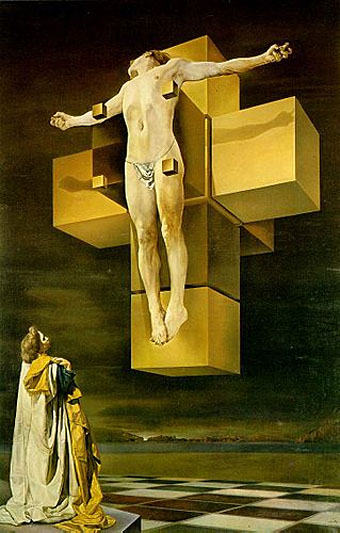
Crucifixion (Corpus Hypercubus, 1954) by Salvador Dalí.

Hinton may not have impressed his mathematical colleagues as much as he hoped but his ideas have an understandable attraction, as the Borges story demonstrates. The story concerns the refashioning of a Buenos Aires house for an unusual resident; thirty years earlier Robert Heinlein wrote “—And He Built a Crooked House—” in which an architect builds a house in the form of a four-dimensional hypercube: only the lowest cube attached to the ground is visible from the exterior. I read that story when I was a teenager, and was already acquainted with tesseracts thanks to school-friends who were maths whizzes; I was the arts whizz, and I think I was probably the first of us Dalí enthusiasts to discover the artist’s own take on the hypercube, Crucifixion (Corpus Hypercubus) from 1954. Borges and Heinlein in those stories were both writing their own forms of science fiction, and Dalí’s painting finds itself co-opted into another story with sf connections, The University of Death (1968) by JG Ballard, one of the chapters in The Atrocity Exhibition (1970):

He lit a gold-tipped cigarette, noticing that a photograph of Talbot had been cleverly montaged over a reproduction of Dalí’s ‘Hypercubic Christ’. Even the film festival had been devised as part of the scenario’s calculated psychodrama.

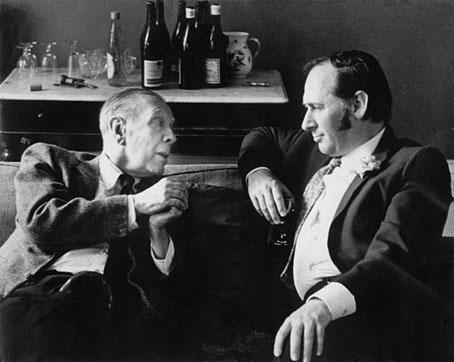
If we seem to have strayed a little then it’s worth noting that Borges was familiar with Ballard’s work: he included The Drowned Giant in the later editions of The Book of Fantasy, the anthology he edited with Adolfo Bioy Casares and Silvina Ocampo. The two writers also met on at least one occasion.
jlb-jgb.jpg

JLB and JGB, circa 1970. Photo by Sophie Baker.

Charles Hinton’s coloured cubes and tesseracts are described in detail in The Fourth Dimension (1906), a reworking of the ideas from A New Era of Thought, and also the source of the colour illustration that everyone reproduces. Mark Blacklock has his own multi-dimensional website where you can read about his construction of a set of three-dimensional Hinton cubes. As for the mental exercises, Blacklock’s piece in Strange Attractor contains an anecdotal warning that the auto-hypnotic system required to fully visualise Hinton’s dimensions can result in a degree of obsession dangerous to the balance of mind. Proceed with caution.

Previously on { feuilleton }
Borges and the cats
Invasion, a film by Hugo Santiago
Spiderweb, a film by Paul Miller
Books Borges never wrote
Borges and I
Borges documentary
Borges in Performance

The art of Fay Pomerance, 1912–2001

pomerance1.jpg

The Sixth Palace of Hell (1945).

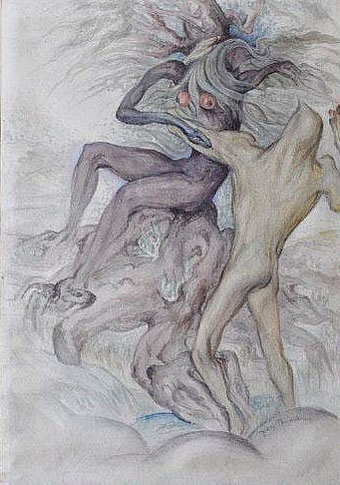
Fay Pomerance’s painting of Lilith makes a startling appearance in a book I have about the history of magic symbols, and it’s that appearance which prompts this post since I’ve never seen her work given any attention elsewhere. This seems surprising when women artists, and artists whose concerns encompass mysticism or the occult, are receiving greater attention than ever before.

pomerance2.jpg

The Union of Isis and Osiris (1959).

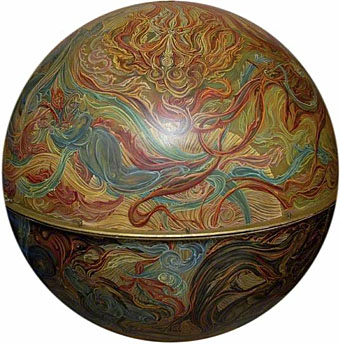
Pomerance was British, and had the misfortune to be working during a lengthy period when expressions of the imagination or unorthodox spirituality in visual art were regarded as suspect or even disreputable. Her work also stands apart from any of the prevailing movements which provide such convenient labels for those art critics and writers who dislike anything that won’t fit into one of their boxes. The Lilith picture shows an obvious debt to another British artist who stands apart from the crowd: William Blake. The BBC’s Your Paintings site has a few of Pomerance’s larger works from the collection at Durham University, including the Sphere of Redemption below which is painted on a fibreglass globe, but for the moment there isn’t a dedicated site representing her art.

pomerance3.jpg

The Temptation (date unknown).

pomerance4.jpg

The Sphere of Redemption (date unknown).

Weekend links 208

sungwon.jpg

The Blue Girl (2013) by Sungwon.

• “Meanwhile, in her parents’ room [Max] Ernst painted aardvarks eating ants and big human hands around the windows. ‘Sexual connotations, I think,’ she says shyly.” Agnès Poirier talks to Cécile Eluard about her childhood among the Surrealists.

• “Thrilling and prophetic”: why film-maker Chris Marker‘s radical images influenced so many artists. Sukhdev Sandhu, William Gibson, Mark Romanek and Joanna Hogg on the elusive director.

• At Dangerous Minds: Throbbing Gristle live in Manchester in 1980, and Brian Butler talks about the rediscovered early print of Kenneth Anger’s Lucifer Rising. There’s a trailer!

• From 1981: The Art of Fiction No. 69 at The Paris Review, an interview with Gabriel García Márquez. Related: Thomas Pynchon reviewed Love in the Time of Cholera in 1988.

• “Seven years ago, a stolen first edition of Borges’s early poems was returned to Argentina’s National Library. But was it the right copy?” Graciela Mochkofsky investigates.

• “What was Walter Benjamin doing with his shirt off in Ibiza?” Peter E. Gordon reviews Walter Benjamin: A Critical Life by Howard Eiland & Michael W. Jennings.

• A video by Marcel Weber for Måtinden, a track from Eric Holm’s Andøya album. Another album on the Subtext label that I helped design.

• More Ian Miller: Boing Boing has pages from his new book, The Art of Ian Miller, and there’s an interview at Sci-Fi-O-Rama.

Outrun Europa, a free compilation of 80s-style electronic music. There’s a lot more along those lines here.

• Praise Be! Favourite religious and spiritual records chose by writers at The Quietus.

Ralph Steadman illustrated Alice’s Adventures in Wonderland in 1973.

British Pathé is uploading 85,000 of its newsreel films to YouTube.

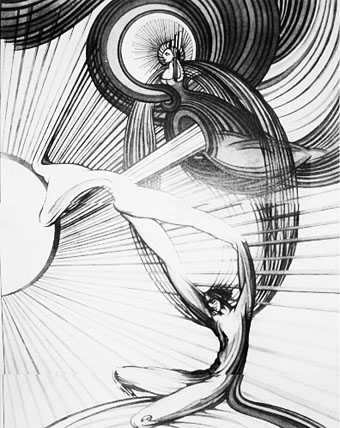
• Drawings by Lebbeus Woods at The Drawing Center, New York.

• At Pinterest: Ian Miller and Kenneth Anger.

Lucifer Sam (1967) by Pink Floyd | The Surrealist Waltz (1967) by Pearls Before Swine | Which Dreamed It (1968) by Boeing Duveen And The Beautiful Soup

Trip texts

trip1.jpg

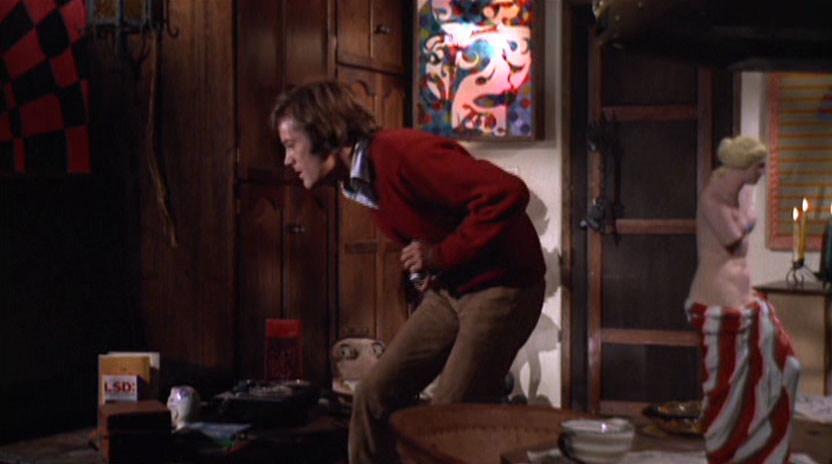
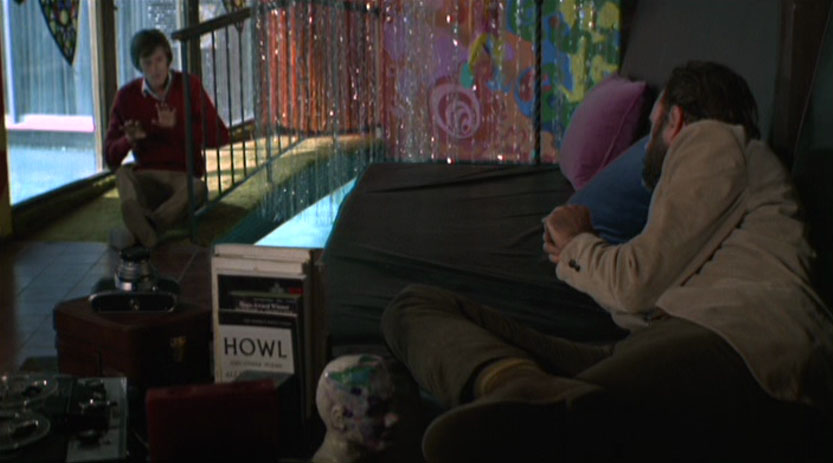
I would have changed the subject today if it wasn’t for spotting a copy of David Solomon’s LSD: The Consciousness-Expanding Drug (1964) in Roger Corman’s notorious and rather creditable stab at psychedelia, The Trip (1967). Corman’s film is an oddity in his run of AIP exploitation films in being far less condemnatory than you’d expect (although Peter Fonda’s character isn’t always enjoying his experience), and must also be the only film in the whole AIP canon with signifying texts.

trip2.jpg

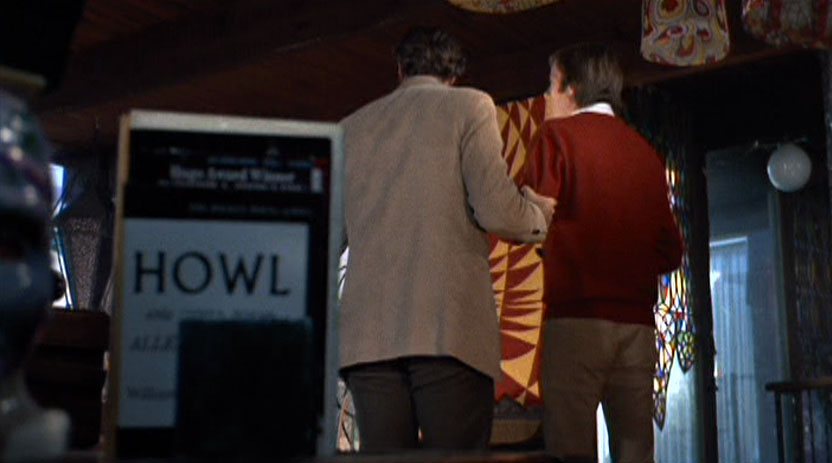
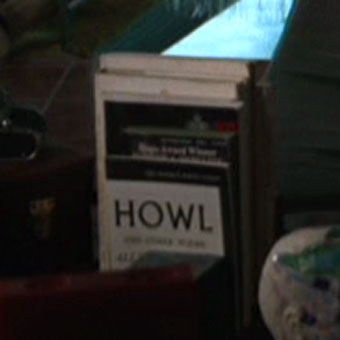
By the time Solomon’s book makes an appearance, Fonda’s character, Paul, has started freaking out but earlier on, during his conversations with John (Bruce Dern), we have Allen Ginsberg’s Howl and Other Poems (1956) shouting out of the frame. “I saw the best minds of my generation destroyed by madness…” Okay Rog, we get it.

trip3.jpg

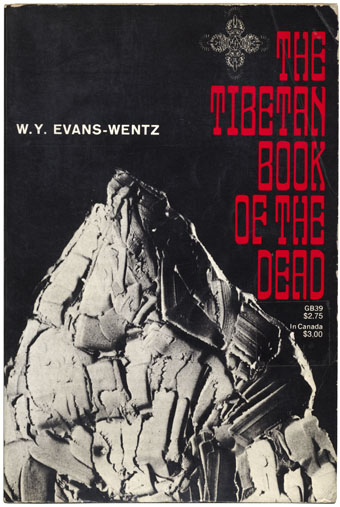
There’s more, however. Behind Howl there’s another book whose identity eludes me, while behind that you can make out the red typography and white dorje symbol from the 1960 OUP edition of The Tibetan Book of the Dead. The only reason I recognised this is because I own that edition so the cover is very familiar. This would be a popular text in an acid-tripper’s apartment; John tells Paul to “Relax and float down stream”, a line that recapitulates the advice given in Leary, Metzner and Alpert’s The Psychedelic Experience: A Manual Based on The Tibetan Book of the Dead (1964). Most surprising for me about this inclusion is that The Tibetan Book of the Dead features a lot more prominently in that other major film about psychedelic experience, Enter the Void (2009). Am I the only person to have made this material connection? Probably. Does anyone care? Probably not, but I do like recording these associations.

trip4.jpg

tbotd.jpg

Cover design by Lawrence Ratzkin.

Previously on { feuilleton }
Acid albums
Acid covers
Lyrical Substance Deliberated
The Art of Tripping, a documentary by Storm Thorgerson
Enter the Void
In the Land of Retinal Delights
The art of LSD
Hep cats