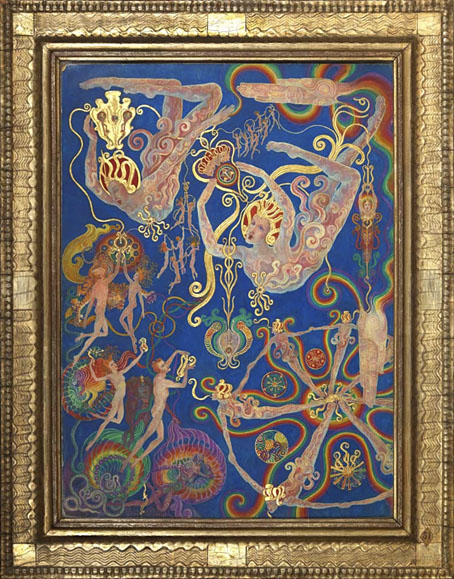
Christian Waller’s The Great Breath

waller09.jpg

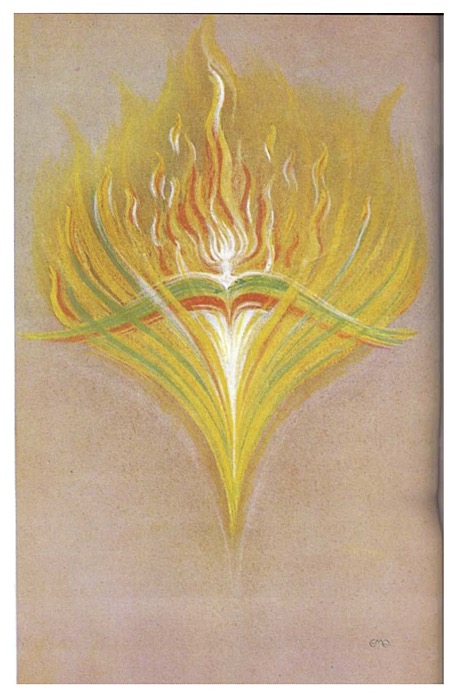
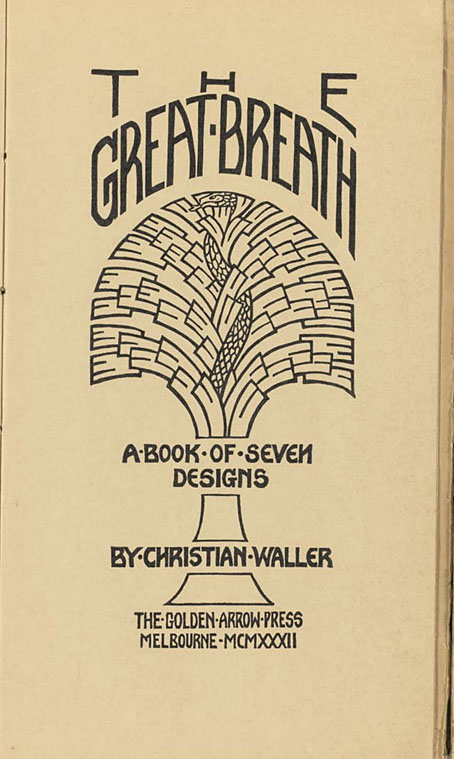
In last week’s anniversary post I threw some barbs at social media to which this piece might act as a riposte; the poisoned waterholes still have their uses. A link on Bluesky to a book by James Hume-Cook, Australian Fairy Tales (1925), had me looking for more information about the book’s illustrator, Christian Yandell (1894–1954), an Australian artist whose illustrations are as good as those being produced in Britain or America at the height of the boom in illustrated books. Ms Yandell is better known today under her married name, Christian Waller. In addition to working as an illustrator she was a printmaker and stained-glass artist. She was also another early 20th-century artist whose work reflects an interest in Theosophy, most notably in a print series from 1932 which she titled The Great Breath.

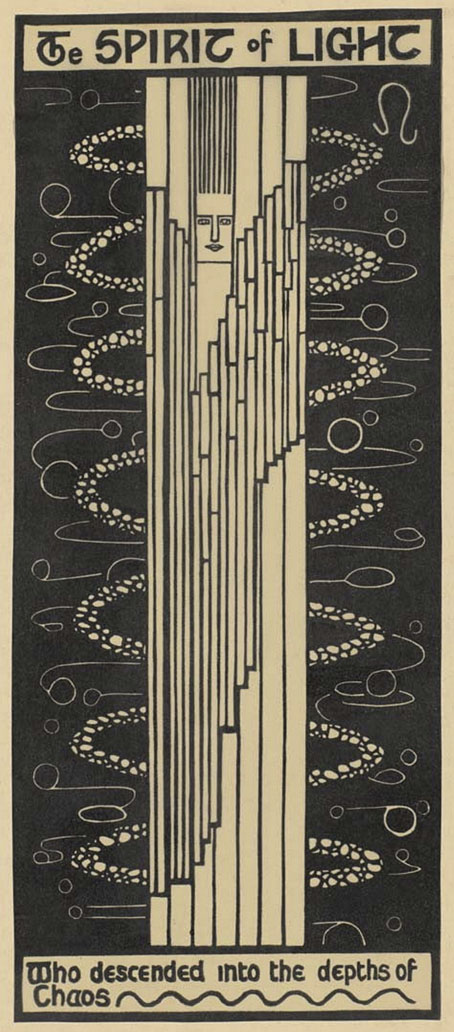
The production of The Great Breath was entirely undertaken by Waller; all aspects from the cutting and printing of the linoblocks to the manufacture of the distinctive gold-painted emerald green cover was done by hand. She printed the blocks on her 1849 hand-press in her studio at Ivanhoe, each book taking about four days to make, hand-bound with green cord. Although it was intended to produce an edition of 150, it seems only about 30 were made, with some unbound impressions extant, usually untrimmed. Each consisted of a title page, colophon, contents page and seven linocut designs. The images were printed in solid black on white translucent tracing paper, trimmed and tipped onto the cream pages. The books were not numbered sequentially, but rather in relation to the numerology of the buyer.

waller08.jpg

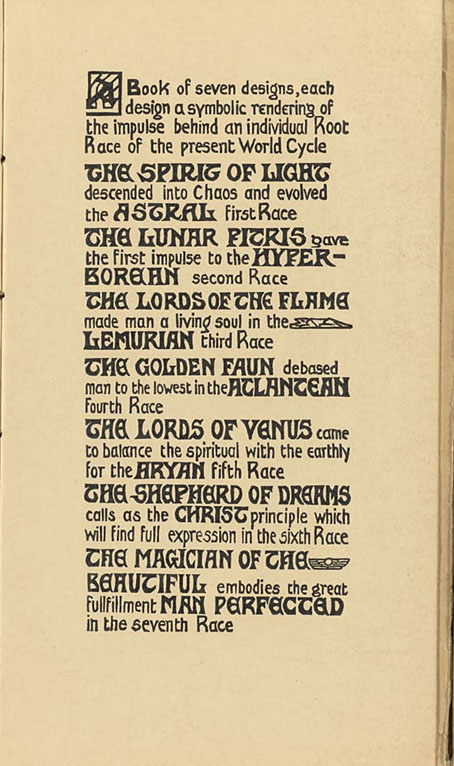
The bound collection comprises seven prints plus an eighth plate presenting vague clues about the meaning of the series and some of the symbolism in the imagery. The prints themselves are in a bolder style than Waller’s storybook illustrations, resembling templates for stained-glass designs. What “The Great Breath” refers to isn’t explained at all, I’d guess you had to be a reader of Madame Blavatsky’s magnum opus, The Secret Doctrine, to be sufficiently enlightened. The explanatory plate features Blavatsky-derived concepts such as “Root Races” and “the World Cycle”, along with references to Atlantis, Hyperborea and Lemuria. The Secret Doctrine incorporates the alleged histories of these lost continents into its collage of myth, religion and mysticism, as a result of which Madame Blavatsky is almost solely responsible for the legend of Atlantis migrating from books of archaeological speculation and pseudo-history to the more rarified realms of occultism. You can trace a thread of Atlantis references from Theosophy to The Golden Dawn, and on into the 20th century, through weird fiction to the crank shelves, where the submerged continent may be found among all the flying saucers, pyramidology and “ancient astronauts”. Since Theosophy has few adherents today it might be said that the elevation of Atlantis to a mystical plane was Blavatsky’s most substantial legacy, if it wasn’t for all the artists who fed off the soup of borrowed ideas in The Secret Doctrine to elevate work of their own. I continue to believe, semi-mischievously, that Theosophy ought to be recognised as the primary force behind the development of abstract art, so many important artists (Hilma af Klint, Kandinsky, Mondrian) were inspired by Blavatsky’s writings. “Inspire” is apt in this context, being derived from Latin and Greek words meaning “to breathe”. Maybe the significance of Waller’s title isn’t so hard to divine after all.

waller01.jpg

Continue reading “Christian Waller’s The Great Breath”

Weekend links 816

rossignol.jpg

The Creative Power of the Spirit, No. 31 of A Goodly Company series, 1920–1933 by Ethel le Rossignol.

• “One moment it was a little blip. The next, our friends are dying”: the gay porn soundtrack composers lost to the Aids crisis. More gay porn: Pink Narcissus, James Bidgood’s micro-budget homoerotic fantasy, will receive a UK blu-ray release later this year.

• Old music: Thirst by Clock DVA gets a very welcome reissue later this year, having been unavailable in any form since 1992. I’m not so happy about the changes to Neville Brody’s original cover design but the album itself is a major post-punk statement.

• “Graphic design was thought to be a man’s discipline,” she says. “So I think it was quite a surprise for people to find me there.” A profile of Margaret Calvert, designer of (among other things) Britain’s road signs.

• At Colossal: A major survey in Paris chronicles Leonora Carrington’s esoteric Surrealism.

• At Public Domain Review: Sara Weiss’ Journeys to the Planet Mars (1903).

• At the BFI: The mystery music video for The Beatles’ Penny Lane.

Winners and entrants for Close-up Photographer of the Year 7.

• “Cats to blame for octopus deity enshrinement delay.”

• Steven Heller’s font of the month is Cattivo.

• At Dennis Cooper’s it’s Jack Arnold’s Day.

Pink Noir (1996) by David Toop | Pink Dust (2013) by Sqürl | The Pink Room 2 (2024) by Seigen Ono

Weekend links 806

wilson.jpg

Cover art by George Wilson for The Twilight Zone #45, September 1972. Via.

• At Public Domain Review: Thea Applebaum Licht on the history of art within art, or cabinets of curiosity and paintings within paintings.

• The final 2025 catalogue of lots for the After Dark: Gay Art and Culture online auction. Homoerotic art, photos, historic porn. etc.

• At Smithsonian Mag: See the “Mona Lisa of Illuminated Manuscripts,” a 600-Year-Old Bible covered in intricate illustrations.

It’s amazing, the number of people out there who love everything about queer life except for queer sex, who would prefer that sex and sexual orientation live in entirely different zip codes, that they exist as non-overlapping magisteria; it’s so much safer that way. Who wants gay sex polluting their enjoyment of the abstraction that is Being Gay?

That is what gay love is, now, in the collective imagination of American commerce: a set of identity relations projected onto bored and indifferent celebrities who will half-heartedly play along with the idea because doing so moves units and, anyway, what does it cost them? The more that sexual orientation slouches to the point of pure abstraction, the less effort it takes. Anyone and anything can be gay, now, because gay is just a set of pompous liberal cultural signifiers that have no earthly material relation to homosexuals.

“I miss when homoeroticism was erotic,” says Freddie deBoer. I’ve made similar complaints myself over the years. For some genuinely erotic homoeroticism, see the latest auction link above.

• At Ultrawolveunderthefullmoon: Illustrations for Edmund Weiss’s Bilderatlas der Sternenwelt.

• DJ Food’s latest harvestings of psychedelic ephemera may be seen here.

• At Dennis Cooper’s: Bruce Connor’s Day.

• The Strange World of…David Lynch.

• RIP Udo Kier and Tom Stoppard.

Atlanta Surrealist Group

Menergy (1981) by Patrick Cowley | Eros Arriving (1982) by Bill Nelson | Erotic City (“Make Love Not War Erotic City Come Alive”) (1984) by Prince & The Revolution

Evelyn Paul’s Myths & Legends of Japan

paul01.jpg

I don’t think I’ve encountered anything by British artist Evelyn Paul (1883–1963) before, but she illustrated a number of books before and after Myths & Legends of Japan, a guide to Japanese folklore which was published in 1912. The book by F. Hadland Davis differs from similar volumes which tend to be simple recountings of folk tales with accompanying illustrations. Davis recounts specific stories but his volume is a more thorough guide to all forms of Japanese folk culture, with chapters on religious tradition and superstition, as well as separate chapters devoted to trees, thunderstorms, bells, mirrors, tea, Mount Fuji, foxes and supernatural beings. The book as a whole runs to over 500 pages, ending with a number of contextual appendices. Davis also lists his sources (Lafcadio Hearn, for one) which you don’t usually find in books of this type. Two of the illustrations show characters from Kwaidan, Hearn’s ghost-story collection: the sinister Lady of the Snow, and the hapless musician Hoichi the Earless.

paul02.jpg

Evelyn Paul’s illustrations strive to balance the traditional elements of ukiyo-e print-making with the watercolour style that was a common feature of illustrated books at this time. The combination doesn’t always work as well as it might—the nebulosity of watercolour painting runs counter to the definition and flatness of woodcut prints—but her illustrations still look more Japanese than European. To be fair to the artist, colour printing using photo separations was still in its infancy in 1912, and Paul’s paintings seem muddier in reproduction than they might have been in their original state. Davis’s book was published by Harrap, Harry Clarke’s London publisher, and you find similar deficiences in the reproduction of Clarke’s paintings.

paul03.jpg

paul04.jpg

paul05.jpg

Continue reading “Evelyn Paul’s Myths & Legends of Japan”

Four Horsemen

adolfs.jpg

Drie Apocalyptische Ruiters (c. 1943) by Willem Adolfs.

Willem Adolfs’ painting only shows three Horsemen of the Apocalypse but his picture is too good to be buried at the foot of this post. Adolfs was a Dutch artist whose work I hadn’t looked at before. His painting is a product of wartime, so the absence of the white horse (usually symbolising war) may perhaps be taken as referring to the conditions of its production. Adolfs spent the later war years in German concentration camps, dying in one near Hamburg in 1945.

duvet.jpg

Saint John sees the Four Horsemen (no date) by Jean Duvet.

After looking at Albrecht Dürer’s apocalyptic woodcuts last week I went searching for more depictions of the Four Horsemen. The quartet are the most familiar characters of the Book of Revelation, and such a useful symbol that their appearance has over the centuries become detached from their Biblical origins. War, Pestilence, Famine and Death embody perennial, universal fears, they don’t require a Christian framing to be acknowledged.

flamande.jpg

Apocalypse flamande (15th century).

There are many depictions of the Four Horsemen, especially from earlier centuries when war in particular tended to arrive on horseback. Recent depictions are less common. In 19th-century art Christian symbols had a cultural weight they no longer possess; paintings of Lucifer or the Whore of Babylon are staples of metal album covers but you’re unlikely to find them in art galleries.

west.jpg

Death on a Pale Horse (1796) by Benjamin West.

The Bruce Pennington paintings at the end of the post are unusual in this respect, being relatively recent and seriously intended despite being the work of an artist known mainly for his book covers. The paintings are from Eschatus, an album-sized volume published by Paper Tiger/Dragon’s World in 1976. The book is a series of pictures illustrating Pennington’s own translations of the prophecies of Nostradamus, a cycle of events which he depicts as apocalyptic science fiction. It’s a strange work, and not a very comprehensible one, but it does include the inevitable Horsemen on the cover painting, along with a portrait of Death (aka Ghost Rider) which appears in a detail on the back cover.

sabatelli.jpg

Vidi, quod aperuisset agnus… (1809) by Luigi Sabatelli.

Continue reading “Four Horsemen”