The Angel of the Revolution

aotr01.jpg

The British Library’s recent uploading of a million copyright-free images to Flickr has been a mixed blessing. On the one hand it’s an exemplary gesture on the Library’s part, on the other I wish they’d archived their images somewhere other than Flickr where the recent interface changes have made using the site for any length of time a very frustrating business.

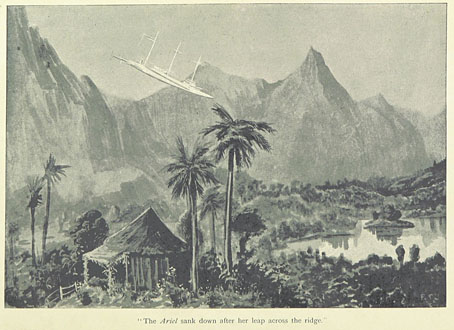
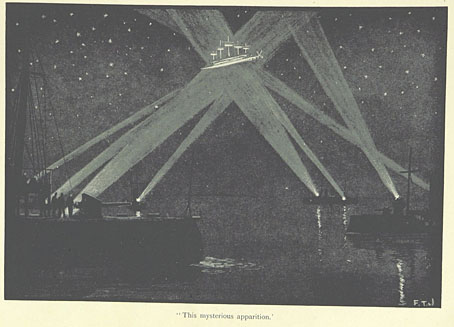
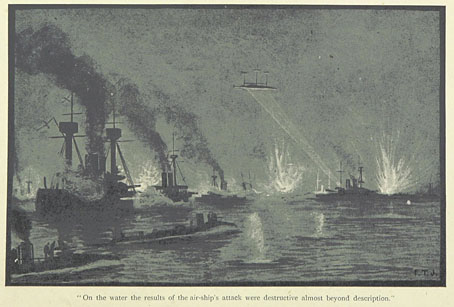
Complaints aside, the unsorted BL haul is being slowly sifted by those who aren’t dissuaded by Yahoo’s iniquities. A recent set labelled Science Fiction is comprised as much of science fact as fiction but it does include these illustrations from The Angel of the Revolution: A Tale of the Coming Terror (1893), a novel of aerial warfare and anarchist revolt by British author George Griffith. This is one of several works from the late Victorian era which show how lazy it is to characterise the period as a time of unthinking imperialism:

First published in 1893, The Angel of the Revolution is a fantastical tale of air warfare in which an intrepid group of Socialists, Anarchists and Nihilists defeat Capitalism with their superior knowledge of dirigibles. Led by a crippled, brilliant Russian Jew and his daughter, Natasha, The Brotherhood of Freedom establishes a ‘pax aeronautica’ over the world, thanks to the expertise of Richard Arnold, a young scientist. Arnold falls in love with Natasha (the eponymous Angel), and Griffith builds a utopian vision of Socialism and romance.

As well as writing a cracking good story, Griffith is also remarkably prescient in predicting future technology, including air travel, tidal power, and solar energy. He also engages with timeless debates over social responsibility. Griffith imagines a world in which the wealth of the obscenely rich is sequestered, their property seized for the public good, and their businesses nationalised. Those with unearned incomes are forced to either pay punitive tax, or to undertake equivalent labour in the community. Griffith’s message lacks subtlety, but it couldn’t be more pertinent in the twenty-first century. (Précis swiped from here.)

aotr02.jpg

Griffith’s novel is essentially Jules Verne’s Robur the Conqueror (1886) with a helping of revolutionary politics; even the aircraft are similar, with Griffith’s illustrator, Fred T. Jane, depicting an armed sky-boat held aloft by the same vertical propellers as those used by Robur’s machine. Jane (not “Janes” as they name him on the Flickr pages) later founded the Jane’s series of warship and aircraft catalogues so it’s fitting that his illustrations combine both those craft in a single design.

aotr03.jpg

Continue reading “The Angel of the Revolution”

Weekend links 193

gauger.jpg

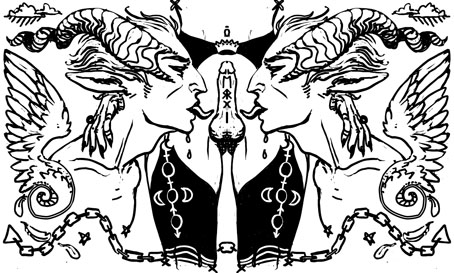
A Problem Glyph by Eliza Gauger. Problem Glyphs are “symbolic illustrations … drawn in response to problems sent in by tumblr users”.

Kosmische Night takes place at the Museum of Bath at Work, Bath, Somerset, on January 25th (Rescheduled to February 22nd).  “…a celebration of all things Teutonic for anyone who enjoys Neu!, Can, Tangerine Dream, Stockhausen and Kraftwerk,” say the organisers. Also on the bill, The Electric Pentacle, a Carnacki-esque collaboration between Narco Lounge Combo and The Levels.

• Shock Headed Peters’ Fear Engine II: Almost As If It Had Never Happened. Joe Banks on Karl Blake, “…one of the most fascinating and colourful characters to emerge from the fertile loam of the post-punk scene”.

• “The great question in the film and the tale is not the existence of the ghosts but the way the governess understands their no-longer-lived lives and desires.” Michael Wood on The Innocents.

Nobody, however, is a greater authority on the intersection of porn and alternative spirituality than Annie Sprinkle. Beginning as a prostitute in the 1960s and 70s, she entered porn in the pre-AIDS era and made over two hundred films. She then jumped into a career as a sex-positive author and educator, which brought her into close conflict not only with feminists like Andrea Dworkin and Catharine MacKinnon, but also right-wing patriarch Jesse Helms, who denounced one of her sex magick performance pieces on the floor of the Senate. For Sprinkle, both sexuality and performance are explicitly spiritual and magical, part of her role as a cultural shaman.

In the Valley of the Porn Witches by Jason Louv.

Stars of the Lid and Wordless Music Orchestra playing for two hours last month at the Basilica of Our Lady of Perpetual Help in Sunset Park, Brooklyn.

Rick Poynor on the late Martin Sharp’s contributions to People, Politics and Pop: Australians in the Sixties (1968) by Craig McGregor.

Maggie Greene on The Woman in Green: A Chinese Ghost Tale from Mao to Ming, 1981–1381.

• “TED actually stands for: middlebrow megachurch infotainment,” says Benjamin H Bratton.

Geoff Manaugh on how corpses helped shape the London Underground.

Tony White on Eduardo Paolozzi at New Worlds by David Brittain.

• Mix of the week: Secret Thirteen Mix 102 by Frank Bretschneider.

• At Dangerous Minds: film of Syd Barrett‘s first psychedelic trip.

NYPL Wire: a New York Public Library Tumblr.

Microbial art by Eshel Ben-Jacob and others.

Interstellar Rock: Kosmische Musik (1974) by The Cosmic Jokers | I, Bloodbrother Be (1984) by Shock Headed Peters | Obscene and Pornographic Art (1991) by Bongwater

Weekend links 188

blackwell.jpg

The Baron in the Trees (2011), a book-cut sculpture by Su Blackwell.

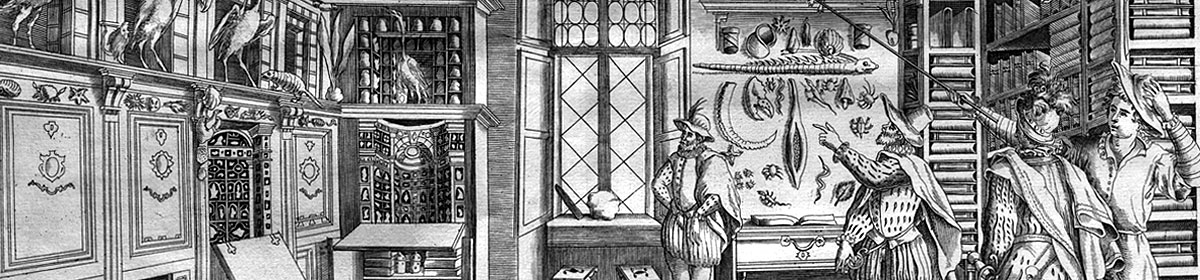
Kurt Andersen at Vanity Fair examines the latest claims that Vermeer used a combination of lenses and mirrors to aid the creation of his remarkable paintings. David Hockney caused a considerable fuss in 2006 when he made similar assertions. Andersen recounts how Tim Jenison (who isn’t an artist) decided to test the hypothesis by building a replica of the room from Vermeer’s The Music Lesson (1662–65) which he then painted with the assistance of a lens-and-mirror apparatus. I’m agnostic on this issue, and don’t regard it as a devaluing of the work of Vermeer (or any other artist) if some special apparatus was used to help create the paintings; artists for centuries have been using whatever technology was available.

One point which isn’t mentioned in the article: lens optics were being developed to a high standard in the Netherlands during Vermeer’s time. One of the developers of the microscope, Antonie van Leeuwenhoek, was a contemporary of Vermeer’s in Delft, and is even alleged to be portrayed in some of the artist’s paintings.

• Before Alfred Hitchcock’s film and Daphne Du Maurier’s short story, The Birds was an “eerie yet satirical and rather metaphysical novel” by Frank Baker, inspired in part by Arthur Machen. Michael Dirda reviews a new edition. Related: “The Day of the Claw: A Synoptic Account of Alfred Hitchcock’s The Birds“, an essay by Ken Mogg examining avian menace through the ages.

Kevin Brownlow and Carl Davis on how they brought Abel Gance’s 270-minute silent masterwork, Napoleon (1927), back to the screen.

Finally, he was asked about the growth of surveillance and the militarization of the police.

“The phenomenon itself shouldn’t be surprising—the scale was surprising—but the phenomenon itself is as American as apple pie,” Chomsky said. “You can be confident that any system of power is going to use technology against its enemy: the population. Power systems seek short-term domination and control, not security.”

Matthew Robare on “American Anarchist” Noam Chomsky in (of all places) The American Conservative.

• “Why the hell wouldn’t I?” Evan J. Peterson on reading/performing his poetry in public, and his new book, The Midnight Channel.

The adversaria of Google Books: captured mark of the hand and digitization as rephotography.

• No surprise that the rabies-haunted town of Scarfolk is soon to have its history fixed in print.

Mazzy Star made a rare TV appearance last week, playing a song from their recent album.

The Sorcerer Blog is obsessively devoted to William Friedkin’s cult film.

• Unexpected Artefacts: Pushing the envelope with Bristol’s Emptyset.

• Mix of the week: Secret Thirteen Mix 097 by Lee Gamble.

• At PingMag: Ryokudo—Tokyo’s Green Roads.

Norman Records’ Top 50 albums of 2013.

Birds Of Fire (1973) by Mahavishnu Orchestra | Attack Of The Killer Birds (2006) by Émilie Simon | One Thousand Birds (2012) by Six Organs of Admittance

Graham Chapman’s opinion

chapman.jpg

The announcement this week that the surviving members of the Monty Python team were getting back together has caused an understandable flurry of excitement. This isn’t something I share despite having the entire run of the Python films and TV series on DVD. I usually feel the same way about band reunions: rather than revisit past glories I prefer to see people doing something new. That said, it would be nice if Eric Idle would allow a DVD release of his Rutland Weekend Television series. His low-budget Python spin-off was broadcast once in the 1970s and hasn’t been seen since, to the continual annoyance of co-star and collaborator Neil Innes.

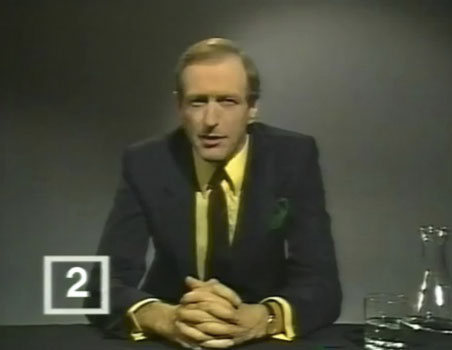
Graham Chapman will be absent from the reunion, of course. His polemic for Channel 4’s Opinions has nothing to do with Monty Python beyond his presence but it’s something I’ve always remembered so it’s good to find it on YouTube. Opinions was a run of half-hour pieces-to-camera by a different person each week; I saw this one when it was broadcast in 1984 but don’t recall any of the others. Chapman’s contribution was memorable at the time for his talking directly and unapologetically about alternatives to heterosexual relations, and what we’d now call hetero-normativity. This would hardly raise an eyebrow today but in 1984 attitudes towards gay people in the UK were growing increasingly harsh under a right-wing government, a virulent press, and the beginning of the AIDS crisis. Chapman’s plea for universal tolerance wouldn’t have made much of an impression but it was good to hear someone talking this way, even if only for 30 minutes on the channel with the least amount of viewers. Chapman was the first person I saw talking on TV about being gay at a time (the 1970s) when few people in public life dared to admit such a thing. His cheerful example was a great riposte to an atmosphere of widespread fear and loathing. His Opinions piece is witty, silly, over-exuberant (as his acting often was), and self-reflexive in the manner the Pythons made their own. You also get to see his partner, David Sherlock, in a variety of background roles. Watch it here.

Weekend links 176

dlouhy.jpg

This week PingMag was looking at Czech film posters. This one by Bedrich Dlouhy is for the belated 1970 release of Kurosawa’s Rashomon.

• In October Alison Goldfrapp curates an exhibition for The Lowry, Salford, featuring her favourite art. Examples will include work by Leonora Carrington, Lotte Reiniger and Henry Darger so I’ll definitely be seeing this one. The new Goldfrapp album, Tales of Us, is released this week. Alison Goldfrapp & Lisa Gunning’s film for Annabel is here.

Michael Glover profiles artist Tom Phillips who has a new show of his paintings at the Flowers Gallery, London. The indefatigable Phillips also talked to Tracy McVeigh about his design for the new 50 pence coin which celebrates the centenary of Benjamin Britten.

Get Carter director Mike Hodges remembers re-teaming with Michael Caine for the island-set crime thriller Pulp, and shares a letter that JG Ballard wrote to him in admiration of the film.

Dismantling the surveillance state won’t be easy. Has any country that engaged in mass surveillance of its own citizens voluntarily given up that capability? Has any mass surveillance country avoided becoming totalitarian? Whatever happens, we’re going to be breaking new ground.

Bruce Schneier on how to deal with the total surveillance state.

• Babel/Salvage presents The Midnight Channel, the newest montage of poetry by Evan J. Peterson, inspired by cinema of the horrific, fantastic and bizarre.

• Mixes of the week are from composer Amanda Feery at The Outer Church, and Pinkcourtesyphone (Richard Chartier) at Secret Thirteen.

• At Dangerous Minds: Kimberly J. Bright on the psychedelic poster art of Hapshash and the Coloured Coat. Related: LSD may not be bad for you, says study.

Queer Zines: a 400-page study edited by AA Bronson & Philip Aarons.

• Justin Abraham Linds on The Walt Whitman of gay porn.

• Designs for theatre and print by Oskar Schlemmer.

Beautiful Mars: a Tumblr.

Catleidoscope!

• Goldfrapp: Lovely Head (2000) | Strict Machine (2003) | Caravan Girl (2008)