Weekend links 342

zarraga.jpg

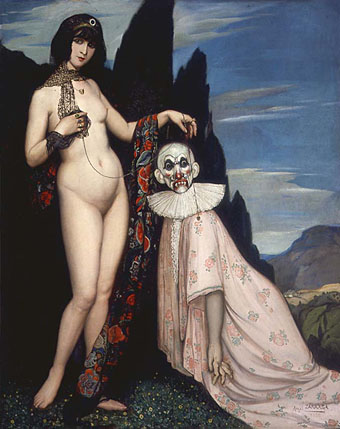
La femme et le pantin (1909) by Ángel Zárraga.

• RIP John Berger. Berger’s essential TV series on art, Ways of Seeing (1972), is at YouTube and Ubuweb; “Such freedom is unthinkable today,” says series director Mike Dibb; the book of the series was designed by Berger and Richard Hollis; ways of seeing Ways of Seeing; Geoff Dyer, Olivia Laing & Ali Smith on Berger; M. John Harrison on Berger.

• The beginning of January means the LRB posting Alan Bennett‘s diary for the previous year. In related news, Network DVD will be releasing Six Plays by Alan Bennett next month, a collection that includes a favourite of mine, Me! I’m Afraid of Virginia Woolf (1978).

• At Dennis Cooper’s: Acid Westerns Day (Restated). Related: Jodorowsky’s El Topo and The Holy Mountain are being released on Blu-ray (Region B) by Gryphon Entertainment.

The acre of suburban lawn surrounding our house became like the Paramount lot for my feverish theatrics. I graduated to building “spook houses” in the family garage out back. Inspired by the ride-through Trimper’s Haunted House in Ocean City, Maryland, designed by Bill Tracy (and it’s still there in operation), I remembered excitedly wheeling through this attraction in these rickety little coffin-shaped cars and dreaming of befriending the crudely built, motorized corpses, cannibals, and skeletons who lived inside. I fantasized the cars breaking down, the panicked, chickenshit children screaming, bolting from their seats, tripping over live wires, and electrocuting themselves. I wanted to take this imagined fear, this frightened happiness, back to my own house where I knew I could preserve, protect, and stylize it on my own adolescent terms.

John Waters on his childhood home

Strange Flowers‘ latest reading recommendations include books on lesbian decadence, occult Paris, flâneurie and the queerness of the Benson family.

Where Evil Dwells (1985), a 28-minute preview of a longer piece of weird cinema (now destroyed) by Tommy Turner and David Wojnarowicz.

Francis Ford Coppola and Brian De Palma having a conversation about Coppola’s The Conversation.

The Edge Question for 2017: “What scientific term or concept ought to be more widely known?”

• Mixes of the week: Drone Theory with Roly Porter, and Secret Thirteen Mix 205 by Stavaris.

Simran Hans suggests where to begin with the films of Todd Haynes.

• More decadence, this time among the Mexican Modernists.

Moon Wiring Club at Bandcamp.

No Name, No Slogan (1989) by Acid Horse | Those Tapes Are Dangerous (1997) by The Bug | Spooky Action At A Distance (2014) by Sqürl

Weekend links 341

fountaingod.jpg

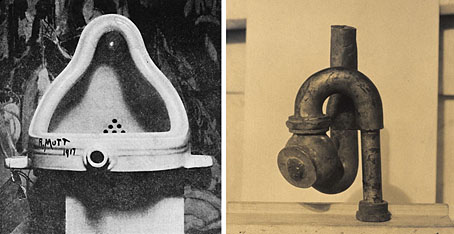
Fountain (1917) by R. Mutt (Marcel Duchamp), and God (1917) by Elsa von Freytag-Loringhoven.

• “What is there left to know about David Bowie? What is there left to unearth?” asks Ian Penman whose lengthy review of recent Bowie books is better by far than a shelf full of cash-in doorstops.

Strázci z hlubin casu is a collection of stories by HP Lovecraft and August Derleth from Czech publisher Volvox Globator. The book reprints artwork of mine on the cover and inside.

• Mixes of the week: Through December by David Colohan, At Alien Altars: A Conjurer’s Hexmas by Seraphic Manta, and Secret Thirteen Mix 204 by James Welburn.

• “Something vindictive resides in soot.” Timothy Jarvis on the weird fiction of Stefan Grabiński. From 2003: China Miéville on Grabiński.

• Paintings by Jakub Rozalski of eastern European peasants with mechas and werewolves.

Colm Tóibín on James Joyce’s A Portrait of the Artist as a Young Man, 100 years on.

Jesse Singal on why straight rural men (in the USA) have “bud-sex” with each other.

Mark Valentine recommends books on tasseography, or divination by tea leaves.

• “Northampton Calling: A Conversation with Alan Moore,” by Rob Vollmar.

Bill Schutt at Scientific American asks what human flesh tastes like.

Gwendolyn Nix on the Tritone, aka The Devil’s Musical Interval.

• At Dennis Cooper’s: _Black_Acrylic presents…Penda’s Fen Day.

• The latest Buddha Machine from FM3 is Philip Glass-themed.

Listen to The Wire’s top 50 releases of 2016

Tritone (Musica Diablo) (1980) by Tuxedomoon | Diabolus In Musica (1987) by The Foetus All Nude Review | Tritone (Musica Diablo) (2016) by Aksak Maboul

Weekend links 339

hiorns.jpg

Untitled (2011) by Roger Hiorns. Photograph by Kate Green.

• “Most surprising and troubling of all is the status of a series of new paintings, also depicting naked male bodies. The figures look archaic, painted using latex and molten and folded plastic. They have sex with each other and with themselves. Extra penises float about, and fill any otherwise unoccupied orifice. There’s a lot of rogering going on, anal and oral, the figures consumed entirely by the act.” Adrian Searle reviews Roger Hiorns’ latest show at the Ikon Gallery, Birmingham.

• “At the heart of magical belief is the belief in your own free will, in your ability to make changes and influence the world. It wasn’t accepting your circumstances, it was working to understand and directly change them.” Jessa Crispin on the women of the Hermetic Order of the Golden Dawn.

Addison Nugent on William Hope Hodgson: “The Forgotten Bodybuilding, Shark-Fighting Sailor who Invented Cosmic Horror (and annoyed Houdini)”. I’d quibble with the “forgotten”—Hodgson is sometimes overlooked but not exactly unknown—but the appraisal is welcome.

• More end-of-year lists: The Quietus posts its Albums of the Year, Bandcamp does the same, while Adrian Curry at MUBI announces his favourite film posters of the year.

Callum James has devised The Quite Difficult Book Quiz for those who’d like a challenge (and a donation to charity) over Christmas.

• “A profoundly poetic anomaly”: Kenan Malik on the Tantric paintings that pre-empt Modernist abstraction.

Patricia M’s Flickr albums contain a wealth of antique graphic design, advertising art and undigitised letterforms.

• “Cronky, shonky, soggy, knackered”: Simon Reynolds on ten years of Moon Wiring Club.

Michael LePointe on the delightful mysteries of The Voynich Manuscript.

Veloelectroindustrial: Wandering the wastelands of former industry.

• Mix of the week: Secret Thirteen Mix 202 by JG Biberkopf.

• “Was Edmund Wilson jealous of Lolita?” asks Alex Beam.

• “Research finds MP3s drain your music of emotion.

Richard H. Kirk‘s favourite albums.

Pavel Banka‘s surreal abstractions.

Dennis Cooper‘s Alan Clarke Day.

Cosmic Surfin’ (1978) by Yellow Magic Orchestra | Cosmic Meditation (1991) by Moondog | Cosmic Call (2006) by The Evpatoria Report

Weekend links 335

oelze.jpg

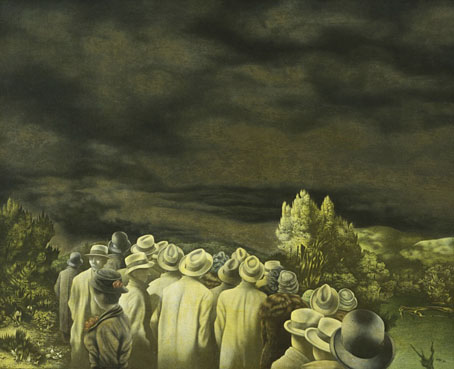
The Expectation (1936) by Richard Oelze.

Richard Oelze, 1900–1980 is an exhibition of paintings and drawings at the Michael Werner Gallery, London, which runs until January 2017. More Surrealist works by Oelze may be seen at But Does It Float and Ubu Gallery.

Will McMorran on the problems of translating the Marquis de Sade’s most obscene work. Related: Jay Sina on Sexistential Horror: HP Lovecraft and the Marquis de Sade as perverse peers.

• Mixes of the week: More Halloween horror at No Condition Is Permanent, Secret Thirteen Mix 200 by JK Flesh, and a mix for The Wire by Botany.

The Chronicles of Clovis (1911), a story collection by Saki (HH Munro) who died 100 years ago this week.

• “Jack is 24, sometimes he’s a drag queen named Sabrina.” The Queen (1968).

• The Mindset of the Macabre: An interview with Abigail Larson.

• “The world is full of bloviators,” says MAD cartoonist Al Jaffee.

Ginette Vincendeau on how the French birthed film noir.

• How to throw a dinner party like Salvador Dalí.

Sastanàqqàm, another new song by Tinariwen.

• At A Year In The Country: more Quatermass.

• Photographs by Klaartje Lambrechts.

Paul Bailey on Pasolini’s lost boys.

Adam Shatz on Leonard Cohen.

Subterranean London

Joan Of Arc (1986) by Jennifer Warnes with Leonard Cohen | Who By Fire (1986) by Coil | The Future (1992) by Leonard Cohen

The mystery of trams

quays-black.jpg

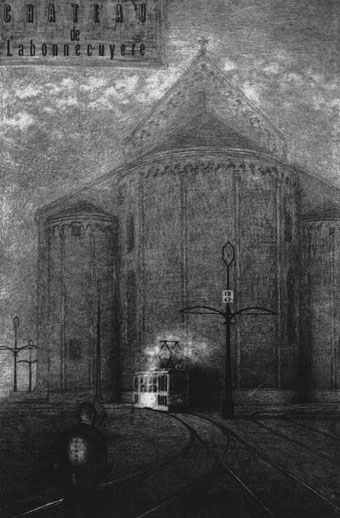
Chateau de Labonnecuyere (c. 1970s) by The Brothers Quay.

Trams are a recurrent feature in the early drawings of the Brothers Quay, and they’ve also appeared in the Quays’ earliest animated films and in some of their designs for the stage. I respond to this fetishisation on the deepest level having been born and raised on the Fylde coast of Lancashire, an area which was for many years the only place in Britain that kept its tramways after the rest of the country had given over the streets to buses and cars. Trams are so ingrained in my consciousness that I still dream about the trams of my childhood, many of which were rattling, streamlined things dating back to the 1930s. Manchester was tramless when I arrived in the city in 1982 but a few years later the council embarked on an ambitious and far-sighted scheme to return trams to the city’s streets. The first routes opened in 1991, and the network has been evolving ever since, pushing out of the centre along disused rail lines.
delvaux1.jpg

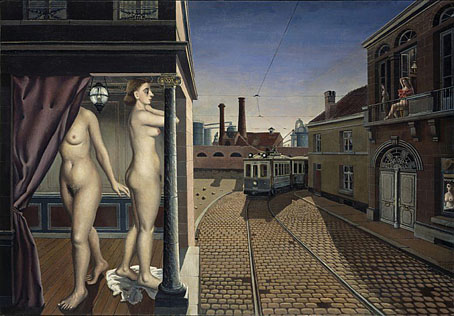
La Rue du Tramway (1938–1939) by Paul Delvaux.

The Quays aren’t alone in being attracted to this form of public transport. Trams haunt a certain type of oneiric European imagination, and I often wonder where the attraction lies. I think it’s something to do with their small scale and the way they remain bounded within the cities they serve. Trains have a romance and mythology of their own but are wide-ranging and far more common, as are buses whose presence on a city street is a reminder that the tram can be replaced. The Quays are Europhiles so they no doubt see the trams of the Continent as another feature of European city life that’s more arresting to American eyes. This post gathers some of the Quays’ uses together with other notable (and favourite) examples.
delvaux2.jpg

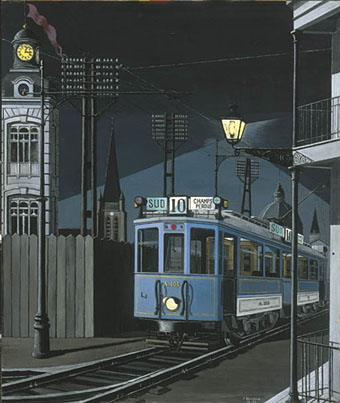
Tram nocturne (1950) by Paul Delvaux.

Several of the examples listed here are Belgian which either means that trams exercise the Belgian imagination more than that of other nations, or I happen to pay more attention to Belgian art. (Probably a little of both.) Paul Delvaux put trams into several paintings but seems to have been the only Surrealist to do so.

tram1.jpg

tram2.jpg

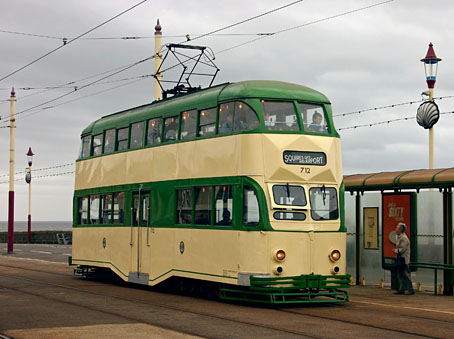
The trams that haunt my imagination are the cream-and-green vehicles that trundled for decades up and down the Fylde coast between Blackpool and Fleetwood. These machines used to run along the line at the end of the street I grew up in so there’s never been a day I can remember when I wasn’t aware of the tram—and of these vehicles in particular—as a viable mode of public transport. Looking at the websites of tram enthusiasts reveals the different names for each generation of Blackpool trams; so I now know that the bow-ended ones (which I always liked) are known as Brush Railcoaches, while the double-deckers are known as Balloons. None of these names were ever used by locals.
schuiten.jpg

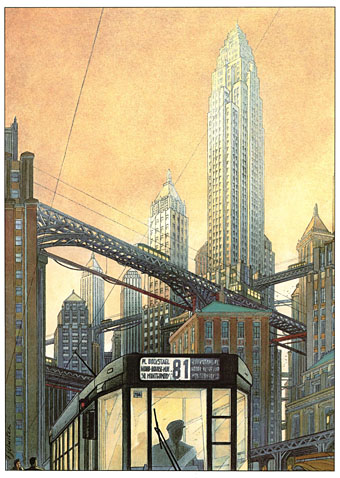
Back to Belgium, and the comics and illustrations drawn by the marvellous François Schuiten are filled with trams. I’ve written at length about the Obscure World mythos of Schuiten and Peeters so rather than repeat myself I’ll point to the mystery of Tram 81, a recurrent and unexplained presence in Schuiten’s work.
nocturna1.jpg

Nocturna Artificiala.

nocturna2.jpg

Nocturna Artificiala.

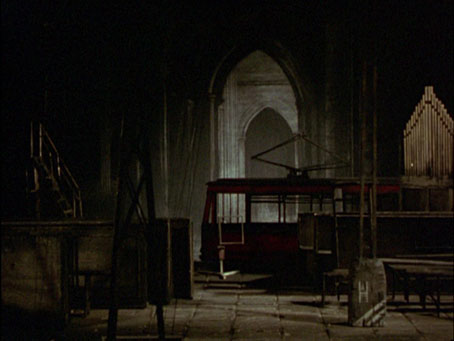
Trams for the Brothers Quay are the small European variety rather than the streetcars seen in some American cities. One of the brothers’ Black Drawings, Chateau de Labonnecuyere, features a pantographed vehicle that glides through their later animated films. The first of these, Nocturna Artificiala (1979), is a wordless masque involving the yearning relationship between the solitary puppet character and an empty, nocturnal tram. The film is an animated extension of Chateau de Labonnecuyere which not only features the drawing itself but also includes a unique moment where the tram glides through the vast cathedral seen in the background.
janacek1.jpg

Leos Janacek: Intimate Excursions.

janacek2.jpg

Leos Janacek: Intimate Excursions.

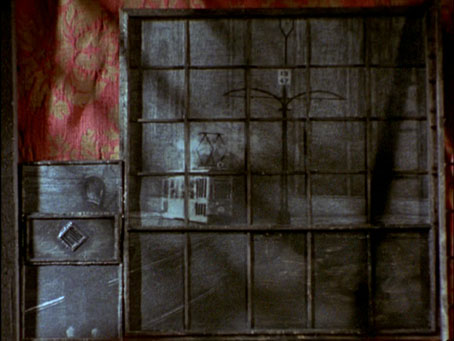
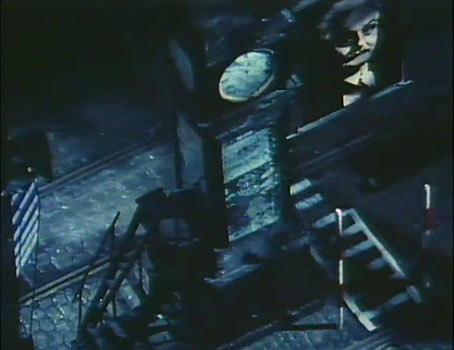
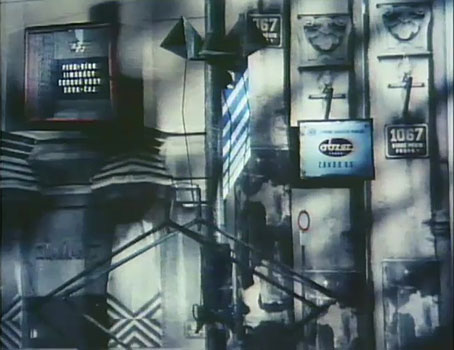
The power-line supports seen in Chateau de Labonnecuyere are a recurrent motif in the Quays’ works. They appear together with the Nocturna Artificiala tram in Leos Janacek: Intimate Excursions (1983), and may be glimpsed among the faded detritus in Street of Crocodiles (1986).
avalon1.jpg

Avalon.

avalon2.jpg

Avalon.

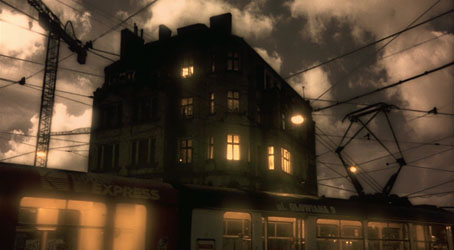
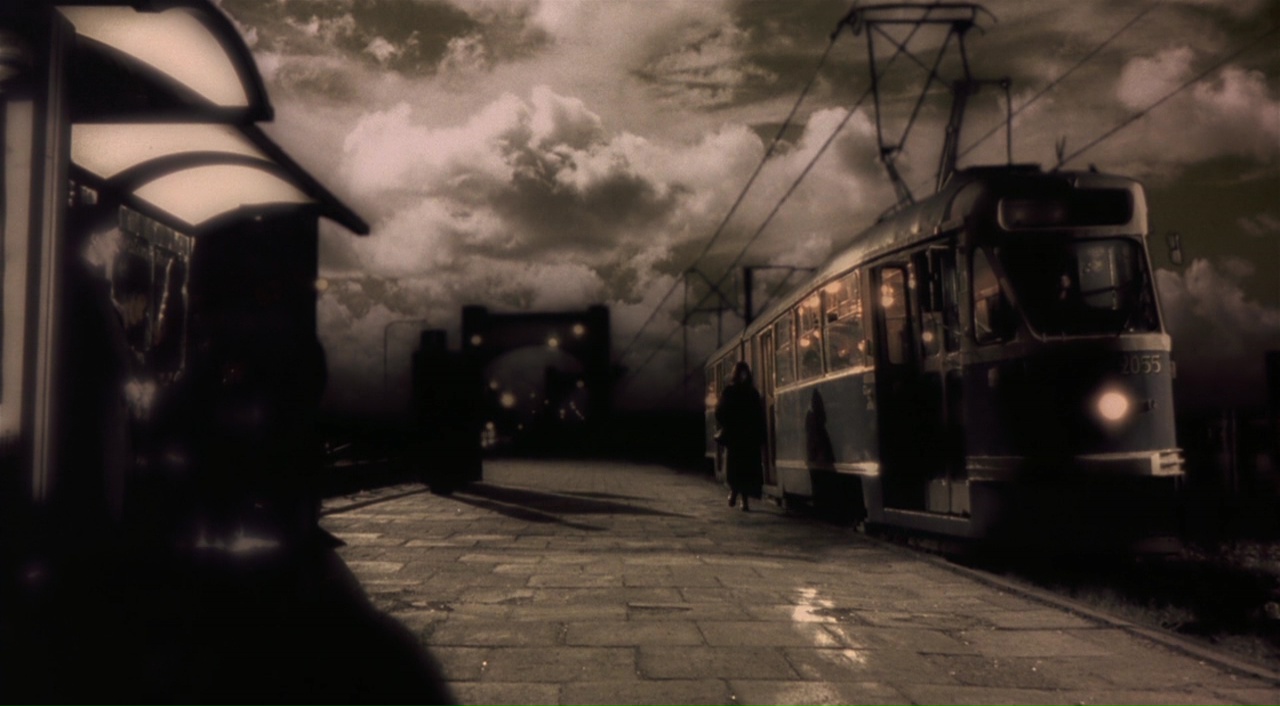
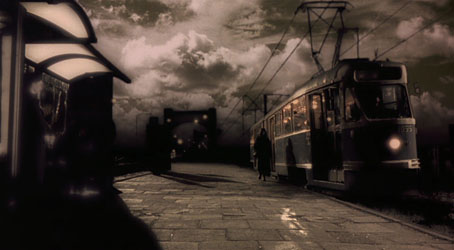
I don’t know what the Quays would make of the science-fiction scenario of Mamoru Oshii’s Avalon (2001) but the recurrent scenes of a nocturnal tram journey would probably appeal, especially since the tram in question is a Polish one. Mamoru Oshii is the director of many SF-oriented animations, not least The Ghost in the Shell (1995). Avalon was a surprise when it appeared (and then seemed to vanish all-too-quickly): a live-action drama concerning the players of a virtual reality game which can have lethal consequences for the contestants. The film was made in Poland with a Polish cast, and the scenes are heavily processed throughout, with everything given a sepia wash. Coming after The Matrix, Dark City et al, the virtual reality aspect wasn’t so much of a surprise but I loved the juxtaposition of a futuristic story in a run-down European setting. And the trams, of course. The dream-like atmosphere of the film’s mundane scenes brings everything back to Delvaux and his tram nocturnes.

I was going to add Tramway (1966) to this list, a short student film directed by Krzysztof Kieslowski, but it’s not especially mysterious. It’s worth a look if you like Kieslowski, however, and may be watched here. If anyone has suggestions for other mysterious trams then please leave a comment.

Elsewhere on { feuilleton }
The Quay Brothers archive

Previously on { feuilleton }
Paul Delvaux: The Sleepwalker of Saint-Idesbald