MMM

macgregor1.jpg

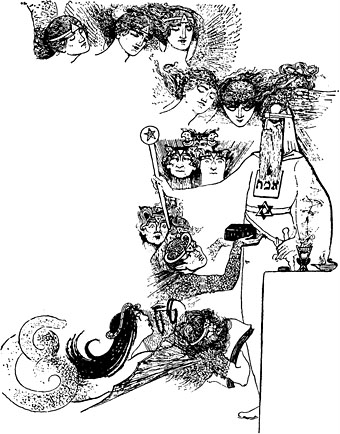
Post number three thousand, and searching the memory for anything which might be filed under MMM led to more occult art. Moina MacGregor Mathers (1865–1928) was the wife of Samuel Liddell MacGregor Mathers, one of the founders of the Hermetic Order of the Golden Dawn in the 1880s. Moina was the sister of the French philosopher Henri Bergson, and later took to signing her illustration work “M. Bergson MacGregor”. The illustration above, however, a frontispiece for her husband’s translation of The Sacred Magic of Abramelin the Mage (1897) was signed “M.M.M.” (The signature has been removed in this reproduction but is visible here.) That triplet of initials is typical of western occultism; when Aleister Crowley (no friend of the Mathers) was appointed head of the O.T.O. in Britain his new lodge was named Mysteria Mystica Maxima, or M.M.M.

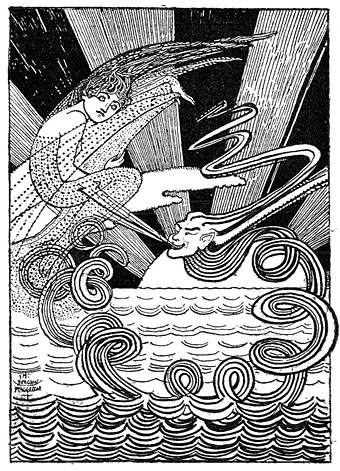
Ms Mathers wasn’t the greatest of artists but her few works have a fin de siècle charm, and are informed by occult study which she and her husband took seriously. The example below is from yet another slim volume of mystical poetry, Poems (1897) by Golden Dawn adept Charles Rosher. No need to wonder why Max Beerbohm made Enoch Soames a poet; it often seems that those who weren’t writing poetry in the 1890s were in the minority.

macgregor2.jpg

Previously on { feuilleton }
Whirlpools
The Sapphire Museum of Magic and Occultism

Whirlpools

whirlpool.jpg

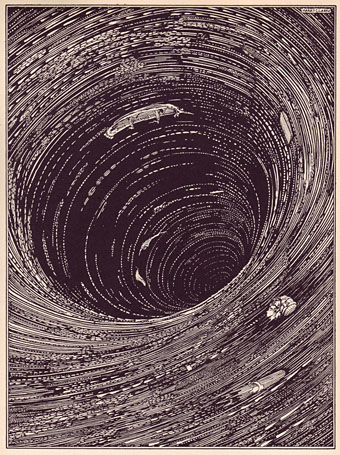
This was a surprise. My first thought on seeing the cover for Ethel Archer’s “book of verse”, The Whirlpool, was that its swirling waters were borrowed from Harry Clarke’s typically astonishing illustration for A Descent into the Maelström by Edgar Allan Poe. The problem there is that the Ethel Archer book was published in 1911 while Clarke’s first collection of Poe illustrations didn’t appear until 1919. The cover for the Archer book was by Ethel’s husband, Eugene Wieland, the publisher of Aleister Crowley’s Equinox periodical/occult treatise, and also the publisher of this volume. Crowley provided an introduction to the book. Given these occult associations it’s possible that Harry Clarke might have seen a copy of this. Clarke’s work appeared in Austin Spare’s own occult periodical, The Golden Hind, and he wasn’t averse to producing occult art of his own. This isn’t to say that Clarke necessarily took anything from the Archer book—sometimes a whirlpool is just a whirlpool—but it’s not outside the bounds of possibility.

There’s a copy of Ethel Archer’s book currently on sale at eBay, together with some original drawings by Eugene Wieland. The cover above came via John Eggeling’s Flickr page of rare book covers. The Poe illustration is via 50 Watts.

maelstrom.jpg

Previously on { feuilleton }
The Sapphire Museum of Magic and Occultism

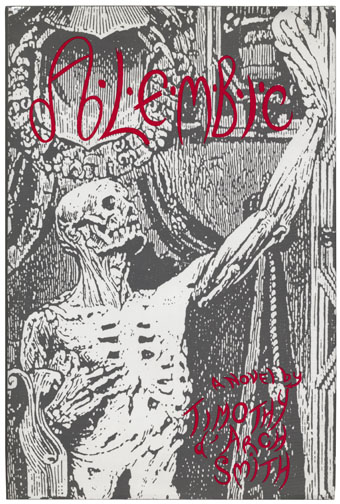
Alembic and Ligier Richier

alembic.jpg

Current reading is Alembic (1992), a curious novel by Timothy d’Arch Smith whose publishings prior to this were all non-fiction, among them a study of the Uranian poets, a bibliography of Montague Summers, and The Books of the Beast, one of the many books about Aleister Crowley. Alembic reflects some of these interests and blends them with others, notably alchemy and rock music, delivering the result in a digressive, comma-strewn prose style which I imagine many readers would find off-putting. From the jacket description:

Alembic is an unsettling novel about madness and alchemy, epistemology and rock and roll, magic and perversion. Thomas Graves, a young antiquarian, works for ALEMBIC, a British government office investigating the contemporary applications of the secrets of alchemy. The strange world of alchemy, however, is as eerie as the rock and roll world of Thomas’s friend Nicholas Spark, leader of a Led Zeppelin-like band called Celestial Praylin. Moving between these worlds, colourfully conveyed in d’Arch Smith’s sonorous prose – at times elegant, at times comic – Thomas Graves feels his grip on reality constantly imperilled; his attraction to the fourteen-year-old daughter of one of his colleagues complicates his existence further. A dramatic turn of events brings all of his fears and fancies out in the open, suggesting finally that the world is as mad as Thomas thought himself to be. Alembic is itself an alembic, a vessel that allows things to disintegrate and be transformed into new, refined substances. Set largely in the early 1980s, Alembic ends in the early years of the twenty-first century as alchemy engineers a new world order of darkness and perfection, destruction and eternal life, concluding a novel of great originality and ill-boding.

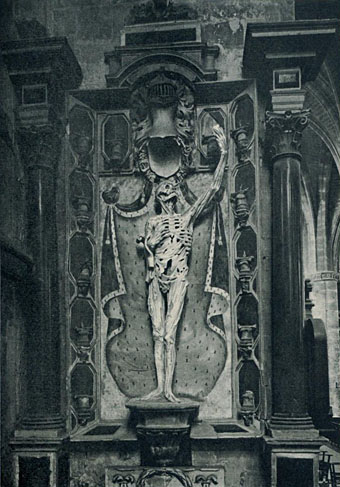
I don’t mind the style, it’s preferrable to the rudimentary bestsellerese that passes for much genre writing today. D’Arch Smith’s writing is witty, and there’s enough going on to sustain the interest. I thought at first the uncredited cover design would have had little to do with the contents but Ligier Richier’s celebrated sculpture of René de Chalon is referred to early on:

Nicholas had done himself to death. That was unequivocally stated in the garish red and black drawing depicted above the lyrics. In a grotesque parody of Ligier Richier’s funerary monument at Bar-le-Duc of the skeletal knight holding out his heart to God—possibly viewed by Ma during her historical tour of Alsace-Lorraine—Nicholas had been delineated in the same mortified yet exultant posture. The original figure was macabre enough, in the flaying of the naked body and the exposure of leg and arm muscles not yet rotted from the bones, to command attention, but the figure was imbued by Richier’s art with an enduring majesty that, though his design had been closely followed, was utterly overturned by the specious caricature of Nicholas Spark emblazoned down the waitress’s white cotton vest.

Given this, it’s a safe bet that the author would have asked for the capital “A” in the title to be given the same phallic connotations as it has in Aleister Crowley’s signature.

richier1.jpg

The web has plenty of photos of Le Transi de René de Chalon (c. 1545) but this view of Richier’s sculpture shows it to better effect than those where the background reduces the impact of the figure. The photos are from Ligier Richier, l’Artiste et Son Uvre (1911) by Paul Denis. As for Alembic, that’s currently out-of-print but copies are easy enough to find online.
richier2.jpg

Elsewhere on { feuilleton }
The book covers archive

Previously on { feuilleton }
Atalanta Fugiens
Splendor Solis revisited
Laurie Lipton’s Splendor Solis
The Arms of the Art
Splendor Solis
Amphitheatrum Sapientiae Aeternae
Cabala, Speculum Artis Et Naturae In Alchymia
Digital alchemy

Weekend links 147

kalynovych.jpg

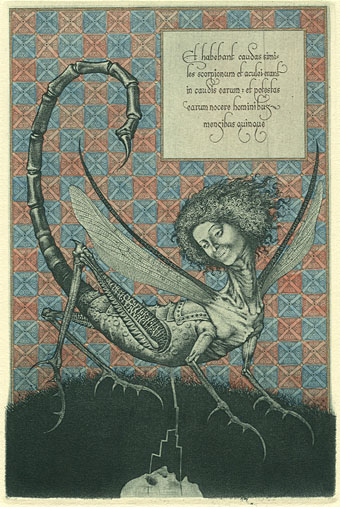
Bestia Apocalypsi (2000) by Konstantin Kalynovych.

A funding page for Better Things: The Life and Choices of Jeffrey Catherine Jones, Maria Paz Cabardo’s documentary film about the late comic artist and illustrator.

• Phantasmaphile’s Pam Grossman has declared 2013 to be the Year of the Witch.

• At WFMU: The Space Ghost Coast To Coast Sonny Sharrock Tribute Episode.

I think that mass culture is idiotic. I always have. Even things that are the sort of trendy new whatevers, it’s always about money and sex and nothing else.

Laurie Anderson on music for dogs and Obama.

• It’s that…thing…again. Clive Hicks-Jenkins on his new Mari Lwyd designs.

• Rick Poynor’s Dictionary of Surrealism and the Graphic Image.

• “Why do gay porn stars kill themselves?” asks Conner Habib.

scarfolk.jpg

If you’re staycationing in Scarfolk this year you’ll be pleased to hear the town now has 20% less rabies. Above: The 1972–73 prospectus for scarecrow and wicker man biology at Scarfolk Technical College. Related: A Day At The Seaside. I guessed the source even without the cryptic comments. Can you?

Laurie Spiegel designed a T-shirt for The Wire magazine.

Julia Holter covers Chiamami Adesso by Paolo Conte.

Strange Attractor has two new Austin Spare prints.

Forgotten Women Designers and Illustrators.

• RIP Alan Sharp, a sharp screenwriter.

• “Can You Pass the Acid Test?

Sonny and Linda Sharrock live at WKCR 03/21/74 | Many Mansions (1991) by Sonny Sharrock | Ghost Planet National Anthem (1993) by Sonny Sharrock

Kenneth Anger’s Hollywood Babylon

anger1.jpg

Nigel Finch was a key member of the team of producers and directors working on the BBC’s Arena arts documentaries throughout their golden run during the 1980s and 1990s. The films he directed himself—among them studies of Robert Mapplethorpe’s photography, and a history of the Chelsea Hotel in New York—gave him an opportunity to push some gay content into the TV schedules at a time when Britain’s gay population were seen as enough of a public threat to be legislated against. Some of that proselytising impulse can be found in Kenneth Anger’s Hollywood Babylon (1991), an hour-long documentary which alternates the life and work of the filmmaker with readings and enactments of the lurid episodes recounted in Anger’s scandal anthologies, Hollywood Babylon and Hollywood Babylon II. Finch at one point asks whether Fireworks, the first film in Anger’s Magick Lantern Cycle, should be regarded as a pioneering piece of gay cinema; Anger’s says he’s happy if people take it that way but says little else about its evident homoerotic atmosphere. He remains as resistant to identity politics as he’s always been. (See the unauthorised biography by Bill Landis for details.)

anger2.jpg

Between the readings and interview sections Finch shows Anger being chauffeured around Beverly Hills in a hearse which stops occasionally at some locus of bygone scandal. Most of the Anger anecdotes are familiar ones from subsequent interviews but there is a bonus for Angerphiles with the appearance at the end of Marianne Faithfull who talks a little about their relationship before singing Boulevard Of Broken Dreams. The picture quality of this YouTube copy could be better but it’s watchable enough.

Update: That YouTube link went private so I’ve updated the links to a better copy at the Internet Archive.

Previously on { feuilleton }
Lucifer Rising posters
Externsteine panoramas
Missoni by Kenneth Anger
Anger in London
Arabesque for Kenneth Anger by Marie Menken
Edmund Teske
Kenneth Anger on DVD again
Mouse Heaven by Kenneth Anger
The Man We Want to Hang by Kenneth Anger
Relighting the Magick Lantern
Kenneth Anger on DVD…finally