Weekend links 183

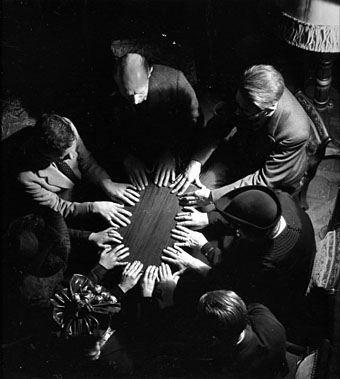
doisneau.jpg

La table qui tourne (1943) by Robert Doisneau.

In [Gödel, Escher, Bach], Hofstadter was calling for an approach to AI concerned less with solving human problems intelligently than with understanding human intelligence—at precisely the moment that such an approach, having borne so little fruit, was being abandoned. His star faded quickly. He would increasingly find himself out of a mainstream that had embraced a new imperative: to make machines perform in any way possible, with little regard for psychological plausibility.

The Man Who Would Teach Machines to Think by James Somers.

Whenever the latest pronouncements about the imminent arrival of artificial intelligence are being trotted out I wonder what Douglas Hofstadter would have to say on the matter. You don’t hear much about Hofstadter despite his having been involved for decades in artificial intelligence research. One reason is that he’s always been concerned with the deep and difficult problems posed by intelligence and consciousness, subjects which don’t make for sensational, Kurzweilian headlines. Hofstadter’s essays on AI (and many other topics) in Metamagical Themas: Questing for the Essence of Mind and Pattern (1985) are essential reading. James Somers’ lengthy profile for The Atlantic is a welcome reappraisal.

• The end of October brings the spooky links: When Edward Gorey illustrated Dracula | Paula Marantz Cohen on Edgar Allan Poe | Yasmeen Khan revisits Werner Herzog’s Nosferatu | Roger Luckhurst on horror from the Gothics to the present day, and Michael Newton on Gothic cinema.

•  Magic Words: The Extraordinary Life of Alan Moore is a biography of the Northampton magus by Lance Parkin. The author talks about his book here, and also here where if you look carefully you can see my Lovecraft book on his shelf.

• A crop of Halloween mixes: Boo, Forever by Jescie | Samhain Seance 2: Hex with a Daemon by The Ephemeral Man | Wizards Tell Lies & The Temple of Doom by The Curiosity Pipe | Radio Belbury’s Programme 11.

The Book of the Lost is an album by Emily Jones & The Rowan Amber Mill presenting music from imaginary British horror films. Release is set for Halloween. More details here.

Laura Allsop on Derek Jarman’s sketchbooks. Jarman’s Black Paintings are currently showing at the Wilkinson Gallery, London.

Magick is Freedom! Existence Is Unhappiness: Barney Bubbles vs. Graham Wood.

• Soho Dives, Soho Divas: Rian Hughes on sketching London’s burlesque artists.

Jenny Diski on the perennial problem of owning too many books.

Equus through the years by Clive Hicks-Jenkins.

Virgin Records: 40 Years of Disruptions

• At BibliOdyssey: Chromatic Wood Type

Witches at Pinterest

The Witch (1964) by The Sonics | My Girlfriend Is A Witch (1968) by October Country | You Must Be A Witch (1968) by The Lollipop Shoppe
Wicker mania

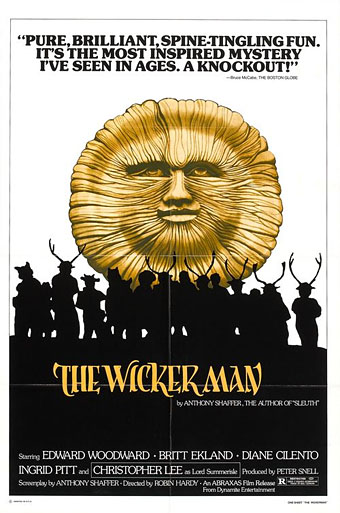
wicker1.jpg

US reissue poster (1979).

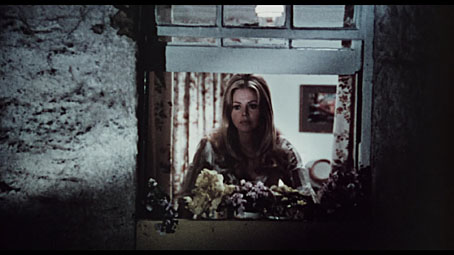
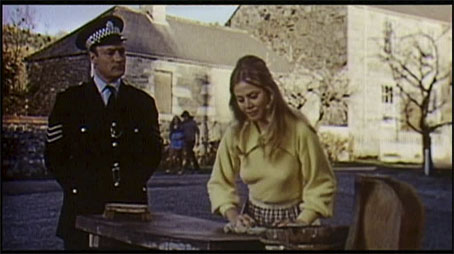
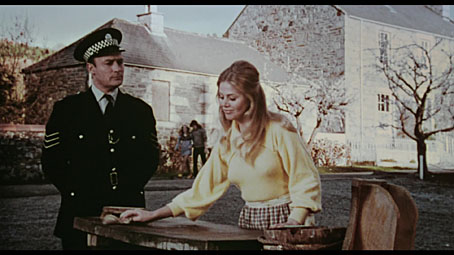
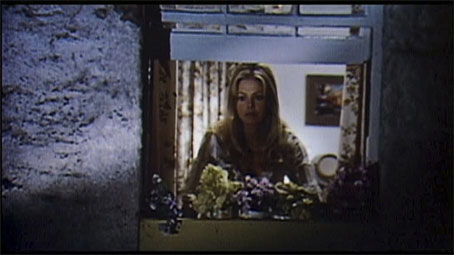
The restored version of The Wicker Man (1973) has been showing in UK cinemas recently, and the Blu-ray edition of the film is released this week. My copy arrived from Moviemail, and while I’m not in a great hurry to watch it again—this is one film that’s so familiar I could lip-synch along with it—it’s been a pleasure to compare the restored scenes to the long-version DVD which appeared in 2002. The earlier version had its missing scenes taken from a 1-inch videotape which was considerably poorer quality than the rest of the film. The restored scenes still look grainy and slightly washed out but now they at least look like pieces of film, not interpolations from video. The screengrabs below show the difference between scenes from the 2002 DVD compared to their equivalents on the Blu-ray. The rest of the film looks pristine, of course.

wicker5.jpg

wicker6.jpg

wicker7.jpg

wicker8.jpg

The new version isn’t as long as the longest version, however, a preliminary sequence in and around the mainland police station having been excised. In a lengthy feature in the October edition of Sight & Sound director Robin Hardy explains that he disliked what he calls “the Z-Cars section” (referring to an old UK TV series), and it’s true that it doesn’t help the story at all. Whether they like it or not, viewers of the film have to accept constable Howie as their proxy within the story, and he’s an insufferable prig throughout. That’s bearable in the context of his presence on Summerisle but the mainland sequence throws his character into relief against his less priggish colleagues.

wicker4.jpg

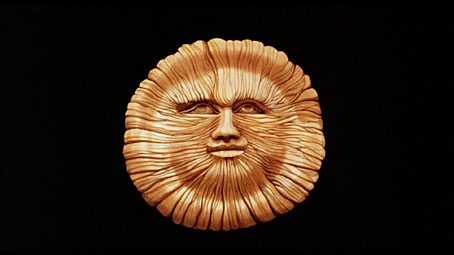
Another slight omission is the title card which used to precede the film thanking Lord Summerisle and the islanders for allowing the filmmakers to observe their rituals. In its place we have a zoom into the face of Nuada the Sun God, a painted rendering of a carved figure seen in the film. I’ve always liked this face which has become an emblem of the film even though it’s not present in all versions. (For more detail about the tangled history of the various prints, see this site.)

wicker2.jpg

Cover photo by Oliver Hunter.

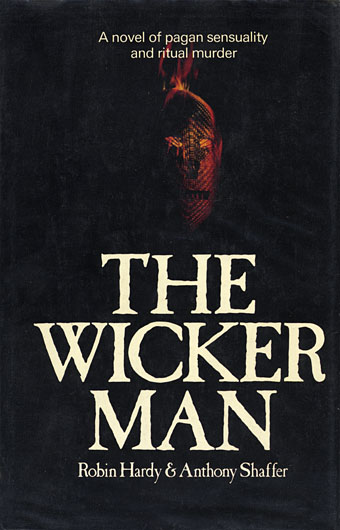
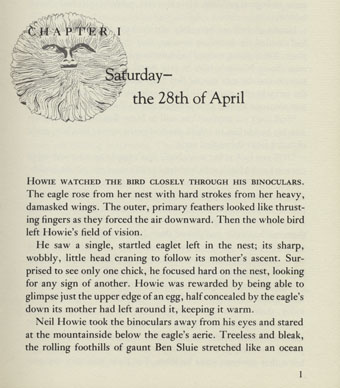
A rather bad drawing of the Nuada face appears at the beginning of each chapter of the novelisation which Hamlyn published in 1979 (and on the cover of the US edition from the year before). This was the year when the film’s reputation began to take off, and also the year it was reissued in the US. Although Hardy and screenwriter Anthony Shaffer are both credited for the novel I suspect the writing is mostly Shaffer’s work. It’s pretty good, and goes into considerable detail, fleshing out the story and Howie’s character, and also showing how much research the pair put into the pagan side of things. You also get the lyrics of some of the songs. Until the complete soundtrack appeared in 2002 the novel was the only place you could find the salacious missing verse from Willow’s Song which describes a maid milking a bull.

wicker3.jpg

And speaking of the soundtrack, the three-disc Blu-ray edition includes the complete soundtrack on one of its discs, a considerable bonus if you don’t have it already. I should note that my good friend Gav insists I mention that the film’s final brass fanfare—labelled as Sunset on the soundtrack album—is a Bulgarian folk tune entitled Rodopska Devoika Zamrakanala Mona Jana, something neither of us has ever seen credited.

Previously on { feuilleton }
Children of the Stones

A Scholar in his Study

rembrandt1.jpg

A Scholar in his Study (detail, 1650–1654) by Rembrandt van Rijn.

Rembrandt produced many etchings throughout his long career, and if he hadn’t also distinguished himself as a painter his etchings alone would have ensured that his reputation survived. For an example of his mastery of deep shadow see St. Jerome in a Dark Chamber (1642) where the solid masses of shade are created by a virtuoso display of cross-hatching.

rembrandt2.jpg

One etching is reproduced far more often than any of the others, the piece known as A Scholar in his Study, which can also be found labelled The Magician, or simply Faust even though it was never intended as an illustration of anyone so specific. The etching is often used as an illustration for Goethe’s play, of course, understandably when it’s one of the few instances in Western art of a first-rate artist depicting a visible occult event. Prior to the 19th century the depiction of magic in paintings or graphic works was generally limited to either mythological or religious tableaux, or to scenes of generic witchery. Rembrandt’s piece is unusual in showing what appears to be a manifestation of some sort, with a disc of Divine Names either partly concealing or forming the head of a spectral figure. The figure is barely visible in smaller reproductions but this large copy reveals the pair of hands below the disc which are drawing the scholar’s attention to what might be a mirror reflecting the glowing disc. Rembrandt produced a number of paintings and etchings on the theme of the scholar or philosopher in his study but none are as curious—or as popular—as this example. If it wasn’t for over-familiarity it’s likely it would seem even stranger today.

rembrandt3.jpg

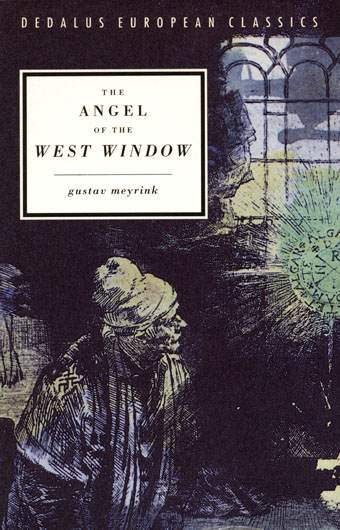
The Angel of the West Window (1991). Design by Tim Gray.

Elsewhere on { feuilleton }
The etching and engraving archive

Previously on { feuilleton }
Rembrandt’s vision

Andrey Avinoff revisited

avinoff1.jpg

(My apologies for the recent downtime. The hosting for this site has been a bit more unstable than usual.)

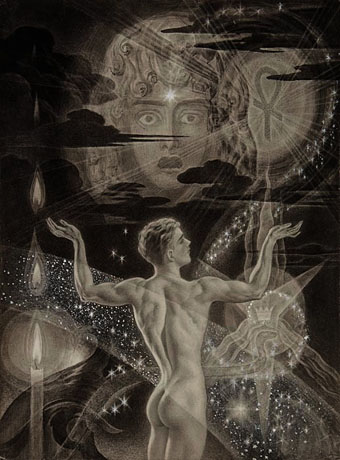
At a time when various Russians are trying to rewrite their nation’s gay history, there’s hardly been a better moment to remind ourselves of some of the people who contributed to that history. When I discovered the art of Andrey Avinoff (1884–1949) in 2007 most of the online examples of his work were in the collection of the Kinsey Institute. Avinoff was a friend of Kinsey’s (the artist escaped the revolution to live in the USA), and the professor no doubt took an interest in the evident homoeroticism of the drawings.

avinoff2.jpg

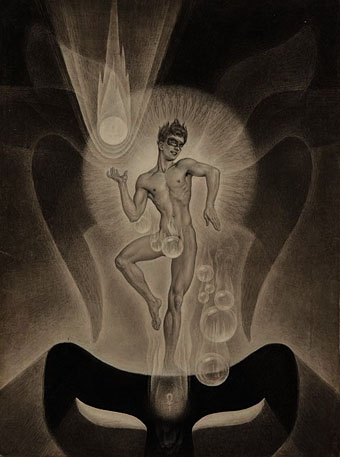
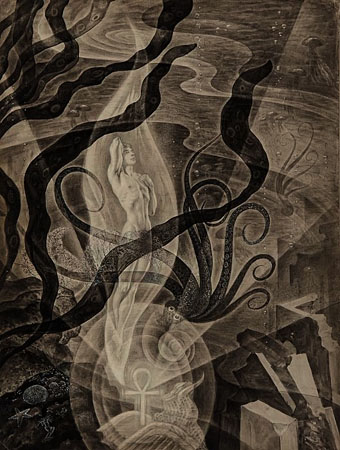
The homoerotics (mostly male nudes in fantasy scenes) are combined with some remarkable occult designs in Avinoff’s 21 illustrations for The Fall of Atlantis, a book-length poem by George Golokhvastoff published in 1944. The book was a limited edition, and a complete set of the drawings wasn’t forthcoming in 2007 so it’s been great to find Javier at Bajo el Signo de Libra posting the complete set. These are stunning illustrations which really ought to be seen by a wider audience; Avinoff isn’t a name you find very often in either the gay or the occult art world yet his draughtsmanship and imagination demand attention from both.

avinoff3.jpg

Elsewhere on { feuilleton }
The gay artists archive

Elsewhere on { feuilleton }
The art of Andrey Avinoff, 1884–1949

Weekend links 178

bantjes.jpg

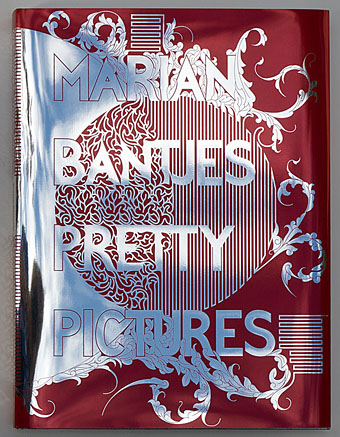
Pretty Pictures, a new book by designer Marian Bantjes, is out on October 1st.

• A writer admired by Angela Carter, Michael Moorcock, Harlan Ellison, Anthony Burgess, Jonathan Meades and Iain Sinclair; a “writer’s writer…[whose] best stories bear comparison with the Ficciones of Jorge Luis Borges”; a writer with an “unsettling quality to his writing, a whiff of brimstone that links him to fin-de-siècle occult figures such as HP Lovecraft—and even, at a further remove, Aleister Crowley”. David Collard explains why you may want to read something by Gerald Kersh (1911–1968), four of whose books are being republished.

• The Eccentronic Research Council and Maxine Peake pay homage to Delia Derbyshire’s The Dreams project with a new single out at the end of the month (Pye Corner Audio and Carol Morley appear on the flip). Ms Peake’s barm-cake reverie may be heard here.

• “Applying for grants, writing artist statements, showing up to openings—artists have to do far more than just make art if they want to find an audience for it.” Jen Graves on lies and deception in the art world.

The material does not make the work. The life does not make the art. Exactly the opposite. The work creates the material. The art creates the life. Did Trinidad exist before Naipaul? Did cargo ships exist before Joseph Conrad? Did Newark and the New Jersey suburbs exist before Philip Roth? Did women in playgrounds in New York City exist before Grace Paley? See how the writer invents the material? These places did not exist as literary subjects. They were invisible to literature. The magic of a great book is that it makes its own subject seem inevitable. The danger is, it makes the subject seem like the source of power in the work.

Phyllis Rose on life and literature.

• Mix of the week: Secret Thirteen Mix 087, 40 minutes of original electronic music by Geistform (Rafael Martinez Espinosa).

• “You’ve Got This“, an It Gets Better-style video support campaign for people recently diagnosed with HIV.

• At Dangerous Minds: Babalon Working: Brian Butler’s trippy occult odyssey with Paz de la Huerta.

Manfred Mohr‘s computer-created artwork, from the 1960s to the present.

Robert Macfarlane on the strange world of urban exploration.

Rick Poynor on Bohumil Stepan’s Family Album of Oddities.

• Oli Warwick talks to Martin Jenkins, aka Pye Corner Audio.

• The 384-page BUTT calendar for 2014 is now on sale.

• Pye Corner Audio: We Have Visitors (2010) | Toward Light (2011) | The Mirror Ball Cracked (2012)