The Egyptian Tarot

tarot01.jpg

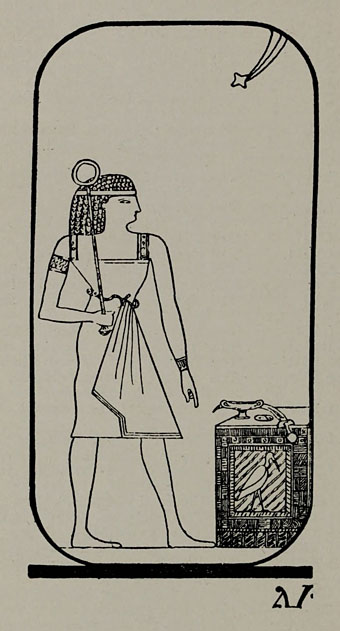
I: The Magus

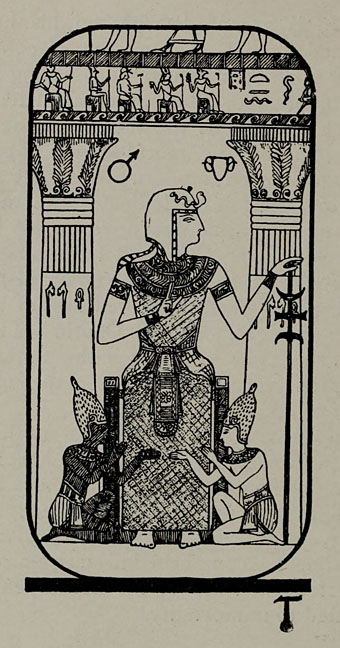
While looking at Tarot designs for work purposes (again) I remembered a book I used to own that demonstrated the symbolism of the Major Arcana by using side-by-side comparisons of cards from the more well-known decks: the Tarot de Marseille, Aleister Crowley’s Thoth deck, the Rider-Waite-Smith cards, and so on. One of the decks shown wasn’t so familiar, a 19th-century design that purported to depict the Ancient Egyptian figures from which the modern Tarot is derived. Like much occult history, this is an invention but I liked the look of the cards with their simple line drawings and clever matching of Egyptian motifs with the traditional symbols. My book was borrowed years ago and never returned (the second Tarot book I’ve had this happen to; don’t lend people your Tarot books!), so I couldn’t look for a reference, but this account of the history of the so-called Egyptian Tarot supplies all the relevant details and more.
tarot02.jpg

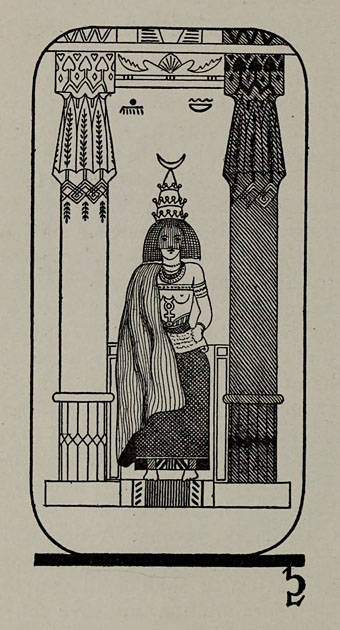
II: The Gate of the Sanctuary

The examples shown here are from Practical Astrology (1901), a book by Edgar de Valcourt-Vermont writing under the preposterous pseudonym “Comte C. de Saint Germain” (a real person, albeit dead by 1901, with a long history of appropriation by writers and charlatans). The drawings are reworkings of the first appearance of the Egyptian designs in an earlier book, Les XXII Lames Hermètiques du Tarot Divinatoire (1896) by R. Falconnier, the drawings there being the work of one M.O. Wegener. In addition to copying the designs Valcourt-Vermont filled out the set with a Minor Arcana of his own devising that looks distinctly amateurish next to the Wegener set. Since then the cards have continued to evolve, a more recent version being the Ibis Tarot which colours the drawings in a manner that doesn’t really suit this type of art. The cards shown in my errant book were memorable in part because they stood out from their vividly-coloured counterparts.
tarot03.jpg

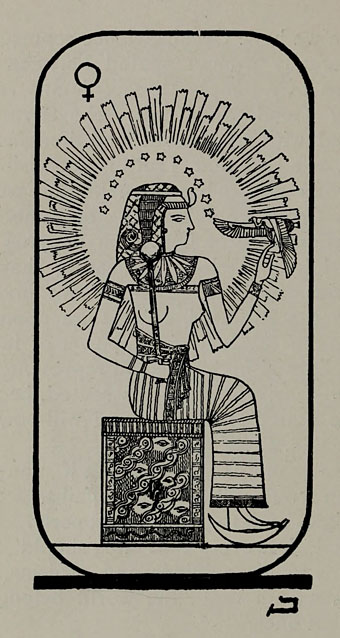
III: Isis-Urania

It’s good to see these again, and also surprising to discover a further detail, that the Wegener drawings had been based on descriptions by Paul Christian in another occult study, Histoire de la Magie (1870). Christian’s book was the subject of a previous post for also being the source of an illustration of a witches’ sabbat that turns up all over the place, usually without credit. Not for the first time, the occult world is smaller than it seems.
tarot04.jpg

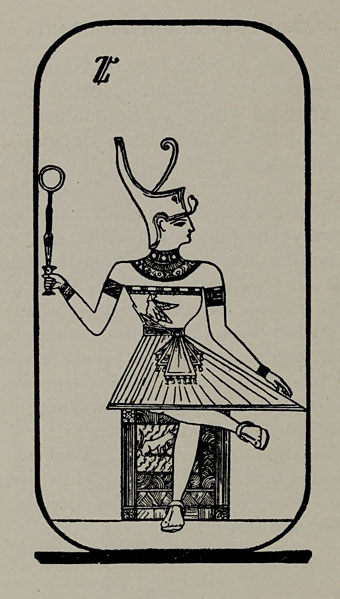
IV: The Cubic Stone

Wikipedia has copies of the drawings from the Falconnier book which may also be seen at Gallica, although the copy I found there was incomplete. The Valcourt-Vermont designs were published as a complete deck, The Egyptian Tarot, by Müller in 1978.
tarot05.jpg

V: Master of the Arcanes

Continue reading “The Egyptian Tarot”

Weekend links 529

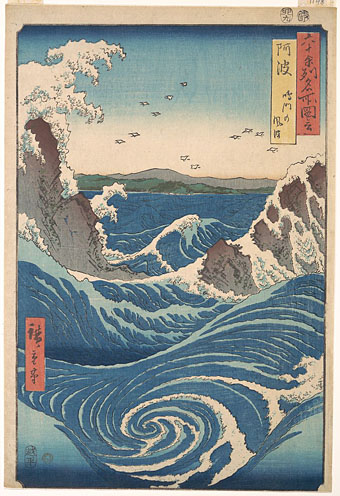
hiroshige.jpg

Naruto Whirlpool, Awa Province, from the series Views of Famous Places in the Sixty-Odd Provinces (c. 1853) by Hiroshige.

• Eric Margolis: “Yukio Mishima may have gone out in an inglorious blaze in 1970, but three of his previously untranslated works have been released in the English-speaking world in the last two years, with another on the way.” The forthcoming novel is Mishima’s only venture into science fiction (!), A Beautiful Star. The book was filmed by Daihachi Yoshida in 2017.

• “[Ace in the Hole] did well in Europe but not here, perhaps because Americans expected a cocktail and felt I was giving them a shot of vinegar instead.” Billy Wilder discussing his career with Charles Higham in 1967.

• Mixes of the week: All these things invisible by The Ephemeral Man, and Secret Thirteen Mix 306 by Yogev Freilichman.

“So I got a phone number for Vangelis, he was living in Paris and I went there and called him up. He said (affects a gruff Greek accent) ‘Hello’, I said, ‘My name’s Jon Anderson’. He said ‘What?’ I said, ‘I’m in a band called Yes’, he said, ‘Are you a singer? Well, come over’, so I went over. There was this big guy with a long kaftan on and a bow and arrow around his shoulder. I got into his palatial apartment near the Champs-Élysées and there’s quite a long hallway down to his living room, and there’s a little old man there sitting by the TV. Vangelis takes out his bow and sends this arrow down the hallway and it goes right through the window, because the window was open. I said, ‘Vangelis, you could have killed somebody’, he said, ‘Oh, don’t worry, I’m Greek’. I said, ‘I know you’re Greek, but come on’.”

Jon Anderson talking to Duncan Seaman about his first encounters with Vangelis

Tarot cards though the ages; examples from a new book on the subject published by Taschen.

The Suspended Vocation again: Ryan Ruby on Pierre Klossowski, “Brilliant Brother of Balthus”.

• Secret Sound podcast #17 is devoted to The Galaxy of Turiya aka Alice Coltrane.

• At Dennis Cooper’s: Shaye Saint John Day.

Kenneth Anger smiles!

Make Me Smile (Come Up And See Me) (1975) by Steve Harley and Cockney Rebel | Uncertain Smile (1983) by The The | Fleeting Smile (1988) by Roger Eno

Weekend links 526

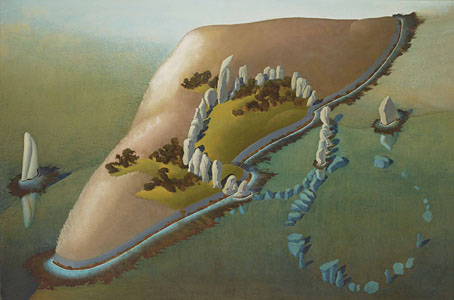
colquhoun.jpg

La Cathédrale Engloutie (1952) by Ithell Colquhoun.

• Many of the recent lists of “where to start with the music of [x]” aren’t filling an urgent requirement, but in the case of Sun Ra—whose discography runs to 95 albums—any guide is a useful one: Sean Kitching chooses 10 recordings from the Ra galaxy. I’m not unacquainted with Sun Ra’s music but there’s so much of it that almost all these suggestions are news. Related: Namwali Serpell on the life and work of a cosmic visionary.

• Coming soon from Strange Attractor, Ithell Colquhoun: Genius of The Fern Loved Gulley by Amy Hale, the first book-length study of the life and work of the British Surrealist and occult artist.

• I doubt I’ll get to see it but I’m pleased to know that the prematurely shuttered Aubrey Beardsley exhibition is returning to Tate Britain. You’ll need a Decadent face-mask.

• And speaking of music lists, Alexis Petridis compiles a ranking of all the songs by a little-known post-punk band from Manchester.

The Last Arcadian (Process Mix): more psychotropic nougat from Moon Wiring Club.

• Kill Me Again… Ken Hollings on Ennio Morricone and the music of the future.

Mervyn Peake‘s visual archive has been acquired by the British Library.

Anitra Pavlico on the fantastic world (and music) of Maurice Ravel.

Stanley Stellar‘s photos of the New York gay scene in the 1980s.

• At Dennis Cooper’s: Fetish.

• RIP Judy Dyble.

Wikidelia

Chelsea Morning (1968) by Fairport Convention | I Talk To The Wind (1968) by Giles, Giles & Fripp feat. Judy Dyble | Morning Way (1970) by Trader Horne

Weekend links 523

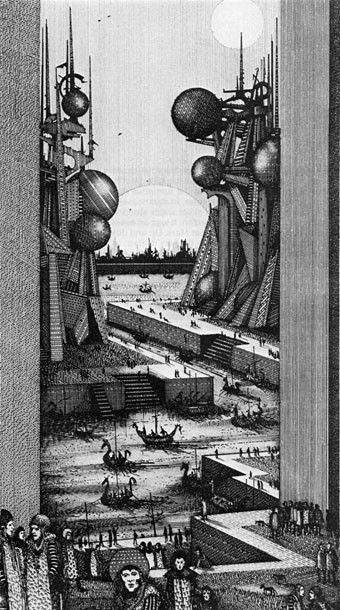
miller.jpg

One of Ian Miller‘s drawings from the illustrated edition of Ray Bradbury’s The Martian Chronicles, 1979.

• “I always said we were kind of an electronic punk band, really. We were never New Romantics, I don’t like it when we get lumped in with that.” Dave Ball of Soft Cell and The Grid talking to Duncan Seaman about his autobiography, Electronic Boy: My Life In and Out of Soft Cell. I’ll now be waiting impatiently for the unreleased Robert Fripp/Grid album to appear.

• “[Patricia] Highsmith’s writing—often eviscerating, always uncomfortable—has never been more relevant,” says Sarah Hilary.

• Ron Peck’s debut feature, Nighthawks (1978), is “a nuanced look at gay life in London,” says Melissa Anderson.

And then there are those figures who seem to flit around the edges of movements without ever being fully involved in any of them, who pursue their own eccentric paths no matter what is going on around them. These are the writers who make up the secret history of literature, the hidden history that’s not easily reduced to movements or trends, and who always waver on the verge of invisibility until you stumble by accident onto one of their books and realize how good they actually are, and wonder, Why wasn’t I told to read this before? But of course you already know the answer: You were not told because it doesn’t fit smoothly into the story those in authority made up about what literature is—it disrupts, it can’t be reduced to the literary equivalent of a meme.

That’s the kind of writer Pierre Klossowski (1905–2001) is. He is not a joiner. He has his own particular and often peculiar concerns, and pursues them. He does not particularly welcome you in. The content of his writing, too, has the feel of a gnostic text, as if you are reading something that, if only you were properly initiated, you would understand in a different way. In that sense his work has an esoteric or occult quality to it—and likewise in the sense that it returns again and again to the intersection of religion and pornography, the sacred and the profane.

Brian Evenson on The Suspended Vocation by Pierre Klossowski

• Chad Van Gaalen creates a psychedelic animation for Seductive Fantasy by the Sun Ra Arkestra.

• More sneak peeks from the forthcoming The Art Of The Occult by S. Elizabeth.

• More Robert Fripp: Richard Metzger on Fripp’s sui generis solo album, Exposure.

Pamela Hutchinson on the pleasures of David Lynch’s YouTube channel.

• Mix of the week: a second Jon Hassell tribute mix by Dave Maier.

• At Dennis Cooper’s: Ferdinand presents…Dark Entries Day.

15 fascinating art documentaries to watch now.

Soft Power by Patten.

• RIP Milton Glaser.

hauntología

Aquarium (1992) by The Grid (with Robert Fripp) | Soft Power (2005) by Ladytron | The Martian Chronicles (2007) by Dimension X

Weekend links 522

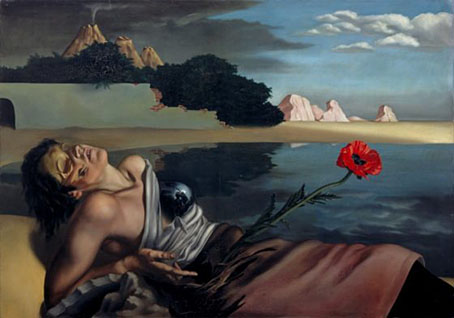
moesman.jpg

Self-Portrait (1935) by Johannes Hendrikus Moesman.

• At Bibliothèque Gay, René Bolliger (1911—1971), an artist whose homoerotica is being celebrated in an exhibition, Les Beaux Mâles, at Galerie Au Bonheur du Jour, Paris, next month. There are more beaux mâles in a new book of photographs, Hi, Hello!, by Roman Duquesne.

• The summer solstice is here which means it’s time for Dennis Cooper‘s favourite fiction, poetry, non-fiction, film, art and internet of the year so far. As before, I’m flattered to be listed in the internet selection. Thanks! Also at DC’s, Michael Snow Day.

• “I hope Roger Corman is doing okay,” I was thinking last week while rewatching one of Corman’s Poe films. He’s been overseeing the production of three new features during the lockdown so, yes, he’s doing okay. I loved the Cries and Whispers anecdote.

• “Unsettling and insinuating, fabulously alert to the spaces between things, Harrison is without peer as a chronicler of the fraught, unsteady state we’re in.” Olivia Laing reviewing The Sunken Land Begins to Rise Again by M. John Harrison.

The original Brain label release of Aqua (1974), the first solo album by Tangerine Dream’s Edgar Froese, had a different track list and different mixes from the Virgin releases. The album has never been reissued in this form.

• New music at Bandcamp: Without Thought, music for an installation by Paul Schütze; and Hatching Under The Stars, songs by Clara Engel.

Deborah Nicholls-Lee on Johannes Hendrikus Moesman (1909–1988), “the erotic Dutch surrealist you should have heard of”.

Kate Solomon on where to start with the Pet Shop Boys. I’d also recommend Introspective.

• Dalí in Holographic Space: Selwyn Lissack on Salvador Dalí’s contributions to art holograms.

• At Spoon & Tamago: An obsession with retro Japanese round-cornered windows.

John Boardley on the “writing mistresses” of the calligraphic golden age.

Mark Duguid recommends Michael Reeves’ Witchfinder General (1968).

• The favourite music of Crammed Discs boss, Marc Hollander.

• Occult/erotic prints by Eleni Avraam.

Aqua: Every Raindrop Longs For The Sea (Jeder Tropfen Träumt Vom Meer) H2O (1973) by Achim Reichel | Aqua (1979) by Dvwb | Aqua (1981) by Phew