Okinami letterforms

okinami4.jpg

A couple of years ago I posted an incomplete collection of record covers based on Hokusai’s prints, many of which included his most famous work, The Great Wave off Kanagawa. In our age of mechanical reproduction Hokusai’s wave has become as much an emblem for Japan itself as any of the official national symbols, reproduced endlessly in a variety of media while being subject to the usual 21st-century derivations and pastiches. This is a common fate for well-known artworks but Hokusai’s wave is one of the few that are flexible enough to be mutated into a seres of letterforms (you can’t really call this a font) like the ones we have here, a design created by Indonesian designer Aditya Tri which grafts portions of the print onto Garamond serifs. The name of the design, Okinami, is the Japanese word for an offshore wave.

okinami1.jpg

Okinami is an unusual design but this isn’t the first time that Hokusai’s wave has been combined with letterforms. When Tomita’s “Musical Fantasy of Science Fiction”, The Bermuda Triangle, was released in the West it was given new cover art, with a gatefold illustration by Don Punchatz and a title design that added the Great Wave to the modified Sinaloa typeface which by this time had become Tomita’s signature font.

tomita.jpg

Design by Joseph J. Stelmach.

Are there other examples out there? I wouldn’t be surprised. Meanwhile, Hokusai’s print will be even more visible next year when it appears on the back of the new 1000 Yen banknote. A good argument for the retaining of physical currency, and further evidence that Japan gets all the best things.

okinami2.jpg

Previously on { feuilleton }
Hokusai record covers
Waves and clouds
Tomita album covers

Weekend links 692

pearse.jpg

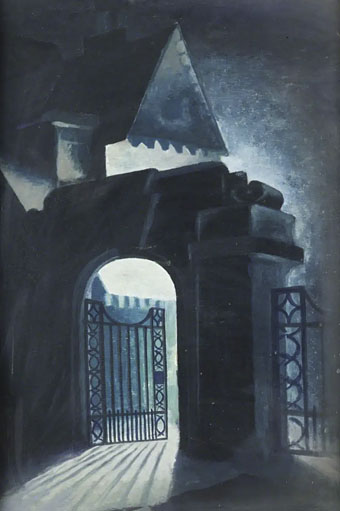
Illustration by Alfred Pearse for The Horror of Studley Grange by Clifford Halifax & LT Meade. Via.

The Haunting at 60: Guy Lodge asks “Is it still one of the scariest films ever made?” I say yes but then it’s always been a favourite. Also, Robert Wise is something of a cult figure in this house, not for his big-budget directing jobs on The Sound of Music and Star Trek: The Motion Picture, but for his RKO horror entries (The Curse of the Cat People and The Body Snatcher), his film noir (Born To Kill, The Set-Up, Odds Against Tomorrow), and two smaller science-fiction films from different decades, The Day the Earth Stood Still and The Andromeda Strain. All this and he also edited Citizen Kane.

• “This show makes an irrefutable case for her technical mastery while also affirming her as a first-rate fabulist whose disparate influences—chivalric romance, medieval architecture, tarot, psychology, astronomy, and much more—cohere into a visionary whole.” Jeremy Lybarger reviewing Science Fictions, the retrospective devoted to the art of Remedios Varo.

• New music: Improvisation On Four Sequences by Suzanne Ciani; Incorporeal by Hidden Horse; Atlas by Laurel Halo; Infinito (Version) by Moritz von Oswald.

While Ballard’s more outwardly conventional books may give us solider, more stable realities, what these realities often present…is a child (or childlike figure) frolicking against a backdrop provided by the destruction of an older order of reality that the world previously took for granted. It’s a cipher for his oeuvre as a whole: endlessly playing among the ruins, reassembling the broken or “found” pieces (styles, genres, codes, histories) with a passion rendered all the more intense and focused by the knowledge that it’s all—culture, the social order, the beliefs that underpin civilization—constructed, and can just as easily be unconstructed, reverse engineered back down to the barbaric shards from which it was cobbled together in the first place. To put it in Dorothean: In every context and at every level, Ballard’s gaze is fixed, fixated, on the man behind the curtain, not the wizard.

Tom McCarthy: JG Ballard’s Brilliant, Not “Good” Writing

• At Public Domain Review: Behold the Nebulous Smear: ‘Abd al-Rahman al-Sufi’s Illustrated Book of Fixed Stars (ca. 1430).

• At Unquiet Things: Shake, Shiver, and Shriek: The Haunted Gothic Nightmares of George Ziel.

Winners of Nature TTL Photographer of the Year 2023.

• The Strange World of…Gavin Bryars

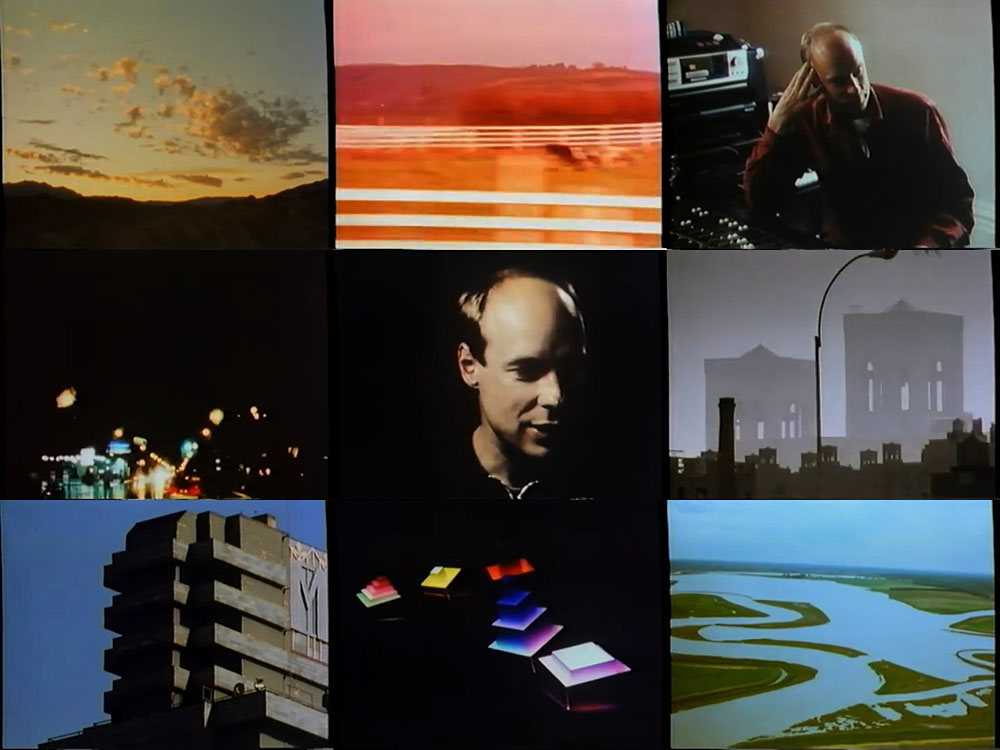
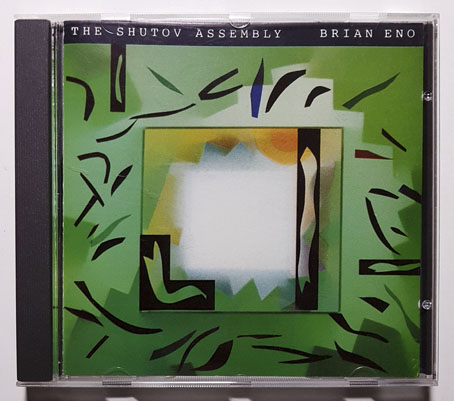
Watch The Stars (1968) by Pentangle | Stars (1983) by Brian Eno with Daniel Lanois & Roger Eno | Kelly Watch The Stars (1997) by Air

Weekend links 691

kruger.jpg

Arcus (2019) by Markus Matthias Krüger.

• “Listeners can only make an educated guess as to what the experience of working with Slapp Happy might have done for Faust.” Fergal Kinney on the 50th anniversary of Sort Of by Slapp Happy, an eccentric intersection of Anglo-American rock and German experimentalism.

• Now that the summer is over people are making mixes again. Take your pick this week between a mix for The Wire by Shane Woolman at Stihia festival, The Observatory by Jay Keegan, or DreamScenes September 2023 at Ambientblog.

• Quantum poetics: “How Borges and Heisenberg converged on the notion that language both enables and interferes with our grasp of reality.” William Egginton explains, with a little help from Funes the Memorious.

“I feel as if I am entering Jorge Luis Borges’s Library of Babel, a universe of books and records, or maybe a labyrinth of paper and vinyl,” a flabbergasted Szwed relates. “The temptation is to read and listen to every one of them in hopes of at least finding the meaning behind Harry Smith the reader and listener.” He adds, with pointedly Borgesian anxiety, that “maybe my book is in there, already written.”

Ed Halter reviewing Cosmic Scholar: The Life and Times of Harry Smith by John Szwed

• At The Daily Heller: Photographs of lost buildings and American ruins.

• At Dennis Cooper’s: The unknowable presents…Secretly encoded.

• At The Paris Review: Six photos from WG Sebald’s albums.

Winners of the Astronomy Photographer of the Year 2023.

The Art of Cover Art: A Substack by Rachel Cabitt.

• New music: Le jour et la nuit du réel by Colleen.

Familiar Reality (1971) by Dr John | Reality Dub (Virtual Reality Mix) (1993) by Material | Reality Net (1994) by Richard H. Kirk

Ash

ash.jpg

Cover art by Clayton Welham.

I’ve been doing the design duties on albums and singles by Emptyset since their first self-titled release in 2009. The latest album from the electronic duo, Ash, is also the 50th release on the Subtext label for which I’ve once again provided a minimal layout. I’ve no idea how the images by Clayton Welham were created, and I’m quite happy not knowing. Ash is available for pre-order ahead of its release next month.

Work announcements here have been rather scarce of late, in part because I’ve been working on a major project which is nearing completion and will no doubt be announced soon. Watch this space.

Weekend links 689

cossard.jpg

Salammbô (1899) by Adolphe Cossard.

• At Unquiet Things: “A mystery that no longer exists: Wrinkle in Time cover artist revealed”. S. Elizabeth explains. I did a little research of my own into this enigma without success. Good to know that it’s been resolved.

• James Balmont’s latest guide to Japanese cinema is an examination of the transcendental oeuvre of Yasujiro Ozu.

• At Spoon & Tamago: Trains intersect with everyday life in nostalgic illustrations by Shinjiro Ogawa.

• DJ Food discovered a set of Zodiac posters by Bruce Krefting from 1969.

• At Wormwoodiana: John Howard on looking for misplaced Machens.

• At Vinyl Factory: Discovering Mort Garson with Hilary Wood.

• At Dennis Cooper’s: More Ozu in Yasujiro Ozu Day.

• New music: Multizonal Mindscramble by Polypores.

• Mix of the week is a mix for The Wire by Aho Ssan.

• Ioneye in conversation with Bill Laswell.

Train Song (1969) by Pentangle | Love On A Real Train (1984) by Tangerine Dream | Tokyosaka Train (2002) by Funki Porcini