Weekend links 566

hokusai.jpg

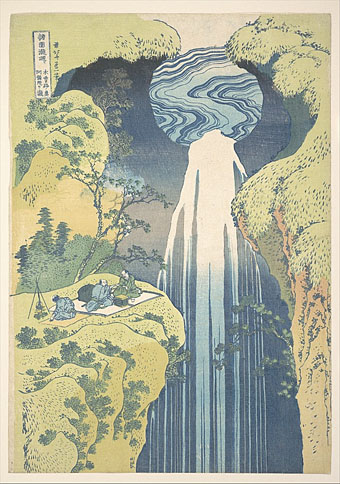
The Amida Falls in the Far Reaches of the Kisokaido Road. From the series A Tour of Waterfalls in Various Provinces (c. 1832) by Hokusai.

• New music: In Love With A Ghost by Kevin Richard Martin (aka Kevin Martin, The Bug, etc), a preview from his forthcoming alternative score for Andrei Tarkovsky’s Solaris (1972). In other hands I’d probably dismiss a further addition to the trend of creating new scores for films that don’t require them. Tarkovsky’s film certainly doesn’t need any new music, and we’ve already had an album-length homage from Ben Frost & Daníel Bjarnason. But I like Martin’s sombre atmospherics so he gets a pass with this one.

• “[Pauline] Oliveros wrote a piece for the New York Times in 1970 titled And Don’t Call Them Lady Composers, focusing on the difficulties of women being noticed and taken seriously in her field. It’s still online and could have been written yesterday.” Jude Rogers on Sisters With Transistors, a documentary about women in electronic music. Madeleine Siedel interviewed Lisa Rovner, the film’s director. Watch the trailer.

Submissions to the 16th number of Dada journal Maintenant will be open at the beginning of October, 2021, following an announcement of the theme of the new issue in September. All you would-be (or actual) Dadaists out there have the summer to plot your potential contributions.

Our reverence for originals takes an absurdly extreme form in the recent craze for NFTs (non-fungible tokens), where collectors and traders spend huge sums of money on unique ‘ownership’ of a digital artwork that anyone can download for free. Since there’s no such thing as the original of a digital file, the artist can now certify the file as the one and only ‘original copy’, and make a fortune. Time will tell whether this is a transient fad or a new way of establishing the feeling of a relationship to the mind of the digital artist.

But our reverence for originals isn’t universal. Treating the original as special and sacred is a Western attitude. In China and Japan, for example, it’s acceptable to create exact replicas, and these are valued as much as the original—especially because an ancient original might degrade over time, but a new replica will show us how the work looked originally. And, as mentioned, there are studios in China where artists are employed to create fakes. Perhaps our culture teaches us to respond to artworks by inferring the mind behind the art.

“Works of art compel our attention—but can they change us?” asks Ellen Winner

• “What Don basically did here is find a series of one or two bar riffs, or parts, that he liked, have me write them down, and then say, in essence, ‘make something out of this’.” John French (aka Drumbo) recalls the making of Trout Mask Replica.

• From 1988 (and relevant this week because I’m reading a Pynchon novel): Thomas Pynchon’s review of Love in the Time of Cholera.

• Andy Thomas on fusion legend Ryo Kawasaki, pioneer of the synth guitar.

• At Dennis Cooper’s: Dimitri Kirsanoff Day.

Gareth Jones’ favourite music.

• RIP Monte Hellman.

The Sea Named “Solaris” (1978) by Tomita | Solaris (2014) by Docetism | Solaris Return (2019) by Jenzeits

Weekend links 560

martin.jpg

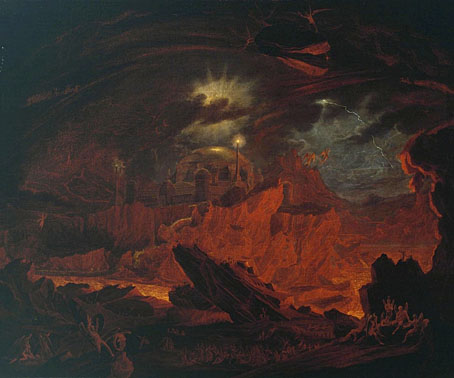
The Fallen Angels Entering Pandemonium, from ‘Paradise Lost’, Book 1 (c.1841) by John Martin.

• “Hergé’s heirs sue artist over his Tintin/Edward Hopper mashups.” The complaint is that the paintings of Xavier Marabout besmirch Tintin’s character by making him seem…human? Silly. I’d sooner complain that Hergé’s ligne claire drawing style is an awkward match for Hopper’s realism. And besides which, isn’t Tintin gay? There’s a lot of wish-fulfilling slash art showing Tintin and Captain Haddock in a closer relationship than Hergé ever would have wanted. This Canadian magazine cover by Normand Bastien dates from 1987.

• “Everyone wanted to make products that looked fast and angry and maybe wanted to lay eggs in your brain.” Alexis Berger tells S. Elizabeth how she avoided years stuck in a design office by becoming a jeweller instead.

• New music: Chiaroscuro by Alessandro Cortini, and Frequencies For Leaving Earth Vol. 4 (One-Hour Loop) by Kevin Richard Martin & Pedro Maia.

The Willows is less a flight of fancy and more an attempt to articulate the ways in which what we dubiously still call “nature” is at once an object of human systems of knowledge and yet also something that undermines those same systems. Thus if The Willows is indeed a classic of “supernatural horror” (as HP Lovecraft would famously note), we might also be justified in calling it “natural horror” as well. In Blackwood’s wonderfully slow, patiently constructed scenes of atmospheric suspense, there is the sense of an impersonal sublime, a lyricism of the unhuman that shores up the limitations of anthropocentric thinking, as well as evoking the attendant smallness of human beings against the backdrop of this deep time perspective.

Eugene Thacker on how Algernon Blackwood turned nature into sublime horror

• Women of Letters: John Boardley talks to Lynne Yun, Deb Pang Davis, Coleen Baik and Duong Nguyen about their typographic designs.

• At Google Arts & Culture: Music, Makers & Machines: A brief history of electronic music.

• At The Public Domain Review: The Universe as Pictured in Milton’s Paradise Lost (1915).

• Beyond the Perseverance drone: Chloe Lula on the sounds of space.

• At Wormwoodiana: Colour magazine (1914–1932).

Wyrd Daze Lvl.4 FOUR STAR is here.

• At Dennis Cooper’s: Hell.

O Willow Waly (1961) by Isla Cameron And The Raymonde Singers | Cool Iron (1972) by The Willows | The Willows (2005) by Belbury Poly

Typographische Jahrbücher, 1902

tj02.jpg

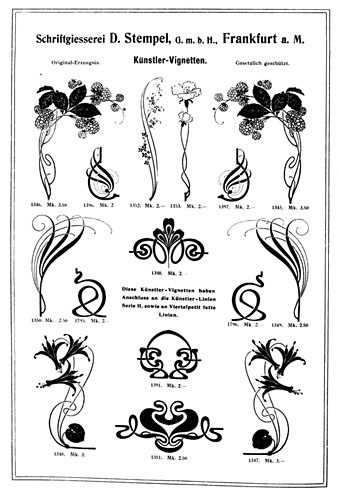
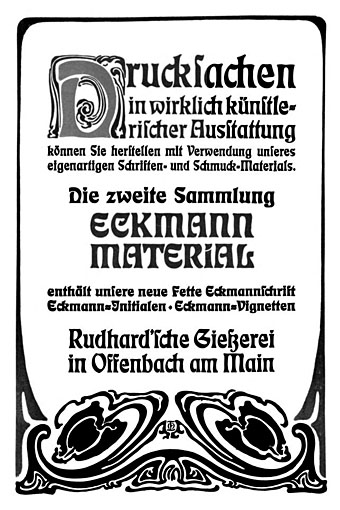
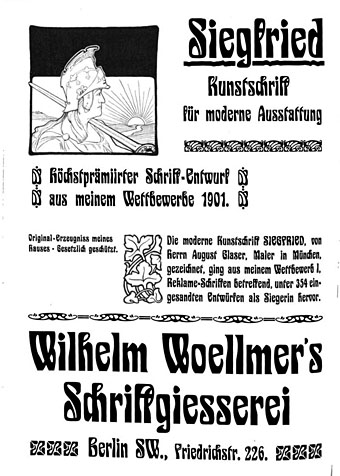
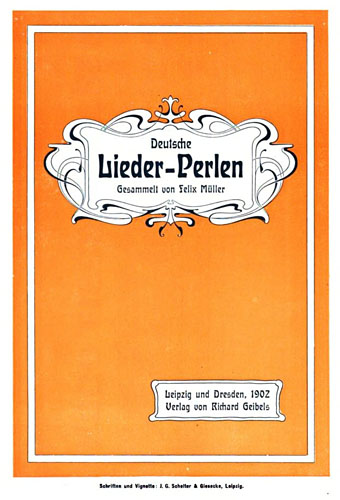
My work this week is more Deco than Nouveau but I enjoy looking at Art Nouveau graphics even when I don’t have any immediate use for them. Typographische Jahrbücher was a German publication for typographers and printers whose pages are filled with samples of the latest type styles and print decorations, together with many adverts that use the same graphics. The examples here are from issues for the year 1902 when Art Nouveau (or Jugendstil as it was in Germany and Austria) had reached its peak as the predominant European style. This is the kind of book I love to see, one with a wide variety of borders, letterforms and motifs for print use alone, not designs for textiles or other crafts. Of note are the pages below promoting a pair of recent typefaces, Eckmann and Siegfried. Both designs soon fell out of fashion but returned to prominence in the 1960s among the typefaces of the occult revival. It’s a shame the quality of this book isn’t better—it’s another poor Google scan—but I’m happy to find it. 750 pages; dig in here.

tj20.jpg

tj05.jpg

tj01.jpg

tj09.jpg

Continue reading “Typographische Jahrbücher, 1902”

Figures of Mortality: Lawrence versus Dalí

lawrence1.jpg

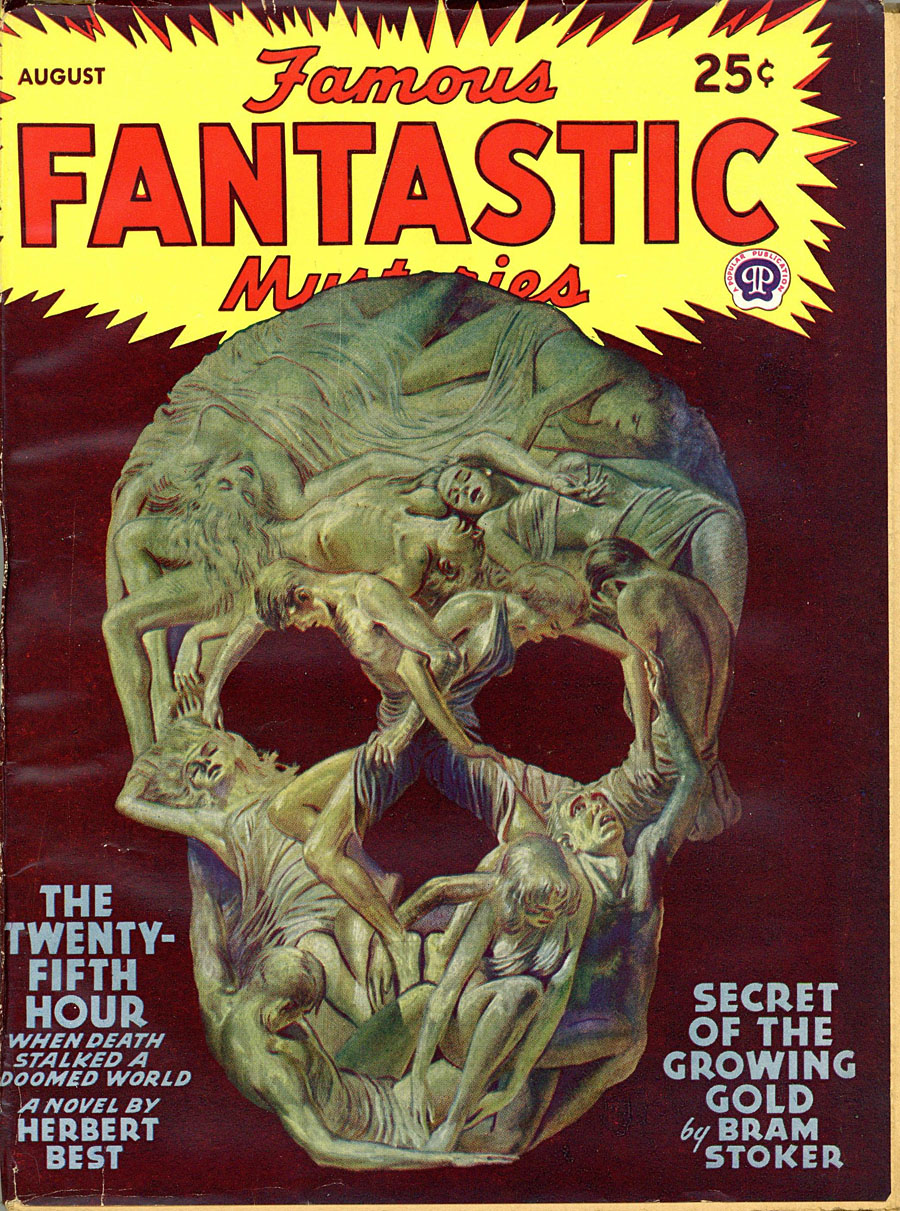
Famous Fantastic Mysteries (August, 1946).

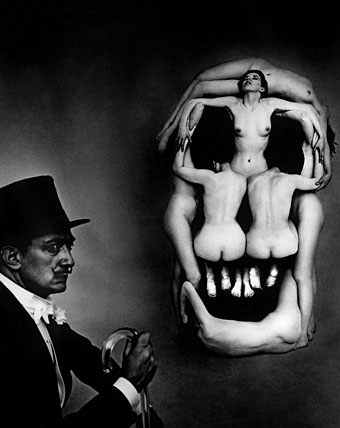
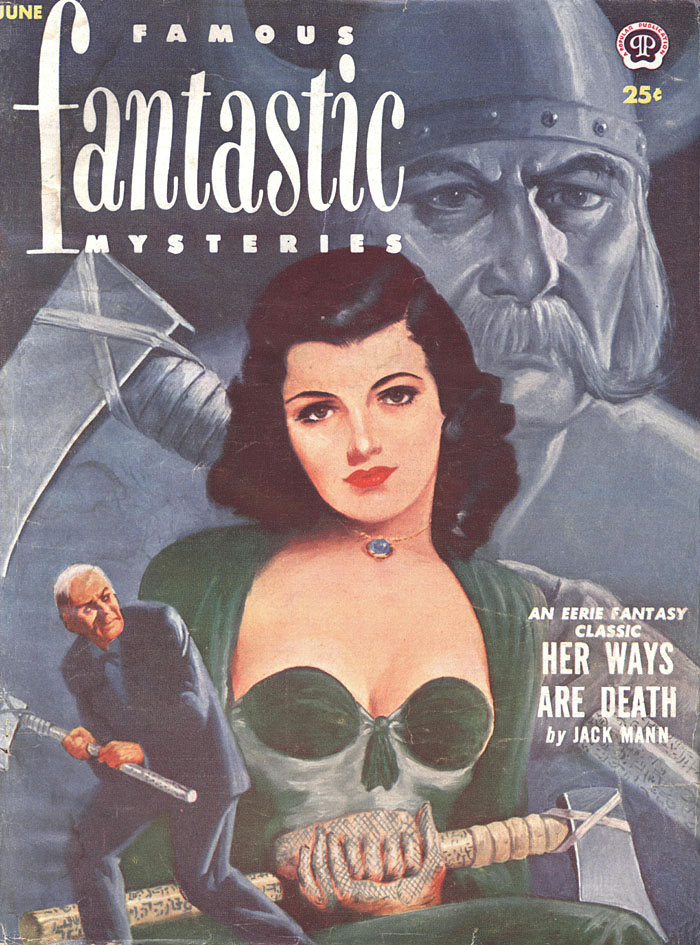
Salvador Dalí and Philippe Halsman popularised the image of a human skull created by an arrangement of bodies in Halsman’s 1951 photo-portrait of the artist, In Voluptas Mors. The assemblage, which was based on a sketch by Dalí, has been imitated by photographers and poster designers but I’ve yet to see any mention of this painted precursor by illustrator Lawrence Sterne Stevens (or “Lawrence” as he was always credited) for Famous Fantastic Mysteries in August, 1946. I’d assume the similarity is a coincidence. The subliminal skull in painting and drawing goes back at least as far as the 1890s (see this post), while Dalí was always very adept at finding and creating visual rhymes. Variations on the skull-from-figures motif appear in paintings throughout his career, one of the earliest being a minor work, Dancer – Skull, from the 1930s. Another painting, a commission for a wartime poster warning US soldiers about the hazards of venereal disease, features a pair of women, and predates Lawrence’s cover by four years.

skull_dali_halsman.jpg

In Voluptas Mors (1951).

Lawrence deserves credit, however, for having created a more successful arrangement of bodies than Halsman and Dalí managed, although it’s easier to do this in a painting than it is to arrange a group of women in a studio. Some of the limbs of Lawrence’s figures are extended or foreshortened, while the contrast between light and shade has been reduced to aid the composition. Lawrence painted a further variation on the subliminal skull in a cover for Famous Fantastic Mysteries the year after the Dalí/Halsman portrait, while Dalí himself returned to the theme with Skull of Zurbarán in 1956.

lawrence2.jpg

Famous Fantastic Mysteries (June, 1952).

Previously on { feuilleton }
Être Dieu: Dalí versus Wakhévitch
Chance encounters on the dissecting table
Salvador Dalí’s Maze
Dalí in New York
Dalí’s discography
Soft Self-Portrait of Salvador Dalí
Mongolian impressions
Hello Dali!
Dirty Dalí
The skull beneath the skin
Impressions de la Haute Mongolie revisited

Ghost Box and The Infinity Box

yuggoth.jpg

It’s less of a surprise than it may seem to go searching for the source of a quote only to find yourself immediately faced with one of your own artworks. The posts here go back almost 15 years, and when so many of them cover niche interests any attempt to further explore a particular niche can circle back to something I’ve already posted. The latest example is an unusual one, however. The picture above is the Haeckel collage I created for the Starry Wisdom collection of Lovecraftian fiction in 1994, a piece that was later digitally refashioned for The Haunter of the Dark book. The quote I was pursuing is as follows:

“Inside the infernal box are impossible spaces, dark screens and mirrors, terrible traces of light, calcified thought forms and endless idiot mutterings. The switch is thrown and the magnetic coils begin to generate their obscene flickering images. This contraption might have been conceived by the Old Ones long before it was assembled by human hands.”
—The Infinity Box, Alan Causley & MB Devot

The description appears together with a dialogue extract from Nigel Kneale’s The Stone Tape on the fourth Ghost Box release, Ouroborindra (2005) by Eric Zann, a one-off album of spooky sample soundscapes created by a pseudonymous Jim Jupp in between his Belbury Poly albums. All the Ghost Box releases feature significant quotes, most of which are genuine extracts from stories, novels, non-fiction works, etc. The description of the Infinity Box raised my suspicion about its authenticity when the only references to either it or Causley and Devot are in listings for the Eric Zann album. My Yuggoth collage appears on this page which further compounds the confusion by making it seem that my art is somehow connected to Causley and Devot and their mysterious box. This isn’t a complaint but it doesn’t help clarify the situation. Alan Causley has no credits anywhere outside the quote but there is another Causley, the celebrated poet, Charles, whose poems are sampled on later Ghost Box releases by The Focus Group, aka Ghost Box co-founder Julian House. Scrutiny of the other Ghost Box albums reminded me that quotes from MB Devot’s writings appear elsewhere on the early releases but I hadn’t bothered to look up the name until now.

ouroborindra.jpg

It’s often the case with posts such as this that mild curiosity turns into deeper intrigue. The web of connections becomes more tangled on the first Ghost Box release, Sketches And Spells by The Focus Group, which has a Devot quote from a text with the apt title The Tangled Beams, and a final track with the title Starry Wisdom. Devot is described by reviewers as either a fictional writer or an authentic scholar, the latter designation being supported by a Wikipedia page. Wikipedia may be prone to errors but it isn’t known for fake entries so this was a surprising discovery; Devot is also referenced on the page for parapsychologist TC Lethbridge who happens to be another source of Ghost Box quotes. Suspicion returns when you try to search for any of Devot’s listed publications, none of which turn up in WorldCat or similar catalogues. One of the Wikipedia print sources is an issue of Fortean Times from 1989 but there’s nothing about Devot listed in the contents of that issue. Issue 53 was a crop circle special, however, so it certainly fits the Ghost Box interest in the paranormal as it manifests in the British countryside. We now know that crop circles were man-made, not the product of flying saucers or other phenomena, so this may be fitting as well.

devot.jpg

I would have left the search there but I did find one further Devot connection that I might otherwise have missed. Folklore and Mathematics is the title of a one-off Ghost Box periodical published in 2007 for people subscribed to the label’s mail order service. It’s a typically fine Julian House artefact that complements the Sketches And Spells album in both its title and its graphics. Inside we find “From the archives of MB Devot”, and discover another reference to the Infinity Box. Apparently the black-and-white graphics that cover all the early Ghost Box discs are vibration patterns—”verberations”—created by Devot’s occult apparatus.

otherwhere.jpg

I wrote above that “any attempt to further explore a particular niche can circle back to something I’ve already posted” so I wasn’t too surprised to have all these explorations finding their way back here. In 2009 Julian House exhibited three invented books as part of The New Spirit Happening, an exhibition of Ghost Box-related work at the Architect’s Gallery in Teddington. I posted two of the covers after the exhibition but couldn’t recall who the books were credited to. The authors are—inevitably—”A. Causley” and “MB Devot”, and the volumes feature by-now familiar phrases: “The Tangled Beams”, “The Infinity Box”. Also more Lovecraftian verberations: “Heavens Other Colour”, “The Eye at the Threshold”. So Causley and Devot have been lurking here for the past decade, in which case having my artwork attached to their names no longer seems like an arbitrary association. “Inside the infernal box are impossible spaces, dark screens and mirrors…”. Indeed there are.

Previously on { feuilleton }
Unearthly tones
Owls and flowers
The White People by Arthur Machen
Stone Tapes and Quatermasses
The Ghost Box Study Series
A playlist for Halloween: Hauntology
Forbidden volumes
The Séance at Hobs Lane
Ghost Box