Weekend links 403

pennington.jpg

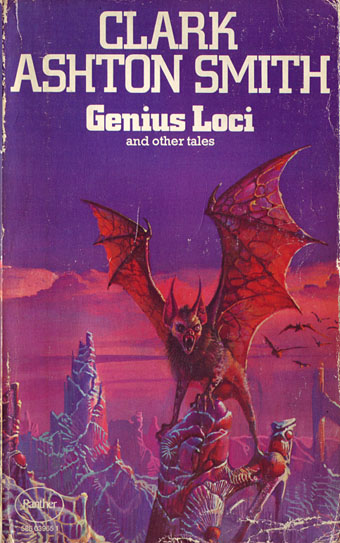
Cover art by Bruce Pennington, 1974. Via Clark Ashton Smith vs Bruce Pennington.

Garçons de Joie. Prostitution masculine à Paris 1860-1960 is an exhibition running at Galerie Au Bonheur du Jour, Paris, until May. The catalogue is expensive (and seems to be in French throughout) but features a substantial amount of rare homoerotic art.

• In the latest Expanding Mind podcast Erik Davis talks to Burt Shonberg biographer Spencer Kansa about LA bohemia, psychedelic art, Marjorie Cameron, gumshoe biography, and his new book Out There: The Transcendent Life and Art of Burt Schonberg.

Gregg Anderson on 20 years of Southern Lord’s dark and heavy art. Related: Earth’s Dylan Carlson announced a new solo album, Conquistador, and single, Scorpions In Their Mouths.

Without any formal training, Smith began to paint and draw his strange visions of sentient plants, grotesque creatures from other dimensions, and throbbing alien landscapes. Eventually commissioned to provide illustrations for Weird Tales, he became one of Lovecraft’s most voluminous correspondents (though never as voluminous as Lovecraft himself). Over the next 10 years, they filled one another’s mailboxes with effusive admiration for each other’s stories and poems. With Lovecraft’s adulatory wind at his back, Smith never strayed far from the Long Valley, and sat home to produce more than a hundred bizarre, linguistically challenging, often unforgettable stories and novelettes for the pulp magazines between 1925 and 1936. Unsurprisingly, Smith’s spurt of fictional creativity didn’t survive the death of Lovecraft in 1937, and while that rich burst of stories may not have earned Smith much money or fame, it caused an almost episteme-shifting earthquake in the brains of the young, aspiring writers lucky enough to read him.

Scott Bradfield on Clark Ashton Smith

Psychomagic, An Art That Heals will be Alejandro Jodorowsky’s next feature film if the crowdfunding is successful. Many rewards are available, large and small.

• At The Quietus this week: Val Wilmer on Sun Ra, and The Strange World of…Cocteau Twins.

• Spectacular images from Chicago’s turn-of-the-century design bible (The Inland Printer).

The shop that buys your dead uncle’s porn collection.

• Mix of the week: FACT mix 642 by Mokira.

Cafe Bohemian (1959) by The Enchanters | Genius Of Love (1981) by Tom Tom Club | A Scandal In Bohemia (1986) by United States Of Existence

HR Giger’s Passagen

giger1.jpg

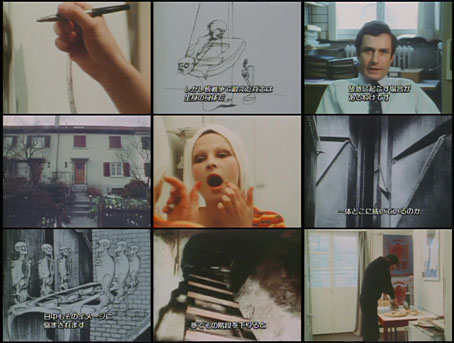
HR Giger’s art books were always very thorough in detailing all the media manifestations of the artist’s work, including film and television appearances. For years this presented tantalising questions, especially regarding the lengthy pre-Alien documentaries that were listed there: what were these films, and when would we get to see them? Giger’s Necronomicon (1976) did finally appear on YouTube a few years ago, and now here’s the second of the pair thanks to an upload of what appears to be a Japanese laserdisc.

giger2.jpg

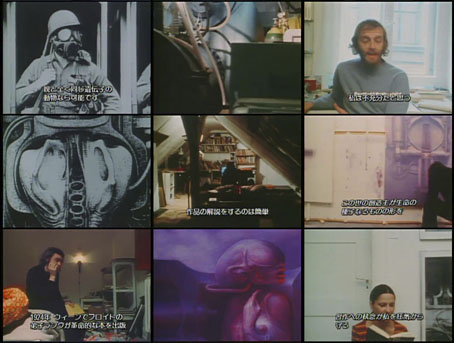
Passagen was made in 1972 by Giger’s friend Fredi M. Murer, their third film collaboration after Heimkiller and High (1967) and Swiss Made 2069 (1968). The latter (which Giger co-directed) is still frustratingly absent from the web, and similarly tantalising for being a 45-minute piece of underground science fiction which features Giger’s first production designs for cinema. Passagen was less ambitious, a 50-minute documentary about Giger’s work made for the German TV station, WDR. As a documentary it functions as a companion to Giger’s Necronomicon, while both films complement the subsequent art books, especially Giger’s Necronomicon (the book) which features many of the paintings seen in the films, together with anecdotes about their origins and inspiration. One of these anecdotes, about the nightmares induced in the young Hans Rudi by a stairway in the hotel next door to the Giger family home, is recounted in Passagen alongside the vertiginous drawings the nightmares inspired. It’s impossible to consider this piece of child psychology, and to watch the artist walking up and down stairs and stepladders, without recalling that Giger died after falling down a flight of stairs in 2014.

giger3.jpg

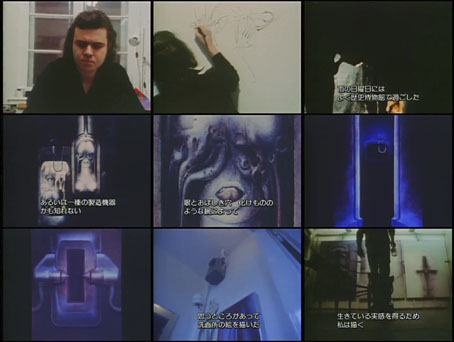
Giger’s Necronomicon is the more interesting of the two documentaries, especially now that the life and work is so well known; the art is taken more for granted, and we also get to see Giger at work on one of his big airbrush paintings. Passagen spends much of its time attempting to contextualise Giger’s drawings and paintings for an unwitting television audience, so a great deal of the running time is given over to newsreel footage of wars, riots, terrorism, atomic explosions and so on. A geneticist discusses the effects of atomic mutation while Giger’s earliest series of pictures, Atomkinder, is shown; psychoanalysts examine his paintings from a psychosexual angle.

Of more interest for Giger aficionados is the presence of his partner at the time, Li Tobler, the subject of several memorable portraits from this period. Among the working shots, the best shows Giger improvising a drawing with the same speed as Philippe Druillet in the Ô Sidarta film. Giger only started using an airbrush in 1972 so most of the works seen here are either early drawings or the paintings in the Passagen and Alptraum series, the style and colouring of which is much closer to the art world of 1972 than anything which would follow. For me the greatest revelation comes early on when Giger picks out a record to play while he’s working. The disc he chooses is just identifiable as Universal Consciousness by Alice Coltrane, an album which had been released the year before. (This isn’t the music heard on the soundtrack, however.) Alice Coltrane’s brand of ecstatic, pan-religious jazz would seem remote from Giger’s own universe but the choice isn’t so surprising if you know that he’d been a jazz enthusiast since the 1950s; in The Book of Alien (1979) his list of influences includes HP Lovecraft, John Coltrane and Miles Davis.

As is evident from the screen grabs, the film is hard-coded throughout with Japanese subtitles. Unlike Giger’s Necronomicon there’s no English overdub either, the soundtrack is in German throughout. I can’t complain when I’ve been waiting so long to be able to see this at all. For those who watched the later film divided into four YouTube clips there’s now a complete version (also Japanese but with English overdub) here.

Previously on { feuilleton }
Heimkiller and High
The Man Who Paints Monsters In The Night
Hans by Sibylle
HR Giger album covers
Giger’s Necronomicon
Dan O’Bannon, 1946–2009
Alejandro Jodorowsky’s Dune
The monstrous tome

Weekend links 402

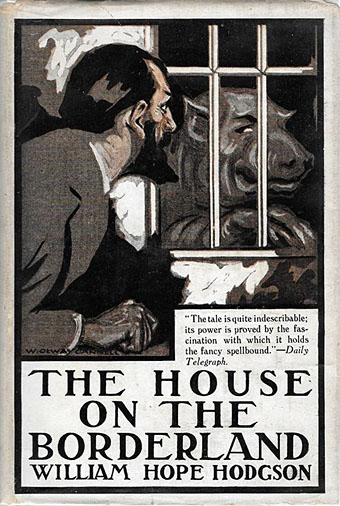
hodgson.jpg

Cover art for the 1921 edition by W. Otway Cannell.

• “An exiled recluse, an ancient abode in the remote west of Ireland, nightly attacks by malevolent swine-things from a nearby pit, and cosmic vistas beyond time and space. The House on the Borderland has been praised by China Miéville, Terry Pratchett, and Clark Ashton Smith, while HP Lovecraft wrote, ‘Few can equal [Hodgson] in adumbrating the nearness of nameless forces and monstrous besieging entities through casual hints and significant details, or in conveying feelings of the spectral and abnormal.’

“‘Almost from the moment that you hear the title,’ observes Alan Moore, ‘you are infected by the novel’s weird charisma. Knock and enter at your own liability.’ The House on the Borderland remains one of Hodgson’s most celebrated works. This new edition features an introduction by Alan Moore, an afterword by Iain Sinclair, and illustrations by John Coulthart.” The long-gestating illustrated edition of William Hope Hodgson’s The House on the Borderland is now available for pre-order from Swan River Press. This is limited to 350 copies so I’d advise anyone interested to order as soon as they can; there’s been a lot of interest in the edition, and with the print run being a small one it’s liable to sell out quickly.

• “Art et Liberté was a movement that came into being in 1938 in Cairo. It was affiliated to Surrealism through contact with André Breton in Paris, and shared Surrealism’s spirit of rebellion and provocation, its desire for dream knowledge and penchant for manifestos.” Marina Warner on the neglected history of Egyptian Surrealism.

• Titan Comics follow their recent collection of Philippe Druillet’s first six Lone Sloane stories with Gail, a book which I don’t think has received an English translation until now.

• Mixes of the week: FACT mix 641 by Alva Noto, a mix by Chris Carter for Bleep/NTS, and Through A Landscape Of Mirrors Vol. I: Sweden by David Colohan.

• 200 years after the first publication of Frankenstein, the city of Bath is to unveil a plaque commemorating Mary Shelley‘s time spent there while writing the book.

• Southern Lord co-founder Gregg Anderson talks to Red Bull Radio about running a record label devoted to avant-garde metal.

• Twelve illustrated dust jackets from Martin Salisbury’s The Illustrated Dust Jacket: 1920–1970.

• At MetaFilter: Links to Hokusai’s drawing guides and similar books.

Canada Modern

Grief (1999) by Tactile | In The Cellar (2005) by Nostalgia | The House On The Borderland (2008) by Electric Wizard

Illustrating Frankenstein

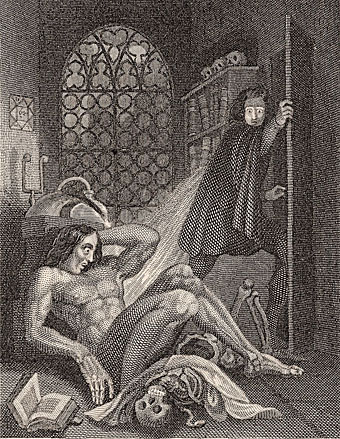
holst.jpg

Frontispiece by Theodore Von Holst of the 1831 edition of Frankenstein. The monster in this illustration, which Mary Shelley would no doubt have seen, is closer to the description in the text than the myriad shambling figures that came later.

It’s a recurrent feature of commissioned work that you sometimes find yourself illustrating novels or stories you might otherwise have never attempted. Spanish publisher Editorial Alma have just added a new edition of Mary Shelley’s Frankenstein to their series of illustrated classics, convenient timing with this year being the bicentenary of the book’s first publication. Last year I produced 33 illustrations for Alma’s collection of Poe stories, as well as 3 new illustrations for a small Lovecraft collection. For their edition of Frankenstein I’ve created 24 full-page pictures, one for each chapter. (I produced 25 in total, 24 for the chapters and one for the letters at the front, but the Spanish translation is arranged slightly differently so one of the drawings has been omitted.) In the past I’ve given little consideration to illustrating classic books, preferring to look for subjects which were less familiar. Frankenstein is a book that isn’t illustrated as much as some but Lynd Ward in 1934, and Berni Wrightson in 1977/78 both produced sufficiently exceptional sets of drawings for me to regard the novel as almost unassailable. Until last year, that is.
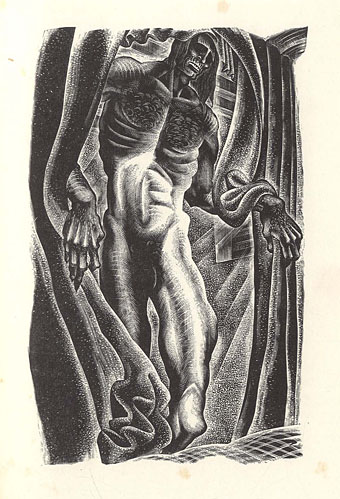
ward1.jpg

Frankenstein by Lynd Ward (1934).

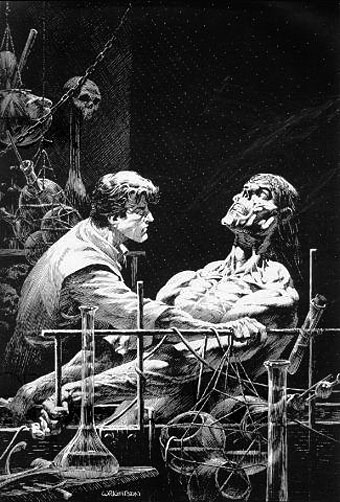
Despite such formidable predecessors, I felt that with this book at least I might be able to offer something new using the blend of collage and drawing that I’ve been evolving recently. There was additional promise in that the story as it’s written is less familiar than the Poe stories, and much less familiar than its fellow horror classic, Dracula. People think they know Frankenstein but what they often know is the manglings the novel has received in various film and TV adaptations. The Ward and Wrightson illustrations stay close to the text, the latter being replete with period detail, and rendered in a style reminiscent of 19th-century wood engravings. Wrightson even copied two of Gustave Dore’s pictures from The Rime of the Ancient Mariner for the opening scenes on the ship, one of which went unused. But Wrightson’s drawings are closer still to Franklin Booth‘s pen-and-ink style which was also derived from wood engraving yet which achieves its effects in a different manner to the engraving process.
frankenstein2.jpg

Frankenstein by Berni Wrightson (1977/78).

Even when artists follow the text of Frankenstein more closely than the screenplay adapters, personal tastes can’t help manifest themselves. So Ward’s drawings reflect the angular and stylised compositions of his “novels in woodcuts”, while Wrightson’s work still shows evidence of his earlier career as a comic artist. With my illustrations I wanted to reflect the artistic spirit that gave birth to the novel, namely Romanticism. Frankenstein is very much a Romantic tragedy with violent passions set against the overwhelming landscapes of the Swiss Alps, the Rhine valley and the Arctic seas. Three of the illustrations below allude to Caspar David Friedrich’s paintings, while many of the others have had their mundane cloudscapes exchanged for gloom and tumult.

I’ve said before that one of the things I enjoy about the collage technique is being able to use engravings and other graphics from the same period (give or take a few decades) as the story itself. The disadvantage of relying on pre-existing sources is that you’re always limited by the available material, so recently I’ve been pushing the technique further to achieve a hybrid style, something midway between the Ernst/Sätty engraving-collage technique and the very laborious, heavily-shaded pen-and-ink style I used when I was drawing comics. The approach isn’t so different to the one I used in my Lovecraft comics many of whose backgrounds and other details were copied from photographs. The difference is that where I used to spend several days working on a single panel (and two weeks working on a page) I can now create an entire picture in half the time. In these new illustrations I feel the hybrid style is working as I intended, allowing me greater freedom to create the picture I have in mind rather than a picture dictated by the source material. Without incorporating original figures and other drawn elements into the compositions it would have been difficult to illustrate a story with the same characters in so many scenes, a problem I encountered when I was illustrating Lewis Carroll’s Alice books and ran out of pictures of Victorian girls.

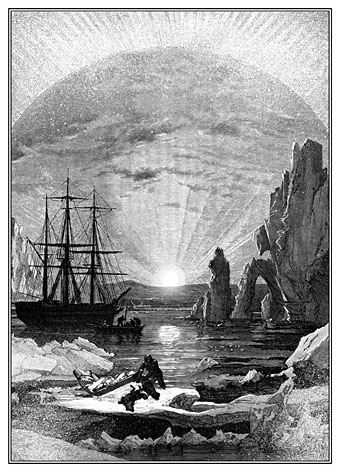
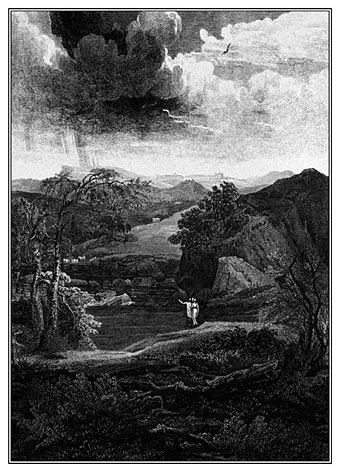
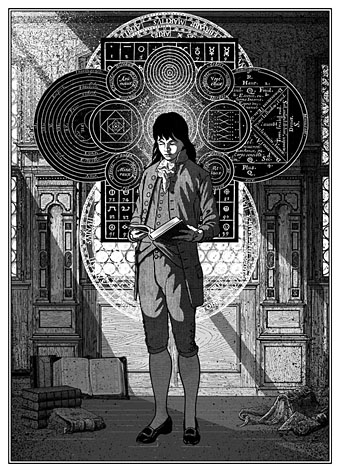
The full run of pictures follows below, including the one which was omitted from the print edition. All may be seen at a larger size here. Since the scenes aren’t always self-explanatory I’ve included fragments of text from each chapter.
frankenstein00.jpg

“In the morning, however, as soon as it was light, I went upon deck and found all the sailors busy on one side of the vessel, apparently talking to someone in the sea. It was, in fact, a sledge, like that we had seen before, which had drifted towards us in the night on a large fragment of ice.”
frankenstein01.jpg

“During one of their walks a poor cot in the foldings of a vale attracted their notice as being singularly disconsolate, while the number of half-clothed children gathered about it spoke of penury in its worst shape.”

This one was omitted from the Alma edition. No loss, really, since the scene doesn’t add much to the story.
frankenstein02.jpg

“When I returned home my first care was to procure the whole works of this author, and afterwards of Paracelsus and Albertus Magnus. I read and studied the wild fancies of these writers with delight; they appeared to me treasures known to few besides myself.”

The diagrams here are taken from some of the books the young Victor Frankenstein is reading. There’s an allusion to this in the magic square on the wall in the back of Theodore Von Holst’s frontispiece, the square being the kind of thing seen in books like this one by Cornelius Agrippa, one of the occult philosophers mentioned in the novel.

Continue reading “Illustrating Frankenstein”

Weekend links 400

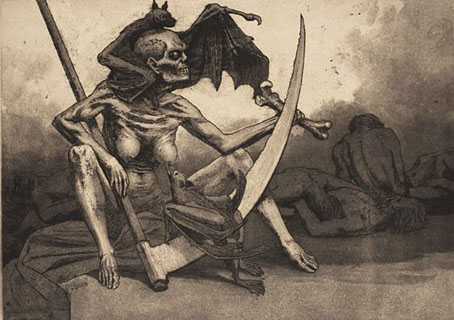
bernard.jpg

Le Répit (La Mort allaitant une chauve-souris) (1895) by Valère Bernard.

Playhouse 90 presents Heart of Darkness by Joseph Conrad. An American TV production from 1957 starring Boris Karloff, Roddy McDowall, Eartha Kitt and others; introduced by Sterling Hayden. It’s bizarre. Acidemic goes into the detail.

• Erik Davis talks to occult writer and drug geek Julian Vayne about Baphomet, the (sur)reality of spirits, evolution, ritualizing entheogens, and his new book Getting Higher: The Manual of Psychedelic Ceremony.

• “Unsurprisingly, 1. Outside was the record that the #BowieBookClub readers most readily associated with Hawksmoor.” Anna Aslanyan revisits Peter Ackroyd’s architectural mystery.

The Flowers of Dorian Gray: part one of a series of posts examining one of Oscar Wilde’s favourite symbols.

• At Haute Macabre, an interview with Michael Locascio & Heather Jean Skawold of Dellamorte & Co.

One Minute Art History, an animated film by Cao Shu.

Film posters at the Harry Ransom Center, UT-Austin.

• Mix of the week: FACT mix 639 by Black Milk.

Susanna‘s favourite albums.

• Welcome to The Spoodoir.

• Flowers Of Evil (1983) by Cortex | Baphomet (1989) by Foetus Inc. | Heart Of Darkness (1989) by Syd Straw