Weekend links 158

soderberg.jpg

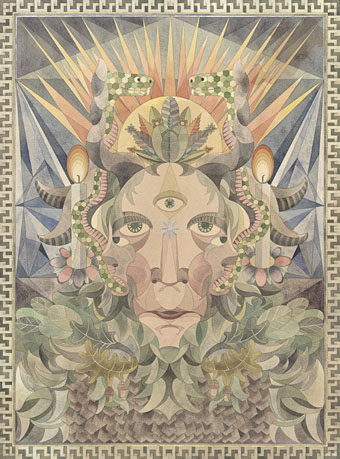
Pan II (2012) by Fredrik Söderberg.

• “Aubade was a surprise success, selling some 5000 copies and going into a second printing and an edition published in America.  Martin was immediately a minor celebrity, being interviewed for articles that couldn’t mention what his book was actually about.” Rediscovering the works of Kenneth Martin.

• “I can’t stand covers which imitate other covers, or which slavishly look like whatever their designated genre is supposed to look like.” Ace cover designer Peter Mendelsund is interviewed.

• At The Outer Church Isablood & Henry of Occult Hand are interviewed about their mixtape.

I’d decided to pay my respects in an unorthodox way, by time-travelling into the period of Thatcher’s pomp, when she occulted the light, alchemised the bad will of the populace and did her best to choke the living daylights out of the awkward, sprawling, socially coddled essence of metropolitan London. Hers was a tyranny of the suburbs operating from a position of privilege at the centre: she might have invested in a Dulwich retirement property, but she couldn’t sleep in it.

Iain Sinclair visits Tilbury on the day of the Thatcher funeral. Related: Iain Sinclair and Jonathan Meades in Conversation, Oxford Brookes University, March 2013.

Ormond Gigli’s best photograph: women in the windows in Manhattan. See it full size here.

Balzac and sex: How the French novelist used masturbation to fuel his writing process.

• At Dangerous Minds: Kenneth Williams and John Lahr discuss Joe Orton in 1978.

• Yet more Bowie: Sukhdev Sandhu reviews Ziggyology by Simon Goddard.

The Spectacular, Wild World of Tenjo Sajiki and its Posters.

• In 1967 Susan Sontag made lists of her likes and dislikes.

Stephen Sparks on fin de siècle author Marcel Schwob.

Day Jobs of the Poets by Grant Snider.

James Turrell’s Ganzfeld Experiment.

The Pan Piper (1960) by Miles Davis & Gil Evans | Panorphelia (1974) by Edgar Froese | Pandora (1984) by Cocteau Twins
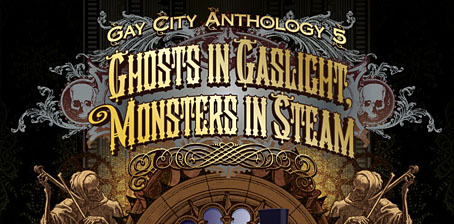
Ghosts in Gaslight, Monsters in Steam

ghosts.jpg

Ghosts in Gaslight, Monsters in Steam is a forthcoming anthology in the Gay City Anthology series from Seattle’s Gay City Health Project and Minor Arcana Press. The publishers describe it as “a multidisciplinary anthology of amazing queer monster and ghost fiction, poetry and art.” I’ve created a cover design for the book, and also have a work-in-progress extract from the never-ending novel I’ve been immersed in since August 2006, a self-contained piece which I call Study in Blue, Green, and Gold. As the anthology title implies, the general (although not exclusive) tenor is spooky steampunk business with a queer inclination; my piece features copious quantities of sex, hallucinogenic drugs, steam locomotives and a fractal cat. Anyone wishing to know more is encouraged to give a push to the Kickstarter donation fund which has been launched to help with promotional costs. I’m very pleased to be involved with this, not least because some of the fiction I’ve been working on for over a decade will receive an airing. I’ve resolved recently to start pushing the writing side of things a bit more so this is a start. When the final anthology contents are announced next month I’ll post an update here.

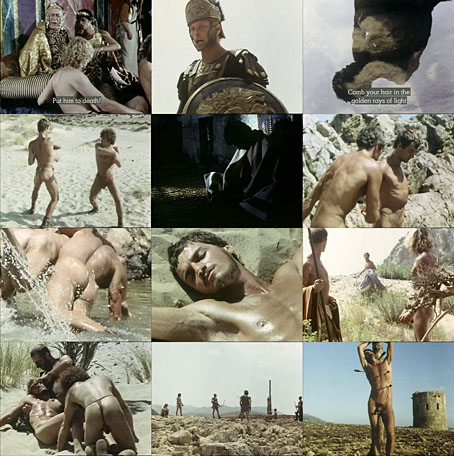
Sebastiane by Derek Jarman

sebastiane.jpg

Sebastiane Opens
October 1976: Sebastiane opened at the Gate cinema in Notting Hill last night after a day of record attendances and good reviews. At the opening Barney James, who plays the centurion, sat next to my parents. At the end of the film he turned to Dad and said, “I don’t suppose forces life was ever like that.” To my surprise Dad replied, “I was out in the Middle East before the war and it’s really quite accurate.”

After its opening at the Gate, where it played for four months before moving into the West End, Sebastiane opened all over the world to wildly different reviews. The Germans found our Latin untuned to their ears, and the French, at least so I was told, panned it. In the States it was classed S for Sex and we were unable to advertise it – so the audiences turned up expecting hardcore and were disappointed. However in Italy and Spain it was a stunning success with lyrical reviews. In Rome, Alberto Moravia came to the first press show and praised the film in the foyer saying that it was a film that Pier Paolo would have loved.

Derek Jarman, Dancing Ledge (1991)

Pasolini would indeed have loved Sebastiane (1976) which owes much to the Italian director’s historical films, especially Oedipus Rex (1967) and Medea (1969). The film was Jarman’s first feature (co-directed with Paul Humfress), produced on a very small budget, and filmed on the coast of Sardinia. Brian Eno provided the music, and Lindsay Kemp has a memorable cameo appearance in the opening scene. The events which lead to the martyrdom of Saint Sebastian (Sebastianus) are dramatised from the point of view of a group of Roman soldiers who have Sebastianus among their company. The film is notable for its all-Latin dialogue, and for being the first non-porn film to feature a male erection, although that detail is often missing from prints which judiciously crop the lower portion of the screen.

The copy linked here has somehow turned up at the Internet Archive, and is the same erection-free version which has circulated for some years on DVD. The sneaky censorship would have been justified ten or more years ago but makes no sense today when far more explicit films are easily available. But if you haven’t seen Sebastiane then you have an opportunity for as long as this copy remains available…which may not be for long since I’m sure its copyright can’t have lapsed.

The late, unlamented and very reactionary British film critic Leslie Halliwell once complained that Pasolini’s “Trilogy of Life” films featured “a forest of male genitalia”. The same might be said of Sebastiane which, judging by the intemperate comments one sees on review sites, provokes a similar splenetic reaction. “It’s just gay porn!” they shriek, to which the obvious response is “No, it isn’t”, and “So what if it was?” A century of cinema has paraded the bodies of women for the gaze of the heterosexual male, the same male who chokes on his dudgeon when faced with the very thing he carries between his legs. Grow up, boys. Also at the Internet Archive (for the time being) is Derek Jarman’s The Garden (1990), the most personal of his later films until his final feature, Blue, in 1993.

Previously on { feuilleton }
A Journey to Avebury by Derek Jarman
Derek Jarman’s music videos
Derek Jarman’s Neutron
Mister Jarman, Mister Moore and Doctor Dee
The Tempest illustrated
In the Shadow of the Sun by Derek Jarman
Derek Jarman at the Serpentine
The Angelic Conversation
The life and work of Derek Jarman

Weekend links 155

austin.jpg

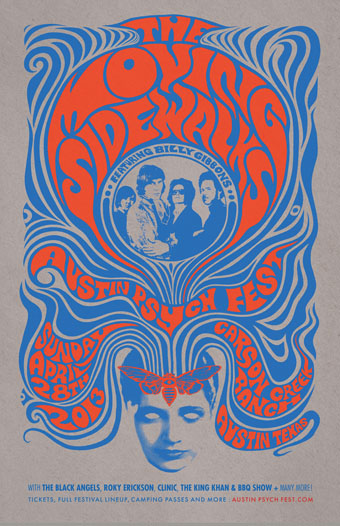
Poster design by Mishka Westell for this month’s Austin Psych Fest. Billy Gibbons’ pre-ZZ Top psychedelic outfit, The Moving Sidewalks, surprised everyone by reforming for a New York gig last month, their first performance together in 44 years.

• Pye Corner Audio played the Boiler Room, London, last week, and remixed a track from FC Judd’s Electronics Without Tears. Also on the latter is Chris Carter who talks about his own remix (and the “Radiophonic” Mr Judd) here.

Tom Bianchi’s Fire Island Pines, Polaroids of New York’s gay enclave from 1975–1983. Related: In Conversation with the Violet Quill: Andrew Holleran, Felice Picano, and Edmund White.

• From 2011: Sex, prison and lost ligatures: The story of Herb Lubalin’s Avant Garde typeface. Related: The ITC Avant Garde Gothic group at Flickr.

• Music reissues: Tape Works 1981–1982 by Laughing Hands is out now, and Scott Walker’s early solo albums will be reissued in the summer.

fraser.jpg

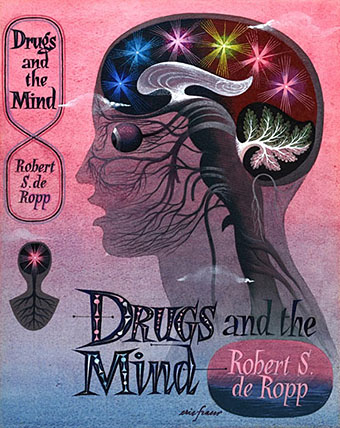
Drugs and the Mind (ii), a cover design from 1957 by Eric Fraser (1902–1983) whose illustrations and designs are in exhibition at the Chris Beetles gallery, London.

• At Ubuweb: William S. Burroughs + Brion Gysin + Genesis P-Orridge – Cold Spring Tape (1989).

The World According to John Coltrane, an hour-long documentary.

Neko Font: for when you need a word made of cats.

Fuck yeah, Sarah Bernhardt

Sordid Spheres!

99th Floor (1967) by The Moving Sidewalks | Over Fire Island (1975) by Brian Eno | Ledge (1980) by Laughing Hands

Memories

scarfe1.jpg

Untitled cartoon by Gerald Scarfe (early 1980s).

Margaret Thatcher saved career of police chief who made Aids remarks

Margaret Thatcher helped save the career of a police chief constable who said Aids patients lived in a “human cesspool of their own making”, newly-released documents show.

THE TELEGRAPH, 04 Jan 2012

Sir James Anderton, then chief constable of Greater Manchester Police, faced calls to quit after making the comments, which were perceived as homophobic.

Now documents secured by the Manchester Evening News give an incredible insight into the 1986 political storm – and show how close the country’s second largest police force came to meltdown.

It can revealed that the government staged a series of crisis meetings aimed at keeping Sir James in post, and that other chief constables accused Sir James of ‘bringing ridicule’ on the police service.

The papers also show that senior civil servants were dismayed over the top cop’s ‘religious overtones’ and feared he had a ‘taste for martyrdom’, but that Mrs Thatcher, the then Prime Minister, privately backed Sir James’s right to speak out – and stamped down demands for a public inquiry into the state of the force. (more)

scarfe2.jpg

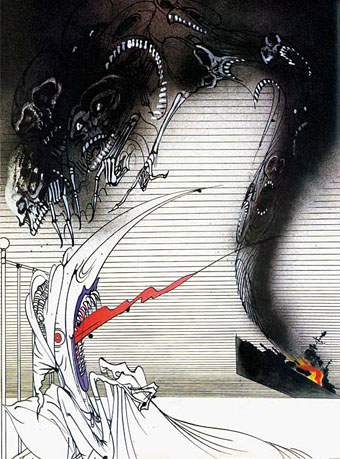
Belgrano Nightmare – Thatcher Wakes Screaming (1982) by Gerald Scarfe.

bell.jpg

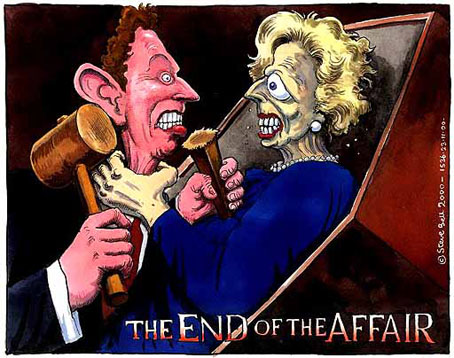
Cartoon by Steve Bell (2000).