Weekend links 572

poumeyrol.jpg

L’Insolite (1980) by Jean-Marie Poumeyrol.

• “As we move down the ladder of prestige into the world of unvetted tweets, we observe an increasing difficulty, among people with very strong opinions, in exercising that basic critical competence of distinguishing between the authorial creation of a character, and the author’s affirmation of that character’s every moral trait and political view.” Justin EH Smith on the HR managers of the human soul.

• “When is a Didone not a Didone? How far must an exemplar Didone, like a Didot or a Bodoni, be altered before it loses its ‘Didoneness’?” John Boardley on the vexed question of font classification, and the need for an alternative to the present system.

• “Birds with Human Faces and Birds with Human Souls share shelf space with The Book of Owls and Expert Obedience Training for Dogs…” Joanna Moorhead visits the Casa Estudio Leonora Carrington in Mexico City.

“Indolent” is a funny way to characterize her natural state, which seems more like “incisive” to me, but I also have the unshakable sense—for myself—that writing can’t or shouldn’t look like staring into space or feel like not wanting to move from the couch. “A fraud is being perpetrated: writing is not work, it’s doing nothing,” she states in that first essay, from 1992. But she immediately counters with, “It’s not a fraud: doing nothing is what I have to do to live.” Listing a few more pertinent existential options, Diski ends with, “Or: writing is what I have to do to be my melancholy self.” The protoplasmic, chattering, melancholic “I” of these essays is, of course, the collection’s constant, its true subject. I can commiserate with her on every page even if emulation is out of reach.

Johanna Fateman on the incisive long-form criticism of Jenny Diski

• At Spine: Vyki Hendy identifies sunburst as a new trend in book cover design. I often think I overuse these things in my own cover designs which means I may be inadvertently (and fleetingly) trendy.

• At the Magnum Gallery, London: Metamorphoses, photographic studies by Herbert List of male bodies and Greek statuary.

• At Spoon & Tamago: A butterfly sipping moisture from puddles, sculpted entirely in wood by Toru Fukuda.

• At Dangerous Minds: Joseph Lanza on the easy listening side of psychedelic pop.

• At CounterPunch: Louis Proyect on thinking like an octopus.

• Mix of the week: Fact Mix 510 by Britton Powell.

Bye Bye Butterfly (1965) by Pauline Oliveros | Butterfly Mornings (2001) by Hope Sandoval & The Warm Inventions | Butterfly Caught (2003) by Massive Attack
Weekend links 570

griffin.jpg

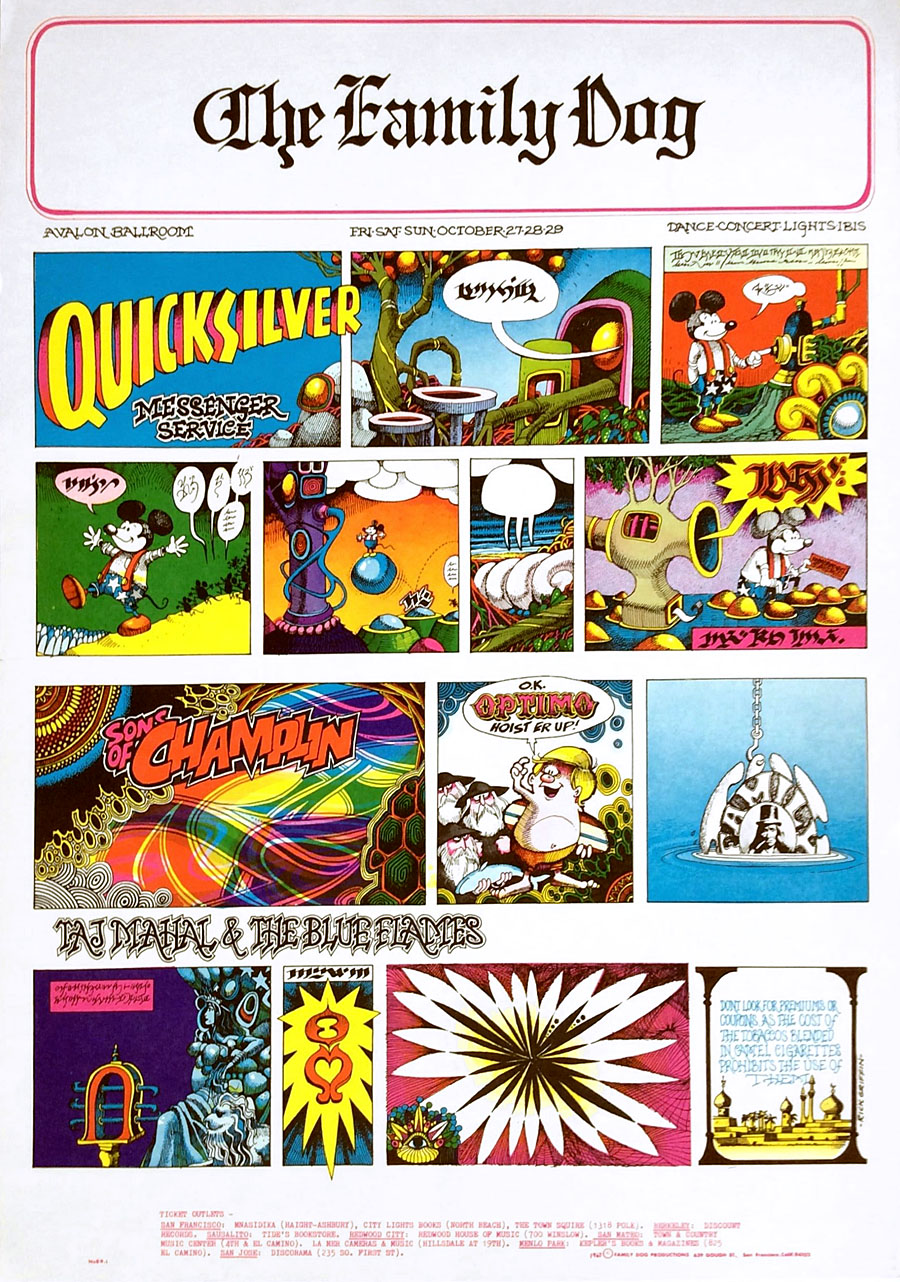
Rick Griffin’s comic-style poster for The Quicksilver Messenger Service at the Avalon Ballroom, October 1967.

• “Like ‘perversion,’ the word ‘script’ has a special meaning for Escoffier, who devotes most of the book’s attention to films featuring sex between men, and treats pornography as a vast screen on which all of our fantasies are projected.” Steve Susoyev reviews Sex, Society, and the Making of Pornography by Jeffrey Escoffier.

• “The themes reflect Griffin’s core obsessions: sex, death, Christ, flesh, liquids, goofy japes, and lysergic gnosis. Man from Utopia is an opus, one that Griffin felt strongly enough about to eschew the usual pulp, printing the cover on good full-color card stock.” Erik Davis on Rick Griffin and a comic book like no other.

Strange Things Among Us, a summer exhibition at The College of Psychic Studies, London, will include among its exhibits a room of art by Austin Osman Spare.

She delighted in the fact that after The Sadeian Woman, she ended up on the mailing lists of both pro- and antiporn groups, though no one (alas) ever sent her any actual porn. She aligns more naturally in retrospect with Madonna—potent, fiercely individualistic, disruptive, and self-invented. Carter’s evolved philosophical position on gender was a variation on Stoicism. Gender roles were “behavioural modes,” a construct (“Baby is hermaphrodite!”), and there was weakness in allowing oneself to be beholden to (let alone enslaved by) a construct. Above all, women should have total sexual agency and also their own money. “I became a feminist,” she wrote in a postcard to Susannah Clapp, “when I realised I could have been having all this instead of being married.”

Minna Zallman Proctor on the life and work of raucous fabulist Angela Carter

• New music: Chapter 4 by the Moritz Von Oswald Trio with Heinrich Köbberling & Laurel Halo, and Synth Vehicles For Guitar by Michael C. Sharp.

• DJ Food searched the back issues of International Times to find a handful of adverts for London’s legendary UFO Club.

• At Wormwoodiana: Mark Valentine explores Hy Brasil, a novel by Margaret Elphinstone.

• Remembering Tom of Finland through stories of those who knew him.

• What I’m Aiming For: Peggy Seeger’s favourite music.

• At Dennis Cooper’s: The Light Show (1965–1971).

• Mix of the week: Haze by The Ephemeral Man.

• A Strange Light From The East (1967) by Tuesday’s Children | Strange Things Are Happening (1968) by Rings & Things | Strange Walking Man (1969) by Mandrake Paddle Steamer

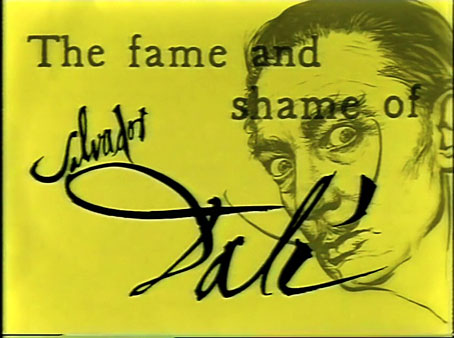
The Fame and Shame of Salvador Dalí

fasosd1.jpg

…one ought to be able to hold in one’s head simultaneously the two facts that Dalí is a good draughtsman and a disgusting human being.

George Orwell

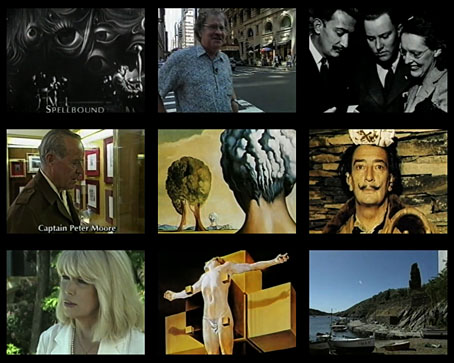
This two-part, two-hour TV documentary from 1997 has a title that makes it sound like more of an exercise in audience pandering than was typical for the BBC’s Omnibus arts strand, fame and shame being qualities that might be considered of greater interest for the general viewer than art history. But Michael Dibb’s film is more insightful than those made 20 years earlier when access to the Dalí circle, and to Dalí himself, required flattery and capitulation to the artist’s whims and attention-grabbing antics. In place of the impersonal approach taken by the BBC’s Arena documentary from 1986 we have writer Ian Gibson serving as a guide to Dalí’s life while conducting research into a major biography, La vida desaforada de Salvador Dalí (The Shameful Life of Salvador Dalí), which was published a year later. “Shame” here refers more to Dalí’s numerous fears and phobias, especially those of the sexual variety, rather than to scandal and public opprobrium, while “Shameful Life” echoes the “Secret Life” title of the artist’s autobiography. Dalí’s sexual neuroses were always to the fore in his art but they remained concealed in his personal life, although the evasions—his frequent declarations of impotence, for example—don’t prevent Gibson from speculating. I saw this documentary when it was first broadcast but had forgotten the discussions of a possible homosexual relationship with Dalí’s adoring friend, Federico García Lorca, as well as the mention of the artist’s voyeurism, all of which was explored in more detail (and with some personal experience) by Brian Sewell a decade later in the TV documentary with the most prurient title of them all, Dirty Dalí: A Private View.

fasosd2.jpg

Gibson is a guide with the advantage of being a fluent Spanish speaker able to engage in conversation with those who knew or worked for the artist. Several of the interviewees are familiar faces in Dalí films: Amanda Lear, art collectors Reynolds and Ellen Morse, Dalí’s first secretary and business manager, Captain Peter Moore, and painter Antoni Pitxot. 1997 was about the last time it was possible to make a documentary about Dalí that might feature interviews with people who knew the artist in his younger days, although José “Pépin” Bello, born the same year as Dalí in 1904, lived on until 2008. Bello was the sole surviving member of a Madrid student group in the 1920s whose other members were Dalí, Luis Buñuel and Federico García Lorca. He also turns up in The Life and Times of Don Luis Buñuel (1984), another BBC film which really ought to be on YouTube, where he makes unsubstantiated claims about having contributed ideas to Un Chien Andalou. It’s easy to be sceptical about the assertions of an uncreative man whose youth had been spent in the company of three great talents but according to this obituary both Dalí and Buñuel confirmed the claims. (The image of a rotting donkey, however, had appeared in Dalí’s paintings before the film was made.)

fasosd3.jpg

Among the other people talking to Gibson are Surrealist poet David Gascoyne, and also George Melly, a man who for a long time was a ubiquitous presence whenever Surrealism was being discussed on British TV. The interviews are separated by clips from other films, two of which have featured in earlier posts: Hello Dalí! (which I keep hoping someone will upload to YouTube in better quality), and Jack Bond’s film of Dalí in New York in 1965. I watched both these again last year when I followed my viewing of the Švankmajer oeuvre with a number of Surrealist documentaries. Jack Bond’s film is especially good for its verité qualities, and for Jane Arden’s attempts to persuade Dalí to talk seriously for once about his art.

The Fame and Shame of Salvador Dalí: Part One | Part Two

Previously on { feuilleton }
Figures of Mortality: Lawrence versus Dalí
Être Dieu: Dalí versus Wakhévitch
Chance encounters on the dissecting table
Salvador Dalí’s Maze
Dalí in New York
Dalí’s discography
Soft Self-Portrait of Salvador Dalí
Mongolian impressions
Hello Dalí!
Dirty Dalí
Impressions de la Haute Mongolie revisited

Weekend links 569

lehr.jpg

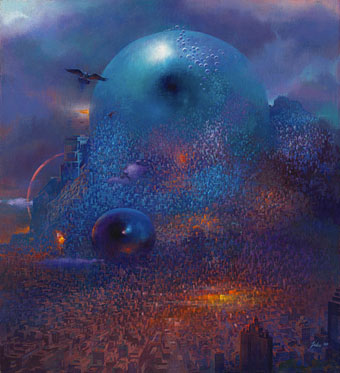
City with Eyes in Blue (1989) by Paul Lehr.

• “Lehr chose science fiction illustration because he saw it as a path to making a living and an opportunity to ‘depict the epic’. ‘War, destruction, celebration, congestion, marching armies, waving flags and banners—the strange and mysterious atmosphere of it all, rather than the literal illustration.'” Jane Frank on the art of Paul Lehr (1930–1998).

• “Time isn’t the only thing Harrison treats as firmly malleable. The same is true of his willingness to play with genre conventions…” Tobias Carroll on M. John Harrison, and an article where you have to ignore the clickbait clichés in the headline.

• The narrators for the forthcoming audiobook of Voice of the Fire by Alan Moore have been revealed.

• At Public Domain Review: A remembrance of aerial forms: Odilon Redon’s À Edgar Poe.

• The weight of the ritual: Frank Rynne on The Master Musicians of Joujouka.

• “Cerne Giant in Dorset dates from Anglo-Saxon times, analysis suggests.

Aaron Moth, the artist creating exquisite collages from vintage [gay] porn.

Clive Hicks-Jenkins on revision in illustration.

• At Wikimedia Commons: Lesbian pulp fiction.

• Mix of the week: A Wire mix by BLK JKS.

• At Dennis Cooper’s: Psychedelics.

Colleen‘s favourite albums.

Ritual Fire Dance (1969) by Tuesday’s Children | Ritual (1973) by Vangelis | Rituals (1981) by Bush Tetras

Weekend links 567

dean-osibisa.jpg

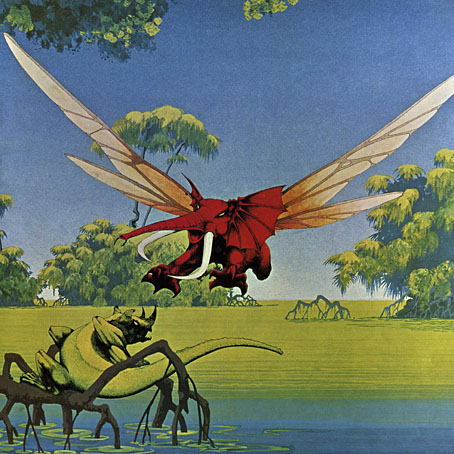
Cover art by Roger Dean for Woyaya (1971), the second album by Osibisa. Dean’s flying elephants made their first appearance on the group’s debut album, and have been an Osibisa emblem ever since.

• Many of Roger Dean’s early album covers are better creations than the music on the albums they decorate. This isn’t the case with Osibisa, however, a Ghanaian group based in London whose discography includes (uniquely, I think) two covers by Dean together with one by Mati Klarwein. The group’s first two albums, Osibisa and Woyaya, are exceptional blends of Ghanaian music with rock, funk and jazz whose omission from the generally reliable Kozmigroov list is a serious error. Garth Cartwright talked to Teddy Osei and Lord Eric Sugumugu about Osibisa past and present.

• “The antiheroes of Angry Young Men cinema railed against the limited life opportunities available to them. Wired and frustrated, they especially chafed against girlfriends, wives, domesticity. Yet they never questioned heterosexuality itself. Not, at least, until The Leather Boys (1964), a relatively little-known film directed by Canadian expatriate Sidney J. Furie.” Sukhdev Sandhu on a film about gay life in pre-decriminalisation Britain that offered a slightly more positive view of its subject than the justifiably angst-ridden Victim (1961).

• “Brian Aldiss once confided to me that the big problem with American science fiction writers was that they loved to write about Mars but knew nothing about Indonesia.” Bruce Sterling on the attractions of being an expatriate writer who adopts a foreign persona, as he did for the stories collected in Robot Artists and Black Swans.

• New music: Fire Tower by The Grid / Fripp. Dave Ball, Richard Norris and Robert Fripp have been collaborating on and off since The Grid’s 456 album in 1992. Fire Tower is a preview of Leviathan, a new album out in June on CD/DVD and double vinyl.

• RIP Michael Collins, the astronaut who orbited the Moon alone, listening to Symphonie Fantastique by Berlioz in the Command Module of Apollo 11 while Neil Armstrong and Buzz Aldrin were walking on the satellite’s surface.

• “‘Walking with a thesis’ could easily function as the subtitle for a significant number of Iain Sinclair’s books.” Tobias Carroll on Iain Sinclair and the radical act of walking through a city.

• “‘Plain speaking, like plain food, is a puritan virtue and thus no virtue at all,’ Meades pronounces.” Steven Poole reviews Pedro and Ricky Come Again by Jonathan Meades.

• Building a panorama: Clive Hicks-Jenkins‘ latest progress report on his Cocteau-inspired illustrated edition of Beauty and the Beast.

• At Unquiet Things: Groovy Goddesses From Dimension X: Gene Szafrans’ Kaleidoscopic Book Covers.

• From leather boys to leather men: Miss Rosen on the little-known photography of Tom of Finland.

Alexis Petridis attempts the impossible again, with a list of Grace Jones’ best songs.

• At Dennis Cooper‘s: Cars.

I’m A Leather Boy (1967) by The Leather Boy | Warm Leatherette (1980) by Grace Jones | Leather Bound (2017) by Patrick Cowley