Weekend links 594

klinger.jpg

Eva und die Zukunft (1898) by Max Klinger.

• “It is no exaggeration to say that MAD invented the modern, postwar American takedown.” Thomas Larson reviews Seeing MAD: Essays on Mad Magazine’s Humor and Legacy.

• At the Internet Archive: Cartoon Modern: Style And Design In Fifties Animation (2006) by Amid Amidi, a book which has been made available as a free download by its author.

• New music: A preview of Metta, Benevolence by Sunn O))), recorded live in the Mary Anne Hobbs’ radio show in 2019; Veils by Víz; The Mountain (Blakkat Dub) by Ladytron.

• At Public Domain Review: Claude Mellan’s The Sudarium of Saint Veronica (1649), an engraving made with a single continuous line.

• “For Harry Houdini, séances and Spiritualism were just an illusion,” says Bryan Greene.

TheStencil is Steven Heller’s font of the month.

• At Dennis Cooper’s: Derek Jarman Day.

Nicky Mao’s favourite music.

Mad Man Blues (1951) by John Lee Hooker | Mad Pierrot (1978) by Yellow Magic Orchestra | Mad Keys (2002) by Al-Pha-X

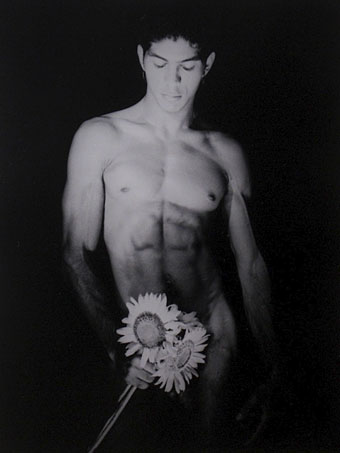
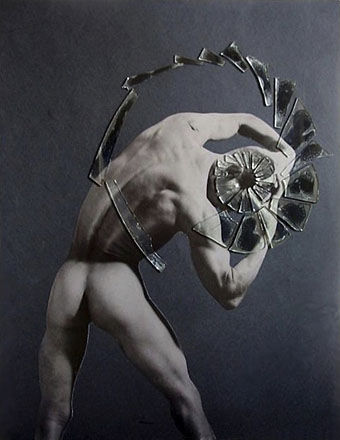
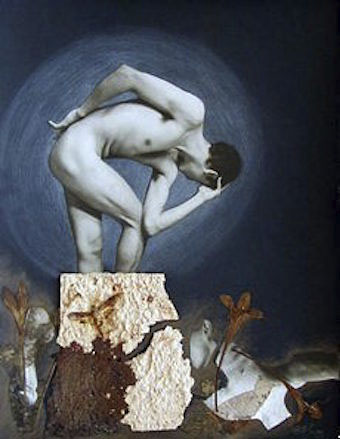
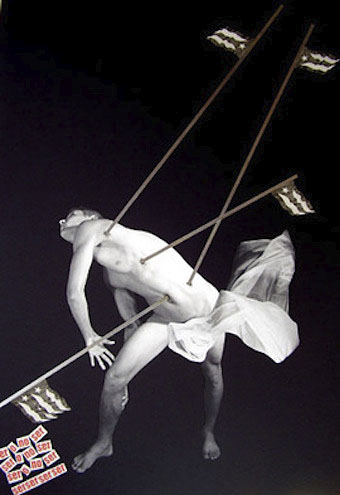
The art of Eduardo Hernández Santos

santos1.jpg

From the series Aproposito los flores.

In 1993 I made Homo-Ludens, which was the first homoerotic exhibition to take place in Cuban photography after the Revolution. This show was committed to a direct, frontal discourse, but very aesthetic. It was not intended to reflect great contradictions, but to propose to society that the male body was also an object to analyze, that it was a source of pleasure, and not only to women.

Cuban artist Eduardo Hernández Santos talking in 2016 about his career (here and here). In addition to straightforward photography, Santos favours collage as a technique, combining his own photographs with fragmented slogans and other imagery. The late date of the Homo-Ludens exhibition is a result of the slow evolution of attitudes towards sexuality in Cuban society. Fidel Castro regarded gay men as degenerates, a common sentiment in Communist circles in the 1960s, and one shared by many fascists. A striking thing about homosexuality is the way you can be despised by a wide variety of people who wouldn’t agree with each other about anything else.

santos2.jpg

From the series Corpus Fragiles.

It’s tempting to wonder what Jean Genet would have thought about Santos’s photographs of male nudes with flowers. Genet used flowers for their symbolic qualities almost as much as Oscar Wilde, so even though it’s unwise to try and second-guess him I imagine he’d appreciate their use here.

santos3.jpg

Untitled (2000).

santos4.jpg

From the series Palabras.

Elsewhere on { feuilleton }
The gay artists archive

Previously on { feuilleton }
The art of Gregorio Prieto, 1897–1992
Emil Cadoo

Weekend links 587

jetpac.jpg

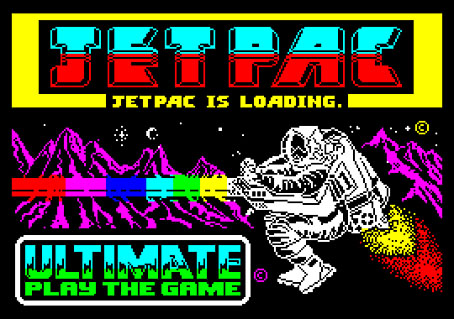
Jetpac (1983) by Ultimate Play The Game. Lunar Jetman was the superior sequel but Jetpac had the better loading screen.

• RIP Clive Sinclair. Products made by Sinclair Research Ltd. were among the first electronic gadgets I owned: the Sinclair Scientific calculator which compelled you to learn Reverse Polish notation before you could use it; the ZX Spectrum computer, of course; and the pocket TV that came bundled with the computer, a machine with such feeble reception that it only ever worked outdoors. I’ve still got my Spectrum computer, and it still worked the last time I plugged it in although it’s hardly worth keeping when emulators proliferate. Spectacol for Android is a good example of the latter. Related: World of Spectrum; the early stages of the Spectrum design process by Sinclair designer Rick Dickinson; XL-1 by Pete Shelley, electro-pop with Spectrum-generated lyrics and graphics.

• Mixes of the week: A Lee “Scratch” Perry tribute mix by Dennis Bovell, and Blood Tide Station 1: Breakaway plus Blood Tide Station 2: Force of Life by The Ephemeral Man.

• “It’s not an easy time to be daring,” says Dennis Cooper, talking to Barry Pierce about his new novel, I Wished.

• London under London: Adam Zamecnik interviews Tom Chivers about searching for London’s lost rivers.

• New music: Ode To The Blue by Grouper, and A Shadow No Light Could Make by Nathan Moody.

• At Public Domain Review: 700 years of Dante’s Divine Comedy in art.

• At Wormwoodiana: The Mushroom Man—A Note on EC Large.

DJ Food trips out with a collection of psychedelic drug posters.

Nodnol (1969) by The Spectrum | Spectrum (1969) by The Tony Williams Lifetime | Spectrum (1973) by Billy Cobham

The art of Alexander Cañedo, 1902–1978

canedo15.jpg

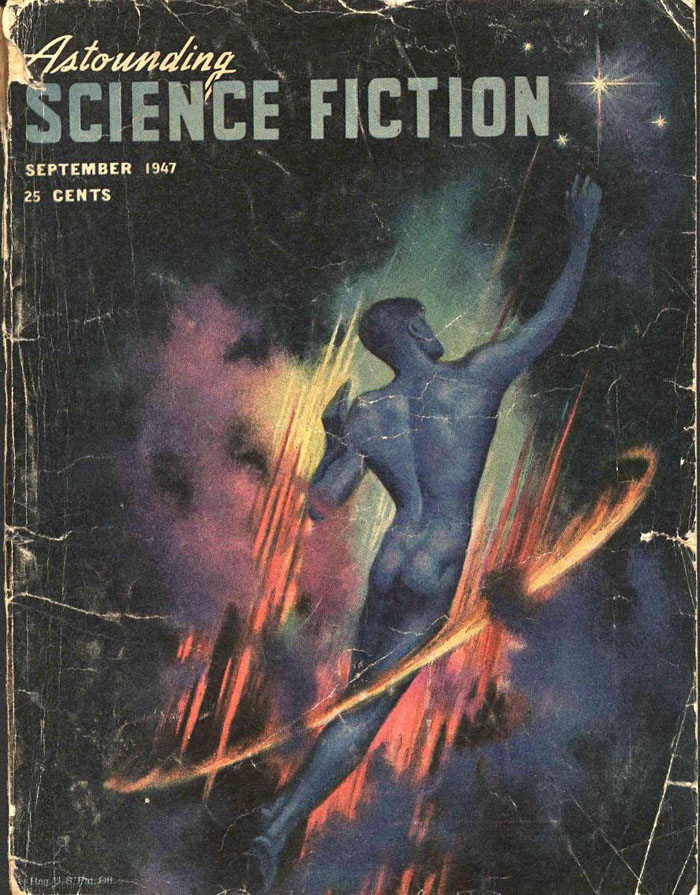
September, 1947.

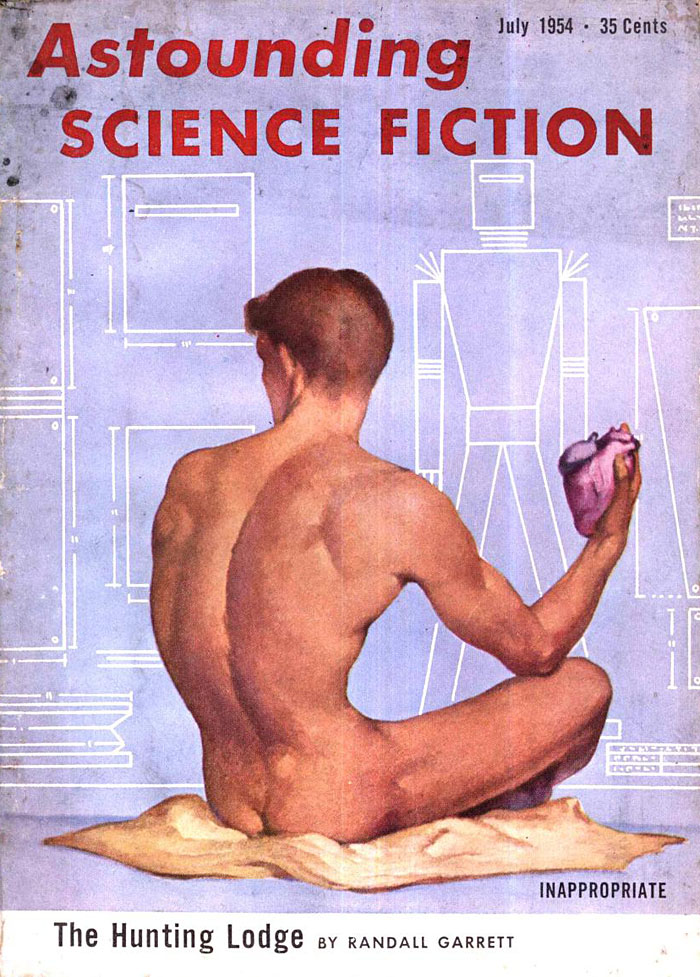
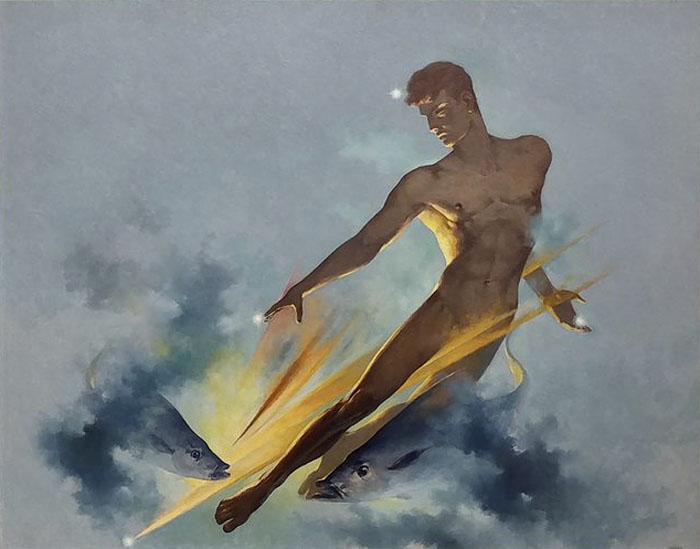
Harry Harrison used to enjoy referring to the “sexual dimorphism” of the cover art on pulp science-fiction magazines, by which he meant that male astronauts would usually be depicted wearing sturdy spacesuits or functional attire while their female counterparts would be given spray-on outfits with plunging necklines, if they were given any clothes at all. Sexism was still thriving in the future, in other words, with visible male flesh in short supply. This makes the handful of cover paintings produced by Alexander Cañedo for Astounding Science Fiction uncommon enough to be almost unique.

canedo16.jpg

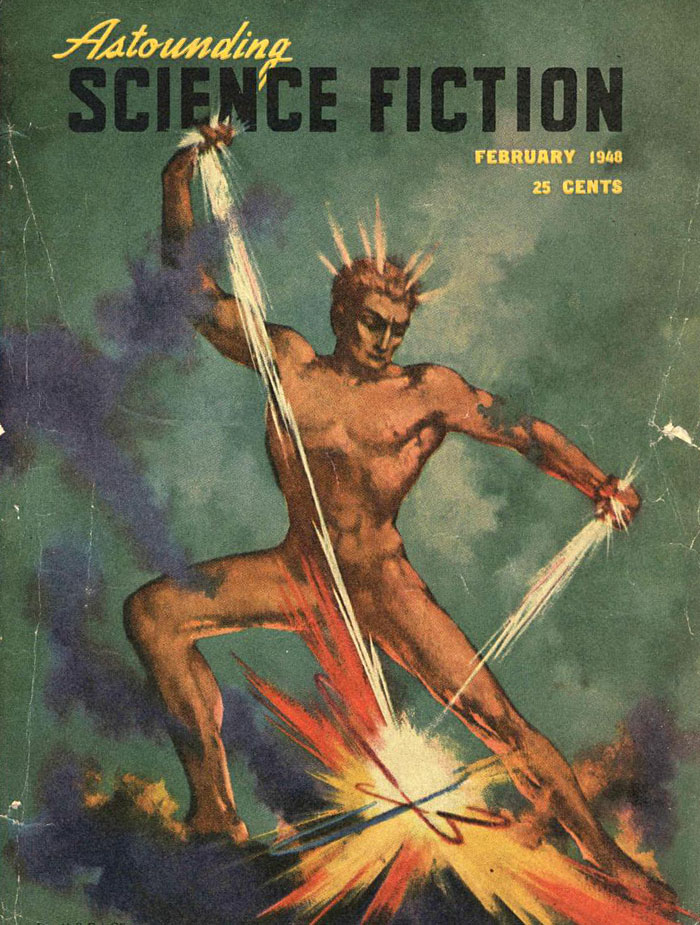
February, 1948.

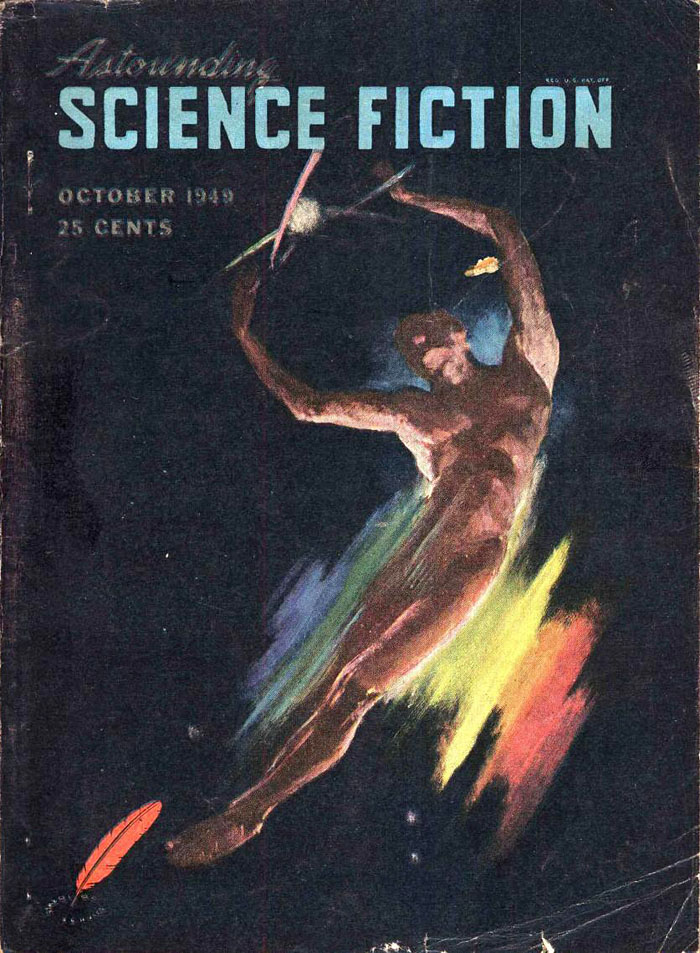
Cañedo was a Mexican-American, born Alejandro de Cañedo, whose covers for Astounding were simply credited to “Alejandro”. The editorial policy at the magazine favoured hard-headed, technology-oriented science fiction, with cover art that avoided the scantily-clad women (and, to be fair, shirtless men…) seen each month on the covers of swashbuckling rival, Planet Stories. Robots and rocket ships were still required at Astounding, however, and half the covers produced by Cañedo feature more predictable imagery. The first of the cosmic nudes appeared after editor John W. Campbell spotted an unsold painting during a visit to Cañedo’s studio. Campbell and his readership regarded the naked males as purely symbolic, which they are up to a point, and Cañedo was praised for his art in the magazine’s letters section. When seen in the context of his overtly homoerotic work the pictures evidently reflect more personal proclivities.

canedo17.jpg

October, 1949.

Cañedo is described today as a gay artist, a claim that can’t easily be verified when the available biographical details repeat the same few facts. But his art away from Astounding returned continually to the human body, a subject where his mastery was sufficient to warrant the publication in 1954 of a short guide for artists, How Cañedo Draws the Human Figure. Most of his drawings and paintings listed on auction sites are nude (or semi-nude) studies, with lovingly rendered male figures predominating. Several of his later paintings could easily have served as additional magazine covers. The manipulation of light and colour in these pictures is outstanding, unlike any treatment of male nudes that I’ve seen before, and by an artist worthy of greater attention.

(Note: Most of these pictures are untitled and undated. I’m also not an art dealer so please don’t ask for valuations.)

canedo18.jpg

July, 1954. “Inappropriate” is the title of the picture which doesn’t relate to anything inside the magazine.

canedo09.jpg

Continue reading “The art of Alexander Cañedo, 1902–1978”

Weekend links 585

bertha_lum.jpg

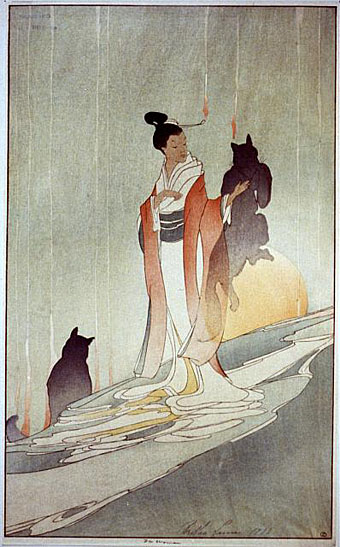
Fox Woman (c. 1916) by Bertha Lum.

• “Apparently he had been walking though customs/arrivals with a large cube of weed stuck on the end of his silver Dr Martens and a foot long silver flashlight full of seed, but when they realised who he was, and that today was his 60th birthday, he was released with just a warning.” Radio Lancashire DJ Steve Barker remembers the late Lee “Scratch” Perry, and links to one of his shows with Perry (and Roger Eagle) here.

• “…it’s the chase itself that shapes the film’s distinctive aesthetic—the under-lit interiors and the sunless and frigid exteriors of the many locations across the city, sites that take the cops well beyond their usual beat, to places both above and below ground.” Chris McGinley explains how William Friedkin’s The French Connection reinvented (and exploded) the police procedural.

• “Toibin, who is himself gay, has always extended historical sympathy to sexual outsiders. As he’s written elsewhere, ‘There are no 19th-century ballads about being gay.'” Dwight Garner reviews Colm Toibin’s The Magician, a novel about Thomas Mann.

Here is the key point: to experience such marvels you have to risk an unsophisticated, even credulous love for corn, and part of that love involves a willingness to submit to what [Phil] Ford calls a “magical hermeneutics” capable of transforming marginal chunks of pop culture. As he writes in the wonderful 2008 essay that inspired the episode, exotica is “less a genre of music than a class of cultural objects that share a characteristic projection of the self across boundaries of space and time.” This makes it essentially psychedelic—“film music for daydreams”—and Ford draws out that historical connection in his essay, which argues that while the hippie movement that Nature Boys like Ahbez prophesied looks like a radical rejection of the space-age bachelor pad of ’50s consumerism, tendrils of transcendent yearning link the exotica imaginary to the earnest if stoned mysterioso to come.

Erik Davis on Eden Ahbez and Californian exotica

Edgar Froese interviewed on WSHU radio in 1974 where he talks about Tangerine Dream, live performance and the future of electronic music.

• At Dangerous Minds: A momentary lapse of reason…when Dario Argento interviewed Pink Floyd in 1987.

• It’s that man again: John Doran interviews Kevin Martin, aka The Bug.

David McKenna on The Strange World of France, La Nòvia & friends.

• At Dennis Cooper’s: Tape deck.

Exotica (1958) by Martin Denny | Exotica Lullaby (1976) by Harry “The Crown” Hosono | Exotica (1979) by Throbbing Gristle