The Witch’s Cradle by Maya Deren

deren1.jpg

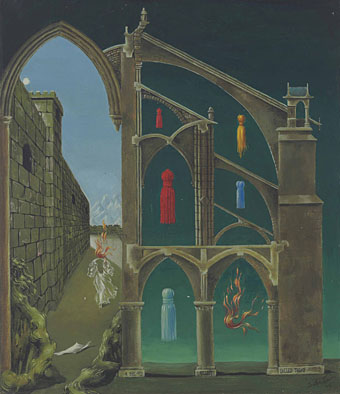
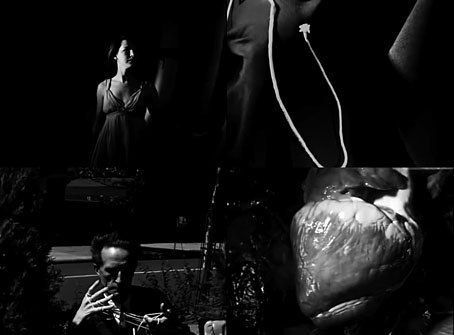
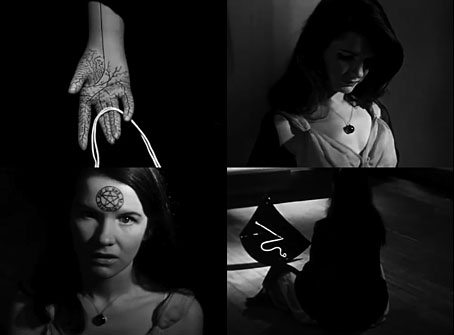
It’s taken a while for Maya Deren’s less familiar films to drift into YouTube’s Sargasso Sea so I hadn’t seen this one until now. The Witch’s Cradle (1943) isn’t really a film like Deren’s other short works, more a collection of fragments for something that was left unfinished. But the Surrealist tenor of the piece means that the diverse shot sequence and unusual imagery can be interpreted in a variety of ways. Pajorita Matta is the woman wandering like a Cocteau heroine through the darkened rooms of one of Peggy Guggenheim’s galleries where we catch glimpses of sculptures and a Max Ernst painting, Blind Swimmers (1934). Prior to this there are brief shots of Marcel Duchamp with this fingers tangled in a cat’s cradle, and later on we see that Pajorita Matta has a pentacle drawn on her forehead, a precursor of Deren’s subsequent occult explorations in Haiti. Disjointed as it is, I prefer this to the solo films that Deren produced after her collaboration with Alexander Hammid, Meshes of the Afternoon (1943), most of which were filmed dance performances. The Witch’s Cradle offers another taste of enmeshed mystery.
deren2.jpg

Previously on { feuilleton }
Alexander Hammid
Meshes of the Afternoon by Maya Deren
Weekend links 458

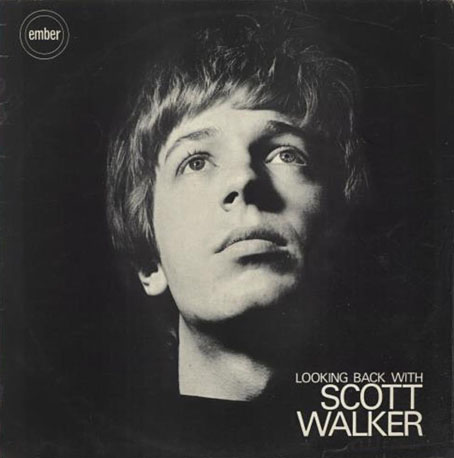
scott.jpg

Photo by Dezo Hoffmann, 1968.

If there’s one thing everyone can agree on about the late Scott Walker it’s that his career was not only improbable but almost impossible in its range and trajectory. My mother saw the Walker Brothers perform in Blackpool 52 years ago, headlining a touring bill that featured Cat Stevens (the artist she most wanted to see) and the soon to be very famous Jimi Hendrix. She enjoyed good pop songs and big orchestras, so even though she’s never expressed a preference for the Walker Brothers or Walker solo I’m sure she could listen to an album or two. But she wouldn’t be able to stand more than a minute of Walker’s output from Tilt (1995) onwards, and even the four watershed tracks on Nite Flights (1978) would be deemed unacceptable. Walker’s progress inverted the stereotype of the 20th-century pop career, the all-too-common descent into blandness and irrelevance, by following a course closer to that taken by painters and literary artists. He walked the walk.

• When Scott Walker’s Climate Of Hunter was announced in 1984, Richard Cook persuaded its introverted creator to talk to the press for the first time in many years. Cook and Walker met again in 1995 when Tilt was released. From 2008: Sean O’Hagan talking to Scott Walker two years after the release of The Drift; at The Wire again: a recording of Rob Young discussing Walker’s career; at the BFI: Scott Walker’s selection of some favourite films; at The New Yorker: Amanda Petrusich on the weird and vast and periodically devastating music of Scott Walker.

• At The Paris Review: Jane Alison suggests meanders, spirals, radials, fractals and cells as alternative to the narrative arc, while Peter Bebergal argues for seeing belief and disbelief in a superposition when it comes to art and the occult.

Sarasota Half in Dream, a feature-length documentary by Derek Murphy and Mitchell Zemil about a decaying Florida suburb.

• Chris Marker, Always Moving: Max Nelson on a Paris exhibition, Chris Marker, les 7 vies d’un cinéaste.

• There’s a little more Scott Walker, inevitably, in this interview with Stephen O’Malley of Sunn O))).

Michael Moorcock talking to The Austin Chronicle about his long association with Hawkwind.

M. John Harrison chooses favourite stories for Jonathan Gibb’s Personal Anthology series.

• Rat Cunning and Bloodshed: An interview with Simon Sellars by Lee Rourke.

In Search of the Seas of Pleiades, a free download by Jenzeits.

• Rammstein are back with a video epic: Deutschland.

Sex Magick is Satanic doo-wop by Twin Temple.

Time, Forward! by Georgi Sviridov.

Orpheus (1967) by The Walker Brothers | Lullaby (By-By-By) (2000) by Ute Lemper | Darkness (2006) by Scott Walker

Weekend links 457

tanaka.jpg

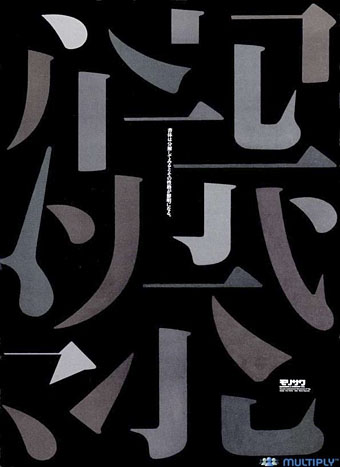
Imagination of Letters by Ikko Tanaka.

Kankyo Ongaku: Japanese Ambient, Environmental & New Age Music 1980–1990 is the latest compilation from Light In The Attic, and another excellent package both musically, physically and design-wise. The album was compiled by Spencer Doran of Visible Cloaks who talked to The Quietus a couple of years ago about his favourite Japanese (and other) music. Simon Reynolds reviewed Kankyo Ongaku last month, and drew attention to Spencer Doran’s Fairlights, Mallets and Bamboo mixes which may be heard here and here.

Michael O’Shea playing his home-made musical instrument (an old door, paintbrushes, etc) on RTÉ in 1980. Shea’s one-and-only album has been deleted for years but was reissued in January. The story of O’Shea’s surprising involvement with Bruce Gilbert and Graham Lewis of Wire (which led to the recording of his album) is recounted here.

Lou Thomas suggests five reasons to watch Shinya Tsukamoto’s Tetsuo: The Iron Man on its 30th anniversary.

…Topor generates a world in which the great unsaid realities of human life are painfully laid bare, amplified through a series of confrontations with “le sang, la merde et le sexe” (“blood, shit, and sex”). While few of his texts have been made available in English, they are nevertheless representative of his wider body of work, in which the reader constantly trips over these same themes as if stumbling upon a naked corpse in a darkened room. They predicate an oeuvre of carnivalesque and necrophilic eroticism, and draw out the pungent, animalistic core hidden within the norms of our everyday existence. Topor’s narratives are shot through with macabre irony, orgiastic scatology, and physical and psychological cruelty, which constitutes a fundamental reframing of the characteristics of human interaction with others.

Andrew Hodgson on Roland Topor’s neglected writings

An anciente mappe of Fairyland: newly discovered and set forth (1920) by Bernard Sleigh.

Maggot Brain: an impromptu Funkadelic cover by Albatross Project.

Anne Billson on purr evil: cinematic cats with hidden agendas.

Sayonara: one of the most Japanese words in the dictionary.

• Painting the Beyond: Susan Tallman on Hilma af Klint.

• RB Russell on bookseller’s labels: part one & part two.

Christopher G. Moore on The Immortals and Time.

• Fuck the Vessel,” says Kate Wagner.

• Japanese Farewell Song (Sayonara) (1957) by Martin Denny | Sayonara: The Japanese Farewell Song (1976) by Haruomi Hosono | Sayonara (1991) by Ryuichi Sakamoto

Weekend links 456

tanning.jpg

A Mrs Radcliffe Called Today (1944) by Dorothea Tanning.

Darran Anderson on how the Bauhaus kept things weird. “Many imitators of the famous art school’s output have missed the surreal, sensual, irrational, and instinctual spirit that drove its creativity.”

• Notes on the Fourth Dimension: Hyperspace, ghosts, and colourful cubes—Jon Crabb on the work of Charles Howard Hinton and the cultural history of higher dimensions.

• “[Edward] Gorey is slowly emerging as one of the more unclubbable American greats, like Lovecraft or Joseph Cornell,” says Phil Baker.

The label “homosexual writer” stuck for the rest of his career, with Purdy confined to what Gore Vidal called “the large cemetery of gay literature…where unalike writers are thrown together in a lot, well off the beaten track of family values”. In later years, Purdy moved further off the beaten track, as much by intention as circumstance. “I’m not a gay writer,” he would tell interviewers. “I’m a monster. Gay writers are too conservative.”

Speaking to Penthouse magazine in 1978, Purdy said being published was like “throwing a party for friends and all these coarse wicked people come instead, and break the furniture and vomit all over the house”. He added that, in order to protect oneself, “a writer needs to be completely unavailable”.

Andrew Male on writer James Purdy

• The Necessity of Being Judgmental: Roger Luckhurst on k-punk: The Collected and Unpublished Writings of Mark Fisher.

Faunus: The Decorative Imagination of Arthur Machen, edited by James Machin with an introduction by Stewart Lee.

• More James Purdy: “His poetry displays a softness that readers of his fiction might not expect,” says Daniel Green.

Drag Star! is a 150,000-word interactive novel/text adventure by Evan J. Peterson.

• At Dangerous Minds: Dave Ball discusses his years as the other half of Soft Cell.

Daisy Woodward on the story of radical female Surrealist Dorothea Tanning.

• Inside the bascule chamber: photos of Tower Bridge, inside and out.

Tim Smith-Laing on the meaning of Miró’s doodles.

• Galerie Dennis Cooper presents…Emma Kunz.

rarecinema: a shop at Redbubble.

Apollo Press Kits

The Fourth Dimension (1964) by The Ventures | Dimension Soleils (1983) by Gilles Tremblay | Into The Fourth Dimension (1991) by The Orb

Sundial and Mile End Purgatorio

blacktower.jpg

The Black Tower.

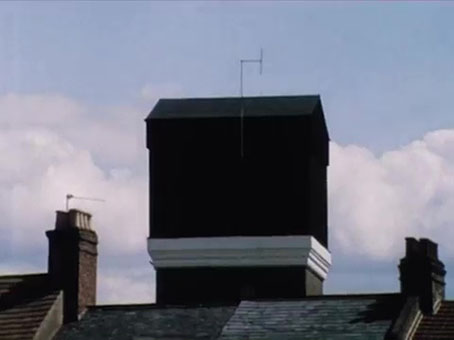
I ought to have devoted this post to The Black Tower (1987), John Smith’s short and sinister film which I linked to at the weekend. It was good to watch it again after seeing a TV screening (no doubt the only one) on the UK’s Channel 4 in 1988. It also reminded me of the two shorter films linked here, both of which were also shown on Channel 4 a few years later in Benjamin Woolley’s excellent Midnight Underground series. All three films are linked by their London locations and their different solutions to the perennial problem of the micro-budget filmmaker looking to make the most of limited resources.

sundial.jpg

Sundial.

Smith’s film is the more substantial work, and of particular interest to those looking for examples of weird (or horror) cinema that avoids Hollywood cliches. The Black Tower combines static views of an unusual building with voiceover and sound effects to turn a mundane piece of architecture into a growing menace. Using a voiceover to craft a narrative from unrelated shots has always been a useful and flexible technique, especially if money is limited; Peter Greenaway did this with all of his early films, and it’s an approach also favoured by Patrick Keiller and Terrence Malick.

mileend.jpg

Mile End Purgatorio.

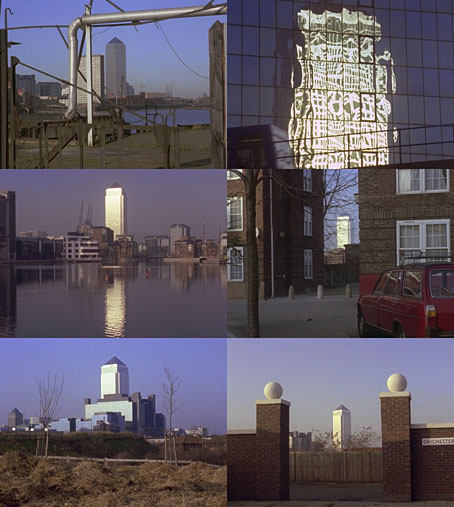
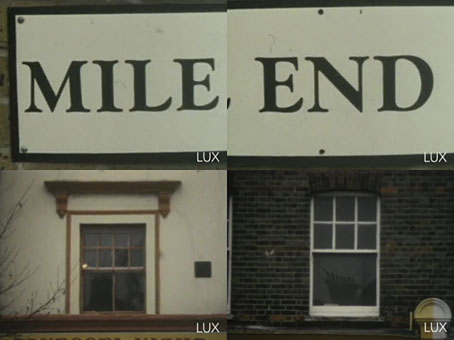
Guy Sherwin uses the same technique for Mile End Purgatorio (1991), an East-End riff on Dante, Hamlet and the Bible, with words by Martin Doyle. William Raban’s Sundial (1993) has no voiceover but it follows The Black Tower in making the Canary Wharf tower the centre of its attention, the fixed point in the passing of a single day. Sherwin and Raban also show how much can be done with a single minute of film.