Weekend links 91

santosh.jpg

Untitled (1978) by GR Santosh at 50 Watts.

Evertype Publishing produces a range of Lewis Carroll special editions including Ailice’s Àventurs in Wunnerland (a translation in Scots), Alicia in Terra Mirabili (a Latin version), and an edition printed in the Nyctographic Square Alphabet devised by Carroll.

• This week’s bookshop animations: Type Books, Toronto presents The Joy of Books while at Shakespeare and Company, Paris, Spike Jonze and Simon Cahn explore the erotic life of book covers in Mourir Auprès de Toi.

• Invisible Girls and Phantom Ladies, a 1982 article on sexism in (US superhero) comics by Alan Moore. Thirty years on, things haven’t improved much at all.

I reread it now, 35 years later, and I am struck by its capacity to change like a magic mirror. Where I had originally seen it as a book about writing, about becoming a writer, I now see it as a book about reading, about taking one’s place in the chain. Where I once assumed it was a book about eternal youth, I now see it as a book about growing up, about learning to live.

Tilda Swinton on Virginia Woolf’s Orlando

Dark Water, Lovecraftian carpet designs (yes, carpets) by Kirill Rozhkov. Danish carpet manufacturer Ege has a catalogue showing the finished products.

Neil Gaiman ventures into the treacherous labyrinth of M. John Harrison’s Viriconium.

Nicholas Lezard reviews The White People and Other Weird Stories by Arthur Machen.

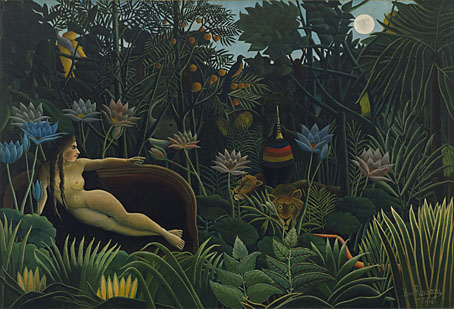
rousseau.jpg

The Dream (1910) by Henri Rousseau at the Google Art Project.

• Reassessing the Saul Bass and Alfred Hitchcock Collaboration by Pat Kirkham.

• Getting There Too Quickly: Peter Bebergal on Aldous Huxley and Mescaline.

Hidden in the Open: A Photographic Essay of Afro-American Male Couples.

Filles En Aiguilles, a new musical work by Schütze+Hopkins.

RubiCANE’s Erotic Illustrations.

Laurie Anderson has a Godplex.

Alan Bennett on Smut.

The Jungle Line (1975) by Joni Mitchell | The Jungle Line (1981) by Low Noise (Kevin Armstrong, Thomas Dolby, JJ Johnson & Matthew Seligman) | The Jungle Line (2007) by Herbie Hancock with Leonard Cohen.

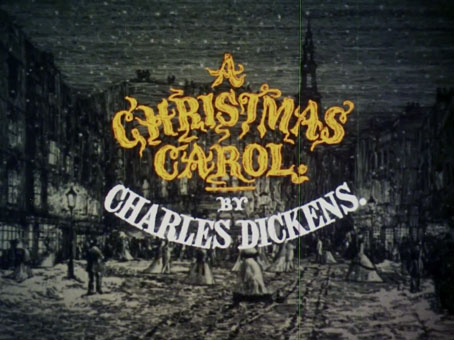
Richard Williams’ Christmas Carol

williams1.jpg

It’s easy to loathe the teeth-grinding sentimentality of Charles Dickens’ seasonal tale, as well as its subtext which isn’t so far removed from Emperor Ming’s instruction to his cowed populace in Flash Gordon: “All creatures shall make merry…under pain of death.” Yet as a ghost story I prefer A Christmas Carol to the sketchier The Signal-Man, and I’ve always enjoyed this memorable 1971 adaptation from the animation studio of the great Richard Williams.

williams2.jpg

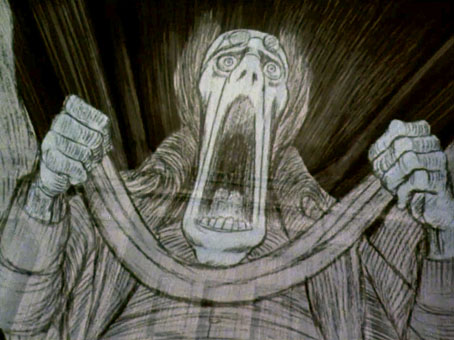
Marley’s ghost.

Williams is best known today for his role as animation director on Who Framed Roger Rabbit? but prior to this he’d distinguished himself as creator of the florid title sequence for What’s New, Pussycat? (1965), and the animated sections—done in the style of 19th-century engravings and political cartoons—for Tony Richardson’s The Charge of the Light Brigade (1968). Williams’ Christmas Carol owes a similar debt to Victorian graphics, not only to the original story illustrations by John Leech, but also to Gustave Doré’s views of Victorian London, scenes which had earlier influenced the production design for David Lean’s adaptation of Oliver Twist. Williams’ film crams Dickens’ story into 25 minutes but nonetheless manages to maintain the tone of the original to a degree which eludes many feature-length travesties, especially those in which the nightmare squalor of Victorian London is reduced to a shot or two of dressed-down extras. Dickens had first-hand experience of the squalor: Kellow Chesney’s The Victorian Underworld (1970) quotes at length from one of the journeys Dickens took (under police escort) through the notorious St Giles rookery, and his ghost story was intended as much as a warning to the complacency of middle-class Victorian readers as a Christmas celebration.

williams3.jpg

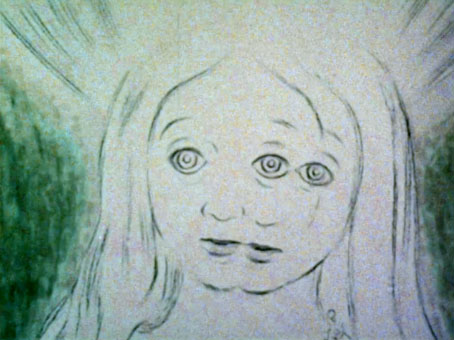
The Ghost of Christmas Past.

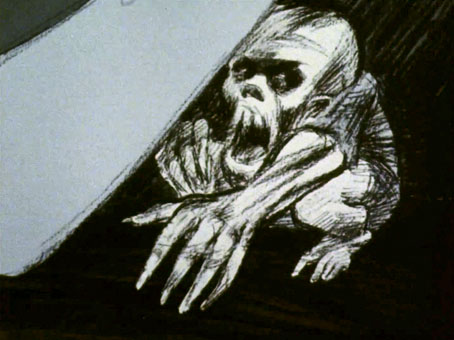
For me the crucial moment in any adaptation comes when the Ghost of Christmas Present shows Scrooge the figures of Ignorance and Want: in most film versions these tend to be a pair of well-fed child actors in rags and make-up; Williams shows us two grim spectres that owe more to Gerald Scarfe than Walt Disney. Williams is also truer to the ghosts themselves: Dickens describes Jacob Marley unfastening his jaw which falls open then remains that way while he proceeds to speak to his former friend; the Ghost of Christmas Past is the androgynous figure from the story with its ambiguous nature also shown by its shimmering indeterminate outline.

williams4.jpg

Ignorance.

Any animated drama relies on its voice actors, and Williams was fortunate to have Alistair Sim (as Scrooge) and Michael Hordern (as Marley) reprising their roles from the 1951 film version, while Michael Redgrave narrates the tale. The film used to be a seasonal fixture of British television, and may still be for all I know (I haven’t owned a TV for years). For the time being it’s on YouTube, of course, with a full-length version here that’s blighted by compression artefacts but is watchable enough. 2012 is the Dickens bicentenary so expect to hear a lot more about the author and his works in the coming year.

Update: The version linked to originally has been deleted. No matter, there’s a much better copy here (for now).

As usual I’ll be away for a few days so the { feuilleton } archive feature will be activated to summon posts from the past below this. Have a good one. And Gruß vom Krampus!

Previously on { feuilleton }
“Who is this who is coming?”

Weekend links 89

gnoli.jpg

A drawing from Bestiario Moderno by Domenico Gnoli (1933–1970).

RIP Russell Hoban. Nina Allan celebrates a favourite writer while David Mitchell, writing in 2005, pays tribute to Riddley Walker. For me the gulf between Hoban and many of his contemporaries could be measured by his entry in the Writer’s Rooms feature the Guardian Review was running for a couple of years: Hoban’s room was the only one that admitted to being cramped and chaotic.

A wristwatch could be “a tiny flowering hell, a wreath of roses, a dungeon of air” and still tell time. A short story could take the shape of an instruction manual for the most routine of tasks (crying, singing, winding said dungeon, killing ants in Rome), or a compendium of tales about fantastical but oddly familiar species. A novel didn’t have to progress from the first page to the last, hung on a rigid skeleton of plot: it could proceed in oblong leaps and great steps backward, like a game, say, of hopscotch. “Literature is a form of play,” said Cortázar. […] It is perhaps because he so stubbornly resists categorization, as much as for the ludic complexity of his work, that Cortázar is in these parts more admired than he is read. The Anglophone literary imagination (or perhaps just its material substrate: the market) appears to have room for only one Latin American giant per generation—Borges, García Márquez, the freshly beatified San Bolaño. Cortázar was too weird, too difficult, too joyously slippery to make the cut.

Eels Über Alles: Ben Ehrenreich on Julio Cortázar

• Alfred Jarry is another writer the Anglophone world has often found “too weird, too difficult”. Jarry has been dead for over a century but Alastair Brotchie’s recently-published full-length biography is the first such work in English. Mark Polizzotti reviews a life of “the poster boy for literary cult figures” at Bookforum.

• “A Beautiful Trip”: Frances Morgan interviews David Lynch about music and sound. And Robert Wyatt talks for 95 minutes to Tony Herrington about his favourite music.

• Twilight Science: Paul Schütze presents solo musical work and various collaborative projects in new digital editions.

occupy.jpg

Jonathan Barnbrook‘s logo design for Occupy London.

• Winter reads: Myths of the Norsemen by Roger Lancelyn Green. Related: What became of illustrations in fiction?

The White People and Other Weird Stories by Arthur Machen is a new Penguin Classic out in January.

• “This Christmas, why not give Viriconium, city of sex, syphillis & consubstantiation?”

• The Casual Optimist announces its Favourite Book Covers of 2011.

The Collect Call of Cthulhu

Living with Burroughs

Function (2011) by Emptyset | Aftertime (2011) by Roly Porter with Cynthia Miller on the Ondes Martenot.

Meeting Harry Smith by Drew Christie

christie.jpg

A short anecdotal film by artist and animator Drew Christie in which musicologist John Cohen relates his first encounter with mercurial polymath Harry Smith, a man small in stature but large in interests and influence. Christie is something of a polymath himself since he also provides the banjo soundtrack. There’s more art and animation at his blog, while Ubuweb (of course) has a small selection of Smith’s own films. Thanks to Caspar for the tip.

Previously on { feuilleton }
Heaven and Earth Magic by Harry Smith
Harry Smith revisited
The art of Harry Smith, 1923–1991

Weekend links 85

farmanfarmaian.jpg

Group I (Convertible Series, 2010) by Monir Farmanfarmaian.

The four albums recorded by Bruce Gilbert and Graham Lewis under the name Dome are being reissued by Editions Mego together with Gilbert & Lewis’s Yclept album. I always preferred Gilbert & Lewis in their Dome incarnation (and Colin Newman solo) to the punk and post-punk stylings of their former band, Wire. Dome were (among other things) eccentric, awkward, noisy, hypnotic and experimental. Their recordings seemed to go largely unnoticed in the early 1980s so it’s good to see them being reissued.

A Children’s Treasury of American Cops Brutally Attacking Citizens: “…it takes quite a lot of tax money to keep a bunch of vicious thugs overfed and dressed like junior Darth Vaders with their portable hard-ons, on the off-chance some college kids might one day peacefully sit outside to protest this nation’s revolting descent.”

• “Stevenson, as has been said, was disarmingly candid about the material he borrowed for Treasure Island. One name, however, is missing from the extensive catalogue of self-confessed ‘plagiarisms’.” John Sutherland at the TLS.

• “Messiaen’s advice was revelatory. ‘You have the good fortune of being an architect and having studied special mathematics’, he told Xenakis. ‘Take advantage of these things. Do them in your music.'”

• “They always said punk was an influence. Tracey Emin, Damien Hirst, what a load of old shit that was. It’s Thatcherite art care of Saatchi & Saatchi.” And don’t ask Jamie Reid about the Sex Pistols.

Dennis Cooper is interviewed at Lambda Literary. I was surprised last week to find my recent post about William Burroughs’ The Wild Boys linked on a feature about the novel at Cooper’s blog.

Cosmic Geometry: The art of Monir Farmanfarmaian at The Paris Review. Related: Monir Farmanfarmaian at the Haines Gallery, San Francisco.

• Paleolithic phallic art suggests that many early European men scarred, pierced and tattooed their penises.

FACT mix 301 is a selection of dub tracks, dubstep pieces and Middle Eastern songs compiled by Kahn.

Who left a tree, then a coffin in the library?

The Little Journal of Rejections (1896).

Clive finished another painting.

The Great Salt Desert of Iran.

Keep Drawing.

• Troisième (1980) by Colin Newman | And Then… (1980) by Dome | The Red Tent pts I & II (1980) by Dome) | Jasz (1981) by Dome.