The Tinderbox

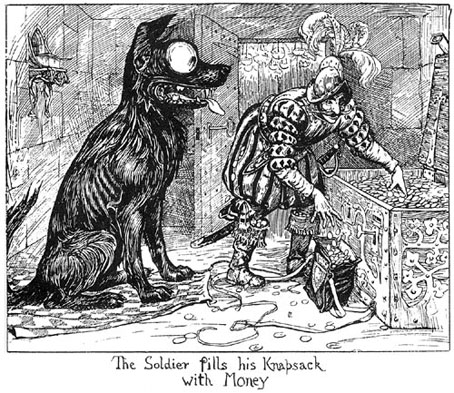
tinderbox4.jpg

HJ Ford (1894).

“Do you see that great tree!” quoth the witch; and she pointed to a tree which stood beside them. “It’s quite hollow inside. You must climb to the top, and then you’ll see a hole, through which you can let yourself down and get deep into the tree. I’ll tie a rope round your body, so that I can pull you up again when you call me.”

“What am I to do down in the tree?” asked the soldier.

“Get money,” replied the witch. “Listen to me. When you come down to the earth under the tree, you will find yourself in a great hall: it is quite light, for many hundred lamps are burning there. Then you will see three doors; these you can open, for the keys are in the locks. If you go into the first chamber, you’ll see a great chest in the middle of the floor; on this chest sits a dog, and he’s got a pair of eyes as big as two tea-cups. But you need not care for that. I’ll give you my blue-checked apron, and you can spread it out upon the floor; then go up quickly and take the dog, and set him on my apron; then open the chest, and take as many farthings as you like. They are of copper: if you prefer silver, you must go into the second chamber. But there sits a dog with a pair of eyes as big as mill-wheels. But do not you care for that. Set him upon my apron, and take some of the money. And if you want gold, you can have that too—in fact, as much as you can carry—if you go into the third chamber. But the dog that sits on the money-chest there has two eyes as big as the round tower of Copenhagen. He is a fierce dog, you may be sure; but you needn’t be afraid, for all that. Only set him on my apron, and he won’t hurt you; and take out of the chest as much gold as you like.”

The Tinderbox (1835) by Hans Christian Andersen
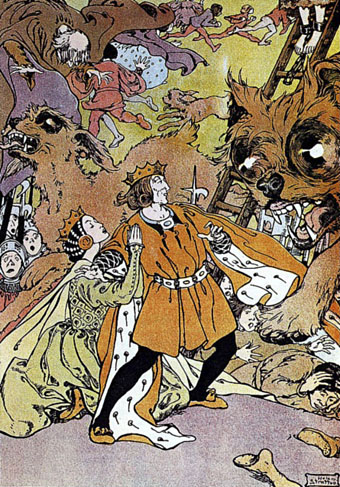
tinderbox1.jpg

Helen Stratton (1910?)

Will at 50 Watts is to blame for this one, the illustrations he posted last week were excessive enough to give even a master of exaggeration like Tex Avery second thoughts. Hans Christian Andersen’s fairy tales have proved so popular over the years that a core group of stories tend to drive out the less familiar works from fresh editions. The Tinderbox is one of these minor stories, the tale of a soldier with a magic tinderbox capable of summoning a trio of supernatural dogs with enormous eyes. My first contact with the story was via a German television adaptation, Das Feuerzeug, filmed in 1958 and later screened in the UK as filler for the children’s TV schedule along with that memorably creepy series (also from Germany), The Singing Ringing Tree. I remembered little about the story but was never able to forget those weird dogs even though their eyes in the TV version are nothing like the way they’re presented in illustrations. They may not be as freaky but the way they’re presented as huge and black makes me think now of the ghostly barghests or black dogs of British folklore.

Searching around for illustrations turned up the handful here. Many illustrators concentrate on other scenes but I’ve only been looking for the dogs. I’m sure there’s more to be found so this may well be a subject to revisit later. The Stratton and Tarrant pictures show the climax of the story when the soldier, about to be hanged for having used the dogs to kidnap a princess, summons his creatures to kill the king, queen and all the people who condemned him. Yes, it’s good wholesome fare for kids.
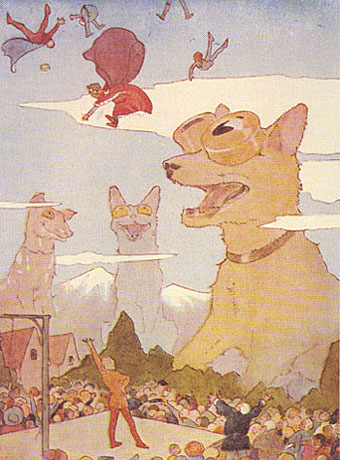
tinderbox2.jpg

Margaret Tarrant (1910).

Continue reading “The Tinderbox”

Weekend links 104

cummings.jpg

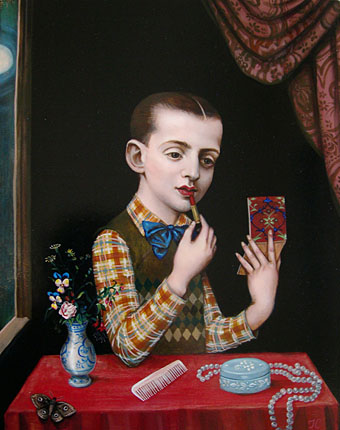
Prettiest Star (2004) by Timothy Cummings.

I Want Your Love, a feature film directed by Travis Mathews catches my attention for having been described as “the gay Shortbus” even though (as the director notes) Shortbus was pretty gay to begin with.

• I’ve always found Hans Christian Andersen’s story of The Tinderbox—a tale of spectral dogs with enormous eyes—to be rather weird. But these illustrations by Heinrich Strub for a 1956 edition beat everything.

• “From an early age, however, I became in secret the slave of certain appetites.” The line that Robert Louis Stevenson deleted from The Strange Case of Dr Jekyll and Mr Hyde.

Scientific American: Homophobes might be hidden homosexuals. Not exactly fresh news but always worth bearing in mind when someone starts ranting about those evil gays.

Minimal Wave: The 80s synth-pop underground. The Minimal Wave label releases a vinyl compilation by Hard Corps this month.

• “Blame the Victorians for making menswear boring.” Alex Jung on the endless tyranny of the suit-and-tie combination.

• Women, Vaginas and Blood: Breaking menstrual taboos with artist Sarah Maple.

London’s lost rivers (again): the hidden history of the city’s buried waterways.

Vincenzo Pacelli says the Knights of Malta murdered Caravaggio.

Street style 1906: Edward Linley Sambourne’s fashion blog.

Architectural Stationery Vignettes at BibliOdyssey.

Hans Bellmer & Unica Zürn at Ubu Gallery, NYC.

Pam Grossman admits to being a “candle hooch”.

Dirty (1986) by Hard Corps | Lost Rivers Of London (1996) by Coil | The Tinderbox (2009) by Patrick Wolf.

Jean de Bosschère’s Folk Tales of Flanders

bosschere01.jpg

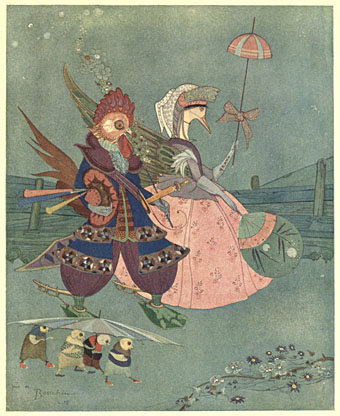
The illustrations of Belgian artist Jean de Bosschère (1878–1953) aren’t as easy to find as those of his British and American contemporaries so it’s a shame there isn’t more of his idiosyncratic work at the Internet Archive. Folk Tales of Flanders is there, however, an edition from 1918 featuring a number of colour plates and many black-and-white illustrations. For once I prefer the paintings over the line drawings, de Bosschère’s colour work perhaps owes something to Edmund Dulac’s style but it’s a lot more eccentric, especially here where he’s required to depict the activities of a host of anthropomorphic animals. The eccentricities extended to the artist’s life and the books he wrote, one of which is an autobiography entitled Satan l’Obscure (1933). A lighter work, Weird Islands (1921), was featured at BibliOdyssey a couple of years ago.

bosschere02.jpg

bosschere03.jpg

Continue reading “Jean de Bosschère’s Folk Tales of Flanders”

Weekend links 101

cabat.jpg

Kraken from Ernie Cabat’s Magical World Of Monsters (1992) at Monster Brains.

“I think for a lot of people who don’t read pulp growing up, there’s a real surprise that the particular kind of Pulp Modernism of a certain kind of lush purple prose isn’t necessarily a failure or a mistake, but is part of the fabric of the story and what makes it weird. There’s a big default notion that ‘spare,’ or ‘precise’ prose is somehow better. I keep insisting to them that while such prose is completely legitimate, it’s in no way intrinsically more accurate, more relevant, or better than lush prose.” China Miéville at Weird Fiction Review expressing an opinion that few in the literary world ever articulate, never mind agree with. Far more common is (to pick a recent example) Ursula K Le Guin dismissing Cormac McCarthy for “pretentious prose”.

• “Militant feminist scientists brainwash a research subject to assassinate the Welsh Minister of Prostitution. Meanwhile World War III is being fought and the USA has been invaded.” The IMDB précis for Taking Tiger Mountain (1983), a feature film directed by Tom Huckabee from a script by William Burroughs, and featuring a 19-year-old pre-Aliens/Near Dark Bill Paxton. The director discusses the film’s production at Screen Slate and attends a rare screening at Spectacle, Brooklyn, NYC, today (March 25th). YouTube has a three-minute clip. Surprising this has remained buried for so long. When can the rest of us get to see it?

• Prestel have published the catalogue for In Wonderland: The Surrealist Adventures of Women Artists in Mexico and the United States. AnOther previewed some of the contents. The exhibition runs at the LACMA, Los Angeles, until 6th May.

…gays only make up about 3% of the population so we spend our whole lives “translating” straight movies, books, ballets into gay terms and studying the heterosexuals around us—we know much more about them than they know about us, just as blacks know a lot about whites but whites know virtually nothing about blacks.

Edmund White (again) interviewed by Frank Pizzoli at Lambda Literary Review.

• New on Caroline True Records: Jon Savage’s “Fame”, Secret History of Post-Punk 1978–81. “Some of it doesn’t sound like anything that has happened since,” says Savage. Indeed. FACT has the track list which I was pleased to see includes Chrome among the usual suspects. Hear a 12-minute promo mix at Soundcloud.

guerin.jpg

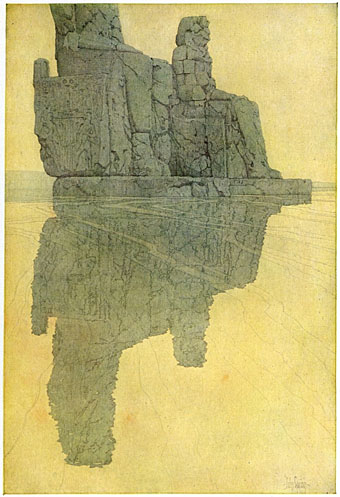
The Colossi of Memnon by Jules Guerin. From Egypt and its Monuments (1908) by Robert Hichens at Golden Age Comic Book Stories.

Gay Life Stories, “a colourful compendium of same-sex love through the ages” by Robert Aldrich. Reviewed here. Related: Alice Dreger asks “Are straight people born that way?”

• Clive Hicks-Jenkins created a series of designs for a Washington DC performance of Stravinsky’s The Soldier’s Tale. Follow their evolution in reverse order at his blog.

• Hocus Pocus: Margaret Eby on the brief epistolary relationship between Harry Houdini and Arthur Conan Doyle.

Rick Poynor on more cover designs for JG Ballard’s Crash.

London, city of dreams and rivers, caught on Polaroid.

• Photo prints by Thom Ayres for sale at Society6.

B*tches in Bookshops

• Meet You In The Subway (1979) by Chrome | New Age (Version III) (1980) by Chrome | Danger Zone (1981) by Chrome | Firebomb (1982) by Chrome.

Weekend links 100

bedini.jpg

How to become a mermaid and dissolve into sea foam in just seven surgical operations (2010) by Carla Bedini.

D.I.Y. Magic was a regular feature in the late Arthur Magazine that’s now become a book by Anthony Alvarado: “Think of it as jail-breaking the iPhone of your mind. Teaching it to do things that its basic programming was never set up for. Advanced self-psychology.” A first edition letterpress silver foil cover is limited to 1000 copies. | More magic: Jimmy Page’s unused soundtrack for Kenneth Anger’s Lucifer’s Rising finally gets an official release on March 20th.

Julia Holter‘s tremendous new album, Ekstasis, has been rocking my world this week. She’s interviewed at FACT where you can also hear the opening track, Marienbad, which receives extra points for being derived from that film. And there’s more: Ritual Music, a live performance at Sea & Space Gallery in Los Angeles, and Fur Felix, a film by Eric Fensler.

Brute Ornament, an exhibition of new work by Seher Shah and Kamrooz Aram opens at the Green Art Gallery, Dubai, on Monday. While the UAE is out of reach for most of us, the gallery site has samples of the work on display.

• This week’s mixtape arrives courtesy of BUTT magazine: Rock Bottom Mix by Cesar Padilla, a blend of acid, glam, grunge, punk, surf and stoner rock. Elsewhere, Richard Norris lists his 20 favourite UK psychedelic records.

the name is BURROUGHS ? Expanded Media at ZKM, the Center for Art and Media in Karlsruhe, is a comprehensive exhibition presenting for the first time in Germany the artistic output of William Burroughs.

Boneland by Alan Garner will be published in August, a new novel that concludes a narrative thread begun with The Weirdstone of Brisingamen in 1960.

• Coming soon (so to speak) on BFI DVD, The Erotic Films of Peter de Rome, more gay obscurities receiving quality attention.

The Northampton Chronicle reports on Alan Moore’s forthcoming novel about the town, Jerusalem.

Susan Cain is playing my tune (again): Why the world needs introverts.

• Techniques of terror: Carl Dreyer‘s Danish Gothic dissected.

• NASA has the latest map of Everything.

The male sex toy revolution.

Lucifer Rising Sessions (1972) by Bobby Beausoleil.