Dunsany’s highwaymen

pledge.jpg

The Pledge.

As mentioned last week, the BFI’s DVD of Schalcken the Painter includes as extras two short films by other directors. Edward Abraham’s The Pit (1962) is an adaptation of Poe’s The Pit and the Pendulum which is creditable but lacks the sustained malevolence of Jan Švankmajer’s version. The second film is The Pledge (1981), a 21-minute adaptation by Digby Rumsey of The Highwaymen, a short story by Lord Dunsany. This is unusual for being one of the very few film adaptations of Dunsany, Rumsey being responsible for two others: Nature and Time (1976), and In the Twilight (1978). Since this is a low-budget work it’s no surprise that the story is a historical piece rather than one of the florid fantasies so beloved of HP Lovecraft. A trio of highwaymen decide to rescue the hanging body of their former comrade and inter it in a bishop’s tomb. (The bishop’s bones, they decide, can go in the earth.) The story is so slight it’s more of a curio than anything, and would probably be better seen along with with the other Dunsany adaptations. Of note is a typically jaunty score by Michael Nyman, while Nyman’s later collaborator, Peter Greenaway, assisted with the editing. If nothing else, Greenaway would have appreciated the film’s macabre nature.

sime.jpg

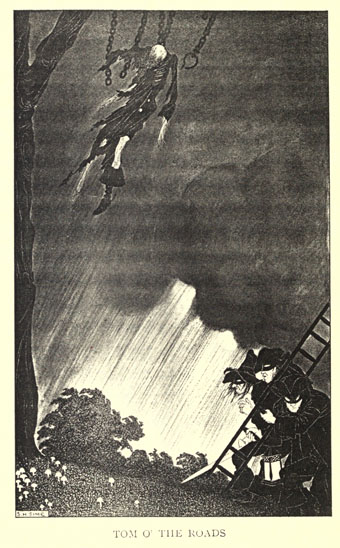
Illustration for The Highwaymen by Sidney Sime.

The original story appeared in Dunsany’s 1908 collection The Sword of Welleran and Other Stories. The Internet Archive has a scan of the entire book with illustrations from Sidney Sime’s prime period. The depiction of the scene at the gibbet is a lot more atmospheric than in the film but then that’s the advantage of the illustrator: there’s no need to worry about a budget.

Previously on { feuilleton }
Schalcken the Painter revisited
The Pendulum, the Pit and Hope
Sidney Sime paintings
Haschisch Hallucinations by HE Gowers
Sidney Sime and Lord Dunsany

Weekend links 181

eye.jpg

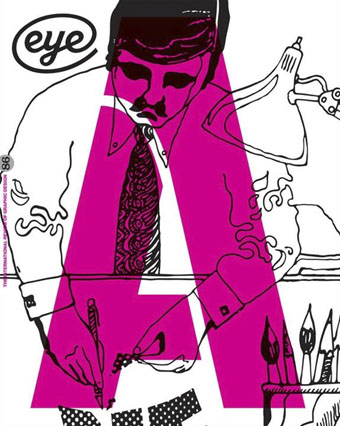
Cover of Eye no. 86 vol. 22, 2013, a type special. Detail from 1970s Letratone brochure, overprinted by character from the Marsh stencil alphabet.

The new edition of Eye magazine includes my essay on the evolution and aesthetics of steampunk. In the same issue Rick Poynor’s feature on the prints of Eduardo Paolozzi mentions a forthcoming book by David Brittain about the artist’s associations with New Worlds magazine in the 1960s. I designed the Paolozzi volume which will be published by Savoy Books in a few weeks’ time. More about that later.

Still on steampunk, KW Jeter notes its popularity among the younger crowd: “If some old fogey peering through his smudged bifocals can’t discern the cool and important stuff going on, such as the tsunami of anarchic multiculturalists using the steampunk scalpel to dissect the past and reassemble it like a two-dollar watch, that’s his loss; the readers are picking up on it.”

• Musicians interviewed: Rhys Chatham: “The reason I got into trumpet playing is because I wanted to play like [Black Sabbath guitarist] Tony Iommi.” | James Ginzburg: “One of the strongest feelings I had was that the act of sitting down and making dance music was like playing a video game…I felt disconnected from it…” | Julia Holter: “I love working with the voice, I love mystery, I love creating atmosphere.” | Roly Porter: “I sit at home and listen to folk and blues from before I was born. I listen to a lot of dub and reggae and classical music. These are all genres which to me seem really interlinked and influential.”

• At Kickstarter: From the director of Lovecraft: Fear of the Unknown, a short film entitled Do Not Disturb. “Two men are forced to share a motel room on a dark & stormy night. One man’s snoring starts to summon creatures into our world.”

The Notting Hill of the 1960s – with Moorcock’s marriage, children, celebrity, the editorship of New Worlds, the collaboration with JG Ballard, Brian Aldiss and the rest – became the proving ground for the shape-shifting Carnaby Street dandy Jerry Cornelius. But all the numerous Moorcock characters, those undying and born-again clones, have a part to play in his “multiverse”, a concept he developed alongside the earlier model suggested by John Cowper Powys. Moorcock’s astonishing catalogue of speculative fiction works to prove his key equation, which is based on meta-temporal parallel worlds drawn from HG Wells, Chaos Theory, String Theory, the Edgar Rice Burroughs of John Carter of Mars and the William Burroughs of Nova Express and the “Interzone”. Publishing all the strange rafts and pods of Moorcock’s prodigious science fiction and fantasy output, as Gollancz have done, is like assembling a ghost fleet, under the joint command of Dr John Dee and Admiral John Ford, with which to invade that uncertain continent we know as the past.

Iain Sinclair on the new series of Michael Moorcock editions from Gollancz.

• “What does science tell us about the relative dangers of drugs? Alcohol is by far the No. 1 most dangerous drug.” Some graphs from the American Enterprise Institute who no one would accuse of being a bunch of stoners.

• “I loved Eudora Welty, Flannery O’Connor, Katherine Ann Porter, Carson McCullers. There was a feeling that women could write about the freakish, the marginal.” Alice Munro at The Paris Review.

Elena Smith on Literary Parkour: @Horse_ebooks, Jonathan Franzen, and the Rise of Twitter Fiction. Related: Boris Kachka has a list of Everything Jonathan Franzen currently hates.

• Mixes of the week: Joseph Burnett compiles Adventures in Modern Jazz while Kier-La Janisse puts together a British Horror mix for Fangoria.

Explore the planet Mars, one giant image at a time.

• At BibliOdyssey: The Turner’s Manual.

A Crimson Grail (for 400 Electric Guitars) (2007) by Rhys Chatham | Arrakis (2011) by Roly Porter | City Appearing (2013) by Julia Holter | Debris (2013) by Faint Wild Light

John Batten’s Celtic fairy tales

batten22.jpg

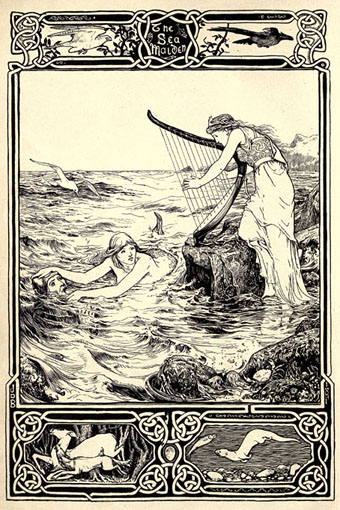
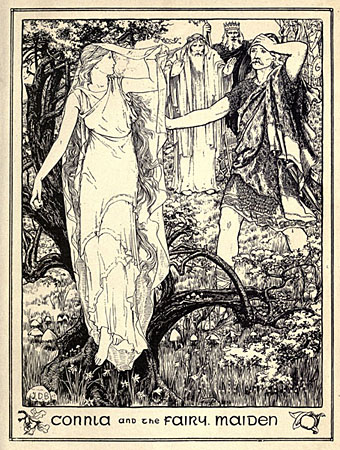
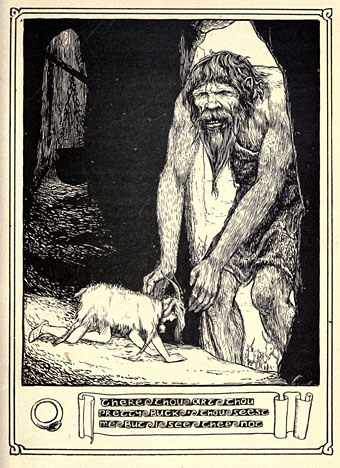
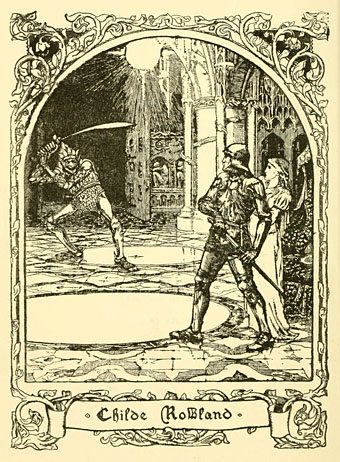
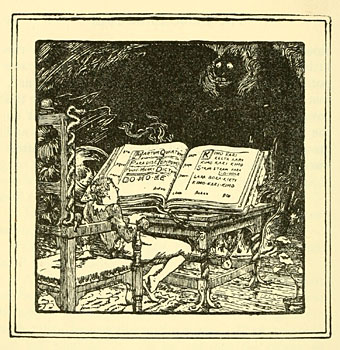
Yet more illustrations from John Dickson Batten, the pages this time being from Celtic Fairy Tales (1892), and More Celtic Fairy Tales (1895). Once again, both books were written by Batten’s regular collaborator Joseph Jacobs. As is often the case where less familiar stories are concerned, they yield some striking imagery.

batten23.jpg

batten24.jpg

batten25.jpg

batten26.jpg

Continue reading “John Batten’s Celtic fairy tales”

John Batten’s English fairy tales

batten09.jpg

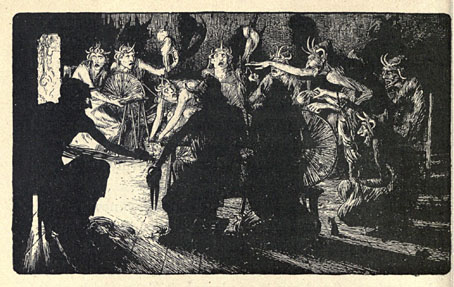
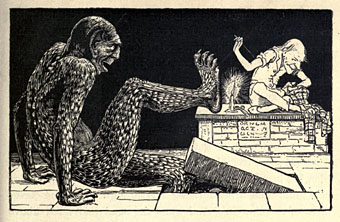
More from illustrator John Dickson Batten with pages from two further collaborations with writer Joseph Jacobs, English Fairy Tales (1890), and More English Fairy Tales (1894). The latter (on the lighter paper below) are much better than the earlier set. The second book also includes The Hobyahs, a surprisingly violent story about a gang of mischievous creatures that the artist illustrates in an almost comic-book style. There’ll be more Batten tomorrow.

batten10.jpg

batten11.jpg

batten12.jpg

Continue reading “John Batten’s English fairy tales”

8 x 8: A Chess Sonata in 8 Movements

8x8-1.jpg

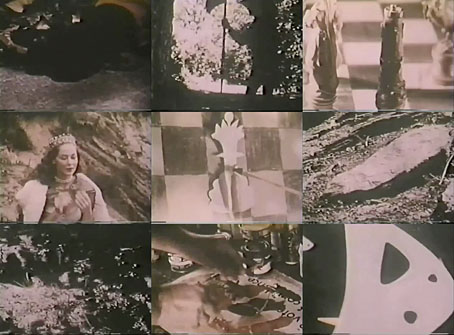
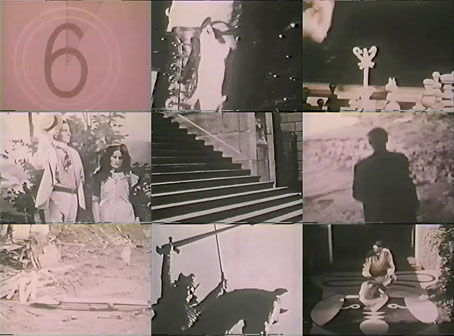
Continuing the Cocteau theme, this fascinating film remains (for the time being) unavailable in a better copy despite its artistic all-star cast. 8 x 8: A Chess Sonata in 8 Movements (1957) can be regarded as a follow-up to Hans Richter’s Surrealist anthology Dreams That Money Can Buy (1947), the directorial credit this time being shared between Richter, Jean Cocteau and Marcel Duchamp. The latter famously quit the art world to devote more time to chess-playing so his involvement with a chess-based fantasy (self-described as “a fairytale for grownups”) isn’t so surprising:

It explores the realm behind the magic mirror which served Lewis Carroll 100 years ago to stimulate our imagination.

The cast comprises famous friends including Cocteau himself, Max Ernst, Dorothea Tanning, Paul Bowles, Fernand Leger, Alexander Calder, Duchamp, and, in the Venetian episode, Peggy Guggenheim in her favourite sunglasses. In places it’s closer to Kenneth Anger’s Inauguration of the Pleasure Dome (1954) than Dreams That Money Can Buy, especially since Anger’s film was another assemblage of unique personalities. One detail I’ve not seen remarked upon elsewhere is the presence behind the camera of Louis & Bebe Barron who assisted with the sound. The Barrons are better known today for their still astonishing all-electronic score for Forbidden Planet (1956). Watch 8 x 8 at Ubuweb or YouTube.

8x8-2.jpg

Previously on { feuilleton }
Dreams That Money Can Buy