Weekend links 660

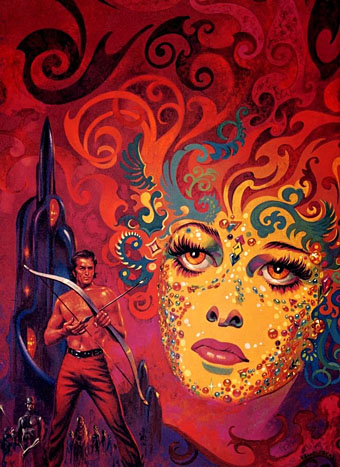
freas.jpg

Cover painting by Kelly Freas for Mayenne (1973) by EC Tubb.

• “The kamishibai (literally “paper play”) is a Japanese form of storytelling that involved a narrator using illustrated paper boards to tell stories. As the story would progress, a new board would replace the previous board, propelling the story forward. This concept served as the inspiration for graphic designer Katsuhiko Shibuya and his class of students at Joshibi University of Art and Design. The task, however, was to deconstruct fairy tales even further using only graphic symbols.” Graphic design kamishibai tell visual fairytales at Spoon & Tamago. Great stuff.

• “If it’s not magical it’s not worth doing it… Without magic there’s no quality.” Musician/producer/catalyst Bill Laswell in conversation.

• At Public Domain Review: Lara Langer Cohen on the emancipatory visions of a sex magician: Paschal Beverly Randolph’s Occult Politics.

• At Smithsonian Magazine: Nicola Jones on the scientific history of cannabinoids.

• “Deep beneath the streets of London, musical wax cylinders reveal lost histories.”

• “The Moon smells like gunpowder.” And all that fine dust is bad for your lungs.

• At Aquarium Drunkard: Guiding Light : A Tom Verlaine Appreciation.

• New music: Sacred Tonalities by Mike Lazarev.

• Supernatural Fairytales (1967) by Art | X-Rated Fairy Tales (1985) by Helios Creed | The Fairy Tale (1991) by Biosphere
Weekend links 659

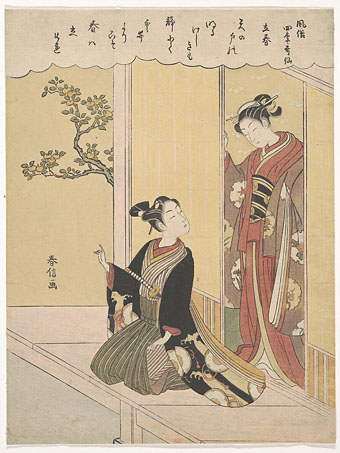
harunobu.jpg

The First Day of Spring (Risshun), from the series Fashionable Poetic Immortals of the Four Seasons (c.1768) by Suzuki Harunobu. Risshun in Japan begins on the 4th of February.

• “…after centuries of imbibing alcoholic beverages as their main source of potable water, European’s new fondness for boiled drinks—coupled with the psychoactive properties of caffeine—swapped societal tipsiness with a mindstate primed for the Enlightenment’s intoxication with reason.” Hunter Dukes on A Treatise Concerning the Properties and Effects of Coffee (1792) by Benjamin Moseley.

• Steven Heller on John Wilcock, Master of the Underground: “[He] was one of the great ‘happening’ characters of midcentury America, beat myth to Hippie legend. He was founder of half a dozen underground papers, and started one of the first citizen-access cable television shows. His achievements are a dense package.”

• At Fonts In Use: Florian Hardwig explores the origin of “the Dune font” as used on the covers of Frank Herbert’s novels during the 1970s and 80s.

• At Smithsonian Magazine: “Hundreds of Frank Lloyd Wright’s designs were never built. Here’s what they might have looked like.”

• Mix of the week: Fact Mix 893 by KMRU & Aho Ssan & Sevi Iko Dømochevsky.

• New music: Hypnagogia by Martina Bertoni, and Cosmos Vol. II by Ran Kirlian & Jaja.

• “Forgotten ‘Stonehenge of the north’ given to nation by construction firm.”

• At Aquarium Drunkard: Soft Machine live at Jazz Bilzen, 1969.

• RIP Tom Verlaine.

• Goofin’ At The Coffee House (1959) by Henri Mancini | Bring Me Coffee Or Tea (1971) by Can | Starfish And Coffee (1986) by Prince

Weekend links 658

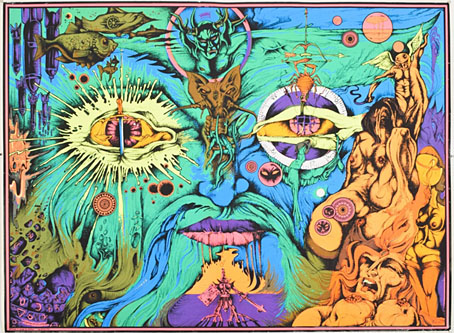
ein-dor.jpg

Also Sprach Zarathustra (1972), a blacklight poster by Asher Ein Dor.

• “Squaring the Circle (The Story of Hipgnosis) is a reasonably informative, if rather dry, look at a subject with much more potential for exploration,” says Dan Shindel, reviewing Anton Corbijn’s feature-length documentary about the album-cover design team. Sounds like a missed opportunity, on the whole, although the history of Hipgnosis has been so thoroughly explored over the course of several books (including a very recent one by Aubrey Powell) that any documentary seems almost superfluous. What I’d most like to see is something we’ll never have, a film about the company directed by the late Storm Thorgerson. And on that note, Thorgerson’s two-part documentary about art and drugs, The Art of Tripping (previously), has resurfaced on YouTube here and here.

• “LunaNet consists of a set of rules that would enable all lunar satellite navigation, communication and computing systems to form a single network similar to the Internet, regardless of which nation installs them. Setting lunar time is part of a much bigger picture. ‘The idea is to produce a Solar System internet,” says Gramling. ‘And the first part would be at the Moon.'” Elizabeth Gibney reports on plans to create a consistent time zone for the Moon.

• “Listening to 12, one cannot help but be struck by this deep expression of Sakamoto’s pain, of his human frailty, strength, and uncertainty about the future.” Geeta Dayal on Ryuichi Sakamoto’s latest album.

• At Public Domain Review: Illusory Wealth: Victor Dubreuil’s Cryptic Currencies by Dorinda Evans.

• At Aquarium Drunkard: Journey to inner space with The Groundhogs.

• DJ Food investigates the High Meadows psychedelic poster site.

• New music: Sub-Photic Scenario by Runar Magnusson.

• At Wyrd Daze: Disco Rd: 23 pages 23 minutes.

• The Strange World of…Chris Watson.

• Lunar Musick Suite (1976) by Steve Hillage | Lunar Cruise (1990) by Midori Takada & Masahiko Satoh | Luna Park (2006) by Pet Shop Boys

Weekend links 655

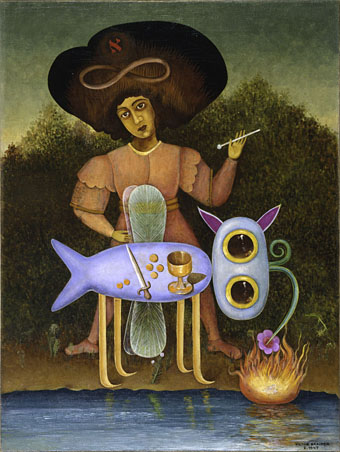
brauner.jpg

The Surrealist (1947) by Victor Brauner.

• At Dennis Cooper’s: Terry Ratchett presents…18 needlessly obscured avant-garde films by Thomas White, Teinosuke Kinugasa, George Barry, Standish Lauder, Helge Schneider, Dusan Makavejev, Oliver Herrmann, Mauricio Kagel, Mamoru Oshii, Gian Carlo Menotti, Pat O’Neill, Vera Chytilová, Shozin Fukui, Willard Maas, Djouhra Abouda and Alain Bonnamy, Juraj Herz, and Jay Schlossberg-Cohen.

• “When I’m convinced that a certain type of book is completely beyond the capacities of my temperament and my technical skills, I sit down at my desk and start writing it.” Italo Calvino discussing his approach to writing in 1983. The essay, The Written World and the Unwritten World, gives its title to a collection of previously unavailable Calvino pieces translated by Ann Goldstein. John Self reviewed the book.

• New music: Komplett Kollaps (A Dedication To Jóhann Jóhannsson) by Rúnar Magnússon, and Composition 1 by Deathprod.

Brann’s new book sweeps across the vast range of things that hold her interest. It thus invites us to enjoy the life of the mind and to live from our highest selves. A thoughtful encounter with this book will make you, I swear, a better person. The book includes chapters on Thing-Love, the Aztecs, Athens, Jane Austen, Plato, Wisdom, the Idea of the Good. The first half provides an on-ramp to the chapter titled “On Being Interested,” which falls in the dead centre of the book. This central chapter serves as more than a cog in the wheel: it is an ars poetica. Addressing issues of attention, focus, and interest itself, as well as how and where to deploy these functions throughout our lives, “Being Interested” offers a solution for any seeker intrigued by the notion that happiness is not an accident but a vocation. Brann characterizes the pursuit of happiness as “ontological optimism […] to be maintained in the face of reality’s recalcitrance.”

Peggy Ellsberg reviewing The Habit of Interestedness by Eva Brann

• “God told me I should take more LSD.” Sari Soininen on her acid-induced photographs.

• At Public Domain Review: The Procession of the Months by Walter Crane.

• At Smithsonian Magazine: See the chilling beauty of winter on Mars.

• Steven Heller’s font of the month is Edie & Eddy Slab.

• RIP Michael Snow, film-maker and musician.

• Kollaps (1981) by Einstürzende Neubauten | Feed The Collapse (1992) by Main | Collapsing Inwards (2014) by Jóhann Jóhannsson

Weekend links 651

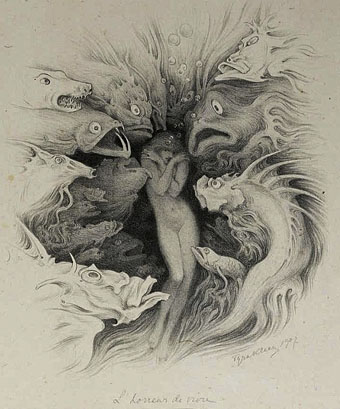
kleen.jpg

The Horror of Living (1907) by Tyra Kleen. Via

• “Voss suggests Af Klint was a pioneer of abstract painting, a label that fits in some ways – her work certainly isn’t representational in the normal sense – but jars in others. She saw her work as a spiritual calling, supercharged with meaning in ways most of her contemporaries struggled to grasp. Most, but not all. Af Klint socialised and collaborated with other visionary women. Some were artists, others were writers, but all were adherents of the new philosophies sweeping Europe in the late 19th century: spiritualism, Rosicrucianism, theosophy.” Madoc Cairns reviewing Hilma af Klint: A Biography by Julia Voss.

• “I want to insist on an amateur internet; a garage internet; a public library internet; a kitchen table internet. At last, in 2023, I want to tell the tech CEOs and venture capitalists: pipe down. Buzz off. Go fave each other’s tweets.” Robin Sloan looking for new avenues away from the corporate cul-de-sacs of social media.

• “Even when subjects take psychedelics in clinical environments devoid of nature…many of them still emerge with stronger relationships to the natural world.” Simran Sethi on the connections between psychedelic use and eco-activism.

• At A Year In The Country: A Shindig! Selection: From Celluloid Hinterlands to Children of the Stones via The Delaware Road and a Sidestep to the Parallel World of él Records.

• At Public Domain Review: Mighty Mikko: A Book of Finnish Fairy Tales and Folk Tales (1922) by Parker Hoysted Fillmore.

• “When coffee is all gone. It’s over.” Spoon & Tamago gets existential at Tokyo’s Museum of Wonky English.

• The “S” Word: Spirtuality in Alternative Music is a book-length study by Matthew Ingram (aka Woebot).

• New music: Does Spring Hide Its Joy by Kali Malone (featuring Stephen O’Malley & Lucy Railton).

• Steven Heller’s font of the month is Geetype.

• Spiritual Awakening (1973) by Eddie Henderson | Spiritual Blessing (1974) by Pharoah Sanders | Spiritual Eternal (1976) by Alice Coltrane