Weekend links 110

janke.jpg

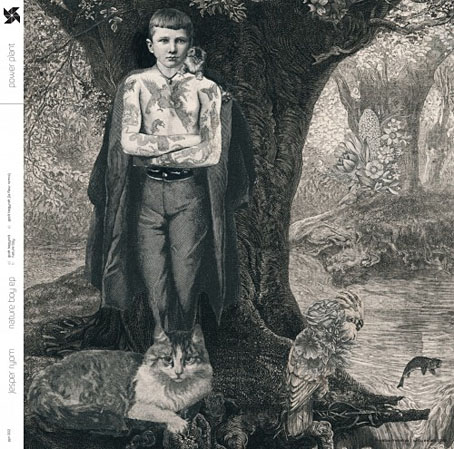
Til Eulenspiegel by Urban Janke. From Twenty Postcards of the Wiener Werkstätte at 50 Watts.

Rorschach Audio by Joe Banks is “essential reading for everyone interested in air-traffic control, anechoic chambers, artificial oxygen carriers, audio art, bell-ringing, cocktail parties, cognitive science, communications interference, compost, the death penalty, Electronic Voice Phenomena, evangelism, evolutionary biology, experimental music, ghosts, the historiography of art, illusions of sound and illusions of language, lip-reading jokes, nuclear blast craters, predictive texting, singing hair, sonic archives, sound design, steam trains, tinnitus, the Turing Test, Victorian blood painting, visual depth and space perception, ultrasonic visual music, ventriloquism, voices and warehouse fires and robberies.”

• “Freud did not understand female sexuality. Klimt did. Klimt’s women please themselves. The realization that women have an independent sexual life was an insight in art.” Eric Kandel discusses his new study The Age of Insight: The Quest to Understand the Unconscious in Art, Mind, and Brain, from Vienna 1900 to the Present.

• Three new books already mentioned here receive further attention: Stan Persky on Christopher Bram’s Eminent Outlaws : The Gay Writers Who Changed America. | Matthew Aquilone on Paul Russell’s The Unreal Life of Sergey Nabokov. | Karin L. Kross on the new translation of the Strugatsky’s Roadside Picnic.

The creative writing moment/movement baffles me and it intrigues me. What does it signify, all this creative longing? And why through language? Specifically fiction, poetry, memoir? […] The crazy part of it is that we are breeding professional, competent, homogenised writers who will go on to teach writing that is professional, competent and homogenised. The intriguing part of it is whether this movement towards creativity and self-expression is really the start of a kind of Occupy – that it could be dangerous and confrontational, not homogenised at all.

Dangerous? But then they won’t get published and win awards and get film deals and… Jeanette Winterson prepares to teach creative writing at Manchester University.

The Underground New York Public Library is a visual library featuring the Reading-Riders of the NYC subways.

Hob by No Man: “Constructed from soundtrack noises from both version of Quatermass and the Pit.”

Stephen Thrower talks about his soundtrack music for The Erotic Films of Peter De Rome.

John Waters surprises everyone by hitchhiking across the US.

• Sounds & the City: An interview with Julia Holter.

The Dead Dream of the Dirigible.

Meditation (1979) by Edward Artemyev.

The Standard Scroll Book

scroll01.jpg

One of the work-related searches at the Internet Archive this week was for scrolls…which I eventually realised should have been for ribbons since it was those text-bearing lengths of graphic ribbon I was looking for. I didn’t find anything useful but the search error did turn up this small book of borders, frames and scrollwork from 1876. The book scanners credit one David H. Moser as the person responsible although in what capacity—compiler, artist or both—we’re not told. I’m still being asked to create highly decorated designs so this will no doubt prove useful very soon. View or download the whole book here.

scroll02.jpg

scroll03.jpg

Continue reading “The Standard Scroll Book”

Devils debris

devils.jpg

The Devils (1971).

There is only one English feature director whose work is in the first rank. Michael Powell is the only director to make a clear political analysis in his films, his work is unequalled. The Life and Death of Colonel Blimp is the finest English feature, and A Canterbury Tale and A Matter of Life and Death are not far behind. When he made these films he was heavily criticized for his treatment of serious themes. Blimp was banned by Churchill and remained in a savaged version for nearly forty years, a plea for tolerance and regard for the enemy as human made at the height of the war there is no more courageous English film. It is a tragedy he has made so few films in the last twenty years, none in the last ten, and a lasting condemnation of all those who make films. He was a major casualty of the spurious social realism of the sixties, whose practitioners have grown fat and invaded the media with their well-scrubbed minds.

Thus Derek Jarman writing in 1980. Ian Christie quoted Jarman’s sentiments in Arrows of Desire: the films of Michael Powell and Emeric Pressburger (1985), pointing to the shared attitudes of the two directors, especially their outsider stance. There were other correspondences: both maintained an abiding interest in the artistic scope of cinema; both were marginalised by the British film world during their lives then lauded after their deaths. Michael Powell for years attempted to produce a film of The Tempest; Derek Jarman, of course, succeeded.

return1.jpg

Return to the Edge of the World (1978).

Then there’s this odd coincidence from Return to the Edge of the World, a short documentary made in 1978 in which Powell and actor John Laurie returned to the Scottish island of Foula where they’d made Powell’s first feature film, The Edge of the World in 1937. The film opens with shots of Pinewood studios and the very first things we see are this pair of abandoned statues which anyone who’s seen Ken Russell’s The Devils will recognise from an early scene. Derek Jarman was the production designer on The Devils so these would have been created according to his instruction. I only noticed this recently when watching Return to the Edge of the World again as it’s now an extra on the BFI DVD of Edge of the World. No need to dwell on the inadvertent symbolism of abandoned statues and languishing careers.

Powell and Pressburger’s marvellous The Life and Death of Colonel Blimp was reissued recently. John Patterson discussing its writer and director tells us why the most English of movies often benefit from an outsider’s perspective.

return2.jpg

Previously on { feuilleton }
Rex Ingram’s The Magician
The Devils on DVD
Derek Jarman’s music videos
Derek Jarman’s Neutron
Mister Jarman, Mister Moore and Doctor Dee
Powell’s Bluebeard
The Tale of Giulietta
The Tempest illustrated
In the Shadow of the Sun by Derek Jarman
The Angelic Conversation
The life and work of Derek Jarman

Le style Louis XV

rococo1.jpg

I’m not always in the mood for the filigree excesses of the rococo era but this French collection of 200 engravings from the reign of the hated Louis XV (1710–1774) is a treat. Peter Jessen is the compiler and the publisher is Guérinet, the house responsible for Friedrich Hottenroth‘s book of costume through the ages. The rococo I prefer is often at the weirder end of the scale where animals start crawling out of the foliage, ogees sprout webs and the sweeping flourishes seem to take on a life of their own. Jessen’s selection includes a number of such examples, in addition to designs for furniture and architectural decoration. Ludwig II would have eagerly taken this as a guide book.

rococo2.jpg

rococo3.jpg

rococo4.jpg

Continue reading “Le style Louis XV”

Reverbstorm: Bauhaus Horror

reverbstorm1.jpg

Lord Horror (after Klaus Barthelmess).

(No, not Pete Murphy and co.) Now that the Reverbstorm book is at the printers I have an excuse to discuss a few of the art and design appropriations that run through the narrative. I wanted to use some Bauhaus-style design back in the early 1990s when we were putting the first of the comic issues together but that idea got buried under conflicting demands and the need to actually finish all the drawing. It was only when I started designing the opening pages in 2008 that I was able to return to some of the original intentions. There were two reasons for this choice: one was that the minimalist graphics of the Bauhaus style worked well in black-and-white, and also provided an effective counterpoint to the very dense and detailed drawings that followed. The second was that the Bauhaus design school found itself in the early 1930s in opposition to the fascist forces which the figure of Lord Horror represents. (Many of the Bauhaus architects and designers eventually fled Germany for Britain and the United States.) This combination of antagonistic elements yielded another of Reverbstorm‘s collisions of counterposed philosophies and aesthetics.

reverbstorm2.jpg

Reverbstorm title page.

The title page is the most flagrant Bauhaus appropriation, a swipe worthy of Peter Saville at his plundering height. Joost Schmidt’s famous Bauhaus-Ausstellung poster is reworked with a Neville Brody typeface (Industria) and with Oskar Schlemmer’s face logo turned into a scowling profile.

On a typographic note, Industria was used right from the start with Reverbstorm since Brody designed it in the Thatcherite 1980s as a deliberate harking back to the authoritarian 1930s. It also has a very appropriate name. The other typefaces used in the book—Morris Fuller Benton’s Empire and Eric Gill’s Perpetua—date from 1937 and 1928 respectively.

reverbstorm3.jpg

Joost Schmidt (1923).

reverbstorm4.jpg

The reworked Oskar Schlemmer face/logo as it appears on the Appendix page. The lightning flash in Reverbstorm has multiple associations: adapted initially from the symbol used by Oswald Mosley’s British Union of Fascists (a symbol also appropriated at various times by David Bowie and Throbbing Gristle) it can also relate to storms, radio broadcasts and electricity in general. Here it becomes a minimal cipher representing Horror’s outrageous plume of hair.

reverbstorm5.jpg

Oskar Schlemmer (1923).

reverbstorm6.jpg

Reverbstorm, part 8.

In part 8 of Reverbstorm Horror ends up naked inside “a Soul” (don’t ask), and we see his figure juxtaposed against a series of backgrounds that recapitulate earlier aspects of the narrative. It was always the intention to end the series with a change of style so I did this by creating a kind of digital maquette figure using vector shapes that could be posed in a variety of ways. The origin of the figure was a sketch by Klaus Barthelmess, one of the students in Oskar Schlemmer’s drawing class. The sketch below appeared in a slightly altered form in issue 5 of the original publications but I always felt more could have been done with it: a posable figure turned out to be the perfect solution. By coincidence, while I was working on the final pages, Clive Hicks-Jenkins had been running a maquette exhibition on his blog. I was tempted to offer my example but a combination of too much work and a reluctance to throw Lord Horror’s obscene and reprehensible presence into the mix put paid to that. Besides which, my figure is a digital creation, not a bona fide paper cut-out.

reverbstorm7.jpg

Drawing by Klaus Barthelmess (1922).

For those who want more Bauhaus design, the Barbican in London is currently staging a major exhibition, Bauhaus: Art as Life, that will run throughout the summer.

Previously on { feuilleton }
Reverbstorm: an introduction and preview