Rue St. Augustin, then and now

augustin1.jpg

Boutique art nouveau, 45 rue st. Augustin (2e arr, 1904–05).

Despite being reasonably familiar with Eugène Atget’s celebrated photos of Paris, this picture of a very elaborate Art Nouveau façade is something I’d not seen until now. The photo is part of the George Eastman House collection of Atget prints, and is unusual for showing a very contemporary shopfront. Atget generally preferred premises redolent of an older, pre-Haussmann Paris, like the window full of barometers at Au Griffon, 39 Quai de l’Horloge. The Rue St. Augustin façade is an especially baroque example of Art Nouveau excess with a flying fish, a large butterfly (or moth) supporting the window, and the ubiquitous fin de siècle female floating above it. Naturally I had to know if the decor had survived but a quick look at Google Maps revealed the mundane scene below. The apartment entrance next door is pretty much unchanged but the wine shop that’s there now shows no traces of its delirious past.

augustin2.jpg

Previously on { feuilleton }
Hector Guimard elevations
Infernal entrances
Hector Guimard sketches
Temples for Future Religions by François Garas
Elizabetes Iela 10b, Riga
Atelier Elvira
Louis Bonnier’s exposition dreams
The Maison Lavirotte
The House with Chimaeras

Hector Guimard elevations

guimard1.jpg

Design for the Facade of Societé Immobilière de la Rue Modern, No. 6 (1909).

Drawings by French architect and designer Hector Guimard (1867–1942), the man who gave Paris those plant-like entrances to the Metro stations. The examples here can be seen in greater detail at the Google Art Project where there’s a few more of his works including his typically organic smoking bench. One thing I like about the architectural drawings is seeing the way he stylised his lettering. Frank Lloyd Wright used to do the same on his plans but I doubt there are any architects today who do the same.

guimard2.jpg

Elevation of an Apartment Building, Société Immobilière, rue Moderne (now rue Agar) (1909–11).

guimard3.jpg

Rear Facade, Castel d’Orgeval, Parc Beauséjour, near Paris: Elevation (1904).

guimard4.jpg

Previously on { feuilleton }
Hector Guimard sketches
Temples for Future Religions by François Garas
Elizabetes Iela 10b, Riga
Atelier Elvira
Louis Bonnier’s exposition dreams
The Maison Lavirotte
The House with Chimaeras

Weekend links 124

despont.jpg

Couple with Clock Tower (2011) by Louise Despont.

Assuming such a thing doesn’t already exist, there’s a micro-thesis to be written about the associations between the musicians of Germany’s Krautrock/Kosmische music scene in the early 1970s and the directors of the New German Cinema. I’d not seen this clip before which shows the mighty Amon Düül II jamming briefly in Fassbinder’s The Niklashausen Journey, a bizarre agitprop TV movie made in 1970. More familiar is the low-budget short that Wim Wenders helped photograph a year earlier showing the Düül performing Phallus Dei. Wenders later commissioned Can to provide music for the final scene of Alice in the Cities. And this is before you get to Werner Herzog’s lengthy relationship with Popol Vuh which includes this memorable moment. Any others out there that I’ve missed?

Album sleeves in their original locations. And speaking of album sleeves, photo prints of some very famous cover designs by Storm Thorgerson will be on display at the Public Works Gallery, Chicago, throughout September and October.

Crazy for kittehs: the quest to find the purring heart of cat videos: Gideon Lewis-Kraus goes where few journalists dare to tread. Also at Wired, the same writer explores the Cat Cafés of Tokyo.

The City of Rotted Names, a “shamelessly Joycian cubist fantasy” by Hal Duncan, available to read in a variety of formats on a pay-as-thou-wilt basis until Monday only.

• Jailhouse rockers: How The Prisoner inspired artists from The Beatles to Richard Hawley.

How To Survive A Plague, a documentary about HIV/AIDS activism in the US.

• Deborah Harry: hippy girl in 1968, punk in 1976, and Giger-woman in 1981.

Alan Garner answers readers’ questions about his new novel, Boneland.

• For steampunk aficionados: ‘COG’nitive Dreams by Dana Mattocks.

• David Bowie, Iggy Pop, Madonna & Asparagus: Kraftwerk in 1976.

• New music videos: Goddess Eyes I by Julia Holter | Sulphurdew by Ufomammut | Warm Leatherette by Laibach.

Blowing bubbles

bubbles.jpg

Chiozza e Turchi, fabricants de savons (1899) by Adolf Hohenstein.

My regular email account is currently malfunctioning so if anyone has sent a mail to my discordia address after 10.00am (UK time) on August 29th I haven’t received it. For the time being I’m switching to my Google account as the default so if anyone needs to get hold of me please use that address.

In the meantime, here’s a great poster by Adolf Hohenstein with a pair of Art Nouveau ladies blowing bubbles.

Update: The mail problem appears to be resolved. Now I have a mail backlog to attend to…

The Bookman Histories

bookman.jpg

Now that Angry Robot books has revealed the cover design which kept me busy throughout July I can do the same here. The Bookman Histories is an omnibus reprinting of Lavie Tidhar‘s steampunk trilogy which comprises The Bookman, Camera Obscura and The Great Game. The stories are frenetic, crowded with incident and feature a huge range of characters that find real people such as Jules Verne and Harry Houdini encountering contemporaries—both human and non-human—from the fiction of the late 19th century. All the requisite steampunk boxes are ticked. David Icke will be thrilled to know that in these books the British royal family are a bunch of lizards from space…

My initial impulse when faced with far too much material was to cram every square centimetre of the cover with detail but if I’d have done that I’d probably still be working on it, and would also have run the risk of it turning into an incoherent mess. So this layout, which is crowded enough, is something of a compromise. I also wanted to save some space for the title design.

bookman2.jpg

The main body of the title isn’t a font but was created from scratch based on letterforms and decorative elements from this fantastic set of fire insurance title pages. I’d been wanting to try something based on these hand-drawn designs ever since Mr Peacay posted them at BibliOdyssey last year. This particular design provided the basic letter shapes although I had to invent several of missing characters.

bookman3.jpg

In the third part of the trilogy the Martians from HG Wells’ War of the Worlds invade, so I spent rather too much time fashioning a Martian tripod from lots of tiny bits of machinery. This is one of the earlier drafts. It was an odd thing finishing this cover (which includes the planet Mars in the background) whilst the world was getting excited by the real landing on Mars of the Curiosity Rover.

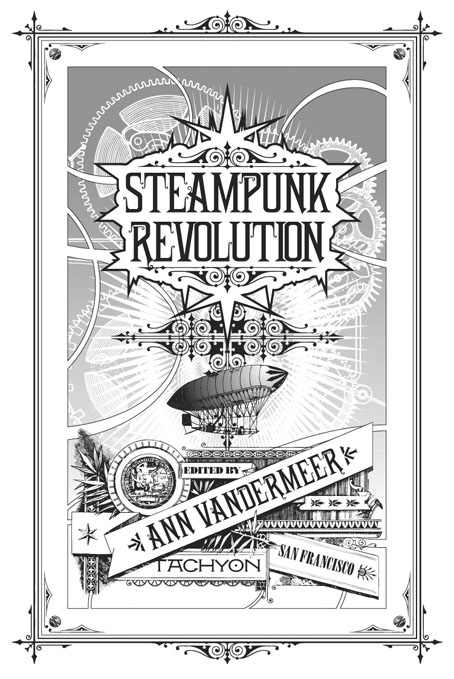
The Bookman Histories will be published in March next year. Meanwhile there’s more steampunk design on its way. Watch this space.

Previously on { feuilleton }
Aether Cola
Crafting steampunk illustrations
SteamPunk Magazine
Morlocks, airships and curious cabinets
The Steampunk Bible
Steampunk Reloaded
Steampunk overloaded!
More Steampunk and the Crawling Chaos
Steampunk Redux
Steampunk framed
Steampunk Horror Shortcuts