Kafka’s machine

kafka.jpg

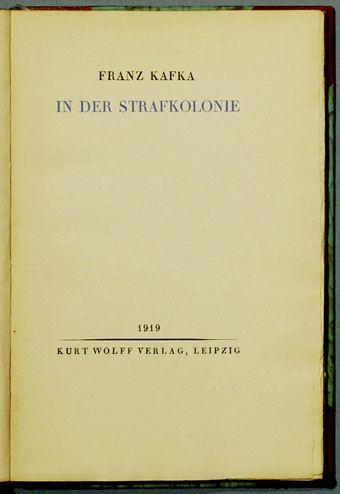
In der Strafkolonie (In the Penal Colony, 1919), a short story by Franz Kafka

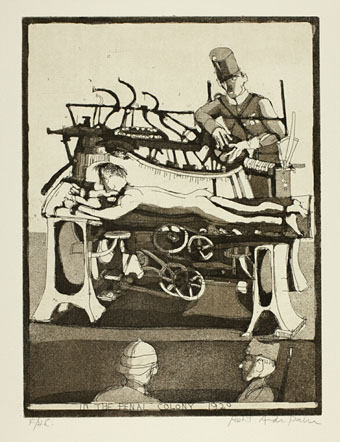
“Yes, the harrow,” said the Officer. “The name fits. The needles are arranged as in a harrow, and the whole thing is driven like a harrow, although it stays in one place and is, in principle, much more artistic. You’ll understand in a moment. The condemned is laid out here on the bed. First, I’ll describe the apparatus and only then let the procedure go to work. That way you’ll be able to follow it better. Also a sprocket in the inscriber is excessively worn. It really squeaks. When it’s in motion one can hardly make oneself understood. Unfortunately replacement parts are difficult to come by in this place. So, here is the bed, as I said. The whole thing is completely covered with a layer of cotton wool, the purpose of which you’ll find out in a moment. The condemned man is laid out on his stomach on the cotton wool—naked, of course. There are straps for the hands here, for the feet here, and for the throat here, to tie him in securely. At the head of the bed here, where the man, as I have mentioned, first lies face down, is this small protruding lump of felt, which can easily be adjusted so that it presses right into the man’s mouth. Its purpose is to prevent him screaming and biting his tongue to pieces. Of course, the man has to let the felt in his mouth—otherwise the straps around his throat would break his neck.” “That’s cotton wool?” asked the Traveler and bent down. “Yes, it is,” said the Officer smiling, “feel it for yourself.”

He took the Traveler’s hand and led him over to the bed. “It’s a specially prepared cotton wool. That’s why it looks so unrecognizable. I’ll get around to mentioning its purpose in a moment.” The Traveler was already being won over a little to the apparatus. With his hand over his eyes to protect them from the sun, he looked at the apparatus in the hole. It was a massive construction. The bed and the inscriber were the same size and looked like two dark chests. The inscriber was set about two metres above the bed, and the two were joined together at the corners by four brass rods, which almost reflected the sun. The harrow hung between the chests on a band of steel.

The Officer had hardly noticed the earlier indifference of the Traveler, but he did have a sense now of how the latter’s interest was being aroused for the first time. So he paused in his explanation in order to allow the Traveler time to observe the apparatus undisturbed. The Condemned Man imitated the Traveler, but since he could not put his hand over his eyes, he blinked upward with his eyes uncovered.

“So now the man is lying down,” said the Traveler. He leaned back in his chair and crossed his legs.

“Yes,” said the Officer, pushing his cap back a little and running his hand over his hot face. “Now, listen. Both the bed and the inscriber have their own electric batteries. The bed needs them for itself, and the inscriber for the harrow. As soon as the man is strapped in securely, the bed is set in motion. It quivers with tiny, very rapid oscillations from side to side and up and down simultaneously. You will have seen similar devices in mental hospitals. Only with our bed all movements are precisely calibrated, for they must be meticulously coordinated with the movements of the harrow. But it’s the harrow which has the job of actually carrying out the sentence.”

(Translation by Ian Johnston)


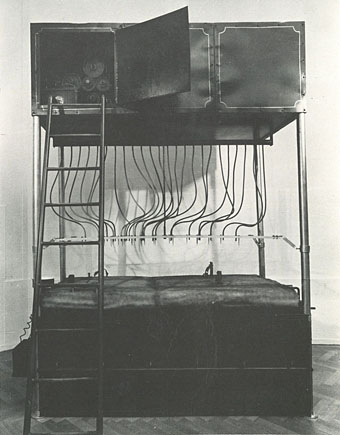
An authorless construction for The Bachelor Machines, 1975–77, an exhibition curated by by Harald Szeemann

szeemann.jpg


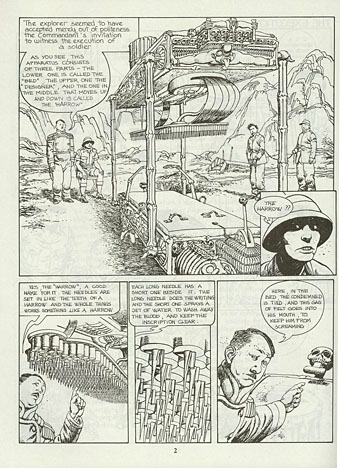
Kafka: The Execution (1989), a comic strip by Leopoldo Duranona

duranona.jpg

Read the full strip.


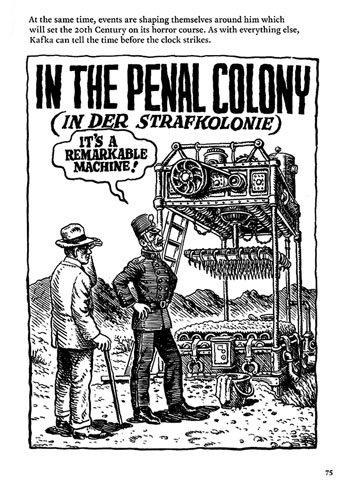
A page from Introducing Kafka (1993), an illustrated biography of Franz Kafka by David Zane Mairowitz and Robert Crumb

crumb.jpg


In the Penal Colony, 1920, from Franz Kafka: Dreams, Diaries, and Fragments (1994), a print by Robert Andrew Parker

parker.jpg


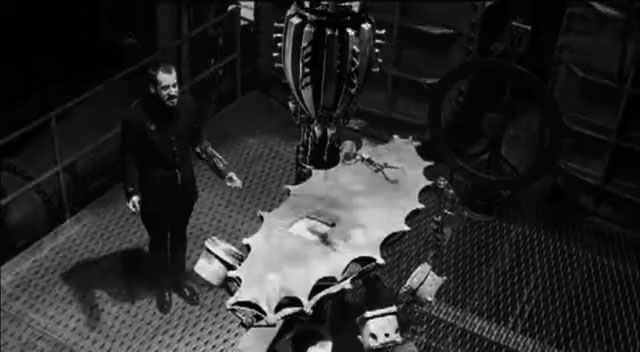
Zoetrope (1999), a short film by Charlie Deaux

zoetrope.jpg


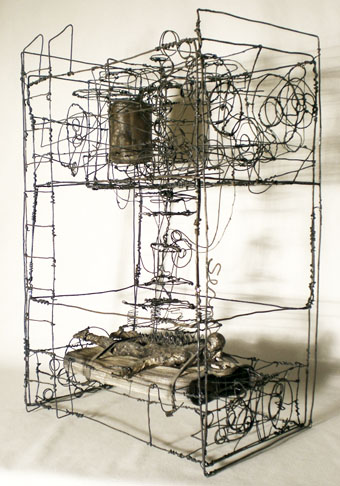
Franz Kafka: The Peculiar Apparatus from the Story In the Penal Colony (undated), a sculpture by Martin Senn

senn.jpg

Previously on { feuilleton }
The Metamorphosis of Mr Samsa, a film by Caroline Leaf
Kafkaesque
Screening Kafka
Designs on Kafka
Kafka’s porn unveiled
A postcard from Doctor Kafka
Steven Soderbergh’s Kafka
Kafka and Kupka

Weekend links 647

oneill.jpg

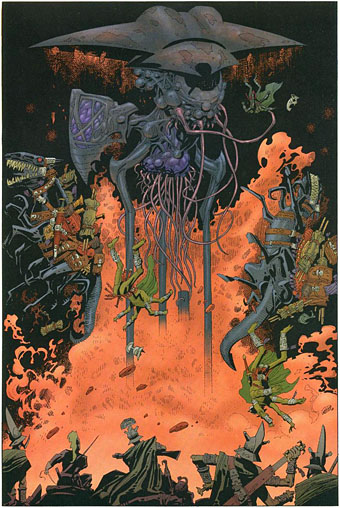
A local dispute on the planet Mars. Art by Kevin O’Neill from The League of Extraordinary Gentlemen.

• “…this image has puzzled enthusiasts of the scientific mystic’s works, both for its obscure provenance and cryptic symbolism. With its pastiche of Renaissance visual style and medieval caption — “A missionary of the Middle Ages tells that he had found the point where the sky and the Earth touch” — the illustration was once thought to have originated centuries before Flammarion published his text.” Hunter Dukes on the enduring mystery of the “Flammarion Engraving”.

• “For Spare, radio, and the waves that carried the music he loved to listen to, were more than just a metaphor for the spirit world. They were an active mode of conveyance for occult energies and vibrations – the swirling, ectoplasmic tendrils from which odd figures emerge in some of his most dense and haunting work.” Mark Pilkington explores Austin Osman Spare’s influence on the world of music.

• At Spine: Design studio Milk & Bone’s designer Alicia Raitt re-imagines all 14 of Kurt Vonnegut’s book covers to celebrate his 100th birthday.

• Farewell to Kevin O’Neill and Nik Turner, both of whom headed to the Western Lands this week.

Mean, moody and magnificent: film noir studio portraits – in pictures.

• Mix of the week: XLR8R Podcast 773 by Roméo Poirier.

• New music: Evergreen by Patrick Shiroishi.

Brainstorm (1972) by Hawkwind | Hurricane Fighter Plane (1985) by Inner City Unit | Brainstorm (1993) by Monster Magnet

Weekend links 636

frey.jpg

Untitled painting by Oliver Frey based on The Wild Boys by William Burroughs.

• RIP Oliver Frey, a prolific illustrator and comic artist whose art for UK computer magazines in the 1980s made a lasting impression on a generation of games players, hence this obituary at Eurogamer. On this site, however, Frey is also remembered for his artistic alter-ego “Zack” (previously), an equally prolific creator of comic-strip erotica for Britain’s few gay-porn mags at a time when any such material being sold in the UK ran the risk of police seizure or even a court appearance. For a while, Zack’s Rogue and Tom of Finland’s Kake were rare examples of assertive, unashamedly lustful gay characters with strips of their own, which makes Oliver Frey something of a pioneer, and a daring one at that.

• “The title characters were a trio of boys named Jupiter Jones, Pete Crenshaw, and Bob Andrews, who live in the fictional California town of Rocky Beach, not far from Hollywood, on the coast…” Colin Fleming on the satisfyingly spooky adventures of Robert Arthur Jr’s Three Investigators. I was never as obsessive as Fleming was but I read all of the books about the trio that I could find in our local library.

• “Though its inimitable visual style has safeguarded it as a quintessential cult film most at home behind a shroud of pot smoke, the influence of Koyaanisqatsi has been sweeping.” Josef Steen on 40 years of Godfrey Reggio’s Koyaanisqatsi.

• “Putting it simply, coincidences and curiosities and chance encounters happen when people go looking for zodiacs.” Mark Valentine on Britain’s terrestrial zodiacs.

• At Literary Hub: Marguerite Duras on writing the screenplay for Alain Resnais’s Hiroshima Mon Amour.

• New/old music: a reissue of Solar Maximum by Majeure.

• New music: Kerber Remixes by Yann Tiersen.

• At Dennis Cooper’s: Ingrid Caven Day.

• Threnody To The Victims Of Hiroshima (1959-61) by Krzysztof Penderecki | Memory Of Hiroshima (1973) by Stomu Yamash’ta | Hiroshima Mon Amour (1977) by Ultravox!

Weekend links 631

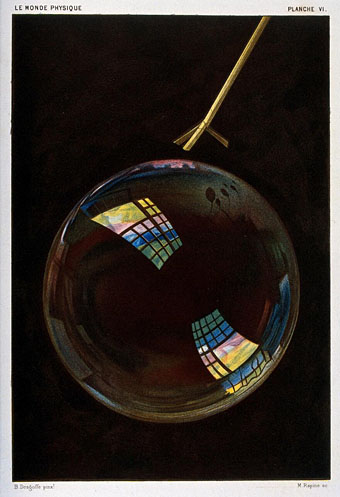
desgoffe.jpg

Soap Bubble (1882) by Alexandre-Blaise Desgoffe. Via.

• “…there is not now, has never been, and will never be a single Platonic form of the paragraph to which all others must conform.” Richard Hughes Gibson on the history of the paragraph.

• At Spoon & Tamago: imaginary covers by international illustrators for The Tokyoiter, a New Yorker-style magazine about the Japanese capital.

• New music: tick tick tick by Stephen Mallinder, and A Vibrant Touch by Aleksandra Slyz.

The Kat had a cult following among the modernists. For Joyce, Fitzgerald, Stein, and Picasso, all of whose work fed on playful energies similar to those unleashed in the strip, he had a double appeal, in being commercially nonviable and carrying the reek of authenticity in seeming to belong to mass culture. By the thirties, strips like Blondie were appearing daily in roughly a thousand newspapers; Krazy appeared in only thirty-five. The Kat was one of those niche-but-not-really phenomena, a darling of critics and artists alike, even after it stopped appearing in newspapers.

Amber Medland on George Herriman, EE Cummings and Krazy Kat

35mm.online: Polish feature films, documentaries and animations, all free to view.

• At Dennis Cooper’s: Spotlight on…Georges Bataille Erotism: Death and Sensuality.

• Inside the Espai Corberó, the home/gallery of the late Xavier Corberó.

Strange Attractor Journal Five.

• RIP Claes Oldenburg.

Krazy Kat (1928) by Frankie Trumbauer & His Orchestra | Krazy Kat (1949) by Artie Shaw | Krazy Kat (1975) by Teddy Lasry

Invasion revisited

invasion1.jpg

More Borges. Recent posts about the Venerable Jorge had me searching again for a subtitled copy of Hugo Santiago’s Invasion, the feature film he made in Argentina in 1969 from a script co-written with Borges and the latter’s friend and frequent collaborator Adolfo Bioy Casares. Subtitled copies of Invasion are now easier to find than they were when I wrote about the film back in 2014; there’s one here although this wasn’t the copy I was watching at the weekend so I can’t vouch for the quality of the subtitles. As before, this is the précis:

In 1957, a small group of middle-aged men fight a clandestine battle against forces quietly invading and taking control of their city, Aquilea. Enigmatic in its story-telling, Hugo Santiago’s once-lost film obscures the motivations of either side, leaving only a series of moves and counter-moves that evokes past dictatorial oppression and those still to come.

invasion2.jpg

Don Porfirio (Juan Carlos Paz).

“Aquilea” is Buenos Aires masquerading as a fictional city, with a name borrowed from Roman history. For Borges readers the views of the city are fascinating in themselves since they show us the streets and café interiors which are settings for many of the writer’s stories; we also see one of his books, El Hacedor, prominently situated on a shelf. Beyond this, the fictionalising of the city pushes the story away from Argentina’s turbulent political history towards the fantastic and the mythic, as does the lack of any background information about the life-and-death struggle we’re witnessing.

invasion3.jpg

The writer visits the set. Left to right: Hugo Santiago, Ricardo Aronovich, Jorge Luis Borges and Lautaro Murúa.

This was Hugo Santiago’s debut feature, made after several years working in France as an assistant to Robert Bresson. For a debut it’s an impressively assured piece of work, a fast-moving thriller of a type you wouldn’t expect Bioy Casares and Borges to be involved with; less time is devoted to dialogue than there is to gunfights and assassinations. Reviewers tend to compare Invasion to Alphaville but this is misleading; Aquilea may be an invented setting but there’s nothing about the place that’s futuristic or unreal beyond the surreptitious invasion which is being staged and resisted in the midst of an oblivious citizenry. A direct influence was a long-running and very popular Argentine comic strip, Héctor Germán Oesterheld’s The Eternaut, in which the surviving inhabitants of Buenos Aires fight against alien invaders; but this is a typical science-fiction scenario, with most of the human beings wiped out and the survivors battling a variety of monsters. Santiago’s film is more elusive than this, although Lautaro Murúa as Herrera, the leader of the resistance, physically resembles the stern protagonist from the comic. Invasion is deadly serious in a way that Alphaville never is, free of the quotation marks that frame all of Godard’s fictional excursions. The photography by Ricardo Aronovich is the high-contrast chiaroscuro of a late film noir like Kiss Me Deadly, as is the atmosphere of doom, paranoia and escalating urgency; characters are shown continually marching or running towards their destinations. Murúa strides through his scenes with the grim determination of Lee Marvin in Point Blank; in fact Boorman’s film is a better comparison than Alphaville, a spare and elliptical neo-noir that was one of the first Hollywood features to embrace the innovations of the Nouvelle Vague.

invasion4.jpg

The harsh separation between black and white extends to the white raincoats of the invaders and the black suits of the resistance, the latter being directed by Don Porfirio (Juan Carlos Paz), an elderly man who spends most of the film in his apartment where he plans operations while talking to his black cat and drinking maté tea (a South American habit frequently referred to in Borges’ stories that you seldom see on screen). Most surprising of all is the soundtrack by Edgardo Cantón, a musique-concrète assemblage of animal cries, metallic shrieks and electronic tones. The inexplicable presence of these sounds complements the inexplicable nature of the scenario while resisting easy interpretation.

invasion5.jpg

Invasion‘s ambiguities may help the film sidestep an overtly political reading but they were deemed threatening enough by the Argentine dictatorship of the 1970s for the negative to be seized and kept from circulation for many years. (Parts of the film are also disturbingly prophetic: the invaders base their operations—which extend to torture and murder—in the city’s athletic stadium; a few years later similar South American stadia were being repurposed as venues for mass execution.) Restoration work on the film in 1999 led to the copies that circulate today. Borges wouldn’t have seen anything of this during his lifetime, his blindness was almost total by 1969, but we’re more fortunate. If you enjoy unusual thrillers this is one I recommend.

Previously on { feuilleton }
Goodfellow and Borges
The Rejected Sorcerer
The Immortal by Jorge Luis Borges
Borges on Ulysses
Borges in the firing line
La Bibliothèque de Babel
Borges and the cats
Invasion, a film by Hugo Santiago
Spiderweb, a film by Paul Miller
The Library of Babel by Érik Desmazières
Books Borges never wrote
Borges and I
Borges documentary
Borges in Performance