Dissent

pen.jpg

If you believe in freedom of speech, you believe in freedom of speech for views you don’t like. Goebbels was in favour of freedom of speech for views he liked. So was Stalin. If you’re in favour of freedom of speech, that means you’re in favour of freedom of speech precisely for views you despise.

Noam Chomsky in Manufacturing Consent: Noam Chomsky and the Media (1992)

Terrorists don’t care about rights or laws so any debate about freedom of speech isn’t directed at them. I’d be more encouraged by the show of solidarity for dead cartoonists if I didn’t believe that many of those currently declaring their support will continue burning up social media in the next few months with demands that something be banned or stopped. We live in censorious times. Censorship (or the urge to see it enforced) never disappears, it migrates along with whatever happens to be taboo to current generations. In the 1970s much of the heat was around sexual content; today it’s predominantly about identity politics. Whatever the provocation, the results are the same: angry people step forward with a demand that something be forbidden. Last September a showing at the Barbican in London of Brett Bailey’s Exhibit B was cancelled after a petition and a demonstration outside the venue. Bonnie Greer wanted to make up her own mind but she didn’t get the opportunity:

These people largely reacted from hearsay, ideology, photos and the reactions of others who had seen it—not their own experience. I’ve seen people like this before, self-appointed judges, roaming the internet in search of what displeases and offends them. One protester went so far as to issue an absurd analysis of the possible psychological damage Exhibit B could cause the actors involved. It was ignorant and insulting psychobabble.

I don’t want to be stopped from seeing a work because, in their opinion, it’s “inappropriate”, “incorrect” or “racist”—words which are, at best, moveable feasts. I want to think for myself.

You’ll be seeing more movable feasts in the next few days when Anglophone commenters begin to discover that Charlie Hebdo was a full-spectrum offender rather like my colleagues at Savoy Books. When David Britton’s novel Lord Horror was being subject to Crown Court disapproval in 1992 The Independent wrote a prissy editorial complaining that the novel and a death metal album by Dismember were hardly worth the trouble of defending. These things weren’t art, they were trash, something that one of the UK comics mags (I forget which one) also complained about when discussing the Meng & Ecker prosecution. You can defend the principle of freedom of speech (or art) without agreeing with anything that’s being said, but for some people this often seems to be a step too far. Lord Horror escaped the obscenity charge thanks to Geoffrey Robertson QC but Meng & Ecker didn’t (comics being deemed trashier than novels by the court); my artwork for Hard Core Horror #5 was deemed obscene three years later in a separate trial in which Savoy were also declared to be unworthy of trial by jury because they were “not a bona fide publisher”. We don’t have a freedom of speech defence in Britain which is why history continues to repeat itself.

In the end all discussion about censorship comes down to this: who decides what is art and what is trash, what should be defended and what should be thrown to the dogs (or the gunmen)? You? Me? The Pope? Some guy in a ski-mask? Is freedom of speech only for the responsible people, for you and your friends? Or does it also apply to the irresponsible, the contentious, the trashy and the downright offensive? If freedom isn’t for everyone then someone, somewhere is willing to decide it’s not for you.
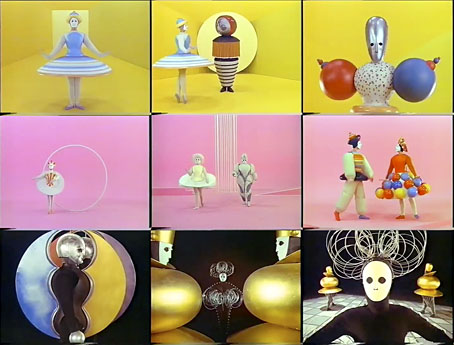
Oskar Schlemmer’s Triadic Ballet

schlemmer.jpg

Oskar Schlemmer’s Triadic Ballet of the 1920s is one of the more famous products of the Bauhaus movement, a radical reinvention of the medium which encased the dancers in cumbersome costumes. The outfits and stage designs are familiar from Bauhaus histories but you’re less likely to see an actual performance, something that’s possible with this 30-minute film made in 1970. The ballet is in three acts: yellow, pink and black. Erich Ferstl wrote the music for the filmed reconstruction by Margarete Hasting, the original score by Paul Hindemith being lost.

The ballet has additional interest for me in having influenced part of the Reverbstorm book. Oskar Schlemmer’s Bauhaus logo is reworked in the opening and closing pages together with other Bauhaus-derived graphics, but I also looked at Schlemmer’s ballet costumes when I was planning the final section which required a stylised transformation of Lord Horror. In the end I used a sketch by one of Schlemmer’s pupils, Klaus Barthelmess, for the Horror figure but the Barthelmess drawing was also of a dancer, and is very similar to some of Schlemmer’s designs, especially the silver-headed robot-like figures that appear in the black section of the ballet.

Previously on { feuilleton }
Reverbstorm: Bauhaus Horror

Weekend links 240

wiley.jpg

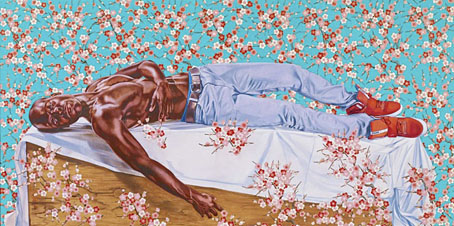
The Death of Chatterton (2014) by Kehinde Wiley.

• Mixes of the week (and the week before that): The Conjurer’s Hexmas: Second Rite by SeraphicManta; Secret Thirteen Mix 140 by Deaf Center; Best of 2014: A Highly Opinionated Mix by Robin The Fog.

• Never mind Music for Airports, how about Music for Neurosurgery? The Tegos Tapes Edits are extracts from “12 hours of unheard Vangelis music soundtracking films of various surgical operations”.

• “It was one of the first magazines that, with science-fiction and comics together, proposed comics for adults.” Aug Stone on 40 years of publisher Les Humanoïdes Associés and Métal Hurlant.

• Zinesters Do It on the Photocopier: Stephanie Schroeder on the Queer Zine Archive Project. Related: Holy Titclamps by Larry-bob Roberts.

A Year In The Country reached the end of its 365 posts. The archive is well worth a browse.

• “These people love to collect radioactive glass. Are they nuts?” asks Ben Marks.

• Think before you share: 86 viral images from 2014 that were totally fake.

• The Anti-Tolkien: Peter Bebergal on Michael Moorcock.

• Extracts from Alan Bennett‘s diary for 2014.

John Cage 4’33” Autotune

Alpha (1976) by Vangelis | Reve (1979) by Vangelis | L’Enfant (1979) by Vangelis

Weekend links 239

crystal.jpg

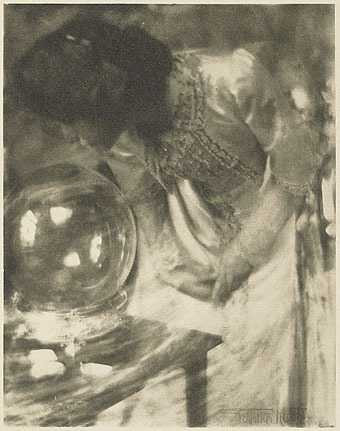
The Crystal Gazer (or The Magic Crystal, 1904) by Gertrude Käsebier.

• “I had to resort to extreme violence”: how Hipgnosis revolutionised the album sleeve. Aubrey Powell, last surviving member of the design team, talks to Joe Muggs.

• Mixes of the week: Radio Belbury: Programme 14; The Conjurer’s Hexmas by SeraphicManta; Secret Mix 139 by A Closer Listen.

• Social progress, high-speed transport and electricity everywhere: Iwan Rhys Morus on how the Victorians invented the future.

• At Cinephilia & Beyond: “The most complete investigation into the origins and making of Citizen Kane.”

Poor Souls’ Light: seven curious tales for the end of the year, and a dedication to Robert Aickman.

• Music and the Occult: Stuart Maconie and Rob Young spend an hour in the magick circle.

Alejandro Jodorowsky and Iain Sinclair in conversation at the British Library, July 2014.

• From 1972: An unpublished Victor Moscoso interview by Patrick Rosenkranz.

The Spooky Story Behind Hollywood’s Favourite Mansion.

The Lost World of British Tape Recording Clubs.

• 2014 was a year of outrage.

Wyrd Daze issue 11

Inspirograph

• Pepper-Tree (1984) by Cocteau Twins | Otterley (1984) by Cocteau Twins | Aikea-Guinea (1985) by Cocteau Twins

Philippe Caza covers

caza12.jpg

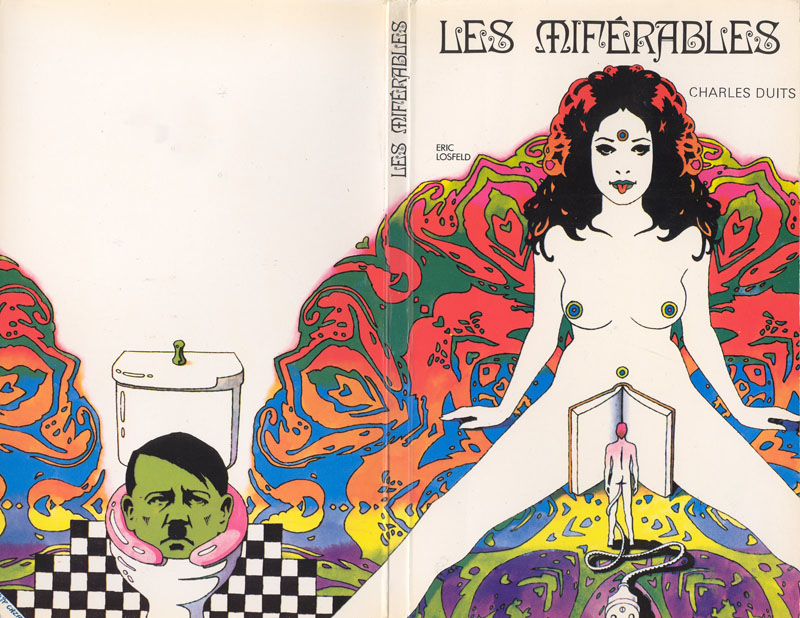
As usual, one thing leads to another. Research for yesterday’s post turned up a Caza book cover I’d not seen before. Les Miférables was published by Éric Losfeld in 1971, a year after producing Caza’s eyeball-searing psychedelic comic book Kris Kool. The author sounds like a character, a friend of André Breton who wrote a handful of novels inspired by his peyote experiences. As should be evident from the cover, Duits’ novel for Losfeld is more concerned with sex, described by this page (which is also the source of the cover art) as being “a kind of mixture of Eastern spirituality and unrestrained pornography”.

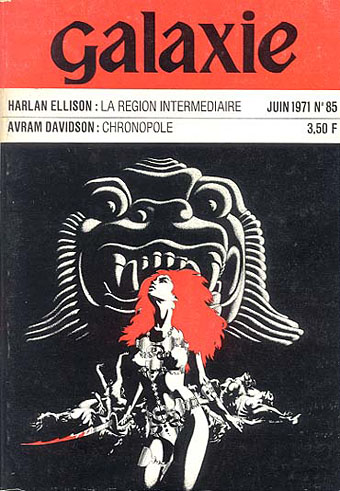
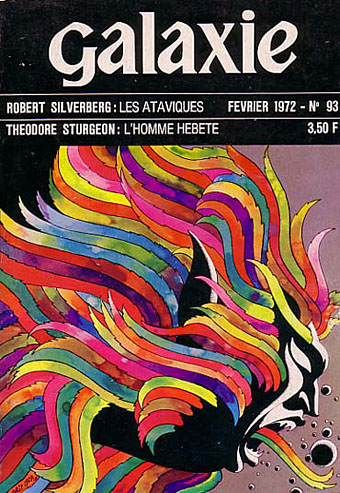
Caza’s art is often concerned with sex even if the subjects are the inhabitants of other planets. Many of the French comic artists of the 1970s produced covers for books and magazines but Caza alone seems to have been very popular as an artist for SF paperbacks. Noosfere has many examples from which I’ve chosen a small selection. (I’ve also had to hunt around for larger copies.) I wouldn’t mind seeing a collection of this artwork without the unsympathetic typography that spoils so many French novels.

caza05.jpg

caza07.jpg

Continue reading “Philippe Caza covers”