Haeckel fractals

haeckel.jpg

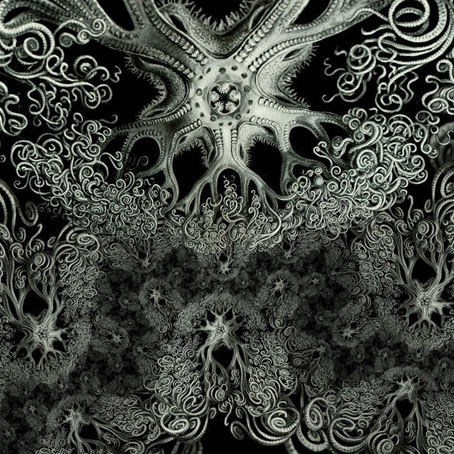
In which Ernst Haeckel’s Art Forms in Nature are given the Mandelbrot treatment. The example above is one of a number of variations created using the splendid Gorgon-headed Starfish, a creature I’ve messed with myself a couple of times.

These fractal images have been created by the Subblue people using their Fractal Explorer plug-in for Adobe’s Pixel Bender Toolkit, both of which are free downloads. I’ve not had chance to play around properly with Pixel Bender but the results here make it seem worth spending time getting to grips with its rather primitive interface.

Previously on { feuilleton }
Ernst Haeckel, Christmas card artist

The Red Book by Carl Jung

jung.jpg

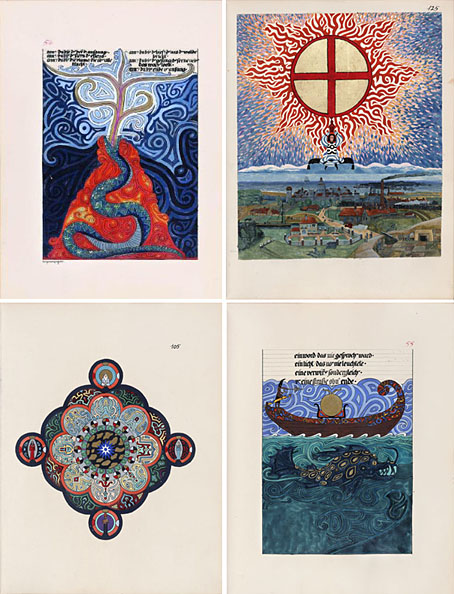
This month is a major one in book publishing as Carl Jung’s magnum opus The Red Book, or Liber Novus, which has remained unpublished for 80 years, is issued in a facsimile edition. Selections of pages have been turning up in reviews and online previews which easily whet the appetite.

In his late 30s, Jung started writing a book called The Red Book. The Red Book is part journal, part mythological novel that takes the reader through Jung’s fantasies — hallucinations he self-induced to try and get to the core of his unconscious. … The book detailed an unabashedly psychedelic voyage through his own mind, a vaguely Homeric progression of encounters with strange people taking place in a curious, shifting dreamscape. Writing in German, he filled 205 oversize pages with elaborate calligraphy and with richly hued, staggeringly detailed paintings. (More.)

Jung maintained a lifelong fascination with alchemical symbolism and many of these pages resemble the kind of plates one finds in alchemical treatises such as the Splendor Solis, if that book had also contained additions from William Blake and Hildegard von Bingen. The only drawback is the price: at £120 this isn’t a casual purchase, but then this is over 400 pages of full-colour at a big size, 45.7 x 30.5 x 5.1 cm. Time to start petitioning rich relatives for Christmas.

The Holy Grail of the Unconscious

Previously on { feuilleton }
The art of Julien Champagne, 1877–1932
Digital alchemy
In the Shadow of the Sun by Derek Jarman

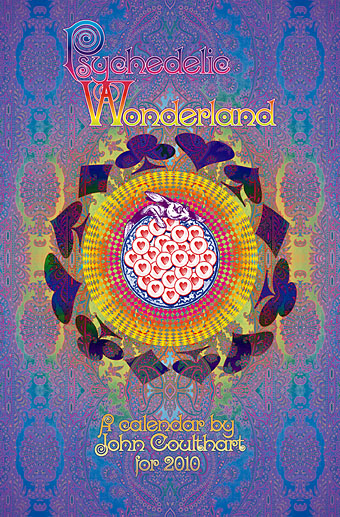
Psychedelic Wonderland: the 2010 calendar

pw00.jpg

So I had a bright idea at the end of September… Instead of rehashing old work for a CafePress calendar design, I thought I’d try something new. I hadn’t done any artwork for myself all year, everything I’d been working on was a commission of some sort. In addition to that, I’d spent a large portion of the year delving deeper into the psychedelic music of the late Sixties, especially the wealth of obscure British bands to be found on the seemingly endless series of compilations which have trickled out over the past two decades. Everyone is familiar with Jefferson Airplane’s White Rabbit but, as I’ve noted before, themes from, and allusions to, the Alice books run through British psychedelia to an even greater degree. The Beatles put Lewis Carroll in their pantheon of influences on the cover of Sgt. Pepper, and Wonderland’s atmosphere of Victorian surrealism chimed perfectly with a resurgence of interest in Victorian art and design.

So at the end of September, mulling over ideas, I picked up one of my Lewis Carroll volumes and looked at the chapter list: 12 chapters…12 months…I could do a psychedelic Alice in Wonderland! The only drawback was being weighed down by ongoing work which meant that anything I did would have to be created quickly and easily. I reckoned it was manageable if I put a few rules in place first: try and rough out a chapter a day; make copious use of clip art decoration and scanned engravings; keep things bold and florid without worrying too much about fidelity to minor story points. In theory I could do the whole thing in about two weeks if I kept on schedule. As it turns out the whole thing took me three weeks as I got increasingly involved with illustrating the story. You can see the results below and larger copies of the pictures here. Two years ago I was saying I probably wouldn’t ever illustrate Lewis Carroll. That was true at the time since I couldn’t find an approach to the stories that would sustain my interest and (possibly) bring something new to the books. Seeing Alice’s adventures through the psychotropic prism of the late Sixties showed me the way into Wonderland. What’s needed now is to do the same next year for Looking-Glass Land. Watch this space.

Some notes on the pictures follow below.

Update: By popular demand, this calendar is now available again.

Continue reading “Psychedelic Wonderland: the 2010 calendar”
Emil Cadoo

cadoo.jpg

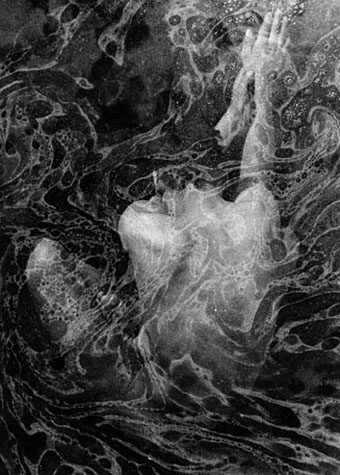
Untitled (1963).

One of a small number of pictures from a recent exhibition of work by American photographer Emil Cadoo (1926–2002) whose nude studies and often homoerotic themes were controversial in America of the Fifties and Sixties but welcomed in France, as was often the case at that time.

In April 1964, all 21,000 copies of the April/May issue no.32 of the American magazine Evergreen Review – containing (among others) texts by Norman Mailer, Jean Genet, William Burroughs, Bryon Gysin, Michael McClure, Karl Shapiro (a who’s who of the day’s practitioners of perceived outrage), and an erotic photo-essay by Cadoo – was seized by the police whilst it was still being bound. The edition had been deemed ‘obscene’ by the county’s district Attorney, whose particular disapproval was leveled at Cadoo. It took the special intermission of Edward Steichen, who compared the images to the work of Auguste Rodin “the greatest living sculptor of our time”, to obtain the condemnation of three judges of this action as ‘unconstitutional’, and to return the magazine to the public domain. (More.)

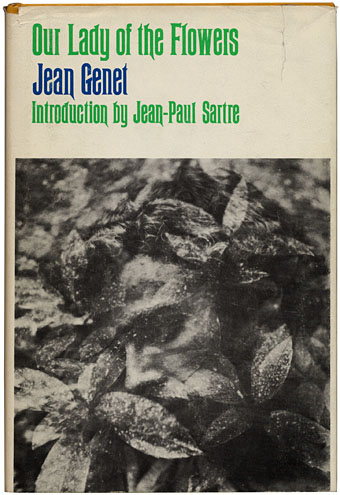
Cadoo favoured the double-exposure to achieve painterly or (for want of a better word) “poetic” effects, and some of these photos were used on book jackets by Grove Press (also the publishers of Evergreen Review), among them this Genet title which I posted a couple of years ago. More of Cadoo’s work can be found on various gallery sites but there’s no dedicated site unfortunately.

genet2.jpg

Photo by Emil Cadoo; design by Roy Kuhlman (1963).

Previously on { feuilleton }
Penguin Labyrinths and the Thief’s Journal
Un Chant d’Amour by Jean Genet

Mervyn Peake at Maison d’Ailleurs

peake.jpg

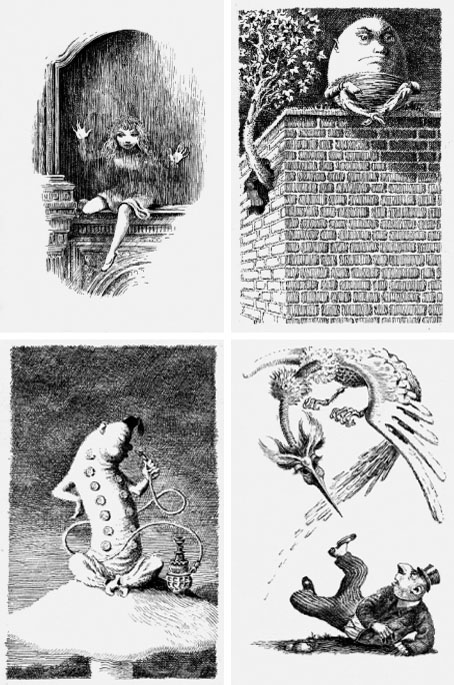
I should have mentioned this a lot sooner considering the museum sent me a copy of the exhibition prospectus. Maison d’Ailleurs is the Museum of Science Fiction, Utopia and Extraordinary Journeys in Yverdon-les-Bains, Switzerland, and their current exhibition is Lines of Flight—Mervyn Peake, the Illustrated Work. Yverdon-les-Bains is too out of the way for most of us but the event gives me another excuse to draw attention to Peake’s illustrations for Lewis Carroll; some of the drawings from Alice’s Adventures in Wonderland, Through the Looking-Glass and The Hunting of the Snark are among the works on display until February 14, 2010.

Mervyn Peake (1911–1968) is celebrated today as the writer of the extraordinary series of novels about Titus Groan (often referred to as the Gormenghast books). Yet, during his lifetime he was more known for his graphic work.

From 1939 and for almost two decades, Peake produced illustrations both for his own work (Captain Slaughterboard; Rhymes without Reason) and for classics (Household Tales by the brothers Grimm; Alice in Wonderland; Treasure Island). His mastery of the pen and the pencil were unrivalled. Visually, his style could be disarmingly economical, using very pure and clean single lines to create a striking sense of volume. But with cross-hatching and dots Peake could also make his drawings look like engravings, providing the characters and objects he depicted, or the background to them, with rich and varied textures and a wide range of shades. (More.)

For more of Peake’s illustration work, see Mervynpeake.org.

Elsewhere on { feuilleton }
The illustrators archive

Previously on { feuilleton }
Charles Robinson’s Alice’s Adventures in Wonderland
Humpty Dumpty variations
Alice in Wonderland by Jonathan Miller
The art of Charles Robinson, 1870–1937
Lovecraftian horror at Maison d’Ailleurs
The Illustrators of Alice