Charles Robinson’s Alice’s Adventures in Wonderland

robinson1.jpg

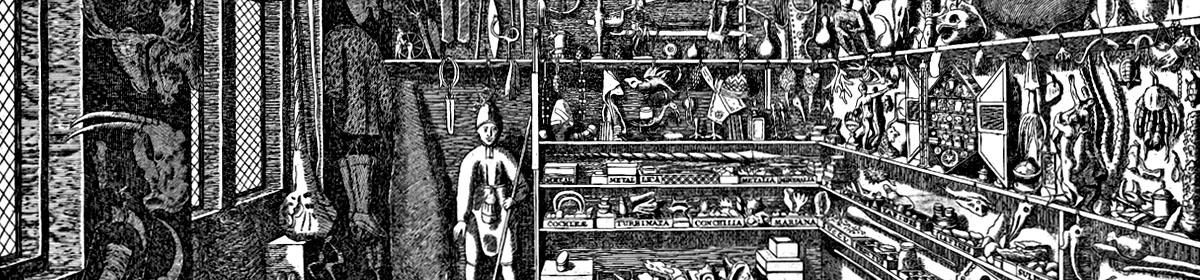
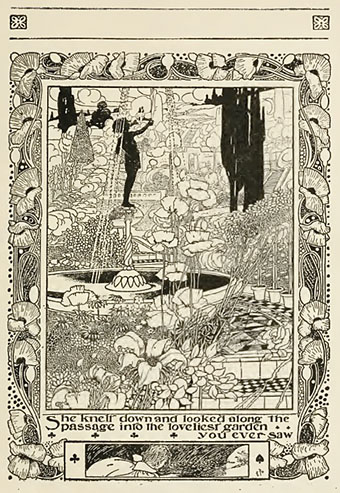
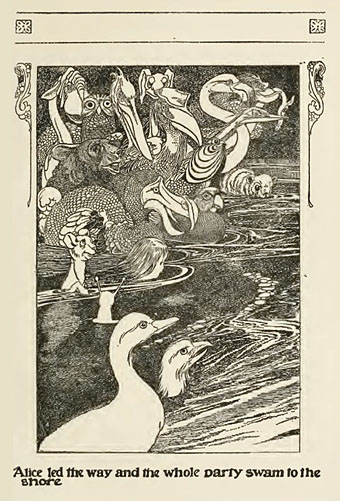
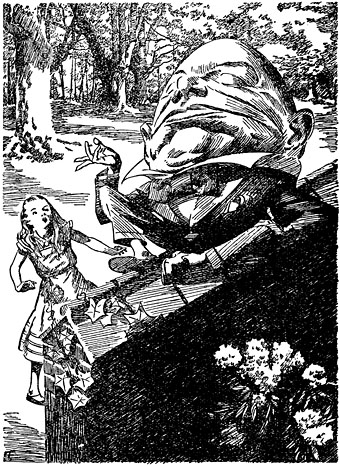
As you might expect, the Internet Archive has a lot of Alice in Wonderland adaptations, including a silent film version whose poor picture quality makes any attempt to watch it a chore. Among the many books in their collection one of the best is this illustrated edition from 1907 by Charles Robinson, brother of the equally talented William Heath. The full-page illustrations are especially good for their swirling embellishments, and I like the way he establishes the playing card motifs very early on. But the PDF version of the book also shows his inventive page layouts with narrow vignettes cutting through the text and the margins featuring tiny figures running about. The colour plates aren’t so impressive but his black-and-white work makes up for that.

robinson2.jpg

Elsewhere on { feuilleton }
The illustrators archive

Previously on { feuilleton }
Humpty Dumpty variations
Alice in Wonderland by Jonathan Miller
The art of Charles Robinson, 1870–1937
The Illustrators of Alice

Humpty Dumpty variations

thurstan.jpg

Humpty Dumpty by EB Thurstan (1930).

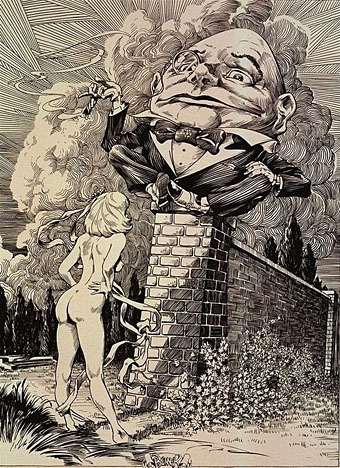
A preoccupation of the past couple of weeks has been Lewis Carroll’s Alice books as I’ve been working on an Alice in Wonderland project which I’ll unveil shortly. Looking around at some of the numerous visual interpretations of the stories I came across two portfolios I hadn’t seen before by comic artist Frank Brunner. These are from the late Seventies, and typically for that decade they work an erotic twist on the books by adding ten years to Alice’s age whilst depriving her of clothes. Nudity aside, Brunner’s drawings don’t depart from tradition very much—or add much, for that matter—but I did notice that he’d based his Humpty Dumpty figure on an earlier version by illustrator EB Thurstan.

brunner.jpg

Humpty Dumpty by Frank Brunner (1978?).

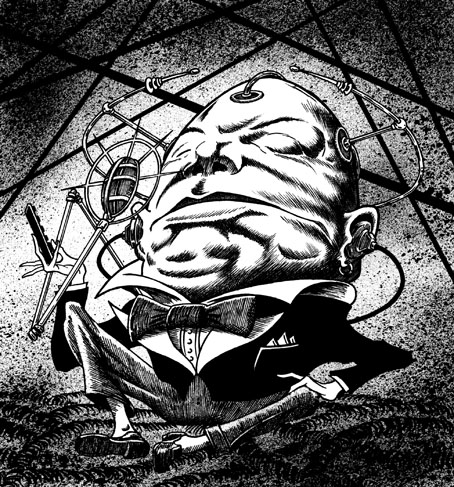
The reason Thurstan’s Humpty is so familiar is that I’d borrowed it myself for one of the many appearances by the character in the Lord Horror comic series, Reverbstorm. Humpty’s presence there would involve too much explanation so you’ll have to be satisfied with the character who explains Jabberwocky remaining inexplicable. As for Brunner’s drawings, you can see coloured versions on his website.

reverbstorm.jpg

Humpty Dumpty from Reverbstorm #3 (1994).

Previously on { feuilleton }
Alice in Wonderland by Jonathan Miller
The Illustrators of Alice

The art of Raphaël Freida

frieda1.jpg

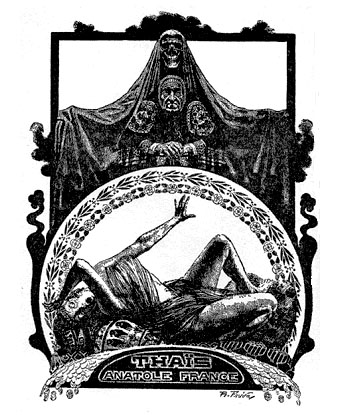
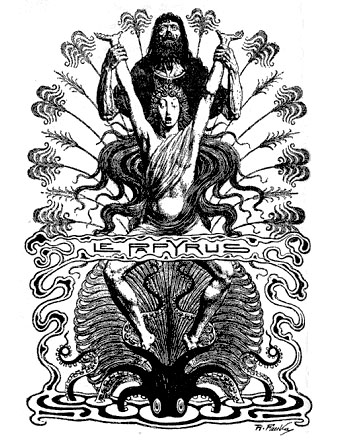
Illustrations by Raphaël Freida for a 1931 edition of Thaïs by Anatole France. I hadn’t come across Freida before and it’s impossible to say more about him or his work, information being frustratingly scant. The site where these are from has other editions of the same book illustrated by Georges Rochegrosse and Frank C Papé.

frieda2.jpg

frieda3.jpg

Elsewhere on { feuilleton }
The illustrators archive

Uranian inspirations

gloeden2.jpg

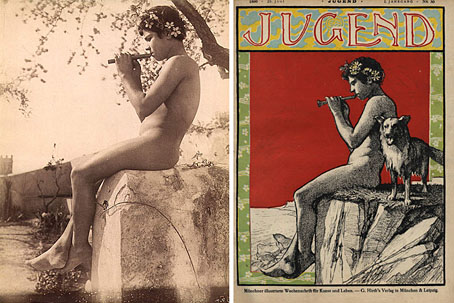
left: Sicilian boy by Wilhelm von Gloeden (no date); right: Jugend cover by Hans Christiansen (1896).

My current reading is The Secret Life of Oscar Wilde (2003), a long and fascinating study by Neil McKenna which attempts to disentangle the true nature of Wilde’s sex life from the myths and evasions of his biography and biographers. Among the pictures in the book, McKenna shows a couple of the “Uranian” photographs by Wilhelm von Gloeden (1856–1931) which Wilde owned. Von Gloeden’s views of naked Sicilian boys were described as “Classical” in a barely-believable subterfuge familiar during the 19th century, and it’s understandable why Wilde, who’d been praising the attractions of Mediterranean youth for most of his adult life, would have found these pictures worthy of purchase. Wikimedia Commons has a substantial set of the photos, although it should be noted that provenance is often uncertain; there were other photographers active in Taormina at the time who catered to a similar market. One photo in particular stood out recently when I recognised it as the possible source for the figure on a Hans Christiansen cover for Jugend magazine of 1896. The cover above has appeared here before but this is the first time I made the photographic connection.
gloeden1.jpg

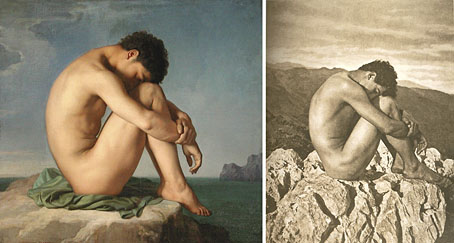
left: Jeune homme assis au bord de la mer by Jean Hippolyte Flandrin (1836); right: Cain by Wilhelm von Gloeden (c. 1902).

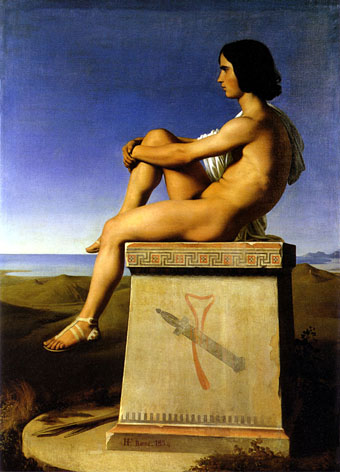
Gloeden, of course, was one of the first people to use the Flandrin pose, as I noted in the original post on that theme. I wonder if he knew he’d been copied in turn? That Jugend cover and its inspiration reminds me a little of Flandrin’s other depiction of Classical youth, his portrait of Polites, a painting which Oscar would no doubt have enjoyed.
polites.jpg

Polites, Son of Priam, Observes the Movements of the Greeks by Jean Hippolyte Flandrin (1834).

Elsewhere on { feuilleton }
The recurrent pose archive
The Oscar Wilde archive

Previously on { feuilleton }
Forbidden Colours
Jugend Magazine
Evolution of an icon