Monsters in art

monstres1.jpg

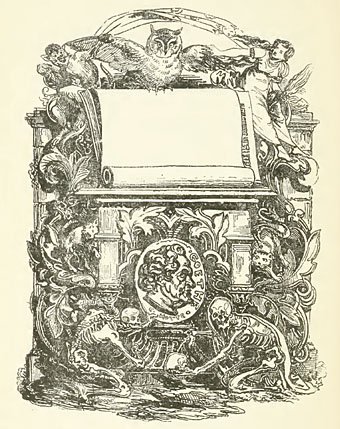
Frontispiece for Goethe’s Faust (c. 1843) by Eugène Delacroix.

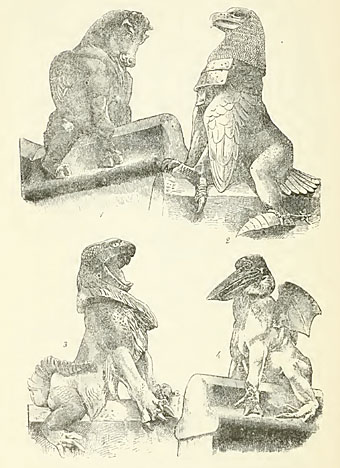
Or a couple of pages from Les monstres dans l’art; êtres humains et animaux bas-reliefs, rinceaux, fleurons, etc., a study of aesthetic teratogenesis by Edmond Valton from 1905. The Delacroix frontispiece gives a better view than the one at the Davison Art Center but they have more of the Faust lithographs. Emmanuel Frémiet’s animals were created to adorn the restored medieval Château de Pierrefonds for Napoleon III. The artist had smaller ceramic copies of the statues made later, of which the lizard is an improvement on the stone version.

monstres2.jpg

Fantastic animals (c. 1870) by Emmanuel Frémiet.

Previously on { feuilleton }
The House with Chimaeras
Frémiet’s Lizard

Dalí’s Elephant

burman.jpg

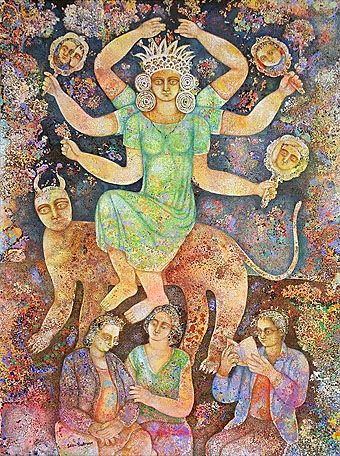
Madhav Reading Stories of Devi (2007) by Sakti Burman.

Dalí’s Elephant is a group exhibition at London’s Aicon Gallery that “traces the echoes of Surrealism in modern and contemporary art from the Indian Subcontinent.” The exhibition title refers to the gift ashtray which Salvador Dalí designed for Air India in 1967:

In 1967 Air India commissioned Salvador Dali to produce a limited edition ashtray which was to be given to a select group of lucky first-class passengers. Dali produced a small unglazed porcelain ashtray composed of a shell-shaped centre with a serpent around its perimeter. This was supported by three stands, two of which point in the same direction and resemble an elephant’s head. The third stand was inverted so that it resembled swan’s head. Dali was initially paid no more than a few hundred dollars for his design but when they received the design the airline bosses were so delighted that they made Dali the surprise gift of an elephant. Dali lived with the elephant for a few days at his Portligat home before donating the beast to the local zoo. (More.)

The Surrealist element is very much a trace in some of the works which seems surprising given the distinctive heritage of India’s religious imagery, as was demonstrated recently at A Journey Round My Skull. But I like the Sakti Burman paintings, especially the example shown here. Dalí’s Elephant runs to September 4th, 2010.

Previously on { feuilleton }
Marsi Paribatra: the Royal Surrealist
Dalí in Wonderland
Bollywood posters
Impressions de la Haute Mongolie revisited
Dalí and Film
The persistence of DNA
Salvador Dalí’s apocalyptic happening
Dalí Atomicus
Impressions de la Haute Mongolie

The art of Jessica Harrison

harrison.jpg

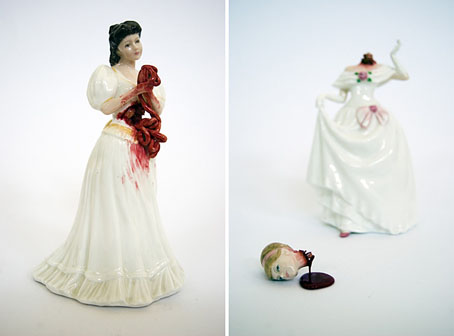
left: Maria (2010); right: Dawn (2010).

British artist Jessica Harrison undermines the saccharine innocence of porcelain figurines in a manner which would no doubt appeal to a Surrealist and black humorist like Jan Svankmajer. As well as these recent pieces, her website features further contemporary takes on Surrealism including a number of pencil drawings, one of which is a self-portrait alluding to that Švankmajer favourite, Giuseppe Arcimboldo.

Previously on { feuilleton }
Surrealism, graphic design and Barney Bubbles
Jan Švankmajer: The Complete Short Films

Weekend links 23

groovy.jpg

“The Go-Go wonder of Paris — That’s space girl. Transistors never wear down, they just go on and on — Even her heart is made of vinyl — It’s a marvy life — With nothing else to do but dance — Why not? – Love? — Forget it, baby — Not for her —” From Mod Love (1967) by Michael Lutin and Michel Quarez.

• “Gay people are not advancing themselves in the (publishing) industry, they’re just regurgitating familiar territory. Of course, artists are always ahead of gatekeepers. That’s the way it works—artists innovate. But in order to fulfill your promise as an editor, agent, publisher or reviewer, you have to be a person who’s embracing the new and looking to elevate what is not yet known. And unfortunately, there’s not a discussion among publishing professionals about enhancing this aspect of people’s responsibilities. In fact, it goes the other way. So there needs to be a psychological revolution on behalf of the people who are controlling what information is allowed to be seen.” From an interview with Sarah Schulman at Lambda Literary.

Jonathan Ross meets Jim Steranko. Also at the Guardian: Unearthing the truth about Alan Moore.

• Photographing an abandoned Art Deco skyscraper. From the people who photographed Neverland at night.

Powers: “aural sculptures” by Andy Partridge inspired by the strange science fiction art of Richard M Powers.
barbier.jpg

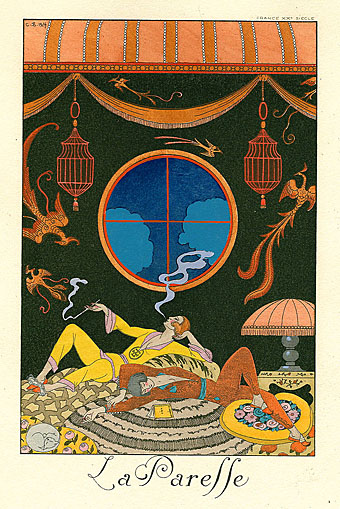
La Paresse (Laziness) (1924) by George Barbier.

Lautréamont’s poison-drenched pages. Roger Cardinal reviews a new edition of Les Chants de Maldoror and Poésies.

The Wire‘s Top 50 Rhythms of All Time, a list from 1992. Some great recommendations but it’s impossible to imagine that being written now without a mention of Klaus Dinger. And where’s Fela Kuti?

• The Wire Salon at Cafe Oto, London, on August 5th presents Rob Young discussing his forthcoming book, Electric Eden: Unearthing Britain’s Visionary Music.

American Pictorial Photography, 1912–1955. Another astonishing picture set at Golden Age Comic Book Stories.

The Beats: Pictures of a Legend. Edmund White on a new exhibition of Allen Ginsberg’s photographs. Related: the trailer for Howl.

The Dream Machine is a point-and-click adventure game made using hand-crafted animation.

Fuck yeah Francisco Lachowski: Brazilian model cutie has many Tumblr fans.

Polly Morgan’s wings of desire. The taxidermy artist interviewed.

Thomas Dolby’s solar-powered boat studio.

Rückstoss Gondoliere (1971) by Kraftwerk: pt. 1 | pt. 2

Ghost clocks

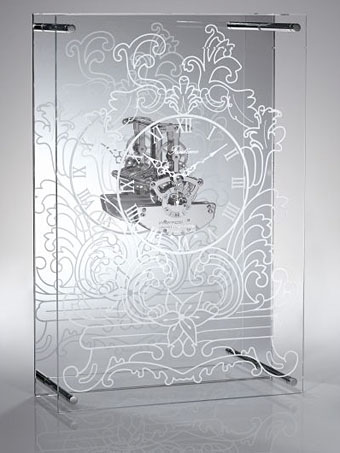
ghost1.jpg

Ghost Clock by Yee Ling Wan (2005).

We’ve had skeleton clocks and mystery clocks this week, ghost clocks would seem the next logical step. There don’t seem to be many devices which fit the label unfortunately but this pair are interesting enough. Yee Ling Wan’s clock is relatively cheap (around £70) compared to yesterday’s antiques and can be purchased from a number of online outlets.

ghost2.jpg

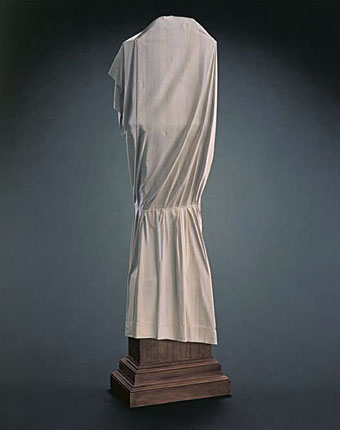
Ghost Clock by Wendell Castle (1985).

Wendell Castle’s Ghost Clock isn’t a timepiece at all but is a solid block of mahogany carved and laminated to give a trompe l’oeil impression of a sheeted grandfather clock. The wrapped object and the confounding of expectations reminds me of Magritte who may have been an inspiration. Ce n’est pas une horloge, perhaps.

Previously on { feuilleton }
Mystery clocks
Skeleton clocks
The Midsummer Chronophage
The Corpus Clock