A.R.T. art

ARTflyer.jpg

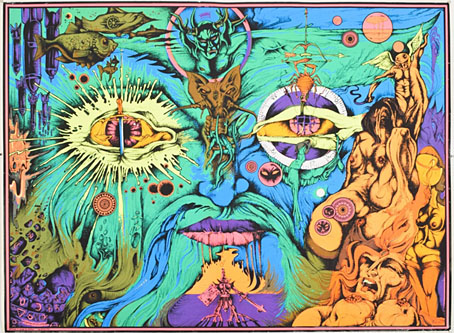
Some Manuel Göttsching-related graphic ephemera. This 1971 flyer for Ash Ra Tempel seems to be a rare item, the only place I’ve seen it being inside one of the inserts for The Private Tapes, a series of six CDs limited to 1000 copies each that Manuel Göttsching released in 1996. I was lucky to buy these when they were first released. A double-disc selection from the series followed two years later but neither this nor the rest of the set have been reissued since, despite containing a wealth of previously unreleased recordings from Göttsching’s archives, including many live concert recordings of Ash Ra Tempel. The flyer was the work of Bernhard Bendig who also drew the sleeve art for the group’s first two albums.

ARTcosmic.jpg

Not as scarce, but not very visible either, is this painting of another somewhat wonky temple by P. Praquin for a 1975 reissue of two Ash Ra Tempel albums: Inventions For Electric Guitar (which isn’t really ART), and Seven Up, the ramshackle studio jam which is mostly spoiled by the bellowings of Timothy Leary and friends. Discover Cosmic was a short-lived series of double-disc reissues of albums originally released on Cosmic Music, an imprint of Barclay Records that repackaged releases from Ohr and Kosmische Musik for the French market. There were three volumes of Discover Cosmic, the other two showcasing Popol Vuh and “The Klaus Schulze Sessions”, this being the first Cosmic Jokers album plus Join Inn by Ash Ra Tempel. The mysterious P. Praquin was responsible for all three cover paintings of which this is the best, wonky or not, a variation on the church-as-spaceship idea that may have been borrowed from the Roger Dean cover for Space Hymns by Ramases. This is one of those graphic contrivances that I usually expect to find repeated elsewhere, although to date the only other example I’ve seen was a Viennese museum poster. But there are more than enough churches that resemble spaceships to give people ideas, especially recent constructions like the Hallgrímskirkja in Reykjavík. If you know of any other steeples blasting off then please leave a comment.

Previously on { feuilleton }
Manuel Göttsching, 1952–2022
The kosmische design of Peter Geitner
Raising the roof

Weekend links 651

kleen.jpg

The Horror of Living (1907) by Tyra Kleen. Via

• “Voss suggests Af Klint was a pioneer of abstract painting, a label that fits in some ways – her work certainly isn’t representational in the normal sense – but jars in others. She saw her work as a spiritual calling, supercharged with meaning in ways most of her contemporaries struggled to grasp. Most, but not all. Af Klint socialised and collaborated with other visionary women. Some were artists, others were writers, but all were adherents of the new philosophies sweeping Europe in the late 19th century: spiritualism, Rosicrucianism, theosophy.” Madoc Cairns reviewing Hilma af Klint: A Biography by Julia Voss.

• “I want to insist on an amateur internet; a garage internet; a public library internet; a kitchen table internet. At last, in 2023, I want to tell the tech CEOs and venture capitalists: pipe down. Buzz off. Go fave each other’s tweets.” Robin Sloan looking for new avenues away from the corporate cul-de-sacs of social media.

• “Even when subjects take psychedelics in clinical environments devoid of nature…many of them still emerge with stronger relationships to the natural world.” Simran Sethi on the connections between psychedelic use and eco-activism.

• At A Year In The Country: A Shindig! Selection: From Celluloid Hinterlands to Children of the Stones via The Delaware Road and a Sidestep to the Parallel World of él Records.

• At Public Domain Review: Mighty Mikko: A Book of Finnish Fairy Tales and Folk Tales (1922) by Parker Hoysted Fillmore.

• “When coffee is all gone. It’s over.” Spoon & Tamago gets existential at Tokyo’s Museum of Wonky English.

The “S” Word: Spirtuality in Alternative Music is a book-length study by Matthew Ingram (aka Woebot).

• New music: Does Spring Hide Its Joy by Kali Malone (featuring Stephen O’Malley & Lucy Railton).

• Steven Heller’s font of the month is Geetype.

Spiritual Awakening (1973) by Eddie Henderson | Spiritual Blessing (1974) by Pharoah Sanders | Spiritual Eternal (1976) by Alice Coltrane

Weekend links 645

macgeorge.jpg

Halloween (no date) by William Stewart MacGeorge.

• Couldn’t Care Less: Cormac McCarthy in a 75-minute conversation (!) with David Krakauer at the Santa Fe Institute, filmed in 2017 and recently posted to YouTube. Not a literary discussion, this one is all about science, philosophy, mathematics, architecture and the operations of the unconscious mind. McCarthy’s essay about the origins of language, The Kekulé Problem, may be read here.

• At Wormwoodiana: Douglas A. Anderson finds a 1932 reprint of an HP Lovecraft story, The Music of Erich Zann, in London newspaper The Evening Standard. The story had appeared a few months prior to this in a Gollancz book, Modern Tales of Horror which reprinted a US collection edited by Dashiell Hammett. The newspaper printing includes an illustration by Philip Mendoza.

• New Hollywood Vs Mutant Cinema: The flipside of US cinema, 1960s–80s. Joe Banks talks to Kelly Roberts, Michael Grasso and Richard McKenna about their new book, We Are the Mutants: The Battle for Hollywood from Rosemary’s Baby to Lethal Weapon.

• At Bandcamp: Rich Aucoin explains the army of synths on his new quadruple album. The battalion includes the bespoke modular setup known as T.O.N.T.O., a rig that few people get to play with.

• New/old music: Malebox, an EP of Patrick Cowley rarities coming soon from Dark Entries.

• Mix of the week: Samhain Séance 11: endleofon by The Ephemeral Man.

• The surreal photographs of Ralph Eugene Meatyard.

• “NASA team begins study of UFOs”.

Ghost Rider (1969) by Musical Doctors | Ghost Rider (1970) by The Crystalites | Ghost Rider (1977) by Suicide

Weekend links 643

wittdorf.jpg

Freundschaftsfoto (1964) by Jürgen Wittdorf.

• “It’s truly astonishing how Laswell collided with vastly divergent musicians and genres while somehow still representing complementary musical spheres.” Yes, indeed. Mixes of the week: Bill Laswell Research Institute: Vol I & II, two 90-minute collections at Aquarium Drunkard dedicated to the career of the indefatigable musician/producer/catalyst.

• “These pieces are created using custom developed software and laser specialised machines resulting in highly detailed laser cut works on layered paper with some works comprising over a thousand individual parts.” Works in paper at Studio Ibbini.

• “The visual history of polyhedra is littered with false starts, poignant failures, and allegories unable to convey the weight of their subject matter.” Noam Andrews explores the history of rendering polyhedral objects in art.

• “When it came to homosexuality, the east was as bourgeois as the west.” Homoerotic art from the communist era by Jürgen Wittdorf (1932–2018) receives a reappraisal.

• More MR James: All of James’ ghost stories in a single volume at Standard Ebooks, the home of free, high-quality, public-domain texts.

• More mixes: A mix for The Wire by NikNak, and XLR8R Podcast 769 by The Sun Ra Arkestra.

• At Spoon & Tamago: Tracing the history of railways in Japan through art.

• At Dennis Cooper’s: Marie Menken Day.

Angeline Morrison‘s favourite albums.

Ghost Train (1961) by Virgil Holmes | Ghost Train (1961) by Electro-Tones | Ghost Train (1962) by The Partners

Weekend links 639

alphaville.jpg

Japanese poster for Alphaville (1965).

Peter Bogdanovich: I think we’d better have your thoughts on Godard.

Orson Welles: Well, since you’re so very firm about it. He’s the definitive influence if not really the first film artist of this last decade, and his gifts as a director are enormous. I just can’t take him very seriously as a thinker—and that’s where we seem to differ, because he does. His message is what he cares about these days, and, like most movie messages, it could be written on the head of a pin. But what’s so admirable about him is his marvellous contempt for the machinery of movies and even movies themselves—a kind of anarchistic, nihilistic contempt for the medium—which, when he’s at his best and most vigorous, is very exciting.

• RIP JLG. I was watching Alphaville again just two weeks ago after a DVD turned up in the local charity shop. Still the only Godard film I like 100% but “liking” seems beside the point. His influence today is everywhere, so fully absorbed into the language of cinema that people barely notice it.

• “The things that cause my gaze to linger are usually the portraits or landscapes that spark a feeling of unease, disquiet and discomfort. A shadow amongst the summer trees, a lurking silhouette reflected in a perfect blue iris, a vibrant flower in the early stages of decay.” S. Elizabeth talking to Beautiful Bizarre about her new book, The Art of Darkness: A Treasury of the Morbid, Melancholic and Macabre.

• Allow John Waters (again) to dictate your film viewing with a Letterboxd list of his favourite films, based on comments in his writings and interviews. On the subject of Godard, Waters’ Crackpot book contains a whole chapter about Hail Mary.

• Astor’s Electrical Future: Iwan Rhys Morus explores a vision of the year 2000 recounted in A Journey in Other Worlds (1894), a “scientific romance” by John Jacob Astor IV, with illustrations by Daniel Carter Beard.

• Strange Attractor has announced a Kickstarter campaign to fund the publication of an Austin Osman Spare Tarot deck.

• At Wormwoodiana: The Parrot, the Unicorn and the Golden Dragon: Some 17th Century Booksellers’ Signs.

• At Bandcamp: Andy Thomas on Chris Watson‘s post-Cabaret Voltaire career in nature recordings.

• A new outlet for cinematic obscurities: Radiance Films.

Alphaville (1978) by Klaus Schulze | Alphaville (1979) by The Monochrome Set | Alphaville (1999) by Scanner