Return of the Triumphant Phallus

salviati.jpg

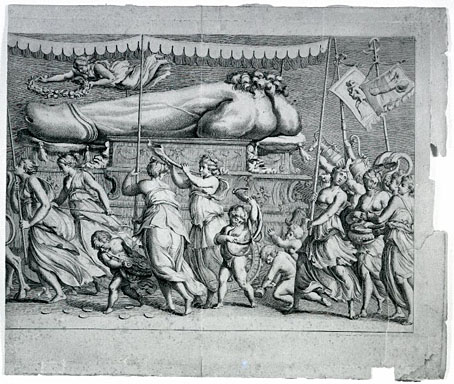
The Triumph of the Phallus (1700–1750).

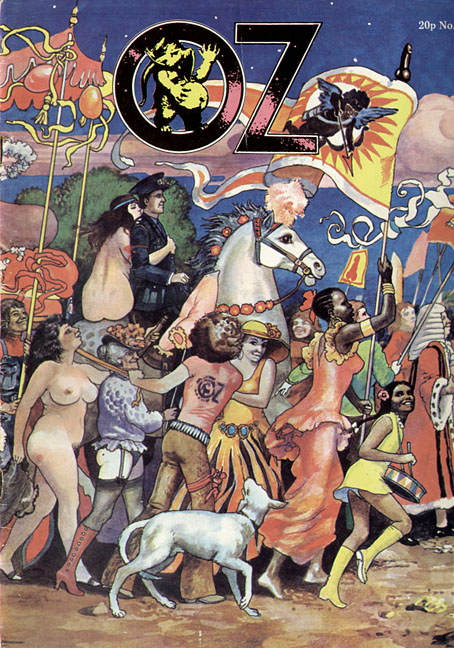
More phallic culture. I posted the above engraving a couple of years ago, an unattributed copy of a drawing by Francesco Salviati (1510–1563) which shows in three panels a giant phallus being driven by a festive crowd towards an equally prodigious vaginal opening. (See the three panels in full here.) A few months after that post I wrote something about British underground artist Jim Leon and failed at the time to notice that Leon had reworked the Salviati procession for a painting used in issue 36 of Oz magazine (July 1971).
oz36.jpg

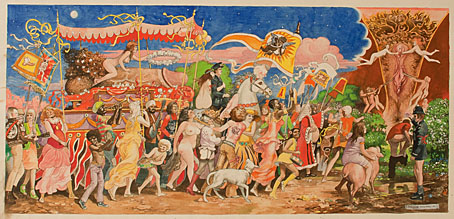
As is evident, here, the magazine editors carefully cropped Leon’s art to avoid stretching the patience of distributors and vendors. The complete work was printed over two pages inside but in a two-colour version which is less than satisfactory. This issue of the magazine also featured Leon’s far more incendiary Necrophilia piece which was the one I selected for my earlier post. What finally made me recognise the link between Leon and Salviati was a posting of Leon’s original painting on the Maggs Counterculture Tumblr (below).
leon.jpg

Leon shortened the procession but follows the rest of the picture very closely. Given the reversal of Leon’s version it’s possible he may have traced an outline as a guide before starting work, some of the details are a precise match. Oz magazine, it should be noted, was aimed at a general readership yet frequently published erotic art by Leon and others in this kind of matter-of-fact manner, something that’s difficult to imagine anyone doing today outside the porn world. Think about that next time someone asserts that we’re living in an unprecedentedly over-sexed era. You can see the whole of Oz #36 here.

Previously on { feuilleton }
The Choise of Valentines, Or the Merie Ballad of Nash His Dildo
The art of Jim Leon, 1938–2002
The fascinating phallus
The Triumph of the Phallus
Le Phallus phénoménal
Phallic bibelots
The New Love Poetry
Phallic worship
The art of ejaculation

Weekend links 58

delpozo1.jpg

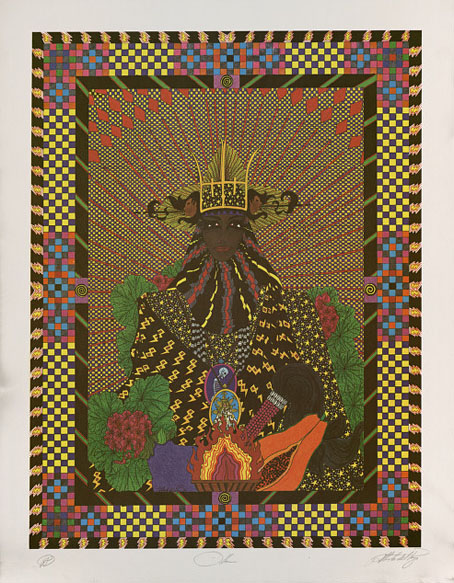
Oya by Alberto del Pozo (1945–1992). Also known as Yansa, Oya is Changó’s third wife. She is the goddess of the winds and of lightning and is mistress of the cemetery gates. Passionate and brave she fights by her husband’s side if needed. Her favorite offerings are papaya, eggplant and geraniums. From Santeria at BibliOdyssey.

Austin Osman Spare is a good example of the dictum that quality will out in the end, no matter how long it remains buried. Overlooked by the art establishment after he retreated into his private mythologies, a substantial portion of his output was equally ignored by occultists who wanted to preserve him as a weird and scary working-class magus. One group dismissed his deeply-felt spiritual interests in a manner they wouldn’t dare employ if he’d been a follower of Santeria, say (or even a devout Christian), while the other group seemed to regard his superb portraits as too mundane to be worthy of attention. Now that Phil Baker’s Spare biography has been published by Strange Attractor we might have reached the end of such short-sighted appraisals and can finally see a more rounded picture of the man and his work:

[Kenneth] Grant preserved and magnified Spare’s own tendency to confabulation, giving him the starring role in stories further influenced by Grant’s own reading of visionary and pulp writers such as Arthur Machen, HP Lovecraft, and Fu Manchu creator Sax Rohmer. Grant’s Spare seems to inhabit a parallel London; a city with an alchemist in Islington, a mysterious Chinese dream-control cult in Stockwell, and a small shop with a labyrinthine basement complex, its grottoes decorated by Spare, where a magical lodge holds meetings. This shop – then a furrier, now an Islamic bookshop, near Baker Street – really existed, and part of the fascination of Grant’s version of Spare’s London is its misty overlap with reality.

Austin Osman Spare: Cockney visionary by Phil Baker.

Austin Osman Spare: The man art history left behind | A Flickr set: Austin Osman Spare at the Cuming Museum | HV Morton meets Austin Spare (1927).

• More quality rising from obscurity: Jerzy Skolimowski’s Deep End. Skolimowski’s drama is one of unpleasant characters behaving badly towards each other. Anglo-American cinema featured a great deal of this in the 1970s when filmmakers disregarded the sympathies of their audience in a manner that would be difficult today. John Patterson looks at another example which is also given a re-release this month, the “feral, minatory and menacing masterwork” that is Taxi Driver.

delpozo2.jpg

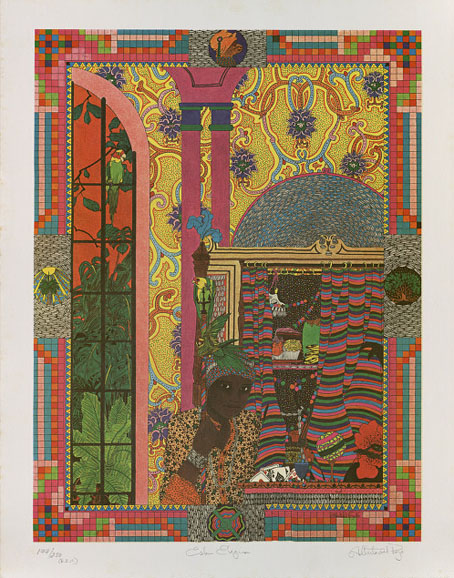
Echú Eleguá by Alberto del Pozo. Among the most ancient of the orishas Echú Eleguá is the messenger of the gods, who forges roads, protects the house, and is heaven’s gate-keeper. In any ceremony he is invoked first. He owns all cowrie shells and is the god of luck. A prankster, Echú Eleguá frequently has a monkey and a black rooster by his side. Like a mischievous boy he enjoys gossip and must be pampered with offerings of toys, fruit, and candy.

Minutes, a compilation on the LTM label from 1987: William Burroughs, Jean Cocteau, Tuxedomoon, Jacques Derrida, The Monochrome Set, and er…Richard Jobson. Thomi Wroblewski designed covers for a number of Burroughs titles in the 1980s, and he also provided the cover art for this release.

Mikel Marton Photography: a Tumblr of erotic photography and self-portraits.

From Death Factory To Norfolk Fens: Chris & Cosey interviewed.

NASA announces results of epic space-time experiment.

Oritsunagumono by Takayuki Hori: origami x-rays.

Plexus magazine at 50 Watts.

Mother Sky (1970) by Can | Late For The Sky (1974) by Jackson Browne.

Deutsche Kunst und Dekoration #22

dkd22-01.jpg

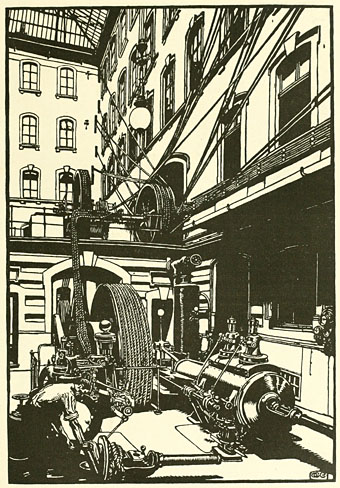
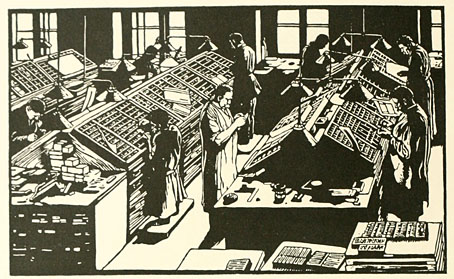
Continuing the delve into back numbers of Deutsche Kunst und Dekoration, the German periodical of art and decoration. Volume 22 covers the period from April 1908 to September 1908, and the highlight of this issue is a series of ink drawings (above and below) by Carl Otto Czeschka, another member of the Wiener Werkstätte. Also in this edition is a feature on Gustav Klimt’s controversial Faculty Paintings. As usual, anyone wishing to see these samples in greater detail is advised to download the entire number at the Internet Archive. There’ll be more DK&D next week.

dkd22-02.jpg

dkd22-03.jpg

Continue reading “Deutsche Kunst und Dekoration #22”

Anita Berber

dix.jpg

Anita Berber (1925) by Otto Dix.

If you’re going to live fast and die young you can do worse than be immortalised by a great painter, as Anita Berber was by the German Expressionist Otto Dix. An “exotic dancer” (among other things) in the Berlin cabarets of the 1920s, Ms Berber died at the age of 29 from a bout of TB but it’s likely that drink and drugs (she was fond of both) would have ruined her eventually. She left us with this striking picture, many equally striking photos, and tales of scandalous behaviour involving nude dancing and sexual partners of any gender. Rather than paraphrase further, I can point you to a typically fine piece about the wild woman at Strange Flowers. Ten Dreams has more paintings by the great Otto whose Berber portrait was used on a German postage stamp in 1991. Impossible to imagine the Royal Mail putting a bisexual drug addict on a postage stamp here, no matter how celebrated the artist.

Weekend links 57

softmachine.jpg

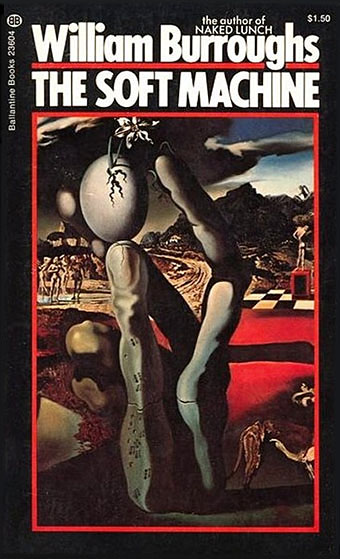
A 1973 Ballantine edition of William Burroughs’ novel with a cover illustration from Metamorphosis of Narcissus (1937) by Salvador Dalí. Via the Burroughs Book Covers archive.

The Sel Publishing House, Turkey, published a new translation of The Soft Machine by William Burroughs in January, an edition which is now under investigation by the Istanbul Prosecutor’s Office following a report by the (deep breath) Prime Ministry’s Council for Protecting Minors from Explicit Publications. The Council lodged a number of complaints, among them assertions of “lacking unity in its subject matter,” “incompliance with narrative unity,” “using slang and colloquial terms” and “the application of a fragmented narrative style.” Details here. Does Turkey still want to join the EU? Because this kind of persistently illiberal bullshit (see the earlier treatment of Orhan Pamuk) isn’t helping their case at all.

• Related to the above: Evan J Peterson reads Allen Ginsberg’s Howl in the toilet of a Seattle gay bar; Ginsberg himself reads Kaddish and other works here.

• More illiberal bullshit: LGBT activists arrested during royal wedding; Queer Resistance released a statement about the arrests. MPs, activists and trade unionists condemn new attacks on the right to protest.

The Dorian Gray That Wilde Would Want Us To Read. Harvard University Press publishes an uncensored and annotated edition of Wilde’s novel. Kudos for using Caravaggio’s Narcissus on the cover.

One weekend in late 1967, they all decamped to a hotel suite in California’s Ojai Valley for a brainstorming session. Amid clouds of pot smoke, they talked all weekend with the tape recorder running. [Jack] Nicholson then took the tapes and turned the conversations into a screenplay; according to Rafelson, he structured it while on LSD.

Revisiting The Monkees’ psychedelic movie, Head.

kraftwerkicons.jpg

Kraftwerk icons for Windows and Mac OS X by Dave Brasgalla.

Robert Louis Stevenson gets his revenge on sneaky literary agent – 120 years later. And Michael Moorcock imagines tales of unseen Mervyn Peake pictures.

Painting doesn’t look so good on the web. It looks better in life. Sculpture looks better in life. What you end up with is just a reproduction. Whereas with film or with sound or with poetry, you get the deep primary experience not the secondary experience. The web delivers those primary experiences very well.

Ubuweb’s Kenneth Goldsmith interviewed.

• Arkhonia’s Another Dispatch in a World of Multiple Veils is now a free download.

• The story of This Is The Sea: An interview with Mike Scott of The Waterboys.

Fairlight: The Rolls Royce of synthesizers.

Haeckel Clock, a free app for the iPad.

What is totalitarian art?

Porpoise Song (1968) by The Monkees | Hope For Happiness (1969) by The Soft Machine | I’m A Believer (1974) by Robert Wyatt.