Weekend links 699

gartside.jpg

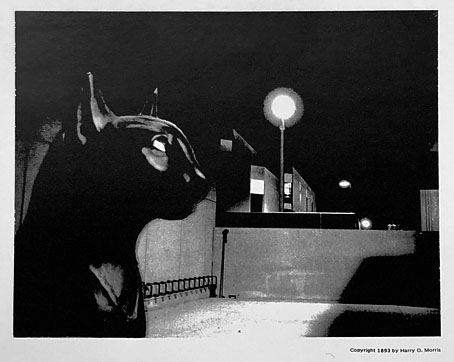
November Evening (1955) by Brian Gartside.

• The next Jon Savage compilation for Caroline True Records will be Jon Savage’s Ambient 90s, a dive into the side of rave culture that I always preferred, even while disputing the use of the “A” word. Anything with beats isn’t ambient by my definition, but I’ve been complaining about the nomenclature since 1991 to no avail. It’s on pre-order anyway.

• “They produced in me an infinity of new images and feelings, that sometimes raised me to ecstasy, but more frequently sunk me into the lowest dejection.” Thus Frankenstein’s monster during his reading of three books that happen to be important texts for the Romantic imagination. Hunter Dukes looks at the syllabus of Frankenstein’s monster.

• “Figure on Led Zeppelin IV cover identified as Victorian Wiltshire thatcher”. Last year I discovered the source for the lyrics and credits lettering designs used on the same album’s inner sleeve. Not as newsworthy, obviously, but I thought it was a good piece of cultural detective work.

• At Aquarium Drunkard: An interview with Morton Subotnick, now 90 years old. “Pioneer” is an over-used label, especially in electronic music, but Subotnick really does warrant the description.

• At Wormwoodiana: Mark Valentine on Unburied Bane, an EP by The Heartwood Institute based on a story by “the enigmatic N. Dennett”.

• At Unquiet Things: Art and captions that didn’t make the print version of The Art of Fantasy by S. Elizabeth.

• “Hidden demon revealed in the shadows of a Joshua Reynolds painting.”

• New music: Polygon by Galya Bisengalieva, and Saor by Claire M. Singer.

• Steven Heller’s font of the month is Letraflex.

• At Dennis Cooper’s: Arthur Lipsett’s Day.

Martin Carthy’s favourite music.

Little Demon (1956) by Screamin’ Jay Hawkins | Ballad Of Maxwell Demon (1998) by Shudder To Think | On Demon Wings (2000) by Bohren And Der Club Of Gore

The art of Kato Teruhide, 1936–2015

teruhide17.jpg

Feeling of Autumn.

I’m still a little obsessed with ukiyo-e prints old and new, and with good reason when you find examples like these. Kato Teruhide was one of a number of 20th-century printmakers who subjected the traditional form to modern refinements, which in this case means vertical views of architectural structures or spaces, some of whose close-ups and unusual angles show how photography has helped expand the visual possibilties of the medium. Ishibi Koji Street is a winter scene that presents a view directly above the street, something I’ve never seen before in this medium. Other scenes constrain their narrow viewpoints even further by the framing of walls or, in the case of the print of Fushimi Inari, the path through the thousand torii gates that lead visitors to the famous shrine. Teruhide pushed his medium close to abstraction without ever being as stylised as some of his contemporaries. Kyoto Romance, a book of his prints, was published in 1992.

teruhide02.jpg

Ishibe Koji Street.

teruhide08.jpg

Bright Moonlight at Ryoan-ji Temple.

teruhide04.jpg

Nisonin Temple.

teruhide16.jpg

Harvest Moon.

Continue reading “The art of Kato Teruhide, 1936–2015”

Imaginary Landscapes: A film on Brian Eno

eno1.jpg

The landscapes are those that may come to mind when listening to one of Brian Eno’s instrumentals, as Eno himself explains in this 40-minute portrait by Duncan Ward and Gabriella Cardazzo. I linked to a streaming copy of this several years ago but Flash streams are no use today so it’s good to find again on YouTube. Imaginary Landscapes was made in 1989, and the relatively short running time isn’t really enough to do justice to Eno as either composer or indefatigable theorist. The brevity is also a little surprising when the whole thing was shot on film in the UK, USA and Italy. Maybe expense was an issue? Whatever the answer, we get to see many actual landscapes—California, the rivers and shoreline of Suffolk, the urban landscape of New York City—while Eno explains some of the ideas behind his art and his music. He discusses his time in New York, which he’d recently left to return to his home town of Woodbridge, and his intention to develop his art installations to a greater degree than he’d done in the past. We know now that he did exactly this, I got to see one of his “Quiet Club” installations at the Hayward Gallery’s Sonic Boom group show in 2000. The quietness was rather compromised by sound leakage from other noisier exhibits but it was one of the show’s more memorable pieces.

eno2.jpg

I’ve a lot of time for Eno’s approach to art installation and the instrumental music he creates for these works, less so for his recent songs. Imaginary Landscapes was made shortly before the release of the song-based Nerve Net, an album I’ve never liked very much, plus another release, The Shutov Assembly, a collection of instrumentals that I’ve listened to more than most of his albums, with the possible exception of Thursday Afternoon. Many of the posts here were written to the accompaniment of The Shutov Assembly, I find it an ideal album of “thinking music”, more so than the later Neroli which is actually titled “thinking music” but which takes the Eno systems approach to a minimal extreme. The Shutov Assembly could be regarded as another collection of imaginary landscapes, with each piece having a nine-letter title that refers to a real location (all of which hosted one of Eno’s artworks) without being in any way illustrative. The Shutov pieces were recorded around the time Imaginary Landscapes was being made, and we see Eno demonstrating synthesizer sounds that are close to some of those you hear on the album. I’d have been happy with a lot more of this, 40 minutes more in fact, but the film-makers had other ideas.

Previously on { feuilleton }
Harold Budd, 1936–2020
Synapse: The Electronic Music Magazine, 1976–1979
Fourth Worlds: A Jon Hassell Mix
Mistaken Memories Of Medieval Manhattan
Thursday Afternoon by Brian Eno
Moonlight in Glory
Tiger Mountain Strategies
Generative culture
My Life in the Bush of Ghosts

Weekend links 698

ayrton.jpg

Contained Maze (1966) by Michael Ayrton.

• At Public Domain Review: Skeletons (1692) by Ikkyu, a Japanese monk, whose book is “a mixture of poetry and prose that comes down to us in printed editions supposedly replicating a manuscript, now lost, by the monk’s own hand. The text describes a series of visions of animated skeletons that Ikkyu had when he visited an abandoned temple. The lively illustrations testify to their maker’s sardonic sense of humour: he images skeletons dancing, drumming, drinking sake, having sex.”

• At The Daily Heller: Victor Moscoso’s Psychedelic Valedictory Exhibit. The exhibition will be at the Instituto Cervantes in New York City which has an accompanying 224-page catalogue of Moscoso’s posters and other designs.

• More Moscoso: Color (1971) and Moscoso Comix (1989), free to download at the Internet Archive. Moscoso’s underground comics experimented with the form in a manner that still looks radical today.

Drone and ambient metal is often invoked in elemental terms. There is something antediluvian and beyond about it. Pierce the earth’s crust, and there is liquid fire, ever so slowly shifting the tectonic plates we inhabit. Such music is envisaged as massive and totally beyond our control. It infuses the foundations of civilization. As Attila Csihar intones on Sunn O))) track ‘Aghartha’, named for a legendary subterranean kingdom: “Into the memories of the consciousness of ancient rocks/ Nature’s answer to eternal question”.

Stripped of the trappings of modern pop and rock, ambient metal invites a search for answers to the bigger questions. Ancient musical modes are resurfaced to get us closer to a putative godhead.

Dan Franklin on Earth 2, the deceptively-titled debut album by Earth. The album’s 30th anniversary has prompted a collection of remixes, Earth 2.23, by various artists

• At Spoon & Tamago: Download over 30 butterfly designs by Meiji-era artist Yuho Tanaka.

• New music: HYbr:ID II by Alva Noto, and The View From Vega by Benge.

The winners of the Landscape Photographer of the Year 2023.

• At Dennis Cooper’s: Guy Maddin Day (restored/expanded).

• A happy 20th birthday to Swan River Press.

Industrial Landscape (1980) by Marc Barreca | Desolate Landscape (2012) by John Zorn | Primordial Landscape (2013) by Patrick Cowley

More Aubrey fakery

fake1.jpg

It’s surprising to find such blatant examples of fraudulence on a major museum website yet here we are with 13 poor attempts at the Beardsley style credited by the Art Institute of Chicago to “Imitator of Aubrey Vincent Beardsley”. Imitators usually sign their work with their own names, not with the name of the artist being imitated, the description required here is “faker”. As Beardsley imitations go, these examples aren’t as clumsy as some of the Nichols fakes; they’re also not as widely disseminated but then Nichols published a book of his attempts. Chicago just happens to be the home of a group of Beardsley’s contemporaries led by Will Bradley who championed the Beardsley style in The Chap-Book. There’s the vague possibility that these drawings may have been the work of a Chap-Book artist (the Art Institute site offers no information) although Bradley himself can be ruled out, he was a much better artist than this.

fake2.jpg

Elsewhere on { feuilleton }
The Aubrey Beardsley archive