Death from above

bombs.jpg

The apocalyptic spectacles of Romantic painter John Martin are routinely treated by art critics as kitsch, a dismissal which ignores the considerable power and perennial attraction that many of his best pictures possess. Kitsch is a bad thing, it seems, unless you’re Jeff Koons or Jake and Dinos Chapman.

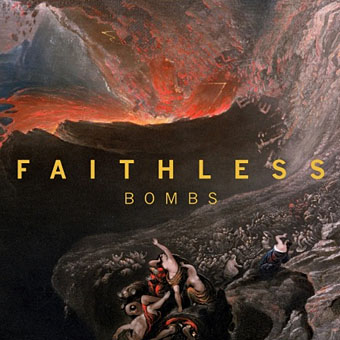
Martin’s most famous work, The Great Day of His Wrath, has raised its tumultuous head again on the cover of Bombs, a recent single by Faithless. The painting depicts a scene from the Book of Revelations with city-capped mountains being upturned onto terrified sinners while lightning cuts through the sky. The video for the song is an anti-war affair by Howard Greenhalgh, juxtaposing innocuous images of everday life with weapons being fired and soldiers being attacked, often in the same shot. So a happy family skips along a beach while a mushroom cloud grows on the horizon. The moral guardians at MTV have duly banned this in order to spare the delicate sensibilities of America’s teenagers. And they wonder why people like YouTube so much? Or Google Video?

heresy.jpg

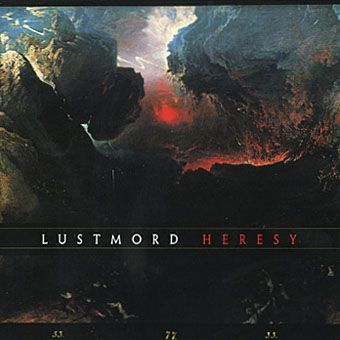
Faithless are a bit late to John Martin’s table, Lustmord featured the painting in full on the cover of Heresy in 1990, an album whose doomy rumbles I much prefer to the duo’s lightweight soul. Better late than never, I suppose.

Previously on { feuilleton }
• The apocalyptic art of Francis Danby
• The Enigma of Desiderio

Volume at the V&A

volume1.jpg

Part of the Playstation Season, “a partnership between PlayStation and 5 international public arts institutions renowned for an innovative approach to arts programming — BALTIC, the V&A, ENO, Sadler’s Wells and the BFI.”

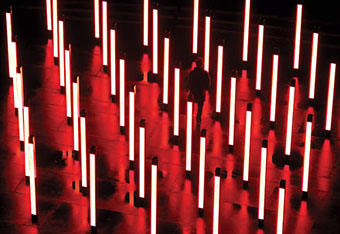
A luminous interactive installation will transform the V&A’s John Madejski Garden this winter. Volume is a sculpture of light and sound, an array of light columns positioned dramatically in the centre of the garden.

Volume responds spectacularly to human movement, creating a series of audio-visual experiences. Step inside and see your actions at play with the energy fields throughout the space, triggering a brilliant display of light and sound.

The piece is a collaboration between lighting designers United Visual Artists (UVA) and Robert Del Naja (alias 3D) of Massive Attack and his long-term co-writer Neil Davidge (as part of their music production company, one point six).

volume2.jpg

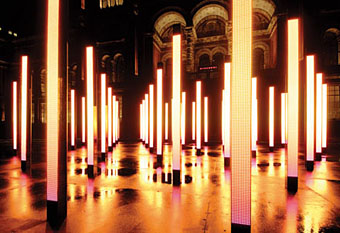
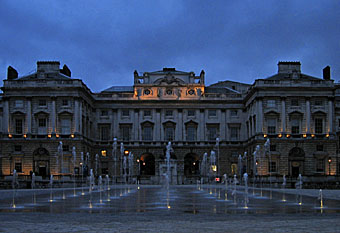
Looks like a cross between Jenny Holzer‘s vertical signs and the Edmond J Safra Fountain Court at Somerset House which I had the opportunity to photograph one gloomy evening back in May (below). And speaking of that square, it’s been turned into an ice rink again for the winter.

somerset.jpg

The art of Shinro Ohtake

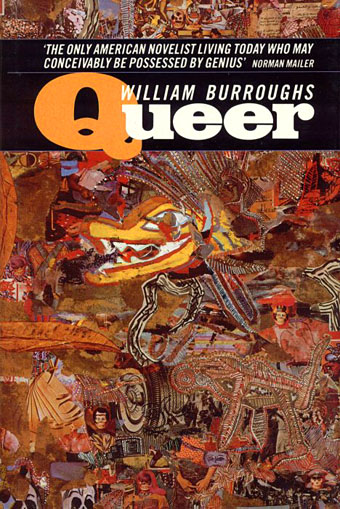
queer.jpg

Shinro Ohtake is always on the attack. Whether it’s against misguided art education, against the cold treatment and economic constraints Japan puts on anyone who could dare to live differently, against the contemporary art establishment that can’t be bothered to even disguise its own incomprehension—his fight as an artist continues. Ohtake is prodigious, original, and a trouble-maker—in the sense that the work of the artist is always to create difference.

William Burroughs

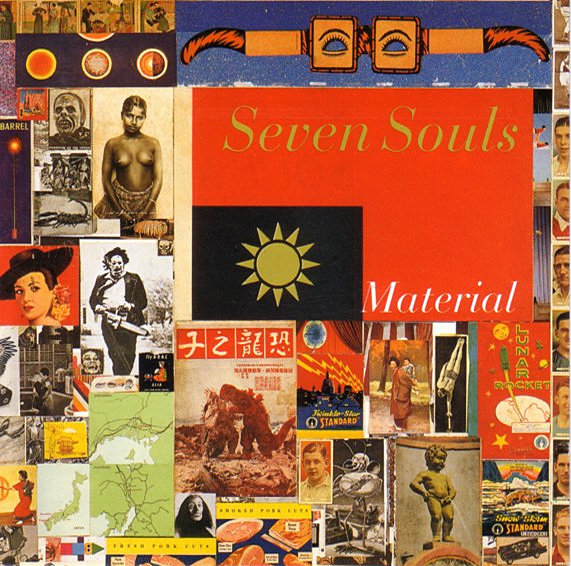
Two disparate things had me looking for Shinro Ohtake‘s work this week: I’ve been doing a short interview about album cover design (more about that at a later date) in which I mentioned his collage for the cover of Seven Souls by Material (1989), then an editorial in the latest Wire describes his current retrospective exhibition at the Museum of Contemporary Art in Tokyo.

seven_souls.jpg

The Material cover is one I picked as a favourite design. It’s difficult trying to pin-point why I think this works so well without it being at all illustrational. (I’m guessing, but it’s likely that Bill Laswell picked it out of one of Ohtake’s collage books, rather than it being specially commissioned.) It may be the collage aspect that works here. The album features readings by William Burroughs set to music and for me is the best of all the Burroughs recordings (Dead City Radio being a close second). Burroughs’ work, of course, involved literary collage via his own cut-up process, and the musical content can also be seen as a collage in the way it mixes different styles and musicians—Simon Shaheen, Shankar, Rammellzee, Foday Musa Suso, Fahiem Dandan and samples of the famous Brian Jones recordings of the Jajouka pipers. It’s a shame that when the CD was reissued in 1997 (in a superior mastering, it should be noted), the original artwork was largely junked in favour of a lot of muddy Photoshop work from the usually excellent Russell Mills. I’ve a huge respect for Mills but this treatment was a serious mistake.

Elsewhere on { feuilleton }
• The album covers archive

Previously on { feuilleton }
• William Burroughs book covers

Druillet meets Hodgson

hodgson.jpg

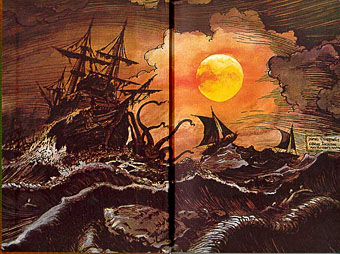
French comic artist and illustrator, Philippe Druillet, illustrates British horror novelist William Hope Hodgson. As anyone familiar with Hodgson’s work knows, this kind of imagery predates Pirates of the Caribbean by nearly a century. More pictures here.

Previously on { feuilleton }
• War of the Worlds book covers
• The music of Igor Wakhévitch
• Le horreur cosmique
• Davy Jones

The art of Yayoi Kusama

kusama1.jpg

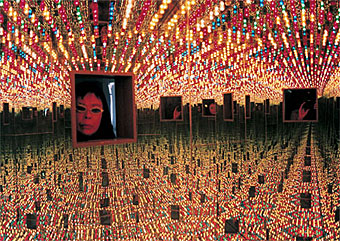
Infinity Mirror Room—Love Forever (1966/1994).
Mirror, light bulbs, stainless steel, wood.
kusama2.jpg

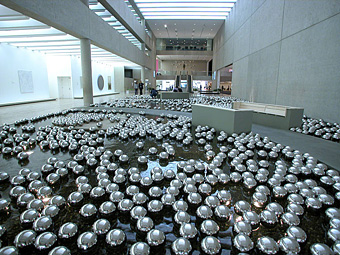
Narcissus Garden (1966/2002).
Watermall, 2000 mirror balls.
kusama3.jpg

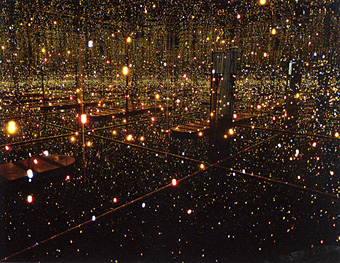
Fireflies on the Water (2002).
150 lights, mirrors and water.
kusama4.jpg

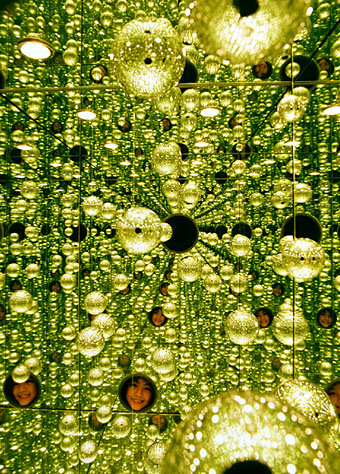
Infinity Mirror Room, Rain in Early Spring (2002).

Since the late 1950s, Yayoi Kusama has used painting, performance, sculpture, and installation to develop a highly personal formal vocabulary that combines repetitive elements such as net and dot patterns with organic and often eroticized sculptural forms. Her early paintings and collages extend the language of Abstract Expressionism and its concern for allover compositions into an intimate form of gridded space.

By the early 1960s Kusama had begun to produce her Accumulations, everyday objects such as chairs, tables, and clothes densely covered with hand-sewn, phallic protrusions. Around the same time, Kusama began to paint net and dot patterns onto household items, and in 1965 she combined all these elements in the installation Infinity Mirror Room Phalli’s Field (or Floor Show). In Infinity Mirror Room a dense field of polka-dotted phallic protrusions extended from the floor of an enclosed space. The walls of the environment were lined with mirrors, leaving only a small passageway into the center of the installation empty.

For the installation Kusama’s Peep Show (1966), the artist constructed a room whose walls and ceiling were covered with mirrors, while the floor was densely filled with glowing electric lightbulbs in different colors. Two small windows allowed the viewer and Kusama to peer inside.

Continuing her obsessive, almost psychedelic approach, the installations suggest a kaleidoscopic mode of perception, in which interior rooms contain unbound, seemingly endless spaces. By the late 1960s, Kusama began to stage performances, sometimes covering her naked body, or others’ bodies, with patterns.

In the early 1970s, Kusama returned to Tokyo; she voluntarily entered a clinic for the mentally ill, where she has remained ever since. She has continued to produce work at a prolific rate, remarkable in its consistency. Her obsessive arrangements, her often radically eroticized alterations of everyday objects, her fascination with infinity, and the all-encompassing nature of her work have remained at the core of her production.

In her most recent works Kusama continues to create reflective interior environments. Fireflies on the Water (2002) consists of a small room lined with mirrors on all sides, a pool in the center of the space, and 150 small lights hanging from the ceiling, creating a dazzling effect of direct and reflected light, emanating from both the mirrors and the water’s surface. Fireflies embodies an almost hallucinatory approach to reality, while shifting the mood from her earlier, more unsettling installations toward a more ethereal, almost spiritual experience.

More information and pictures at her site.

Previously on { feuilleton }
• Atomix by Nike Savvas