DIY aesthetics

penguin_blank.jpg

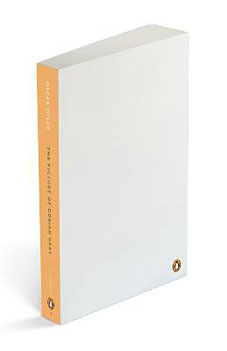
“According to consumer research conducted on what factors matter to people when they decide whether or not to pick up a book in a bookshop, the cover design comes out as most important. So this might be the stupidest thing we’ve ever done.

“…The covers are art-quality paper, and from internal Penguin efforts we know that they hold ink, paint, pencil and glue…. Each one comes shrink-wrapped so the paper doesn’t get dirty, and I hope people might give them as gifts.”

Helen Conford, Senior Commissioning Editor at The Penguin Press.

The latest ploy by Penguin to shift that tricky back catalogue of classics that everyone has heard of but few people read, resorts to what might be called audience interactivity, in other words print a book with a blank cover and the suggestion that the reader draw their own. They’re calling the scheme “My Penguin” which is unfortunate, this has the same treat-me-like-a-child quality as Microsoft’s dreadful “My Computer” and “My Documents”. The new line will be unveiled next week with the following titles: Crime and Punishment by Fyodor Dostoyevsky, Emma by Jane Austen, Magic Tales by the Brothers Grimm, Meditations by Marcus Aurelius, The Picture of Dorian Gray by Oscar Wilde and The Waves by Virginia Woolf.

This is a rather more interesting idea than Headline’s repackaging of Jane Austen as Georgian chick-lit earlier this year, a move guaranteed to disappoint anyone expecting Helen Fielding in period costume. Penguin is asking readers to send in their designs which they’ll then feature in an online gallery. In a way this goes against the traditional function of the paperback which serves as a cheap(ish), easily portable object that’s often treated with considerable disrespect while being used. Anyone who spends a couple of hours crafting their own cover design will quickly find they have a bespoke art object in their home that they want to preserve, not bend out of shape during the morning commute then discard when finished. It’ll be interesting seeing how this project develops. Will many of these unique designs turn up later on the Oxfam shelves along with all the other secondhand volumes, or will people want to keep them? Will we start seeing dedicated collectors of these titles and their artworks? (Some will no doubt be worth a great deal of money in the future if the cover is drawn by a famous owner.) And some are easier to illustrate than others; everyone knows the story of Dorian Gray but what would be suitable for Marcus Aurelius, for instance?

Elsewhere on { feuilleton }
• The book covers archive

Previously on { feuilleton }
• The Picture of Dorian Gray – I
The glass menagerie

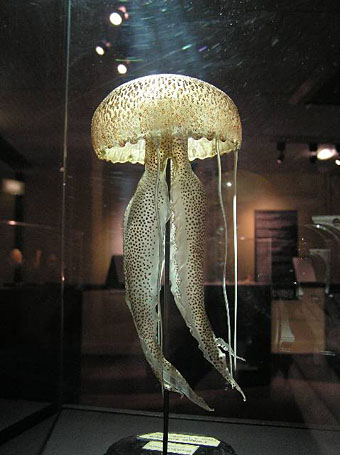
blaschka1.jpg

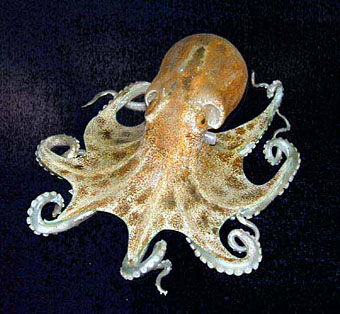
Not the play by Tennessee Williams, rather the glass sculptures of sea creatures by Leopold and Rudolf Blaschka.

Leopold (1822–1895) and Rudolf (1857–1939) Blaschka were a father and son partnership, originally from Bohemia. Their work making spectacular glass models of natural history objects began in 1857, in Germany. Rudolf joined his father in business in 1876 and after 1880 there were so many orders for their glass models that this became their sole business.

The Blaschkas are best known for their glass flowers, made from 1886 to 1936. Many of these are now displayed in the Botanical Museum of Harvard University. After his father’s death in 1895, Rudolf continued to make glass flowers. However, during their lifetimes they also made many accurate models of mainly marine animals. Dying with no children, their glass-working secrets were not passed on.

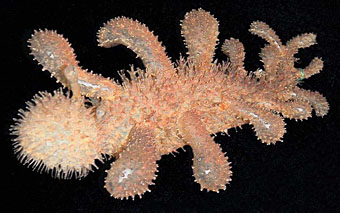
blaschka2.jpg

(More photos like this here.)

Looking at these sculptures I was curious to know whether they worked from real specimens or not. They may have used some for reference but I suspected many of their works were based on the famous colour plates of sea creatures, radiolaria, and so on, in Ernst Haeckel’s Kunstformen der Natur (1899–1904). A quick search confirms this, Haeckel was consulted, as were earlier scientific studies such as Philip Gosse’s Naturalist’s Rambles on the Devonshire Coast (1853) and GB Sowerby’s Popular History of the Aquarium of Marine and Fresh-Water Animals and Plants (1857).

blaschka3.jpg

(More photos like this here.)

Nancy Marie Brown writes about the Blaschka’s glass flowers (and what’s known of their working methods) here.

Previously on { feuilleton }
• The Bowes Swan

The art of Thomas Häfner, 1928–1985

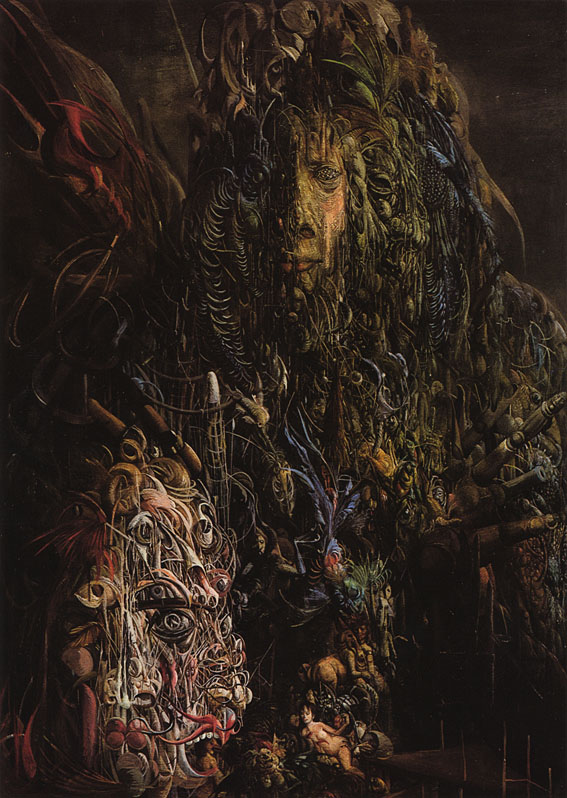
lucifer.jpg

Lucifer (no date).

…I find nothing fantastic in so-called fantastic art, it is an aspect of reality in search of sanity beyond the normal bounds. I believe that fantastic art is related to the protective dream, that it prolongs the healing dream and finds symbols that change dread into wonder, strangeness and beauty.

As in all figurative art, fantastic art must of course be judged not only by its intentions but by the quality of the execution, and by standards that have been almost totally lost in the turbulence of changing fashions, movements and politics on the art market. This has led to a noticeable helplessness among the critics, who seem to ignore a growing tendency toward the fantastic in the hope that it will fade away and die. I do not believe it will.

Thomas Häfner

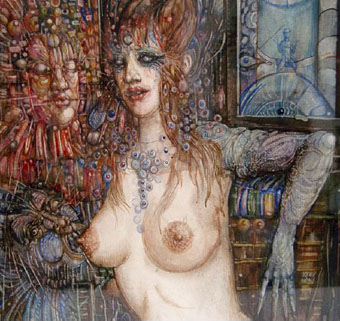
Who was Thomas Häfner? Good question, because he’s virtually invisible on the web. The painting above is scanned from David Larkin’s excellent Fantastic Art (Pan/Ballantine, 1973) and was also used as a cover image for an edition of Blaise Cendrars‘ scurrilous masterpiece, Moravagine. The Demon Woman below is a watercolour original for sale on eBay. Häfner was a member of a group of German artists who called themselves the Young Realists, formed in Düsseldorf in the mid-Fifties. Significantly, another group of young imaginative painters was active at the same time in Vienna, the Fantastic Realists, who included the great Ernst Fuchs among their number. “Realism” here can be considered as referring to a style that favoured the hard-edged realistic approach of Surrealism; Häfner’s content certainly wasn’t realistic.

These people remain neglected or unknown because art critics like to pretend there’s only one story being told in the development of art at any given time when there are usually several, often with conflicting agendas. So we’re always being informed that the dominant movement in fin de siècle Paris was Impressionism and hear little of the Symbolists who were equally—if not more—popular, productive and influential during that period.

(This laziness carries over to other areas; Debussy is continually described as “an Impressionist composer” when one of his most famous works, Prélude à l’après-midi d’un faune, was based on a Symbolist poem by Mallarmé. There are no fauns in Impressionist paintings.)

The prevailing trend in the mid-Fifties was the thin gruel of Abstract Expressionism, the complete antithesis of the kind of art being produced by Häfner, Fuchs and company. There’s a reason for the elevation of this type of work over others. Critics such as Clement Greenberg saw abstraction (which, ironically, grew out of Surrealism) as being a politically acceptable direction after the turmoil of the Second World War. The Nazis liked realism in their art, while the Soviets under Stalin and the Chinese under Mao had declared Socialist Realism to be the official art of the Communist Revolution, therefore realism of any variety was reactionary and bad. Further irony comes when the CIA agreed with this argument and secretly promoted Abstract Expressionism outside America. This has led us to the situation we have today where a Willem de Kooning painting, Woman III (1952–53), was recently sold for $137.5 million which means collecting this kind of work is now a game for billionaires. It really would be the final irony if the kind of realistic art that Clement Greenberg despised was elevated to a new popularity by over-priced Abstract Expressionism as collectors with fewer assets were forced to look elsewhere. Critics can protest all they like but these days it’s money that speaks with the loudest voice in the world of art.

demon_woman.jpg

Demon Woman (no date).

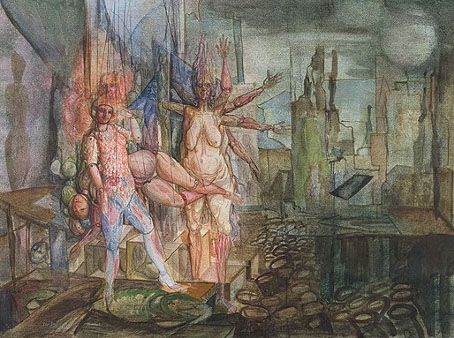
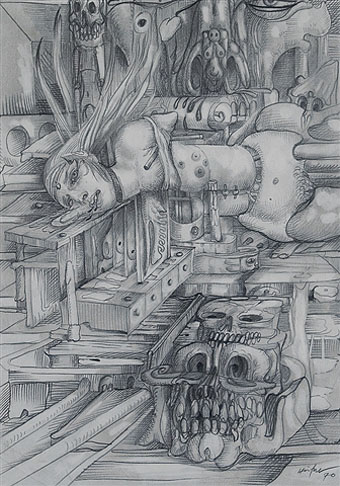
Update: added some additional works:

hafner2.jpg

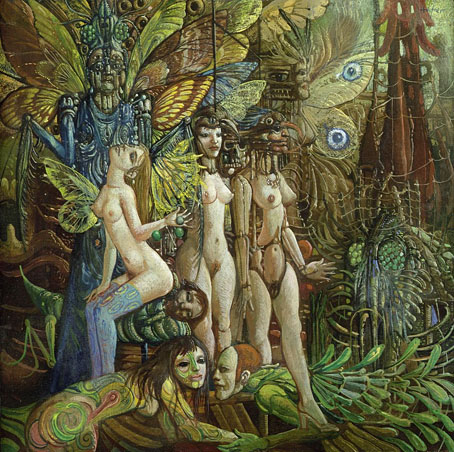
Marionetten (1964).

hafner1.jpg

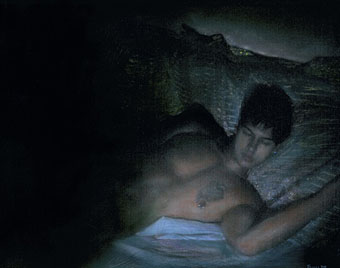
Szene mit Schädeln (1970).

hafner3.jpg

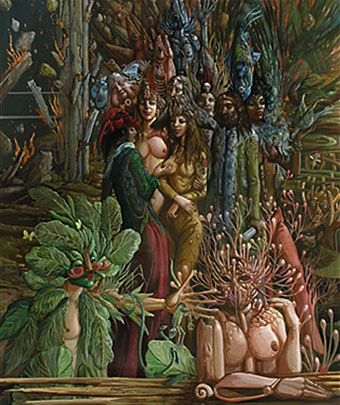
Phantastische Waldszene (1971).

hafner.jpg

Masken in zerfallener Umgebung (1974).

hafner2.jpg

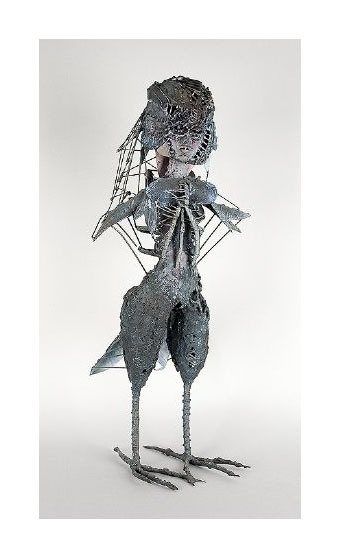
Die Harpye (no date).

Elsewhere on { feuilleton }
• The fantastic art archive