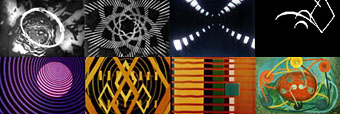
Ten films by Oskar Fischinger

fischinger.jpg

After complaining a couple of days ago about the difficulty of seeing works of abstract cinema, it turns out that a collection of Oskar Fischinger’s great animations appeared earlier this year.

Decades before computer graphics, before music videos, even before Fantasia (the 1940 version), there were the abstract animated films of Oskar Fischinger (1900–1967), master of “absolute” or nonobjective filmmaking. He was cinema’s Kandinsky, an animator who, beginning in the 1920’s in Germany, created exquisite “visual music” using geometric patterns and shapes choreographed tightly to classical music and jazz. (John Canemaker, New York Times)

Oskar Fischinger is one of the greatest artists of the 20th century, embracing the abstraction that became the major art movement of that century, and exploring the new technology of the cinema to open abstract painting into a new Visual Music that performs in liquid time. (Biographer William Moritz)

We now understand Oskar Fischinger not only as a link between the geometric painting of pre-war Europe and post-war California but as a grandfather of the digital arts.
(Art Critic Peter Frank)

That’s good, so now how about the Whitneys, Jordan Belson, Harry Smith…?

Via Boing Boing.

Elsewhere on { feuilleton }
• The abstract cinema archive
The art of Andreas Martens

rork1.jpg

rork2.jpg

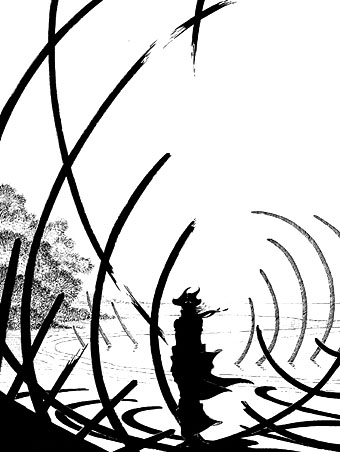
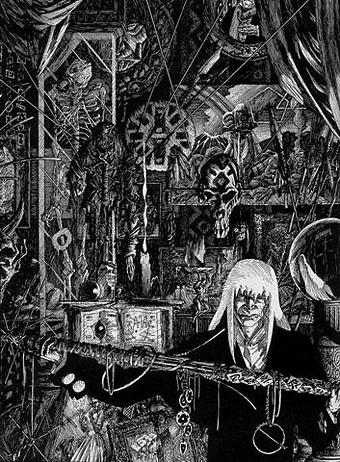
Andreas Martens, artist of Rork.

A native of Germany, Andreas (Andreas Martens (1951- ) studied at the St. Luc comics school in Belgium, assisting Eddy Paape on Udolfo, before relocating to France. His genre series include Arq, Cromwell Stone, Cyrrus, Rork and its spin-off, Capricorne, as well as a number of single works such as La Caverne du Souvenir (The Cave of Memory), Coutoo, Dérives (Adrift), Aztèques, and Révélations Posthumes (Posthumous Revelations).

Previously on { feuilleton }
• The art of Harry Clarke, 1889–1931

The Bowes Swan

bowes_swan.jpg

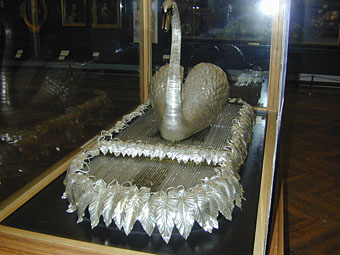
“I watched a silver swan which had a living grace about his movements and a living intelligence in his eyes.” Mark Twain, Innocents Abroad.

The Silver Swan is perhaps the best known and best loved object in The Bowes Museum. It is musical automaton in the form of a life-size model of a swan, comprising a clockwork mechanism covered in silver plumage above a music box. It rests on a stream made of twisted glass rods interspersed with silver fish. When the mechanism is wound up, the glass rods rotate, the music begins, and the swan twists its head to the left and right and appears to preen its back. It then appears to see a fish in the water below and bends down to catch it, it then swallows the fish as the music stops and resumes its upright position. The whole performance lasts about forty seconds. In reality the fish has been concealed lengthways on a pivot in the swan’s beak and returns to this position. In real life swans do not eat fish.

The Bowes Museum site has more details about John Joseph Merlin’s splendid swan and this page has a QT movie of the automaton in action.

Lapis by James Whitney

lapis1.jpg

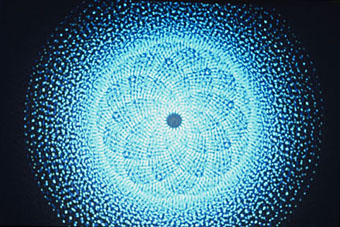
Lapis (1966).

Proof of the conservative nature of cinema as an artistic medium can be found in the way its abstract practitioners don’t merit anything like the attention received by Piet Mondrian or Jackson Pollock. In cinema narrative is all, and it’s ironic that when artists such as Julian Schnabel or Robert Longo turn to film they end up telling stories.

lapis2.jpg

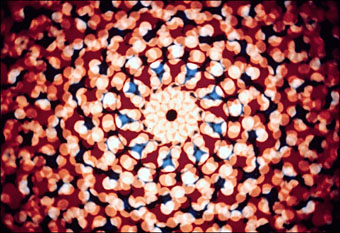
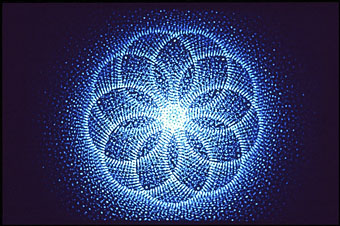
James Whitney’s Lapis (1966) is a classic work in this field, a 10-minute animation that took three years to create using primitive computer equipment:

In this piece smaller circles oscillate in and out in an array of colors resembling a kaleidoscope while being accompanied with Indian sitar music. The patterns become hypnotic and trance inducing. This work clearly correlates the auditory and the visual and is a wonderful example of the concept of synaesthesia.

lapis3.jpg

James and his brother John were pioneers of the use of computers in animation. Looking around for stills from Lapis turned up this fascinating page of early computer graphics:

In the early 1960s digital computers became available to artists for the first time (although they cost from $100,000 to several millions, required air conditioning, and therefore located in separate computer rooms, uninhabitable ‘studios’; programs and data had to be prepared with the keypunch, punch cards then fed into the computer; systems were not interactive and could produce only still images). The output medium was usually a pen plotter, microfilm plotter (hybrid bwn vector CRT and a raster image device), line printer or an alphanumeric printout, which was then manually transferred into a visual medium.

It’s difficult to see these films outside a special screening at a gallery or arts cinema. The Keith Griffiths documentary Abstract Cinema is an excellent introduction, including both Lapis and James Whitney’s Yantra among many other short works. However, this isn’t available to buy so viewing it means scouring TV schedules or waiting for some of these neglected works to turn up on YouTube. Gene Youngblood’s 1970 book Expanded Cinema discusses abstraction and the Whitneys and is available as a free PDF download here.

Update: Lapis on YouTube again, in full this time!

Elsewhere on { feuilleton }
• The abstract cinema archive