Weekend links 43

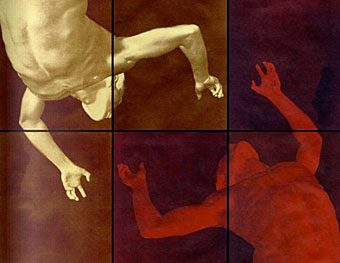
broadcast.jpg

From the video for I See, So I See So by Broadcast.

RIP Trish Keenan of Broadcast. Tributes here and here. The Broadcast/Focus Group collaboration …investigate Witch Cults of the Radio Age was The Wire‘s album of the year for 2009. Joseph Stannard interviewed Trish Keenan and James Cargill in October of that year.

Who Knows What Tomorrow Might Bring, a new pay-what-you-please Arthur mixtape. Also at Arthur, Sunday Lectures by Freeman House here, here, here and here.

• Cormac McCarthy’s description of American pioneers in Suttree (1979) kept coming to mind during the past week:

Where hunters and woodcutters once slept in their boots by the dying light of their thousand fires and went on, old teutonic forebears with eyes incandesced by the visionary light of a massive rapacity, wave on wave of the violent and the insane, their brains stoked with spoorless analogues of all that was, lean aryans with their abrogate semitic chapbook reenacting the dramas and parables therein and mindless and pale with a longing that nothing save dark’s total restitution could appease.

Born This Way: “A photo/essay project for gay viewers (male and female) to submit pictures from their childhood (roughly ages 4 to 14), with snapshots that capture them, innocently, showing the beginnings of their innate LGBT selves. It’s nature, not nurture!”

Mischievous street art characters. Chris Marker wouldn’t want us to forget Monsieur Chat. Speaking of Chris Marker, there’s Plato’s Cave as Kino: Owl’s Legacy Excerpt & Becoming Imperceptible.

With the point of a knife Dr. LeBaron took from the little round box a small quantity of a dark, greenish-colored gum, which, as it was passed from one to another for inspection, gave off an agreeable, aromatic odor. Then, as he was engaged in filling two capsules from the box, he explained:

“As le docteur read from ze book of Monsieur Richet, ze favoreet méthode in ze Orient ees to take ze Haschisch by ze smoke in ze Persian pipe—ze hookah, ze nargileh. But zey also take eet in ze great varieté. Ze principal kind zat come to ze market of Europe, ees zat I show you—ze Haschisch, an’ ve take eet like ze dose of quinine,” said he, as he handed a well-filled capsule to both Smith and Arnold.

Throwing back his head, Smith bolted his dose without ceremony, and Arnold immediately followed his example.

Haschisch: A Novel (1886) by Thorold King. Related: Haschisch Hallucinations (1905) by HE Gowers.

• Dan Hill’s personal report from the drowned world of Brisbane. Related: Hayley Campbell recalls swimming in the city’s hazardous floodwaters when she was a wild child. Also: Canoeing in McDonald’s.

Cabinet Card Backmarks, florid advertisements from Victorian cabinet photos. Callum James made a post on the subject in 2008 and has a Flickr set showing his discoveries.

• The Brothers Quay made a public information film about AIDS in 1996. (Now deleted from YouTube…boo!)

The secret stories of book inscriptions. Related: The Book Inscriptions Project.

• Ani, Turkey: City of 1001 Churches, all of them abandoned and ruined.

Vulgar Army: Octopus in Propaganda and Political Cartoons.

• Designer John Gall makes collages in his spare time.

Phantasmaphile at Tumblr.

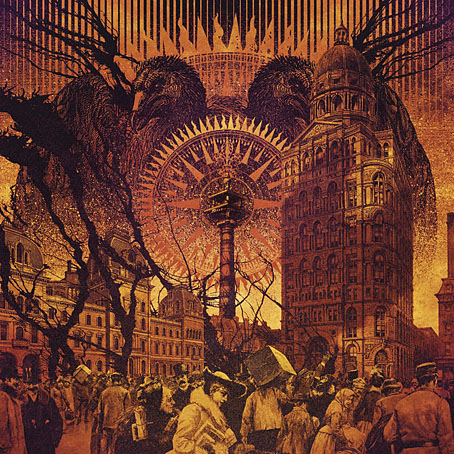
Witch Cults and I See, So I See So, both by Broadcast & The Focus Group.

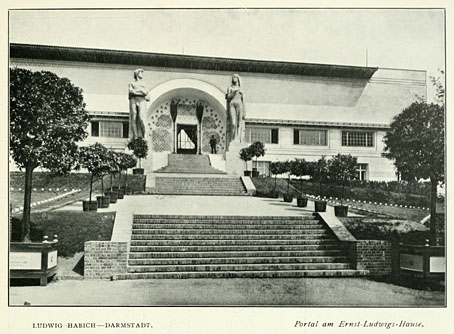
Deutsche Kunst und Dekoration #2

dkd02-01.jpg

Continuing the delve into back numbers of Deutsche Kunst und Dekoration, the German periodical of art and decoration. Volume 2 covers the period April–September 1898 and, as before, this issue can be downloaded in a variety of formats at the Internet Archive. This edition opens with a feature on the Wertheim department store, Berlin, design by Alfred Messel. Like many examples of Art Nouveau architecture, the store suffered damage during the Second World War and was eventually demolished.

dkd02-02.jpg

This number also has a lengthy feature devoted to artist Hans Christiansen whose work was appearing regularly in issues of Jugend magazine at this time. The colour panels below are Christiansen’s work.

Continue reading “Deutsche Kunst und Dekoration #2”

The art of Carel Willink, 1900–1983

willink1.jpg

Townscape (1934).

Carel Willink was a Dutch painter whose self-described brand of “imaginary realism” conjured in its early years a collection of views of desolate plazas, empty lanes and abandoned ruins over which smoke or cloud hangs like an ominous portent. The works of Giorgio de Chirico and Paul Delvaux come to mind when looking at these pictures although Willink’s work has enough unique qualities to stand apart from his more famous contemporaries. I’m also reminded a little of Spanish artist Arnau Alemany who has a similar predilection for isolated architecture.

willink2.jpg

Chateau in Spain (1939).

There’s an official Willink website here, while further paintings can be seen at this Flickr set and also at Ten Dreams.

Elsewhere on { feuilleton }
The fantastic art archive

Previously on { feuilleton }
Bruges-la-Morte
Taxandria, or Raoul Servais meets Paul Delvaux
The art of Arnau Alemany

The Colmore Fatagravures

colmore1.jpg

Golden Fairy Specimen.

These have already been featured on many other sites but that shouldn’t exclude their presence here. The Wunderkammer concept seems to be a recurrent fascination on the web—see here and here and here, for example—possibly because the nature of the medium lends itself to the accumulation of curiosities. It’s a small step from collecting genuine curios to inventing those the world stubbornly refuses to provide, that’s what we see happening here and also at some of the earlier posts below. About the Colmore Fatagravures we’re told:

A Scottish adventurer, inventor, and photographer named Neville Colmore claimed to have constructed a device capable of “…parting the veil of Faery…”. The device, which he called the “Spectobarathrum”, produced beautiful photo graphic plates he called “fatagravures”, through a now lost process. The original “Spectobarathrum” along with all of the images he claimed to have made were believed destroyed in a fire. (More.)

colmore2.jpg

French Harpy of Questionable Provenance.

In a similar vein, I’ve already mentioned that I’ve done some design and illustration for the Thackery T. Lambshead Cabinet of Curiosities, the sequel to the Lambshead Disease Guide which is forthcoming from HarperCollins. The new book is edited by Ann & Jeff VanderMeer and publication has been announced for June. Jeff unveiled the near-final cover design just before Christmas (not my work, I should note) and a preview of some of the contents, including one of my interior pages. More about this closer to publication.

Previously on { feuilleton }
The specimens of Alex CF
Walmor Corrêa’s Memento Mori
Harpya by Raoul Servais
The art of Ron Pippin
Custom creatures
Jan Švankmajer: The Complete Short Films
Cryptozoology
The Museum of Fantastic Specimens

Weekend links 42

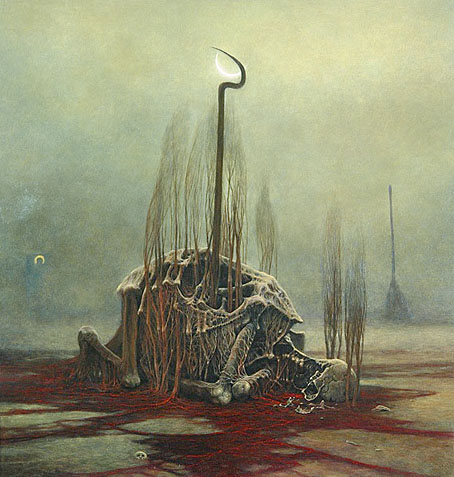
martin.jpg

Blasphemous Rumours (2009/2010) by Ryan Martin. The artist now has a dedicated site for his paintings.

The Museum of Censored Art, a mobile gallery, will be showing the withdrawn David Wojnarowicz film outside the National Portrait Gallery, Washington DC, until their contentious gay art exhibition closes next month. Related: Bishop of Mallorca criticises calendar—which shows Catholic youths posing naked—for ‘not respecting Christian symbols’.

• Didier Lestrade published French gay zine Magazine in the 1980s, and later co-founded Têtu. He’s interviewed at BUTT and has started uploading the entire run of Magazine about which he says: “I don’t want to stamp some kind of logo on this material. It’s gay. It’s gay history. It belongs to everybody. If you want to take a piece of it, please try to mention the origins of it, a simple code word “Magazine” will be enough. If you wanna be more specific, be my guest.”

HMV, Britain’s last big music chain, is closing 60 branches. Yet a new wave of CD stores is thriving. Oh, HMV, how I’ll miss your £17 CDs (and double-CDs at £34)… On second thoughts, no I won’t, your wretched retail barns always exemplified the greed endemic in the music business.

kasner.jpg

Love Comes/Destroyer by Stephen Kasner.

• Artist Stephen Kasner‘s work has adorned music releases by Sunn O))), Isis and others. He’s currently another American creator in need of assistance with medical expenses. Details here.

The Ghosts of Old London: the gloomy Victorian metropolis in all its deteriorated splendour. See also: In Search of Relics of Old London.

• “It’s time to recognise [Sandy] Denny as not simply a folksinger but one of Britain’s great poets of song,” says Rob Young.

Louis Pattison talks to Locrian about JG Ballard, old VHS tapes and their new album The Crystal World.

The Dreams That Stuff Is Made Of: Lebbeus Woods’ big drawings.

Hannes Bok portfolios at Golden Age Comic Book Stories.

An Iranian rapper named Salome. Also here and here.

A Moment of (Alan) Moore.

RIP Mick Karn.

Book Worship.

Sons of Pioneers (1981) by Japan; Tao-Tao (1982) by Masami Tsuchiya; Glow World (1983) by Bill Nelson.