Weekend links 567

dean-osibisa.jpg

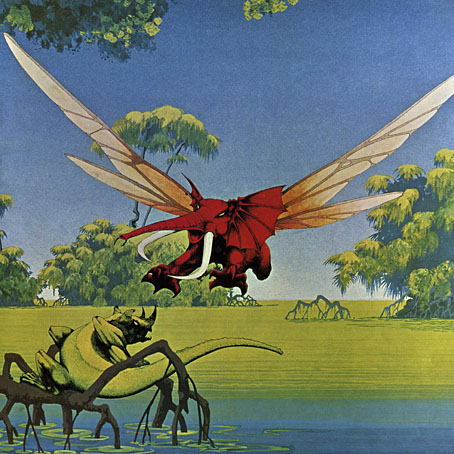
Cover art by Roger Dean for Woyaya (1971), the second album by Osibisa. Dean’s flying elephants made their first appearance on the group’s debut album, and have been an Osibisa emblem ever since.

• Many of Roger Dean’s early album covers are better creations than the music on the albums they decorate. This isn’t the case with Osibisa, however, a Ghanaian group based in London whose discography includes (uniquely, I think) two covers by Dean together with one by Mati Klarwein. The group’s first two albums, Osibisa and Woyaya, are exceptional blends of Ghanaian music with rock, funk and jazz whose omission from the generally reliable Kozmigroov list is a serious error. Garth Cartwright talked to Teddy Osei and Lord Eric Sugumugu about Osibisa past and present.

• “The antiheroes of Angry Young Men cinema railed against the limited life opportunities available to them. Wired and frustrated, they especially chafed against girlfriends, wives, domesticity. Yet they never questioned heterosexuality itself. Not, at least, until The Leather Boys (1964), a relatively little-known film directed by Canadian expatriate Sidney J. Furie.” Sukhdev Sandhu on a film about gay life in pre-decriminalisation Britain that offered a slightly more positive view of its subject than the justifiably angst-ridden Victim (1961).

• “Brian Aldiss once confided to me that the big problem with American science fiction writers was that they loved to write about Mars but knew nothing about Indonesia.” Bruce Sterling on the attractions of being an expatriate writer who adopts a foreign persona, as he did for the stories collected in Robot Artists and Black Swans.

• New music: Fire Tower by The Grid / Fripp. Dave Ball, Richard Norris and Robert Fripp have been collaborating on and off since The Grid’s 456 album in 1992. Fire Tower is a preview of Leviathan, a new album out in June on CD/DVD and double vinyl.

• RIP Michael Collins, the astronaut who orbited the Moon alone, listening to Symphonie Fantastique by Berlioz in the Command Module of Apollo 11 while Neil Armstrong and Buzz Aldrin were walking on the satellite’s surface.

• “‘Walking with a thesis’ could easily function as the subtitle for a significant number of Iain Sinclair’s books.” Tobias Carroll on Iain Sinclair and the radical act of walking through a city.

• “‘Plain speaking, like plain food, is a puritan virtue and thus no virtue at all,’ Meades pronounces.” Steven Poole reviews Pedro and Ricky Come Again by Jonathan Meades.

• Building a panorama: Clive Hicks-Jenkins‘ latest progress report on his Cocteau-inspired illustrated edition of Beauty and the Beast.

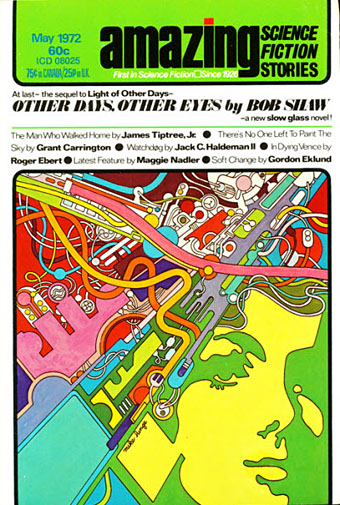
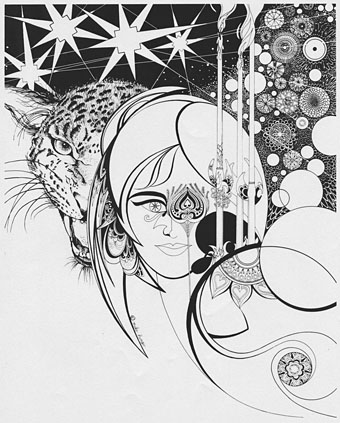
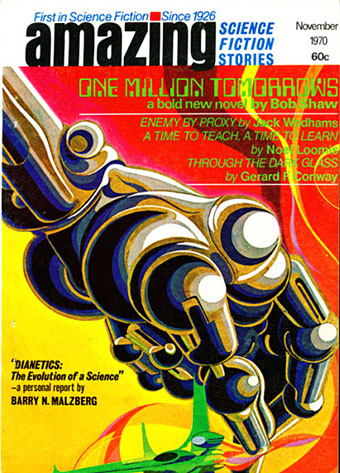
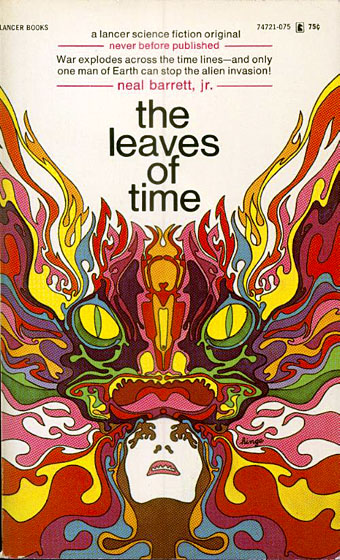
• At Unquiet Things: Groovy Goddesses From Dimension X: Gene Szafrans’ Kaleidoscopic Book Covers.

• From leather boys to leather men: Miss Rosen on the little-known photography of Tom of Finland.

Alexis Petridis attempts the impossible again, with a list of Grace Jones’ best songs.

• At Dennis Cooper‘s: Cars.

I’m A Leather Boy (1967) by The Leather Boy | Warm Leatherette (1980) by Grace Jones | Leather Bound (2017) by Patrick Cowley
Solid Space: Jon Anderson’s cosmic voyage

olias1.jpg

Jon Anderson’s solo debut, Olias Of Sunhillow, is reissued this week in a double-disc set comprising a remastered CD plus an audio DVD. I’d been hoping for some time that this album might be given a proper reissue, it’s one I like a great deal but my old CD has never sounded as good as it ought to. The album may command cult status round here but you don’t see it mentioned anywhere outside Yes forums or partisan enclaves like the Prog Archives. This post may be taken as a small corrective to the neglect.

olias2.jpg

Olias Of Sunhillow was released in 1976, and was the most unusual of all the solo albums recorded by the individual members of Yes in the mid-70s, being a spin-off from some of the group’s early albums, or at least their cover art. Roger Dean’s first cover work for the group was on Fragile in 1971, for which he painted a miniature world rather like one of MC Escher’s planetoids. This was Dean’s idea, the band had suggested a broken piece of porcelain as the cover image. The back cover of the album showed the same planet in a state of fragmentation with a fish-like spaceship floating above it (see below). Another drawing of the fish-ship was added to the front cover before the album’s release, and it’s this ship, and the narrative it suggests, that leads eventually to Anderson’s solo album. Two years after Fragile, the planetary disintegration had turned into an exodus on the group’s triple-live album, Yessongs, the back cover of which shows pieces of planet being towed through space by a similar fish-ship. The other panels of the cover depict the arrival of these fragments on a newer, larger world. Anderson’s album takes this sequence of events then filters them through Vera Stanley Alder’s mysticism to craft a musical odyssey which Discogs describes as:

…the story of an alien race and their journey to a new world due to catastrophe. Olias, the title character, is the chosen architect of the glider Moorglade, which will be used to fly his people to their new home. Ranyart is the navigator for the glider, and Qoquaq is the leader who unites the four tribes of Sunhillow to partake in the exodus.

olias3.jpg

For many years in British music circles it would have been a grave error to even acknowledge this album’s existence, never mind admit to actually liking it. This was partly the old animus against progressive rock, an unexamined prejudice that lasted well into the 1990s, but Anderson’s album had so many strikes against it that it might have stood as the winner of a disapproval lottery for the more ideologically rigid writers and readers of the NME. It’s Jon Anderson (strike 1), the lead singer of progressive rock (2) group Yes (3), whose album is a science fiction (4)/ fantasy (5) concept (6), littered with Tolkien-like invented names and words (7), and with a multi-page sleeve embellished with detailed fantasy illustrations (8) by David Fairbrother-Roe. The design was art directed by Hipgnosis, who subsequently designed the next two Yes albums. Anderson originally wanted Roger Dean to create the packaging, which would have provided a further strike of disapproval against the album, but Dean’s career had gone into overdrive following the publication of Views so he either didn’t have the time or didn’t want to be involved. In Views Dean mentions “another project” based on the fish-ship’s journey which may be a reference to Anderson’s forthcoming album, the credits of which thank Dean for “planting the seed”.

views1.jpg

Roger Dean’s original artwork for Fragile (1971). Another fish-ship was added to the final cover art.

Continue reading “Solid Space: Jon Anderson’s cosmic voyage”

R. Shteyn’s Viy

shteyn01.jpg

My weekend viewing was the recent double-disc release from Eureka: Viy (1967), a Russian film directed by Georgi Kropachyov & Konstantin Yershov with Aleksandr Ptushko, and A Holy Place (1990), a Serbian film directed by Djordje Kadijevic. Both features are based on Viy, a story by Nikolai Gogol which the author described as a transcription of a Ukrainian folk tale although the piece is assumed to be Gogol’s invention.

shteyn02.jpg

The story concerns Khoma, a seminarian in Kiev, whose alarming nocturnal encounter with a witch is followed by a seemingly unconnected summons to a Cossack village where a young woman has just died. The woman’s last wish was that Khoma should say prayers for her, something he’s reluctantly compelled to do when this involves spending three nights locked in the church where her coffin lies. The events in the church are the heart of the story, and involve a reanimated corpse, a flying coffin, and a climax involving a visitation by “the unclean powers”, all of whom try to attack Khoma by breaking into a circle he’s drawn around himself. The monstrous Viy is described by Gogol as the “chief of the gnomes” although the Russian filmmakers offer no such description of the shambling creature that a crowd of vampires lead into the church. Ukrainian gnomes are evidently a world away from the miniature beings that populate British gardens.

shteyn03.jpg

These drawings by R. Shteyn (or Shtein) are from a heavily-illustrated Russian printing from 1901 which may have contributed to the 1967 film: many of the scenes in the film closely resemble the illustrations, especially the appearance of the main characters and the Cossack villagers. These are only the full-page drawings but they include the climactic appearance of the terrible Viy. The rest of the drawings may be seen here.

shteyn04.jpg

shteyn05.jpg

Continue reading “R. Shteyn’s Viy”

Weekend links 559

fukuda.jpg

Cover art by Toshiyuki Fukuda for the Japanese edition of the new novel by Kazuo Ishiguro.

• “The story here is how between 1978 and 1982, this impulse shed its novelty genesis and its spoils were divvied up between gay producers making high-energy soundtracks for carnal abandon, and quiet Hawkwind fans smoking spliffs in Midlands bedrooms.…this excellent compilation offers fresh understandings of a period in sonic history where the future was up for grabs.” Fergal Kinney reviews Do You Have the Force? Jon Savage’s Alternate History of Electronic Music, 1978–82.

DJ Food continues his history of mini CDs with Oranges And Lemons, the 1989 album by XTC which was released in the usual formats together with a limited edition of three small discs in a flip-top box. The cover art by Dave Dragon is a good example of the resurrected groovy look.

• “If Austin Osman Spare, William Burroughs, Mary Butts and Kathy Acker got together for a séance, the transcript could well look like this.”

• How Leonora Carrington used Tarot to reach self-enlightenment: Gabriel Weisz Carrington on his mother’s quest for mythic revelations.

• Mixes of the week: Sounds Unsaid at Dublab with Tarotplane, and To Die & Live In San Veneficio by SeraphicManta.

• At Dennis Cooper’s: 5strings presents…Solve et Coagula: An introduction to Israel Regardie.

• The Joy of Silhouettes: Vyki Hendy chooses favourite shadow-throwing cover designs.

Emily Mortimer on how Lolita escaped obscenity laws and cancel culture.

Freddie deBoer has moved his writing to Substack.

• New music: Wirkung by Arovane.

• Children Of The Sun (1969) by The Misunderstood | Children Of The Sun (1971) by Hawkwind | Children Of The Sun (2010) by The Time And Space Machine

The Stormbringer Sessions by James Cawthorn

stormbringer15.jpg

One of the books I was designing last year is published next month. The Stormbringer Sessons is a resurrection by John Davey of a sketchbook created by James Cawthorn in the mid-1980s for an Elric graphic novel that Cawthorn was commissioned to adapt and illustrate for Savoy Books. This is a limited edition that’s unlikely to be reprinted so anyone interested is advised to pre-order. (See below.)

stormbringer16.jpg

Slipcase decoration.

The original Stormbringer by Michael Moorcock isn’t a novel as such but a collection of the second series of linked novellas about Elric of Melniboné that Moorcock wrote for Science Fantasy from 1961 to 1964. Over the course of ten stories Moorcock introduced a character and a world that acted as a riposte to the Tolkienite school of heroic fantasy, where the divisions between Good and Evil are clear and fixed. Elric is like one of Sergio Leone’s characters: the difference between Clint Eastwood’s “Good” in The Good, the Bad and the Ugly and Lee Van Cleef’s “Bad” is merely a matter of degree; both men are killers chasing the same hoard of gold coins. (By coincidence, Leone was preparing to the upset the Western genre with A Fistful of Dollars just as Moorcock was finishing the first Elric stories.)

stormbringer03.jpg

James Cawthorn was one of Moorcock’s oldest friends, and a frequent collaborator. He not only illustrated the first Elric stories but also co-wrote the fourth one, Kings in Darkness. Despite having created many Elric illustrations Cawthorn always seemed to want to draw comics based on other characters, notably Moorcock’s Dorian Hawkmoon whose adventures have recently been reprinted in three volumes by Titan Books. The Stormbringer commission was a result of the late David Britton’s obsession with Elric in general and the Stormbringer book in particular. Stormbringer begins with Elric having retired from adventuring; his soul-stealing sword is locked away and he’s settled down to married life. The opening scenes parallel (and prefigure) many Hollywood plots: Elric’s wife is abducted for unknown reasons so Elric has to take up his sword and go after her. What follows is a pursuit into a world growing increasingly dark and chaotic, and with it the realisation that the events taking place are a part of a long-foretold apocalypse that will (and does) destroy that world. The progression from a regular sword & sorcery tale to doom-laden widescreen baroque, with a dragon army flying over a churning Boschian hellscape, is one of the enduring attractions of the book.

stormbringer04.jpg

Britton had first persuaded Cawthorn to adapt Stormbringer into comic form in 1976 but the work on that occasion was compromised by lack of time. The sketches in The Stormbringer Sessions are Cawthorn’s roughs which were drawn in preparation for the second attempt, with the entire story worked out in panel form over 250 pages, complete with dialogue and captions. Some of the opening pages are rough indeed, but the drawings for the apocalyptic finale, presented in many double-page spreads, are almost finished pieces. The sketches may lack the finesse of Cawthorn’s other comics work but the power of his drawing and his imagination shines through. Nobody seems to know why he abandoned this project despite having a publisher waiting for it, but he was also adapting the third Hawkmoon book at the time, and had already spent the past decade working on the Hawkmoon trilogy.

stormbringer05.jpg

My design for this one is fairly straightforward, mostly a matter of framing and typesetting the opening and closing pages, as well as creating graphics for the cover and the slipcase. As with the Elric-themed Hawkwind album, The Chronicle of the Black Sword, I opted for Celtic-style knotwork for the decoration. Elric’s world isn’t our world but knotwork designs are universal (maybe even multiversal) while being satisfyingly antique and abstract. The publication is a co-production between Jayde Design and Savoy Books, with the book being limited to 100 numbered hardbacks in a decorated slipcase. Each copy also contains a colour print of the cover painting. The book may be ordered here. More page samples follow.

stormbringer06.jpg

Continue reading “The Stormbringer Sessions by James Cawthorn”