Weekend links 51

narcissus.jpg

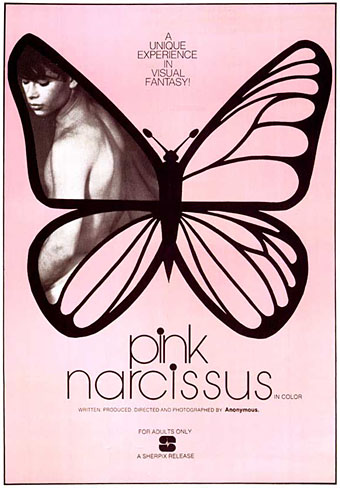
James Bidgood’s luscious and erotic micro-budget masterpiece Pink Narcissus (1971) receives a screening at the IFC Center Queer/Art/Film festival, NYC, on Monday. The film is presented by Jonathan Katz, curator of the Hide/Seek gay art show whose controversial history was recounted here in December. The NYT ran a short piece about Bidgood, now 77 and not the first artist to be disappointed by his past work; they also have a Bidgood slideshow. Hide/Seek, meanwhile, is now a touring exhibition.

• Related: the delightful Drew Daniel of Matmos (and Soft Pink Truth) posing in a jockstrap at the Club Uranus, San Francisco circa 1990; he also used to go-go dance wearing a fish.

• The Isle of Man may have one of the oldest parliaments in the world but its laws have often been out of step with its neighbour across the Irish Sea. This week the island joined the rest of the UK in granting civil partnerships to its citizens. Now the name whose punning appeal so delighted James Joyce doesn’t seem as inappropriate.

Howard Jacobson: “The novelist Yukio Mishima posed pointing a Samurai sword to his chest and ultimately had himself beheaded in public. This is what’s called taking your art seriously.”
hutter.jpg

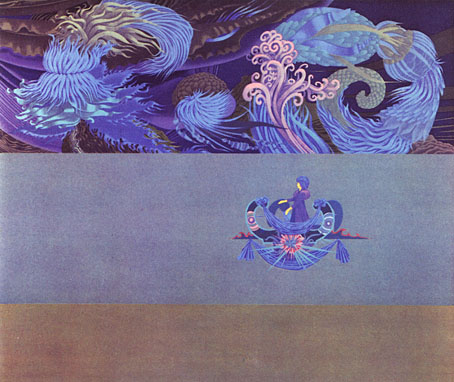
The Realm of the Queen of the Night (1974) by Wolfgang Hutter from Zauberflote at 50 Watts.

The revelatory operations of the chance encounter lie at the heart of le merveilleux (“the marvelous”)—the Surrealist conception of beauty. You find something marvelous in the world (an object, an image, a person, a place) that corresponds, like a piece clicking into a puzzle, to a deep inner need.

Slicing Open the Eyeball: Rick Poynor on Surrealism and the Visual Unconscious by Mark Dery.

Boy from the Boroughs: Alan Moore interviewed by Pádraig Ó Méalóid; Michael Moorcock interviewed at Suicide Girls.

• Illustrations from Quark, the anthology of speculative fiction edited by Samuel Delany & Marilyn Hacker in 1970.

The Residents, sans masks, filmed at their San Francisco home in the 1970s.

• Bach’s Toccata and Fugue in D minor played on a glass harp.

What art can do for science (and vice versa).

• You can never have too much Virgil Finlay.

• Lydia Kiesling reviews Lolita.

Alain Resnais film posters.

Red Mug, Blue Linen.

No GDM (dub version) (1979) by Gina X | L. Voag’s Kitchen (2004) by Soft Pink Truth.
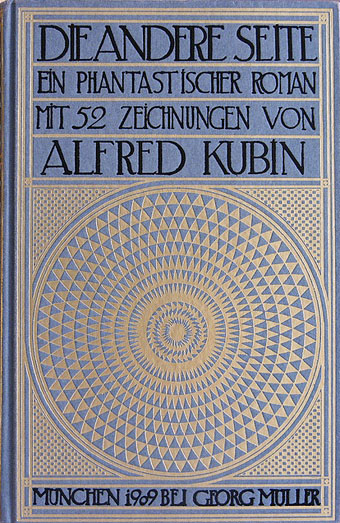
Die Andere Seite by Alfred Kubin

kubin1.jpg

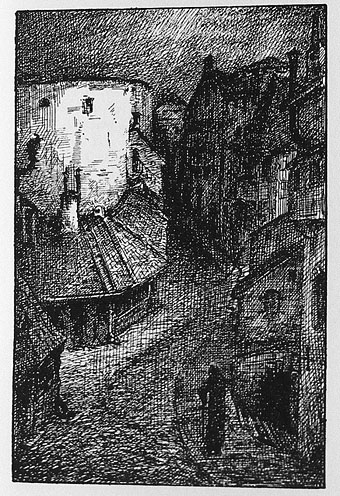
Re-reading Alfred Kubin’s strange fantasy novel Die Andere Seite (The Other Side) this week, I found myself suffering the same frustration as when I bought the book, namely that the illustrations in the Dedalus edition are very poor reproductions. When this new translation appeared in 2000 there wasn’t any convenient way to see better copies of Kubin’s drawings unless you had the earlier (and for me, elusive) Penguin edition. Thanks to Flickr we can now see reproductions from the first printing of 1909 in this set of photos. Not all the drawings are featured but the ones present are better than those in my volume. The illustrations are often rather perfunctory, and they lack the finesse and erotic weirdness of Kubin’s better known works, but a couple are as macabre as one would expect. And I love the cover design.

kubin2.jpg

As to the story, it concerns an unnamed narrator who receives a request from an old school friend, Claus Patera, to leave Munich and go with his wife to live in the city of Pearl, a newly-built metropolis in a nation known as “The Dream Realm” which Patera has founded in the Far East. Having travelled there the couple find themselves in a city filled with other displaced Europeans which is at first eccentric then increasingly nightmarish. It’s the kind of book you might expect an artist like Kubin to have written, in other words, and since the narrator is a thinly-veiled counterpart of the author we can occasionally glimpse the man behind the works. Anyone interested in Kubin the artist is advised to seek it out.

Alfred Kubin at Weimar

Elsewhere on { feuilleton }
The illustrators archive

Previously on { feuilleton }
The Hourglass Sanatorium by Wojciech Has
Kafka’s porn unveiled
Hugo Steiner-Prag’s Golem

The art of Mario Laboccetta

laboccetta01.jpg

Tales of Hoffmann (1932).

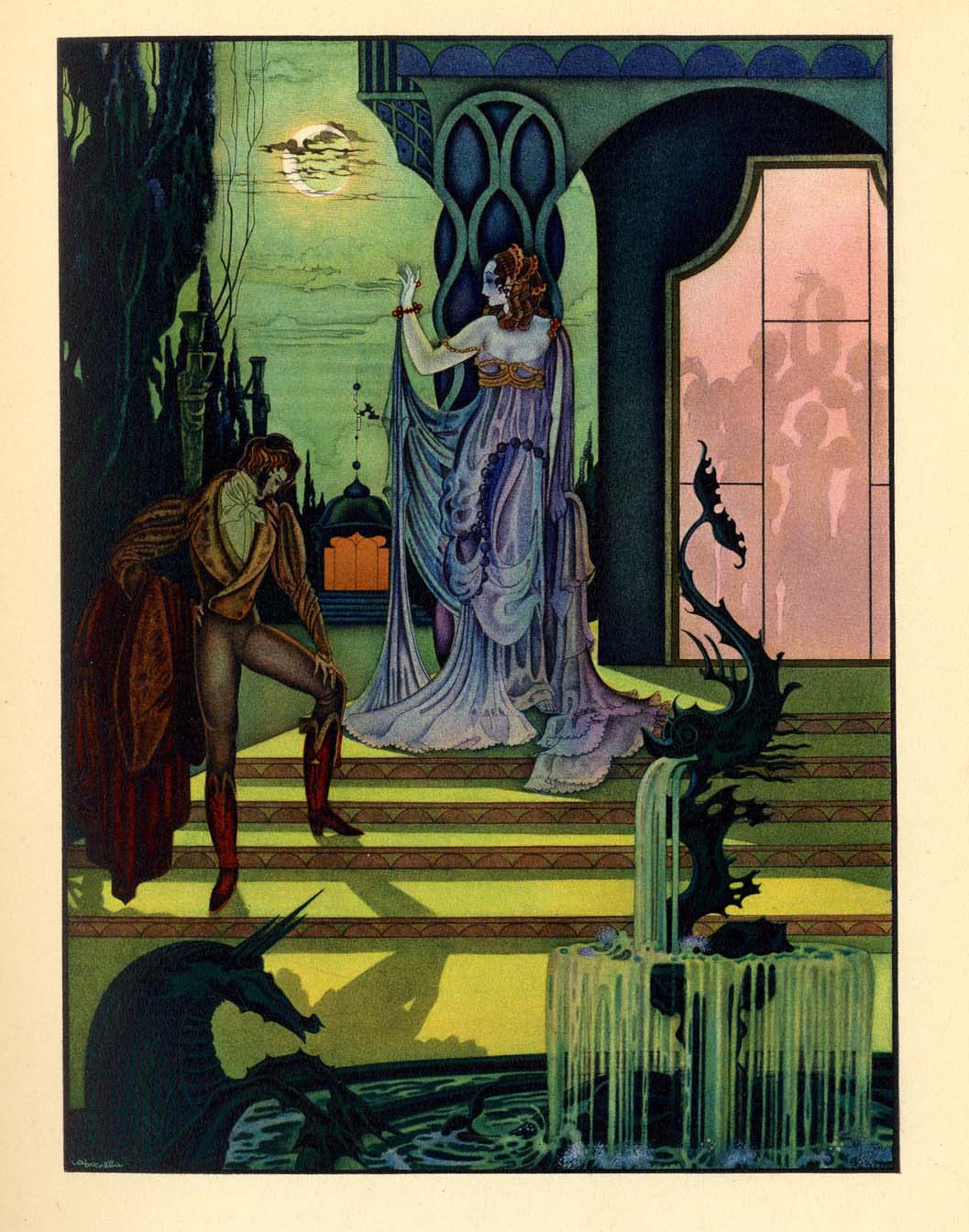
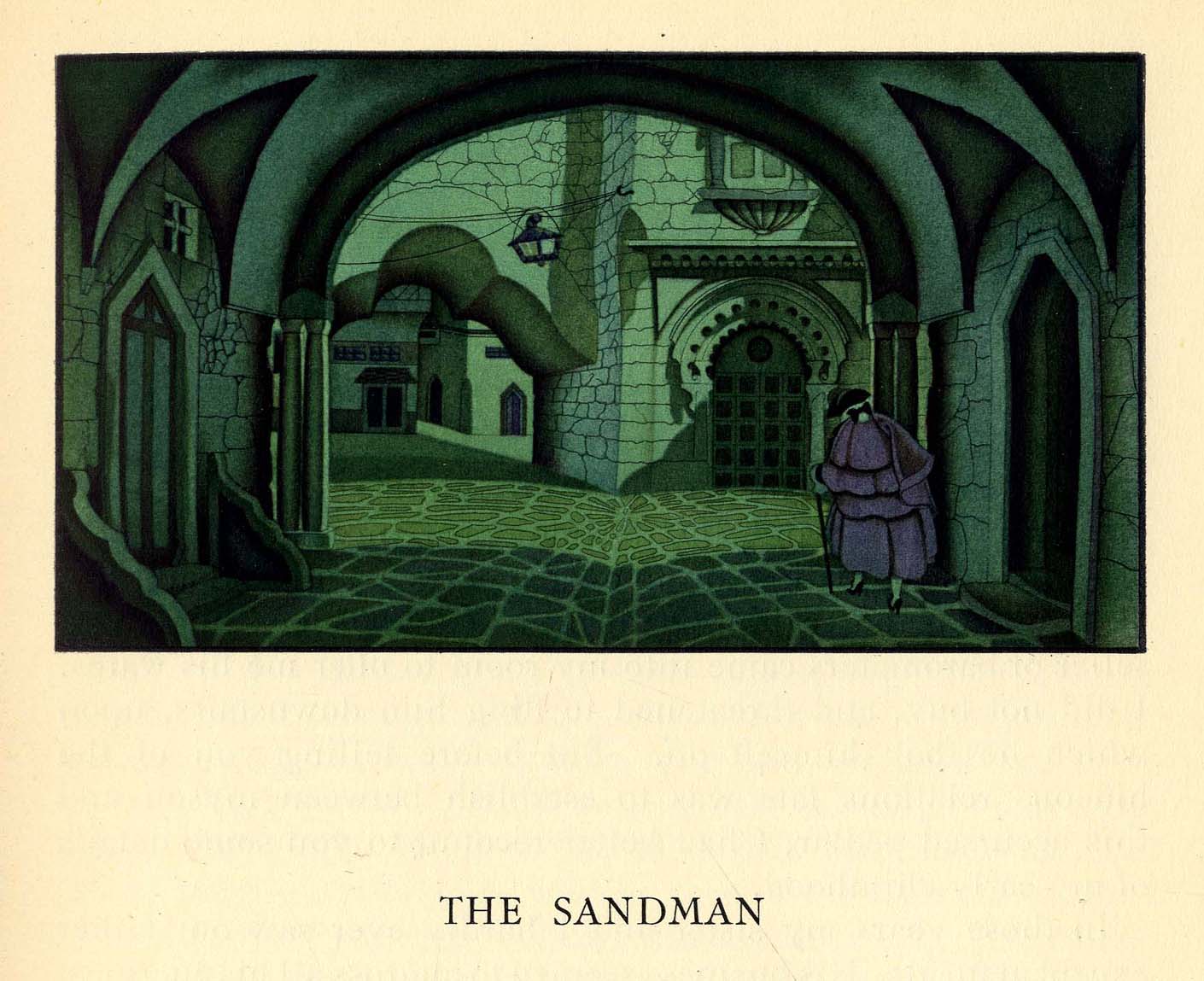
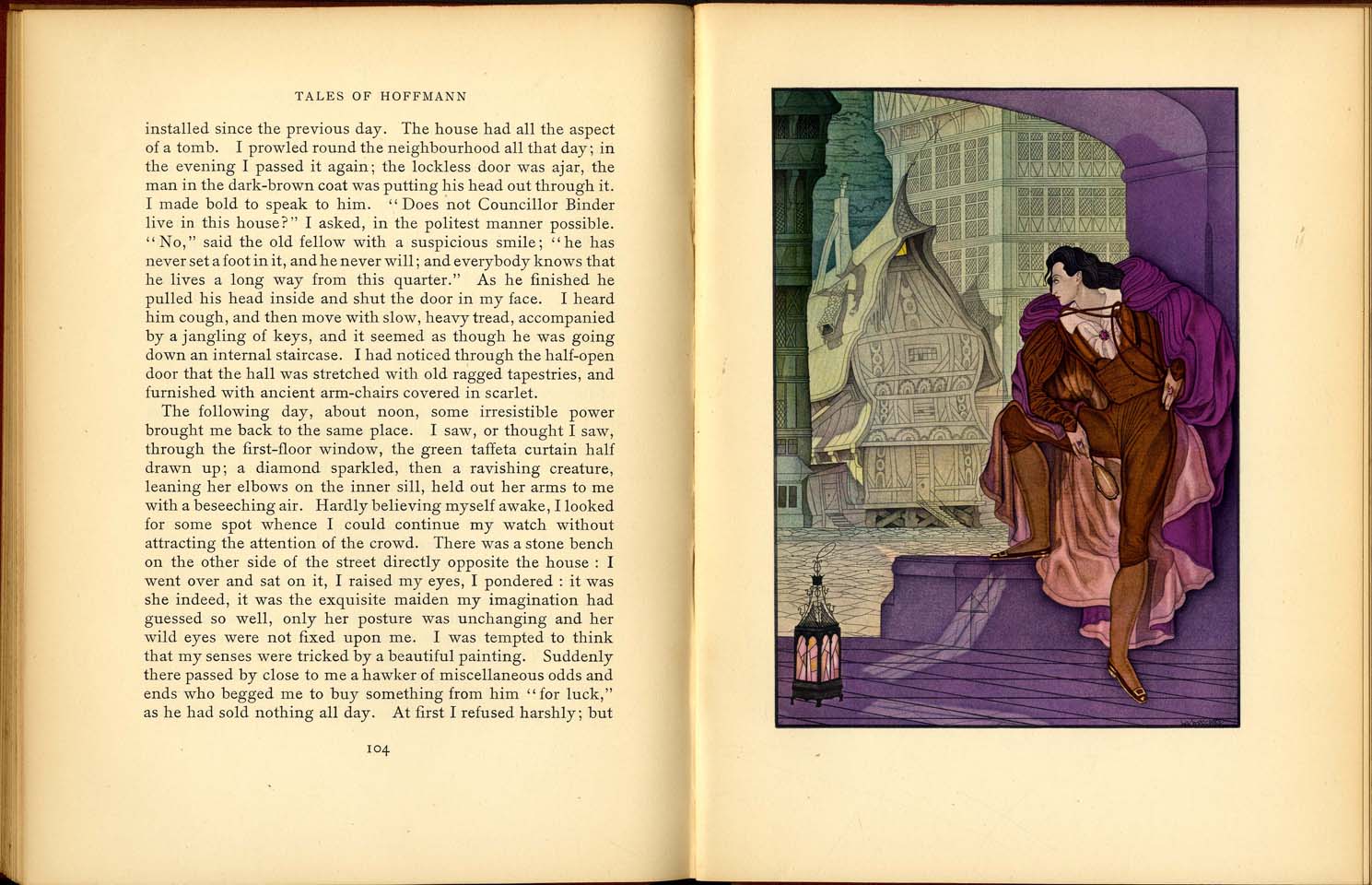
Another great illustrator about whom information is scant; I need better reference books, the web is often no use at all. Monsieur Thombeau posted the cover to Laboccetta’s edition of Les Fleurs du Mal (below) which had me looking around for other work by the artist. VTS has pages from a 1932 edition of Tales of Hoffmann while more of the Baudelaire pictures can be found on various bookdealers’ sites. As to the artist, we’re told he was an Italian living in Paris, and this French site has a small list of his illustrated editions. It’s frustrating to see that Les Paradis Artificiels is among these; what did he make of Baudelaire’s opium visions?

laboccetta02.jpg

Tales of Hoffmann (1932).

laboccetta03.jpg

Tales of Hoffmann (1932).

Continue reading “The art of Mario Laboccetta”

Weekend links 49

ceranic1.jpg

Star City by Tomislav Ceranic.

• Noted in the blogosphere this week: A Journey Round My Skull underwent a transmutation into 50 Watts; a blog devoted to artist, designer & illustrator Jessie M King; “The arts and musicks of the supranatural” at Secret Lexicon; From the Farm, Railroads, Sewing Machines & Beyond, lengthy reminiscences from a long life in America.

Barney Bubbles in Wonderland, in which the designer and his chums indulge in some Carrollian shenanigans somewhere in the 1960s. The resulting footage is now a promo video for Balloon Race by Bear Driver.

HP Lovecraft’s favourite words, the desert island books of Jorge Luis Borges, a profile of Christopher Isherwood, and Edward Gorey again.

[Arthur] Machen explicitly talks about the strength of London, as opposed to Paris, in that London is more chaotic. Although he doesn’t put it in these words, I think what partly draws him to London is this notion that, in the absence of a kind of unifying vision, like Haussmann’s Boulevards, and in a city that’s become much more syncretic and messy over time, you have more room to insert your own aestheticizing vision.

China Miéville in a great interview at BLDGBLOG.

Matryomin is “the unique, original erectronic [sic] musical instrument invented by Masami Takeuchi in 2000”. Yes, a theremin inside a Russian doll. The Mable ensemble playing Duke Ellington’s Caravan is, well…I’m still speechless. And there’s also this.

Conductor turns the New York subway system into an interactive string instrument.

ceranic2.jpg

Discordia by Tomislav Ceranic.

Amazingly enough, prostitution was legal during the Victorian period. There were tons of brothels all over the major cities of England, and of all different kinds. There were lots of flagellation brothels; these were places where primarily men would go to be whipped by women or by men. There were also gay male brothels. You could go to a park in London at night, pick up what were called the “park whores” and give them a very small amount of money to have sex openly in the park. I also write about gay “cruising,” which was quite common. If you knew the right place to go and knew the right signals, you could pick up a man on the street and have sex in an alley.

Deborah Lutz is interviewed about her book Pleasure Bound: Victorian Sex Rebels and the New Eroticism.

Cult-ure: Ideas can be dangerous, a book by Rian Hughes.

Chernobyl: Europe’s strangest wildlife refuge.

The Eadweard Muybridge Online Archive.

Aubrey Beardsley at Tumblr.

Caravan (1959) by Martin Denny | Caravan (1961) by 80 Drums Around The World | Caravan (1962) by Sir Julian | Caravan (1965) by The Ventures | Caravan (1973) by Enoch Light & The Light Brigade | Caravan (1997) by Jimi Tenor (I could go on and on, yes I could…)

Deutsche Kunst und Dekoration #10: Heinrich Vogeler

dkd10-01.jpg

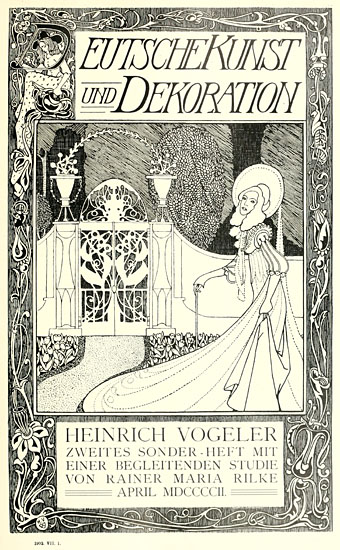
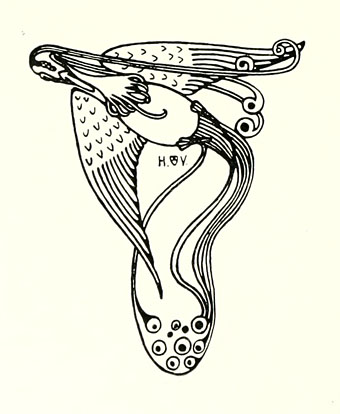
Continuing the delve into back numbers of Deutsche Kunst und Dekoration, the German periodical of art and decoration. Volume 10 covers the period from April to September 1902. There’s so much of interest in this edition I thought it worth making a two-part post. The number opens with a substantial piece devoted to artist and illustrator Heinrich Vogeler (1872–1942) whose edition of Oscar Wilde stories was featured here a while ago. One of the pleasures of this journal is the attention they devote to overlooked artists. Vogeler has an unusual and distinctive style, playful and florid, and with the same enthusiasm for filling the paper with tiny details as later illustrators such as Harry Clarke. Some of these illustrations are for fairy stories, others for more adult fare; peacocks abound. The article also has examples of his painted work although I find his line drawing to be of greater interest. As before, anyone wishing to see these samples in greater detail is advised to download the entire volume at the Internet Archive. Part two follows tomorrow.

dkd10-02.jpg

dkd10-03.jpg

Continue reading “Deutsche Kunst und Dekoration #10: Heinrich Vogeler”