The Happy Hypocrite by Max Beerbohm

beerbohm01.jpg

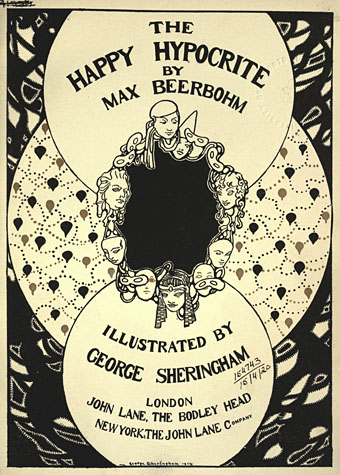
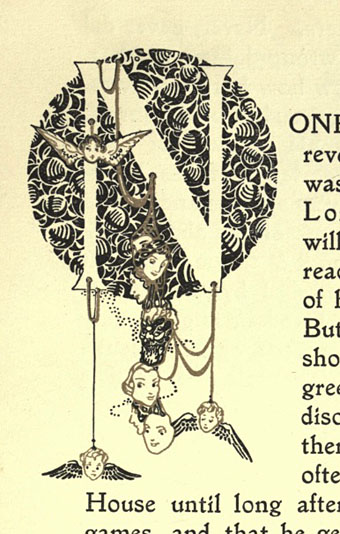
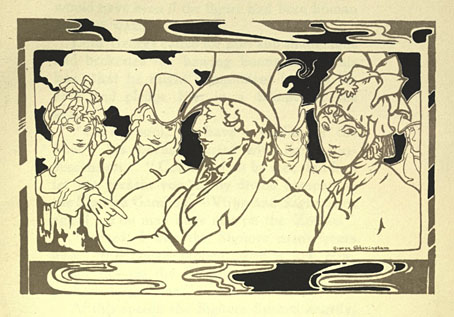
The spirit of the 1890s persists in this 1915 edition of a story the splendid Max wrote originally for The Yellow Book in 1896. Originally subtitled “A Fairy Tale for Tired Men”, The Happy Hypocrite is a typically light-hearted affair concerning the misadventures of one Lord George Hell. The setting is the Regency era so beloved of many of the London Decadents, Aubrey Beardsley included, and the rather fine illustrations are by George Sheringham whose style was distinctive enough to avoid any Beardsley pastiche. The copy preserved at the Internet Archive includes a number of full-colour plates but time and the vicissitudes of reproduction haven’t done them any favours, hence the concentration here on the monochrome drawings.

beerbohm02.jpg

beerbohm03.jpg

Continue reading “The Happy Hypocrite by Max Beerbohm”

Weekend links 62

pavlishin.jpg

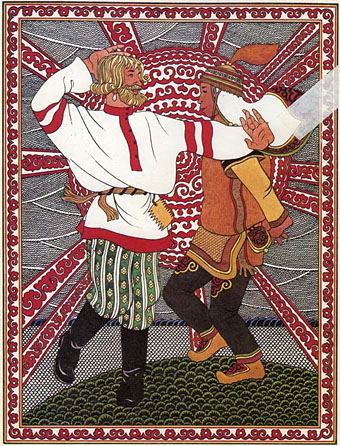
A plate from Tales of the Amur by Dmitry Nagishkin, a 1975 edition illustrated by Gennady Pavlishin.

• The week in Surrealism: Opera of the surreal gives Dalí an encore: Yo, Dalí, a previously unperformed work by Xavier Benguerel, receives its premier in Madrid. Meanwhile Tate Liverpool’s summer exhibition, René Magritte: The Pleasure Principle, is profiled here. “René Magritte has inspired more book covers than any other visual artist,” says James Hall.

If Rimbaud anticipated the Surrealists by decades, Ashbery is said to have gone beyond them and defied even their rules and logic. Yet though nearly 150 years have intervened since Rimbaud’s first declaration of independence, many readers in our own age, too, still prefer a coherence of imagery, a sameness of tone, a readable sequential message, even, ultimately, what amounts to a prose narrative broken into lines.

Lydia Davis on Rimbaud’s Wise Music.

• Umberto Eco’s glimpse into the art of the novel | Return to Wonderland: an essay on Lewis Carroll’s world by Alberto Manguel | Heavy sentences by Joseph Epstein: On How to Write a Sentence and How to Read One, by Stanley Fish.

And then there’s the mystery of what happened to him for those four months in London when we have no trace of him. Rimbaud mentions Scarborough in “Promontory” and talks about “Hotels, the circular façades of the Royal and the Grand in Scarborough or Brooklyn.” Since there’s that missing period in England, people say he must have gone to Scarborough, and have even checked hotel registers for that period, but as far as I know nobody has ever found anything. Someone even checked railway and train schedules in order to pin him to this real place. I seem to remember a French writer admitting that Rimbaud was never in Brooklyn, but kind of wishfully thinking that he might have been. Which is very funny. “Rimbaud in Brooklyn”: there’s a project for someone.

A Refutation of Common Sense, John Ashberry on translating Rimbaud.

• Robert Jeffrey posts a video of his nine-year-old self giving Madge a run for her money in 1991. As Boy Culture puts it: “Anyone who feebly clings to the belief that gay can be prayed away should take a look at this and give up already…” Amen.

• The mathematics of Yog-Sothoth: Richard Elwes on Exotic spheres, or why 4-dimensional space is a crazy place.

• For I Will Consider My Cat Jeoffry by Christopher Smart (1722–1771).

• Lesbian pulp fiction, 1935–1978 and Faber 20th century classics.

• As The Crow Flies, a new album from The Advisory Circle.

• New World Transparent Specimens by Iori Tomita.

• 79 versions of Gershon Kingley’s Popcorn.

• Minor Man (1981) by The League of Gentlemen.

Carl Corley

corley.jpg

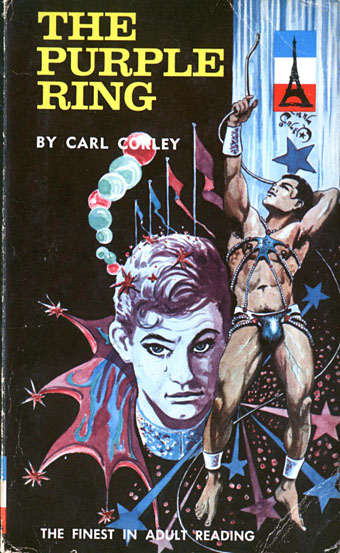
The Purple Ring (1968).

I’ve not read any of Carl Corley’s novels but their covers become familiar once you start searching through archives or articles devoted to the gay pulps of the 1960s. Corley was unusual in this field in authoring his books under his own name (most gay and lesbian pulps are credited to unlikely pseudonyms) as well as providing the cover art for each title. His paintings try for more of a distinctive look than the usual standard of the time— generally two half-dressed guys pouting at each other—but then he was illustrating his own work so could tailor the art for the story. This kind of fiction is a lot more visible now than it used to be, attracting the attention of queer historians and academics, but there’s still no dedicated site for many of these artists and writers beyond Gay on the Range. There’s a couple more Corley covers on Flickr (here and here) but for now The Haunted Lamp seems to have the best collection.

Elsewhere on { feuilleton }
• The gay artists archive
• The book covers archive

Previously on { feuilleton }
• Sherbet and Sodomy
• Bugger Boy
• Gay book covers

Franz Stassen’s illustrated Hoffmann

stassen01.jpg

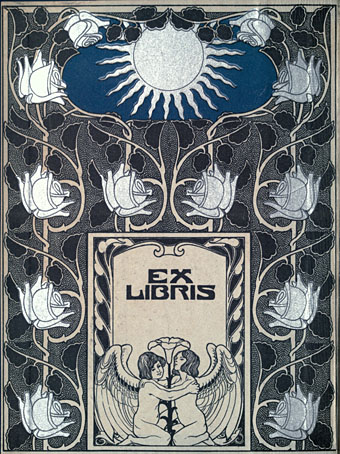
Endpaper design with an ex libris plate by the artist.

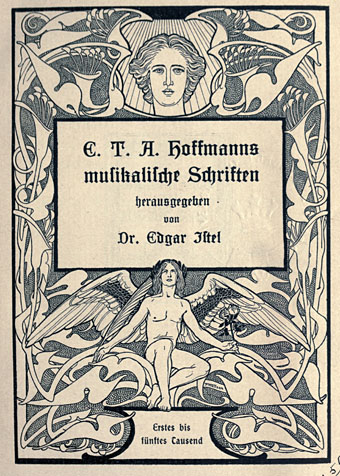
Another prolific illustrator with a clear-line style, Franz Stassen (1869–1949) here decorates the pages of Musikalische Schriften, a book devoted to the musical works of writer ETA Hoffmann. I haven’t checked but I’m fairly sure that Stassen was featured in Jugend magazine a few times, his florid style in this undated volume would certainly complement the work of the other artists there. Like some of those artists, Stassen was enthused by Teutonic nationalism during the First World War, a path that led eventually to work for, and plaudits, from the Nazis. We’re also told (via an unsourced Wikipedia detail) that he ended his days in a gay relationship, something the Third Reich would have either overlooked or conveniently ignored.

stassen02.jpg

stassen03.jpg

Continue reading “Franz Stassen’s illustrated Hoffmann”

Valenti Angelo’s Salomé

angelo.jpg

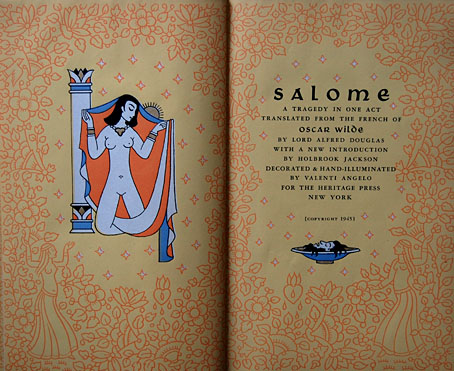
And still they come… Valenti Angelo (1897–1982) was an American printmaker, author of several books for children and the illustrator of an estimated 250 classic works of fiction including this 1945 edition of Wilde’s Salomé for Heritage Press. Angelo has an engagingly simple style in this and other works, reminding me of David Sheridan’s Tarot designs. The Internet Archive has a copy of his illustrated The Imitation of Christ with drawings reminscent of Eric Gill’s woodcuts.

Elsewhere on { feuilleton }
• The illustrators archive
• The Oscar Wilde archive
• The Salomé archive