Weekend links 779

finlay.jpg

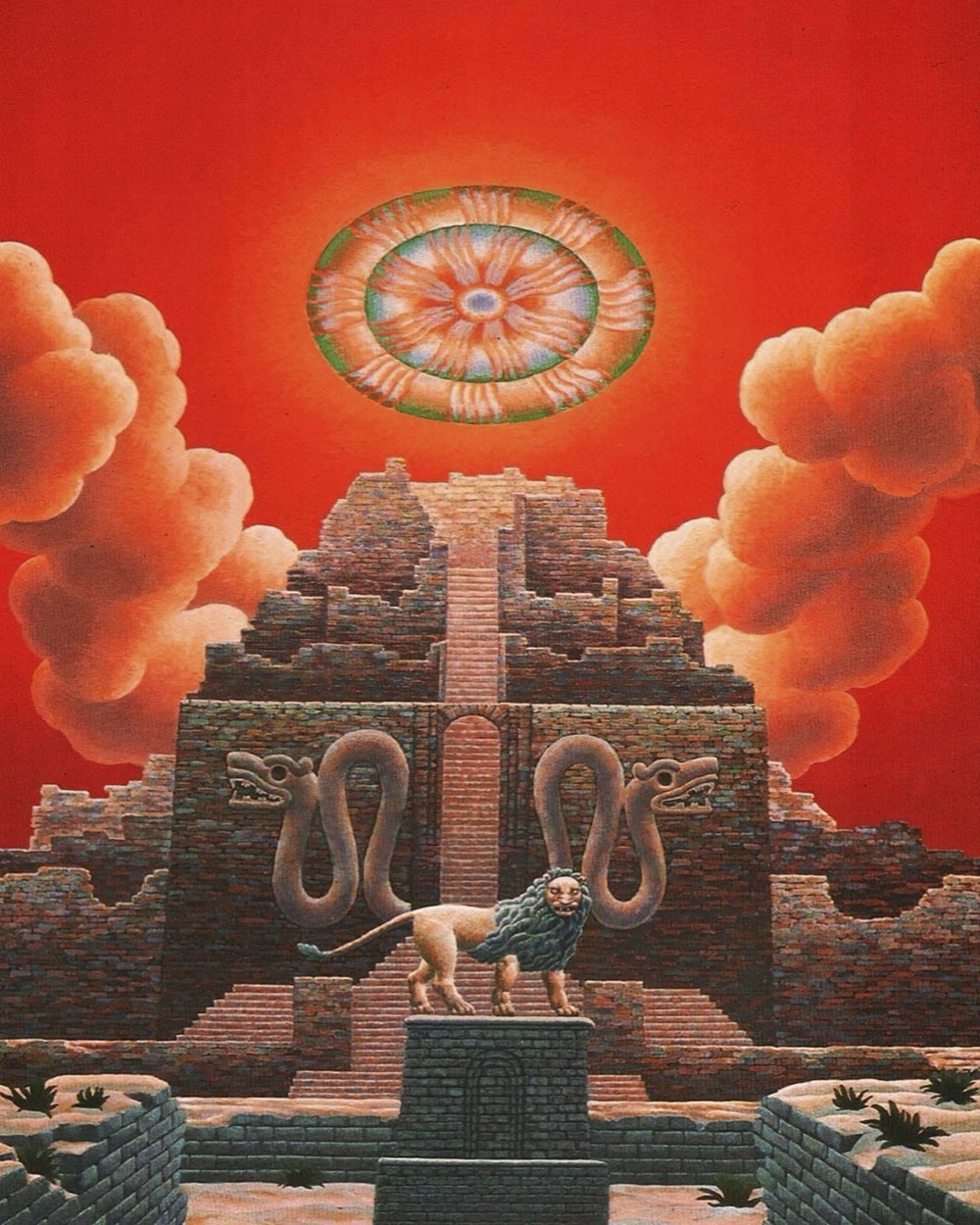
The Crystal World by JG Ballard. An illustration by Virgil Finlay for the Summer–August 1966 issue of Things To Come, the Science Fiction Book Club mailer.

• At Blissblog, Simon Reynolds looks back on 20 years of limited-edition electronic music reissues by the Creel Pone label. (Previously.) A bootleg enterprise but a very worthwhile one since most of the reissues would otherwise remain deleted and largely forgotten. I thought the releases had finished years ago but it seems not, Discogs now lists over 300 of them.

• “Everyone recognized the brilliance of Robinson’s eventual script: they just didn’t want to make it.” David Cairns on the miserable magnificence of Bruce Robinson’s Withnail and I.

• Coming soon from Top Shelf: More Weight: A Salem Story, Ben Wickey’s illustrated account of the Salem Witch Trials.

• The tenth installment of Smoky Man’s exploration of The Bumper Book of Magic has been posted (in Italian) at (quasi).

• At Colossal: “A unique portfolio of Hilma af Klint’s botanical drawings communes with nature’s spiritual side”.

• At Nautilus: The Visual Language of Crystals—Chemistry becomes art in Thomas Blanchard’s timelapse video.

• At Unquiet Things: Supernatural field notes and incomprehensible eldritch frequencies: The art of Ed Binkley.

• See some of the entries from the 2025 Milky Way Photographer of the Year.

• New music: Instruments by Water Damage, and Reverie by Deaf Center.

• The Strange World of…Editions Mego.

Strobe Crystal Green (1971) by Gil Mellé | Crystal Leaves (1983) by Ippu-Do | Crystalline Green (2002) by Goldfrapp

Ulrich Eichberger album covers

eichberger01.jpg

El Condor Pasa (Paul Nero In South-America) (1970) by Paul Nero Sounds.

It’s the groovy look again. Since compiling a list of artists and designers working in this post-psychedelic style I keep finding practictioners I hadn’t noticed before. German designer and art director Ulrich Eichberger is someone I might have spotted earlier if I’d examined his discography, especially when several of the albums he worked on are ones I’ve owned for many years. The covers of those albums aren’t very psychedelic, however, and don’t even look like the work of the same designer until you scrutinise the credits. The examples here are those where he was working as a cover artist as well as designer, favouring the ones where the pop-psych hallmarks are in evidence: vivid colours, bold outlines, and faces or figures treated to various degrees of stylisation. Elsewhere, the influence of Heinz “Yellow Submarine” Edelmann may be seen in the watercolour blooms that fill the backgrounds. Most of these designs are for the German wing of United Artists Records (or its Liberty affiliate) which means that Eichberger got to work for two of the major German groups of the early 70s, Can and Amon Düül II.

eichberger02.jpg

Partyrausch – Das Ideale Tanzalbum 70/71 (1970) by Various Artists.

eichberger03.jpg

Tago-Mago (1971) by Can.

I’ve never thought this was a very good cover but it’s the most popular album of those listed here.

eichberger04.jpg

Partyrausch 71/72 (Das Ideale Tanzalbum) (1971) by Various Artists.

eichberger05.jpg

In The Groove (1972) by Charly Antolini.

Included mainly because of the title.

Continue reading “Ulrich Eichberger album covers”

Harry Clarke’s illustrated Swinburne

clarke30.jpg

Aholibah (1928).

You won’t find Harry Clarke’s illustration for Swinburne’s Aholibah in Selected Poems of Algernon Charles Swinburne even though it was intended for the book, and was the illustration that Clarke deemed his favourite of the series. The erotic nature of the drawing was too much for the publisher so Clarke had to content himself by pasting a reproduction in his own copy. The copy above has been scanned from Nicola Gordon Bowe’s Harry Clarke: His Graphic Art; everything below is from the published Swinburne collection which turned up recently at the Internet Archive.

clarke01.jpg

Selected Poems of Algernon Charles Swinburne was Clarke’s last illustrated book, published in 1928, three years before his untimely death. Of all the major Clarke books that appeared during the artist’s lifetime it’s always been the most difficult to find. Some of the drawings have been reprinted in recent collections but never the book itself. As with Clarke’s Faust, the erotic and morbid qualities of the illustrations generated disquiet outside the publisher’s office, with Humbert Wolfe in the book’s introduction stating that Clarke’s interpretations were completely opposed to his own. Given the erotic and morbid preoccupations of the poet and his work this surprises me; Swinburne’s poetry was admired by Aleister Crowley and HP Lovecraft, among others. They weren’t reading him because he was writing paeans to daffodills.

clarke02.jpg

My earlier mention of this volume included a link to a defunct blog with a collection of the illustrations separated from the text. This was unavoidable at the time, there wasn’t anywhere else that you could see all of them in one place. But seeing the illustrations with the poems benefits the drawings as well as the verse, especially when the poems themselves aren’t so familiar. For my part it’s also good to see all of the illustrations, being the owner of a first edition which I bought many years ago only to discover that a couple of the best pictures had been carefully removed with a razor. This is a common problem with old illustrated books. Caveat emptor as always.

clarke29.jpg

Clarke didn’t do many double-page illustrations. This is one of his best.

clarke05.jpg

Continue reading “Harry Clarke’s illustrated Swinburne”

The art of Dick Ellescas

ellescas01.jpg

The Boy Friend (1971).

I chanced upon the album cover art of Dick Ellescas a few weeks ago when I was searching for something on Discogs. Classical music labels are extraordinarily lazy when it comes to packaging their recordings, as a result of which the commissioning of original art always stands out. Dick Ellescas turned up again more recently when I was working my way through the Ken Russell filmography. Russell’s Sandy Wilson adaptation, The Boy Friend, was released in the US with an Ellescas poster that combines an Art Deco style with the modishness of early 70s graphics. This also stood out from the crowd and sent me in search of more of the same. The examples here are only a small selection from the Ellescas oeuvre; Discogs credits him with over 30 album covers. The Strauss cover below is uncredited so there may be more out there. Some of Ellescas’s illustrations for Cosmopolitan magazine may be seen here.

ellescas02.jpg

The Magic Christian (1969).

ellescas03.jpg

Borodin/Liadov: Symphony No.1/From The Book Of Revelation From Days Of Old/A Musical Snuff-box (1971); Moscow Radio Symphony Orchestra, USSR Symphony Orchestra.

ellescas04.jpg

Strauss: Die Frau Ohne Schatten (1971); Kurt Eichhorn, Orchestra of Bavarian Radio, James King.

ellescas05.jpg

Continue reading “The art of Dick Ellescas”

Weekend links 772

barbarella.jpg

Barbarella (1968) by Robert McGinnis. Not one of his best (see below) but the film is a cult item round here.

• At the Bureau of Lost Culture: Alan Moore on Magic, a recording of the three-way talk between Alan Moore, Gary Lachman and myself for last year’s launch of the Moon and Serpent Bumper Book of Magic.

• At Colossal: “Daniel Martin Diaz encodes cosmic questions into geometric paintings and prints.” And is heavily influenced by Paul Laffoley by the looks of things.

• RIP Robert McGinnis, illustrator and poster artist. Related: The Artwork Of Robert McGinnis, Part 1 | The Artwork Of Robert McGinnis, Part 2.

• At Public Domain Review: “The Form of a Demon and the Heart of a Person”: Kitagawa Utamaro’s Prints of Yamauba and Kintaro (ca. 1800).

• Coming soon from Ten Acre Films: The Quatermass Experiment: The Making of TV’s First Sci-Fi Classic by Toby Hadoke.

• New music: Lost Communications by An-Ting; UPIC Diffusion Session #23 by Haswell & Hecker.

Anti-Gravity Holiday Every Month by Robert Beatty.

Barbarella (Extended Main Title) (1968) by Bob Crewe And The Glitterhouse | Barbarella (1991) by The 69 Eyes | My Name Is Barbarella (1992) by Barbarella