Weekend links 812

satantango.jpg

• RIP Béla Tarr. I came late to Tarr’s films, he’d retired from directing by the time I worked my way through most of his oeuvre in 2019. As I’m always saying: better late than never. What I never expected from reading reviews was the irreducible strangeness at the heart of the later films, as well as their meticulous construction. With regard to the latter, mention should be made of the director’s regular collaborators: Ágnes Hranitzky (wife, editor and co-director), László Krasznahorkai (writer), and Mihály Víg (composer).

More Tarr: “The whole fucking storytelling thing is everywhere the same. That’s why I decided I have to do my movies.” Tarr talking to R. Emmet Sweeney in 2012; and at Criterion, Béla Tarr: Lamentation and Laughter by David Hudson.

• “When [Fela Kuti] first saw Lemi Ghariokwu’s work, he said, ‘Wow!’ Then he plied him with marijuana and asked him to design his album sleeves. The artist recalls their extraordinary partnership – and the day Kuti’s Lagos HQ burned.”

• At Smithsonan Mag: “Hundreds of mysterious Victorian-era shoes are washing up on a beach in Wales. Nobody knows where they came from.”

• At Ultrawolvesunderthefullmoon: The collage art of Wilfried Sätty.

• At the BFI: Leigh Singer selects 10 great Lynchian films.

• At Unquiet Things: The vast luminous art of Andy Kehoe.

• At Dennis Cooper’s it’s another Jan Švankmajer Day.

• New music: Light Self All Others by Tarotplane.

• At I Love Typography: Heart-shaped books.

• At Colossal: Luftwerk.

• Sailin’ Shoes (1972) by Van Dyke Parks | Dead Man’s Shoes (1985) by Cabaret Voltaire | New Shoes (2007) by Angelo Badalamenti.

H.P.L.

hpl.jpg

It’s that man again. Presenting the latest reworked page from the ongoing reconstruction/improvement of my Haunter of the Dark book. The picture will illustrate “Abdul Alhazred”, the final section of Alan Moore’s text for The Great Old Ones in which HP Lovecraft is positioned at Malkuth, the “Kingdom” in Alan’s eldritch Kabbalah. This makes Lovecraft himself the receptive vessel of the energies descending from the spheres above, while paradoxically being the source of those energies. Or some of them at least… The Great Old Ones is a Mythos Kabbalah which features Dagon, Hastur, Tsathoggua and Yig as well as Cthulhu and the rest. Alan doesn’t subscribe to Kenneth Grant’s baseless theory that Lovecraft really was a receptacle for transmissions from interdimensional entities, but the incorporation of the writer into his own pantheon isn’t unprecedented. Abdul Alhazred was a childhood persona of Lovecraft’s before he assigned the name to the author of Al Azif, or the Necronomicon; further personas may be found in Through the Gates of the Silver Key (“Ward Phillips”), Robert Bloch’s The Suicide in the Study (“Luveh-Keraph, priest of Bast”), and other fictions.

hpl.jpg

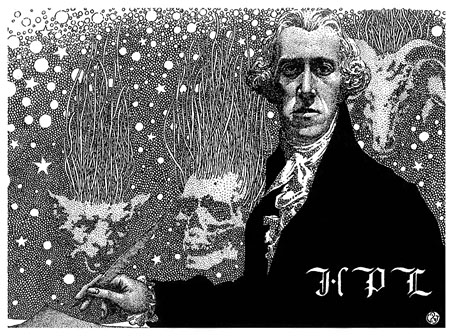
HPL (1937) by Virgil Finlay.

Whether this literary sport warrants the apparently limitless production of Lovecraftian art featuring the man himself, usually sprouting or festooned with tentacles, is a debatable matter. Virgil Finlay began the fantastic portrait trend in 1937 with his memorial depiction of the author writing with a quill pen while dressed in 18th-century garb. The earliest example that I can think of showing Lovecraft paired with the ubiquitous tentacles was the Moebius cover for Lettres d’Arkham in 1975, although there may well be other drawings prior to this. I’ve often wondered what Lovecraft would have made of the deluge of publications and images derived from his work, especially those that place him inside the products of his imagination.

moebius.jpg

Cover art by Moebius, 1975.

And speaking of which… I was at a loss at first with how to approach a new Lovecraft portrait, all I knew was that one was necessary. The original Malkuth picture from 1999 is another poor Photoshop job which has nevertheless been reused elsewhere on a few occasions, even appearing in 2007 on the cover of an issue of FATE magazine. For the new version I started with the portrait itself, using white lines on black to copy the same portrait photograph that formed the centre of the older picture. This was then duplicated and flipped horizontally to create a kind of Janus head which gives the portrait a suitably weird quality without wreathing it in tentacles. The mirrored head harks back to a sequence of treated photos by JK Potter which I first saw in the Heavy Metal Lovecraft special in 1979. Potter had used the same portrait photo to create effects that were somewhat compromised by poor reproduction, leading me to be believe that I’d created something slightly different to the first panel in his sequence. While researching this post I turned up an earlier version of the artwork which appeared on the back of the first issue of a US fanzine, Fantasy Mongers, also in 1979. The clearer reproduction revealed that the first head in Potter’s sequence is almost identical to my own. Ah well…

jkpotter.jpg

Photo art by JK Potter from the back cover of Fantasy Mongers #1, 1979.

The rest of the picture was improvised around this central image. Having drawn the portrait in white-on-black I decided to use a similar technique for the other elements. The Cthulhoid pillars are based on those in my Red-Night Rites painting from 1997, one of which appeared in the 1999 picture. The smaller figure on the right is from one of the photos that Wilfred Talman took while wandering the streets of New York with Lovecraft and Frank Belknap Long. This also appeared in the 1999 picture but for the new version I’ve emphasised what appears to be a book that Lovecraft is carrying in his right hand. Searching around for a complementary figure that might represent Abdul Alhazred turned up a 19th-century photo of a character who not only looked the part but is also standing in a manner similar to the Talman Lovecraft. If you look closely he’s also carrying a book, an addition of my own which turns him into the author of Al Azif. The polyhedra supporting the pair aren’t as arbitrary as they may seem. The spheres serve a dual purpose, preventing the figures from floating in space (or standing in water) while also relating to the Sephiroth of Malkuth which is identified with the Earth in the Kabbalistic scheme of planetary associations.

The next reworked picture will be Tsathoggua which is being polished rather than completely overhauled. I’m hoping I might have this done by the end of the month but I’m still chipping away at The Dunwich Horror while doing all this, as well as working on things which pay the bills. (I’ve just finished designing and illustrating another book.) Further progress will be announced in due course.

Elsewhere on { feuilleton }
The Lovecraft archive

Previously on { feuilleton }
The Return of the Crawling Chaos
Lettering Lovecraft
Weird ekphrasis and the Dunwich Horrors
Kadath and Yog-Sothoth
Another view over Yuggoth

Two new covers

rockhill.jpg

My latest cover designs have arrived in time for Spook Month, although the first of these suits the season more by association than its appearance. Jim Rockhill’s A Mind Turned in Upon Itself is a study of the work of J. Sheridan Le Fanu, Ireland’s leading writer of ghost stories and Gothic fiction. This is another design for Swan River Press which adheres to the publisher’s preferred format of a dustjacket that wraps a small hardback with textured and illustrated boards. The brief was fairly straightforward, to present a rare photograph of Le Fanu in a suitably attractive manner. My initial idea was to create a frame that would reflect to some degree various aspects of Le Fanu’s fiction, but it quickly became apparent that the portrait photo was too tall and narrow to sit easily inside a frame that matched the ratio of the book. A better option was to look for a frame which could fit the shape of the book while also filling in the space around the photo.

dore.jpg

A page from The Workshop: a Monthly Journal Devoted to Progress of the Useful Arts.

When Le Fanu was writing in the mid-19th century book design had become very lavish, with a proliferation of presentation volumes gold-blocked and embossed on their covers and spines. The Heztel editions of Jules Verne are prime examples, as are the many editions of Gustave Doré’s books. My cover is an adaptation of a German edition of Doré’s Bible which had an unusual panel in the centre that happened to be a good size and shape to accommodate the Le Fanu photo, although I still had to extend the design a little. My version also includes a pair of small Le Fanu monograms embedded in the frame.

outline.jpg

For the board illustration I followed the form of an earlier Swan River book with an Irish theme, The Far Tower, whose boards I covered with an engraving collage. The end result, which looks like a single illustration, is a composite of two smaller illustrations from a book of views of Ireland, together with a quantity of foliage which frames the design and joins the pictures together.

ppc.jpg

The second cover is for a book I’m working on at the moment, Lovecraft’s Brood, a sequel to Tachyon’s well-received Lovecraft’s Monsters. I was very pleased to be asked to work on this one, the earlier book is a favourite of mine from among the books I’ve done for Tachyon, and Ellen Datlow is an expert at compiling well-chosen story collections. There’s not much I can say about the cover which follows the form of the previous book. As with Lovecraft’s Monsters, the framed face will also appear as one of the interior illustrations. You’ll have to wait a while to see the results of this, however. Watch this space.

brood-cover.jpg

Meanwhile, I’ve neglected to mention another Tachyon book whose interiors I’ve designed which is available now. The Essential Horror of Joe R. Lansdale is a great introduction to the work of a master of horror fiction whose stories manage to be grim and witty in equal measure. Very grim at times; visceral horror is Lansdale’s forte. The collection includes his best-known story, Bubba Ho-Tep, and features cover art by another Swan River Press cover artist, Dave McKean.

Previously on { feuilleton }
Lovecraft’s Monsters

Wilfried Sätty and the Cosmic Bicycle

satty1.jpg

Listen, Sleep, Dream (1967), a poster by Wilfried Sätty.

Continuing the San Francisco theme, twenty years ago today I was visiting the city myself. Jay Babcock, Richard Pleuger and I had driven up there from Los Angeles to research some of the history of Wilfried Sätty (1939–1982), master collagist, psychedelic poster artist, record cover designer and book illustrator. We spent 24 hours driving around the Bay area: up to Petaluma, where we met Sätty’s friend and artistic collaborator, David Singer, a fine collage artist in his own right; then to Berkeley to talk to Walter Medeiros, custodian of the Sätty estate and one of the leading scholars of the psychedelic poster scene; finally to North Beach, where we found the house in Powell Street where Sätty was living and working in the 1960s and 70s.

satty2.jpg

Sätty and an unknown woman in the artist’s basement pad/studio at Powell Street, a place he referred to as “the North Beach U-boat”. This was from a magazine feature that I photographed at David Singer’s house. I forget the source, it may have been from a 1972 TIME article about San Francisco artists.

The trip was a dizzying experience, but fascinating for what it revealed about Sätty and his work. From David Singer we learned, among other things, that the name “Sätty” had been chosen as a pseudonym by the former Wilfried Podriech for its echo of Ancient Egypt; the pronunciation, when you pay attention to the umlaut, conjures the word “Seti”. Walter Medeiros showed us stacks of original Sätty artwork, including all the collages intended for the artist’s final book, Visions of Frisco, a visionary history of the city which was published in 2007. Medeiros later emailed me a few additional notes which I have filed somewhere, correcting my guesswork in the piece I’d written about Sätty for Strange Attractor Journal earlier in 2005. At the time the only information I had to hand was the scant biographical information in Sätty’s books, the interview that he gave to Man, Myth and Magic in 1970, and a few web pages devoted to the artist which someone had put together in the late 1990s then never updated.

satty3.jpg

The house at 2143 Powell Street as it was in 2005. Those trees have grown considerably in the past 20 years.

All of which had me looking last week to see whether Sätty had a more substantial web presence today. Happily, he does, with this dedicated site maintained by Ryan Medeiros, Walter’s son. I’m saddened to read that Walter Medeiros is no longer with us but it’s gratifying to discover his family continuing his efforts to preserve Sätty’s legacy. Sätty is often reduced to a minor figure in the history of San Francisco poster art but he was more than this: a book creator as well as an illustrator, and a collage artist who extended Max Ernst’s engraving collage into new dimensions, using printing presses to multiply and overprint his assemblages.

satty4.jpg

Sätty’s first book, The Cosmic Bicycle, was published in 1971 by Straight Arrow Books, the publishing imprint of Rolling Stone magazine. This is a collection of collages, a few of them in colour, in which the compositions have a distinctly Surrealist quality. Sätty’s subsequent work downplayed the wild juxtapositions in favour of greater compositional control. His subsequent collection, Time Zone (1973), is a wordless “novel” in the manner of Max Ernst’s collage books.

satty5.jpg

The Cosmic Bicycle is also the title of a 4-minute animated film which brings to life some of Sätty’s pictures from the book. I linked to a copy of this years ago but that link is now defunct so here it is again, an odd little film which runs the artwork through a solarisation process then moves pieces of them around to the accompaniment of an electronic score. (As usual with Vimeo today, you have to log in to see it.) The film was directed by Les Goldman, an animation producer who was mentioned here recently in relation to The Hangman (1964), a short film he made with Paul Julian. Goldman’s own film seems almost amateurish in comparison but the music is by Moog pioneers Paul Beaver and Bernie Krause, credited here as Parasound Inc. Beaver and Krause’s Gandharva album features one of Sätty’s finest cover designs, with title lettering by David Singer. The film score isn’t the duo’s finest by any means—I’d even describe it as rather annoying—but it’s good to see their Sätty connection reinforced.

Previously on { feuilleton }
The original Gandharva
The Occult Explosion
Wilfried Sätty album covers
Nature Boy: Jesper Ryom and Wilfried Sätty
Wilfried Sätty: Artist of the occult
Illustrating Poe #4: Wilfried Sätty
Weekend links 776

hoffmeister.jpg

Illustration by Adolf Hoffmeister for a Czech edition of The First Men in the Moon by HG Wells.

• It’s good to hear that Czech animator Jiří Barta is back at work on his long-gestating feature film based on the Golem legend. The new iteration looks like a reimagining of the entire project.

• Among the new titles at Standard Ebooks, the home of free, high-quality, public-domain texts: The First Men in the Moon by HG Wells.

• This week in the Bumper Book of Magic: Ben Wickey breaks down more of his Great Enchanters pages.

• At Colossal: Charles Brooks photographs the interiors of musical and scientific instruments.

• At Igloomag: Philippe Blache on neo-noir, doom jazz and related atmospheric music.

• At The Daily Heller: The book-brick that is the 1,264-page Emigre Specimen Encyclopedia.

• New music: Changing States by Matmos, and Of Shadow Landscapes by Skotógen.

• At the BFI: Josh Slater-Williams selects 10 great Japanese time-travel films.

• Lawrence English remembers the sound-art pioneer Alan Lamb.

Tunde Adebimpe’s favourite albums.

Time Machine (1967) by Satori | Time Machine (1968) by Lemon Tree | Turn Back Time (1971) by Time Machine