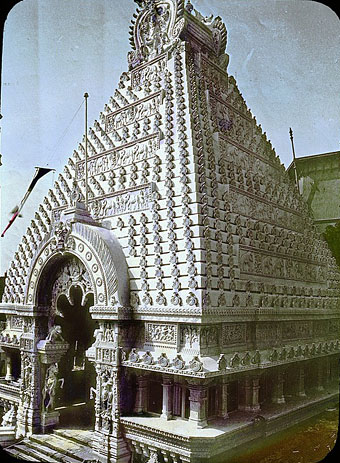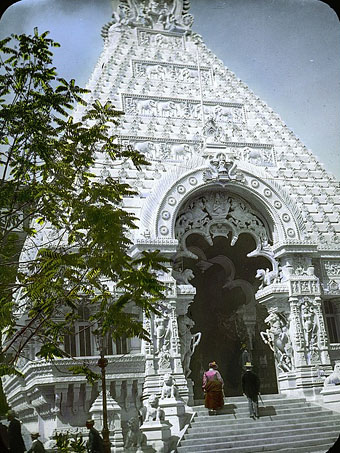
The Cambodian Pavilion, Paris, 1900

exposition1.jpg

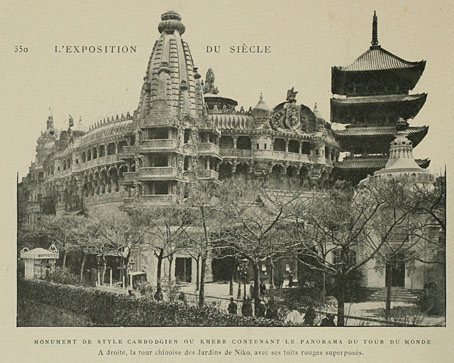
Despite being one of the most striking and beautiful national pavilions in the Exposition Universelle of 1900, the Cambodian building seldom features isn’t featured in any of the exposition guides I’ve seen. These photos are from the excellent set of William Henry Goodyear views presented by the Brooklyn Museum at Flickr. If it wasn’t for the people visible in the picture below (and the Parisian lamp-post) you wouldn’t know these were from the exposition at all.

exposition2.jpg

exposition3.jpg

Another trace of Cambodia appeared via the Tour of the World exhibition where a variety of “exotic” buildings were forced to occupy the same plot of ground. This group does appear in the guides, the view here being from L’Exposition du Siècle by Albert Quantin. The multi-story confection dominating this scene may superficially resemble some of the Angkor temples, but for me it’s more reminiscent of buildings like the Casa Milà which Antoni Gaudí was constructing in Barcelona a few years later.

Previously on { feuilleton }
Le Manoir a l’Envers
Suchard at the Exposition Universelle
Esquisses Décoratives by René Binet
Le Palais de l’Optique, 1900
Exposition Universelle films
Exposition jewellery
Exposition Universelle catalogue
Exposition Universelle publications
Exposition cornucopia
Return to the Exposition Universelle
The Palais Lumineux
Louis Bonnier’s exposition dreams
Exposition Universelle, 1900

Angkor panoramas

angkor3.jpg

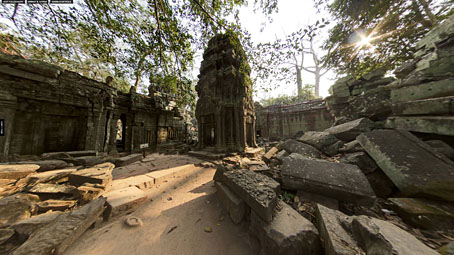
Ta Phrom by Rob van Gils.

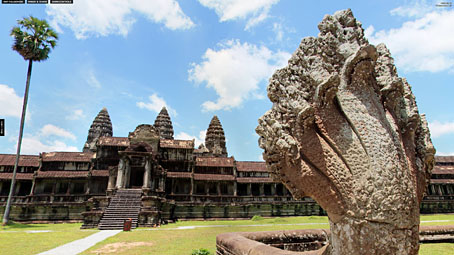
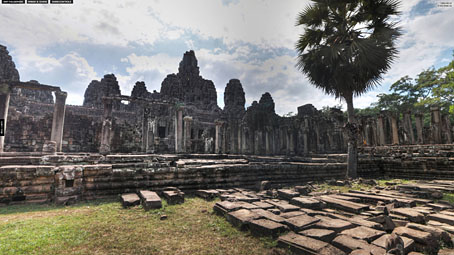
A Cambodian architecture post by Will from 50 Watts sent me to 360 Cities for some panoramic views of the temples of Angkor and environs. I always prefer the sight of these places in their weed-infested state even though all those weeds and tree roots were slowly destroying the stonework. For more recent photos, John McDermott’s site has many beautiful infra-red views of the temples and their statuary. (Click on the Fine Art section.)

angkor1.jpg

Naga at Angkor Wat – Siem Riap, Cambodia by Tetsuyayoshi.jp.

angkor2.jpg

Angkor by Vasiliy Nikitenko.

Elsewhere on { feuilleton }
The panoramas archive

Previously on { feuilleton }
The Temples of Bagan
The temples of Angkor

Weekend links 65

plakhova.jpg

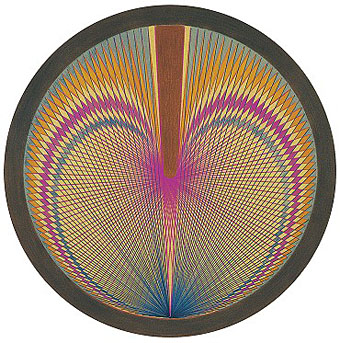
From Light Beyond Sound, a new series of works by Tatiana Plakhova.

“The invasion philosophy of the Olympic Park strikes me as just like the invasion philosophy behind going into Iraq,” he says, “or anywhere else that you blast into, put up the fence, establish the Green Zone, explain everything, put it all into this lovely eco-terminology…” Iain Sinclair

• Iain Sinclair has a new book out, Ghost Milk: Calling Time on the Grand Project, a critique of the tendency of British governments to waste money on white elephant projects. He’s visited this territory before in Sorry Meniscus, the small book/essay about the Millennium Dome. That book grew out of a piece for the London Review of Books which can be read here. Among the current round of interviews there’s this piece in which the title of the book is explained, and a talk with John Walsh at The Independent where he describes how the site for the 2012 Olympics has destroyed his patch of London.

A celebration of the writing and art of Mervyn Peake: “Mervyn Peake, creator of Gormenghast, is now recognised as a brilliant novelist and artist. Michael Moorcock, China Miéville, Hilary Spurling and AL Kennedy celebrate his achievements.”

• Looking like a children’s book invaded by the inhabitants of alchemical engravings, Die Geburtstagsreise (The Birthday Trip, 1976) by Monika Beisner.

• At AnOther mag this week: The ear in Blue Velvet and publisher Peter Owen on Salvador Dalí’s novel Hidden Faces.

Four Days, Four Recordings by Jon Brooks aka The Advisory Circle. Related: The Hauntological Society.

Leaving it to Chance: maverick director Nicolas Roeg on Don’t Look Now.

Brian Eno: “This is my problem with Tracey Emin; who fucking cares?”

• Scans of Max Ernst’s masterwork Une Semaine de Bonté.

Susie Bright: Mapping the Erotic and the Revolutionary.

How to Become a Sensuous Witch, 1971.

The View From Her Room (1982) by Weekend | Weekend live on the OGWT (October, 1982) • Gormenghast Drift (1992) by Irmin Schmidt.

Weekend links 64

magritte.jpg

The Sixteenth of September (1956) by René Magritte.

To Magritte admirers, The Sixteenth of September is a deceptively realistic work painted in 1956, one of a series in which the artist plays tricks with light and time of day. It shows a crescent moon impossibly shining through the dark mass of a tree, against a dawn sky.

To [Marc] Bolan fans, the painting has an entirely different significance: 16 September 1977 was the date the singer was returning home in the small hours from a night out, in a Mini driven by his girlfriend Gloria Jones. […] Fans say the tree in the painting closely resembles the sycamore the car crashed into, and the moon was at the same phase on 16 September 1977. (more)

• New Yorkers finally got a successful vote for gay marriage making New York state the sixth and largest in the US giving full marriage rights to its gay citizens. One of America’s conservative journals, National Review, made the striking point that forty years ago New York was in the vanguard of gay liberation while Spain under Franco was a dictatorship with no gay rights at all. No one then would have bet on Spain beating New York to gay marriage rights as it did in 2005. Allow me to note that we still only have civil unions here in the UK.

• Related: Queer Beacon: LGBT spaces in New York City by Kian Goh, and at Scientific American: The Intelligent Homosexual’s Guide to Natural Selection and Evolution, with a Key to Many Complicating Factors by Jeremy Yoder.

• A pair of intrepid photographers breach the midnight security at St Paul’s Cathedral to bring back photos of the building rooftop. Related (and looking like a good location for a British equivalent of Stalker), photos of the disused Thorpe Marsh Power Station, Yorkshire.

• Mixtape of the month: the ATP I’ll Be Your Mirror collection by Portishead, a great blend of rock, rap and electronic odds-and-ends. Also a dash of Alan Moore & Stephen O’Malley.

Eddie Campbell is blogging again. Welcome back to the madhouse, Eddie. His smart and witty daughter, Hayley Campbell, continues to file regular bulletins from her London bunker.

• Your Tumblrs this week: Fuck Yeah Ken Russell and Fuck Yeah Powell & Pressburger.

Robot Flâneur: Exploring Google Street View.

Paris Visages by Marco Gervasio.

• “Push the button, Max!

Written On The Forehead (2011) by PJ Harvey.